
Subject · Featured Study
The Christian Traditions
The families of churches, the councils and movements each came from, and the creed most of them confess.
Before His arrest Jesus prayed that all who believe in Him may be one.
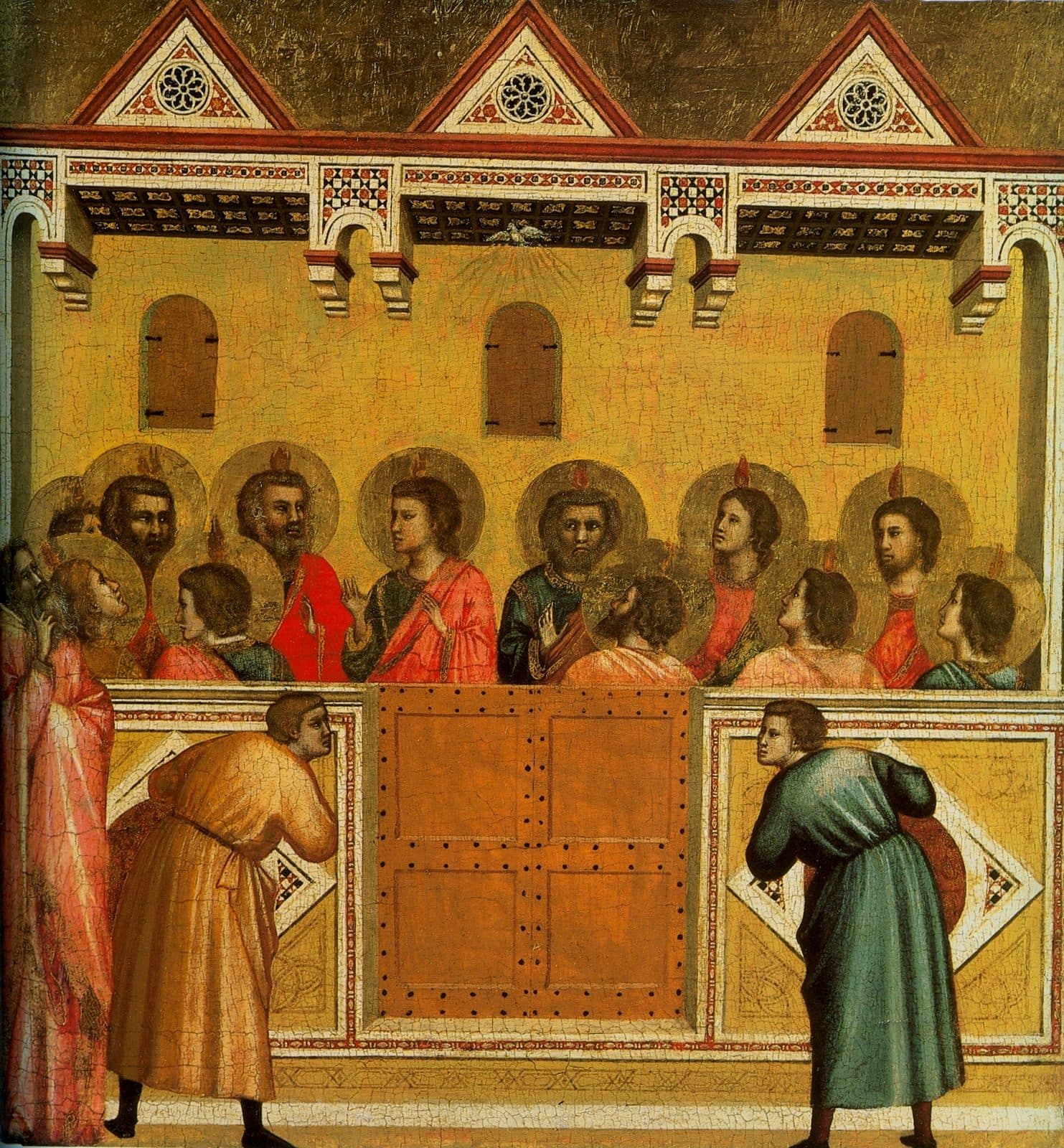
Giotto, Pentecost, about 1310 to 1318. Public domain.
THE ARTWORKThe panel shows the coming of the Spirit in Acts 2, the day the church began, and hangs in the National Gallery in London.
Summary
Christians today belong to a few families of churches: the Eastern Orthodox, the Oriental Orthodox, the Church of the East, the Catholic Church, and the churches of the Reformation and later revivals.
- Two councils divided the early churches of the East: Ephesus in 431 and Chalcedon in 451.
- In 1054 a legate of Rome and the patriarch of Constantinople excommunicated each other, and East and West went separate ways.
- The Reformation from 1517 gave the Lutheran, Reformed, Anglican and Anabaptist families, and the Baptists followed in 1609.
- Methodism grew from a revival in England after 1738, and the Pentecostal movement from a revival in Los Angeles in 1906.
- Their common creed, dated by tradition to Constantinople in 381, names one holy, catholic and apostolic church.
The Prayer, the Plea and the Council
The texts every family reads on the unity of the church
The prayer of John 17 closes the words Jesus spoke to the apostles in John 13 to 16.
I am not asking on behalf of them alone, but also on behalf of those who will believe in Me through their message, that all of them may be one, as You, Father, are in Me, and I am in You. May they also be in Us, so that the world may believe that You sent Me.Paul turns the prayer into a charge to the church.
and with diligence to preserve the unity of the Spirit through the bond of peace. There is one body and one Spirit, just as you were called to one hope when you were called; one Lord, one faith, one baptism; one God and Father of all, who is over all and through all and in all.Acts shows the first church meeting a division. Teachers from Judea said that Gentile believers had to be circumcised to be saved, and the apostles and elders met in Jerusalem to settle the question.
On the contrary, we believe it is through the grace of the Lord Jesus that we are saved, just as they are.”The apostles and elders sent their decision to the Gentile churches by letter.
It seemed good to the Holy Spirit and to us not to burden you with anything beyond these essential requirements: You must abstain from food sacrificed to idols, from blood, from the meat of strangled animals, and from sexual immorality. You will do well to avoid these things. Farewell.Divisions in Paul's Day
Two letters of Paul, 1 Corinthians 1 and Ephesians 4
Corinth shows division inside one congregation while Paul, who planted it, still lived.
What I mean is this: Individuals among you are saying, “I follow Paul,” “I follow Apollos,” “I follow Cephas,” or “I follow Christ.” Is Christ divided? Was Paul crucified for you? Were you baptized into the name of Paul?Ephesians 4 holds both halves of the question the families answer: a unity the church is given, and a unity it is still to reach.
until we all reach unity in the faith and in the knowledge of the Son of God, as we mature to the full measure of the stature of Christ.How the Families Came to Be
Twelve events, from the Council of Ephesus to the declaration of Rome and the Church of the East
| Date | What happened | The family it marks | Certainty |
|---|---|---|---|
| 431 | The Council of Ephesus condemns Nestorius, Patriarch of Constantinople | The Church of the East | known |
| 451 | The Council of Chalcedon adopts its Definition of Faith | The Oriental Orthodox churches | known |
| 16 and 20 July 1054 | Cardinal Humbert, a legate from Rome, lays a sentence of excommunication against Patriarch Michael Cerularius on the altar of Hagia Sophia; a synod in Constantinople excommunicates the legates | East and West part | known |
| 21 January 1525 | In Zurich Conrad Grebel baptizes George Blaurock on his confession of faith, and the Swiss Brethren begin | The Anabaptists | known |
| 1530 | The evangelical princes present the Augsburg Confession to Emperor Charles V at the Diet of Augsburg | The Lutheran churches | known |
| 1534 | The Act of Supremacy makes the king head of the Church of England | The Anglican churches | known |
| 1609 | In Amsterdam the English Separatist John Smyth baptizes himself and then the rest of his congregation | The Baptists | known |
| 24 May 1738 | At a society in Aldersgate Street in London, John Wesley hears Luther's preface to Romans read and feels his heart strangely warmed | The Methodists | known |
| December 1784 | The Christmas Conference in Baltimore organizes the Methodist Episcopal Church | The Methodists in America | known |
| 14 April 1906 | William J. Seymour begins meetings at 312 Azusa Street in Los Angeles; the revival continues until about 1915 | The Pentecostals | known |
| 7 December 1965 | Pope Paul VI and Patriarch Athenagoras lift the excommunications between Rome and Constantinople, saying these had been directed against persons and not against the churches | East and West | known |
| 11 November 1994 | Pope John Paul II and Mar Dinkha IV sign a Common Christological Declaration | The Church of the East | known |
- Date
- 431
- What happened
- The Council of Ephesus condemns Nestorius, Patriarch of Constantinople
- The family it marks
- The Church of the East
- Certainty
- known
- Date
- 451
- What happened
- The Council of Chalcedon adopts its Definition of Faith
- The family it marks
- The Oriental Orthodox churches
- Certainty
- known
- Date
- 16 and 20 July 1054
- What happened
- Cardinal Humbert, a legate from Rome, lays a sentence of excommunication against Patriarch Michael Cerularius on the altar of Hagia Sophia; a synod in Constantinople excommunicates the legates
- The family it marks
- East and West part
- Certainty
- known
- Date
- 21 January 1525
- What happened
- In Zurich Conrad Grebel baptizes George Blaurock on his confession of faith, and the Swiss Brethren begin
- The family it marks
- The Anabaptists
- Certainty
- known
- Date
- 1530
- What happened
- The evangelical princes present the Augsburg Confession to Emperor Charles V at the Diet of Augsburg
- The family it marks
- The Lutheran churches
- Certainty
- known
- Date
- 1534
- What happened
- The Act of Supremacy makes the king head of the Church of England
- The family it marks
- The Anglican churches
- Certainty
- known
- Date
- 1609
- What happened
- In Amsterdam the English Separatist John Smyth baptizes himself and then the rest of his congregation
- The family it marks
- The Baptists
- Certainty
- known
- Date
- 24 May 1738
- What happened
- At a society in Aldersgate Street in London, John Wesley hears Luther's preface to Romans read and feels his heart strangely warmed
- The family it marks
- The Methodists
- Certainty
- known
- Date
- December 1784
- What happened
- The Christmas Conference in Baltimore organizes the Methodist Episcopal Church
- The family it marks
- The Methodists in America
- Certainty
- known
- Date
- 14 April 1906
- What happened
- William J. Seymour begins meetings at 312 Azusa Street in Los Angeles; the revival continues until about 1915
- The family it marks
- The Pentecostals
- Certainty
- known
- Date
- 7 December 1965
- What happened
- Pope Paul VI and Patriarch Athenagoras lift the excommunications between Rome and Constantinople, saying these had been directed against persons and not against the churches
- The family it marks
- East and West
- Certainty
- known
- Date
- 11 November 1994
- What happened
- Pope John Paul II and Mar Dinkha IV sign a Common Christological Declaration
- The family it marks
- The Church of the East
- Certainty
- known
The Verses on the One Church, by Book
Eight more New Testament texts on the unity of the church and its divisions, in canon order
| Reference | What it says | It speaks of |
|---|---|---|
| Matthew 16:18 | Jesus says He will build His church. | The church |
| John 17:11 | Jesus asks the Father to keep His disciples one. | Unity |
| Romans 16:17 | Paul warns against those who create divisions contrary to the teaching. | Division |
| 1 Corinthians 11:18 to 19 | Divisions appear when the church comes together. | Division |
| 1 Corinthians 12:12 to 13 | In one Spirit all were baptized into one body. | Unity |
| 1 Corinthians 12:25 | There should be no division in the body. | Unity |
| Galatians 3:28 | All are one in Christ Jesus. | Unity |
| Ephesians 2:14 to 16 | Christ makes Jew and Gentile one new man in one body. | Unity |
- Reference
- Matthew 16:18
- What it says
- Jesus says He will build His church.
- It speaks of
- The church
- Reference
- John 17:11
- What it says
- Jesus asks the Father to keep His disciples one.
- It speaks of
- Unity
- Reference
- Romans 16:17
- What it says
- Paul warns against those who create divisions contrary to the teaching.
- It speaks of
- Division
- Reference
- 1 Corinthians 11:18 to 19
- What it says
- Divisions appear when the church comes together.
- It speaks of
- Division
- Reference
- 1 Corinthians 12:12 to 13
- What it says
- In one Spirit all were baptized into one body.
- It speaks of
- Unity
- Reference
- 1 Corinthians 12:25
- What it says
- There should be no division in the body.
- It speaks of
- Unity
- Reference
- Galatians 3:28
- What it says
- All are one in Christ Jesus.
- It speaks of
- Unity
- Reference
- Ephesians 2:14 to 16
- What it says
- Christ makes Jew and Gentile one new man in one body.
- It speaks of
- Unity
Four Greek Words
The words for church, unity, division and party
| Word | Spoken | Meaning | Where it stands |
|---|---|---|---|
| ἐκκλησία | ekklēsía | an assembly, a congregation | Matthew 16:18; Acts 15:3, Acts 15:4 and Acts 15:22 |
| ἑνότης | henótēs | unity, oneness | Ephesians 4:3 and Ephesians 4:13 |
| σχίσμα | schísma | a split or tear, a division | 1 Corinthians 1:10, 1 Corinthians 11:18 and 1 Corinthians 12:25; John 7:43 |
| αἵρεσις | haíresis | a choice, a party or sect | Acts 15:5, the party of the Pharisees; 1 Corinthians 11:19; Galatians 5:20 |
- Word
- ἐκκλησία
- Spoken
- ekklēsía
- Meaning
- an assembly, a congregation
- Where it stands
- Matthew 16:18; Acts 15:3, Acts 15:4 and Acts 15:22
- Word
- ἑνότης
- Spoken
- henótēs
- Meaning
- unity, oneness
- Where it stands
- Ephesians 4:3 and Ephesians 4:13
- Word
- σχίσμα
- Spoken
- schísma
- Meaning
- a split or tear, a division
- Where it stands
- 1 Corinthians 1:10, 1 Corinthians 11:18 and 1 Corinthians 12:25; John 7:43
- Word
- αἵρεσις
- Spoken
- haíresis
- Meaning
- a choice, a party or sect
- Where it stands
- Acts 15:5, the party of the Pharisees; 1 Corinthians 11:19; Galatians 5:20
What the Families Confess Together
Where the creed came from, and the one clause East and West confess differently
The Schaff-Herzog Encyclopedia gives the account East and West have held since the sixth century, that the creed was drawn up at the Council of Constantinople in 381. It also sets out external and internal difficulties with that account.
The Western churches confess it with the words and the Son added to the article on the Spirit, and the Eastern churches confess it without them. The words and the Son first appear in the creed in the acts of the Third Council of Toledo in 589, came into use at Rome in the ninth century, and were disputed by Photius.
Four Teachers on the Unity of the Church
Four teachers from the fourth century to the nineteenth, earliest first
John Chrysostom preached at Antioch and was later archbishop of Constantinople.
“But what is, ‘In Us’? In the faith which is on Us. Because nothing so offends all men as divisions, He provideth that they should be one. ‘What then,’ saith some one, ‘did He effect this?’ Certainly He effected it. For all who believe through the Apostles are one, though some from among them were torn away. Nor did this escape His knowledge, He even foretold it, and showed that it proceeded from men's slack-mindedness. ‘That the world may believe that Thou hast sent Me.’ As He said in the beginning, ‘By this shall all men know that ye are My disciples, if ye love one another,’ And how should they hence believe? ‘Because,’ He saith, ‘Thou art a God of peace.’ If therefore they observe the same as those of whom they have learnt, their hearers shall know the teacher by the disciples, but if they quarrel, men shall deny that they are the disciples of a God of peace, and will not allow that I, not being peaceable, have been sent from Thee. Seest thou how, unto the end, He proveth His unanimity with the Father?”
John Chrysostom · Homily on the Gospel of John 82 · on John 17:21Patristic
Theophylact of Ohrid wrote in the same Eastern church about seven centuries later.
“As the spirit in the body encompasses and unites everything, so too does the Holy Spirit unite the Church, even though we differ in race, character, and occupation. And through the Holy Spirit we become one body. Therefore, let us strive to preserve this unity …”
Theophylact of Ohrid · Commentary on Ephesians · on Ephesians 4:3Patristic
John Wesley returns to the prayer of John 17.
“The glory which thou hast given me, I have given them - The glory of the only begotten shines in all the sons of God. How great is the majesty of Christians.”
John Wesley · Explanatory Notes upon the New Testament · on John 17:22Evangelical
Jamieson, Fausset and Brown read the same verse more than a century after him.
“It is not the future glory of the heavenly state, but the secret of that present unity just before spoken of; the glory, therefore, of the indwelling Spirit of Christ; the glory of an accepted state, of a holy character, of every grace.”
Jamieson, Fausset & Brown · Commentary Critical and Explanatory on the Whole Bible · on John 17:22Reformed
Where Is the One Church?
The answer of six families, each with the objection another family raises
The Orthodox ChurchEastern Orthodox
The Holy and Great Council of the Orthodox Church, meeting at Pentecost 2016, confessed the Orthodox Church as the One, Holy, Catholic and Apostolic Church. It founds the unity of the church on its establishment by Christ and on communion in the Holy Trinity and in the sacraments. It holds the duty to preach all the truth contained in Holy Scripture and Holy Tradition. OrthodoxWiki adds that the Orthodox Church receives the seven ecumenical councils held from 325 to 787 as its authority on the Trinity and the Incarnation.
The objection, from the Westminster Confession of Faith: the whole counsel of God is set down in Scripture or deduced from it, and no tradition of men may add to it.
The Church of the EastAssyrian
In their Common Christological Declaration the Assyrian Church of the East and the Catholic Church confessed together the faith formulated by their common Fathers in the Nicene Creed. They confessed that salvation is fulfilled within the one, holy, catholic and apostolic Church, the Body of Christ, and that the particular Assyrian and Catholic churches can recognize each other as sister Churches.
The objection, from the same Orthodox council: the non-Orthodox churches and confessions have diverged from the true faith of the One, Holy, Catholic and Apostolic Church.
The Catholic ChurchRoman Catholic
The Second Vatican Council taught in Lumen Gentium that the church of Christ subsists in the Catholic Church, governed by the successor of Peter and by the bishops in communion with him. The same text says that many elements of sanctification and of truth are found outside its visible structure.
The objection, from the Orthodox as OrthodoxWiki gives it: at an ecumenical council each bishop casts one vote, and no one see rules the others.
The Reformation churchesLutheran, Reformed, Anglican
The Augsburg Confession defines the church as the congregation of saints in which the Gospel is rightly taught and the sacraments rightly administered. The Thirty-Nine Articles of the Church of England call the visible church a congregation of faithful men in which the pure word of God is preached and the sacraments duly ministered.
The objection, from the Anabaptists: the Schleitheim Confession gives baptism to those who have learned repentance and amendment of life.
The gathered churchesAnabaptist, Baptist
For the Baptists the church is made of believers who have confessed their faith. The London Baptist Confession of 1689 gives baptism only to those who profess repentance toward God and faith in Christ, and holds immersion necessary to its due administration.
The objection, from Wittenberg: the Augsburg Confession teaches that children are to be baptized, being offered to God through baptism and received into His grace.
Methodist and PentecostalWesleyan, Pentecostal
The Methodist Articles of Religion keep the Anglican article's definition of the visible church as their Article XIII. The Assemblies of God confess a baptism in the Holy Spirit distinct from and subsequent to the new birth, witnessed by the initial physical sign of speaking with other tongues. They confess that the church is the body of Christ and consists of all who accept Christ, whatever their denomination.
The objection, from Lumen Gentium and from the Orthodox as OrthodoxWiki gives it: the church is one visible communion under bishops in succession from the apostles.
Five Statements of Faith to Read Whole
Four confessions and one council constitution, each free to read online
The Augsburg Confession
The Lutheran reformers · 1530
The German Evangelical Church Diet called it the oldest common document of evangelical doctrine in Germany.
READ IT FREE →The Schleitheim Confession
The Swiss Brethren · 1527
Its first article, on baptism, is the ground of the Anabaptist objection in the folds above.
READ IT FREE →The Westminster Confession of Faith
The Westminster Assembly · 1646
It opens with the chapter Of the Holy Scripture.
READ IT FREE →The Second London Baptist Confession
Baptist churches in England · 1689
It first appeared in London in 1677 and again in 1688 and 1689.
READ IT FREE →Lumen Gentium
The Second Vatican Council · 1964
Its eighth section is the passage the folds above quote.
READ IT FREE →Bearing With One Another and Praying for Union
In Ephesians 4:2 Paul asks each believer for humility, gentleness and patience, bearing with one another in love.
The Orthodox Church, in the council text quoted above, prays unceasingly for the union of all. In their declaration Rome and the Church of the East pledged to do everything possible to remove the obstacles that still keep them from full communion.
Keep studying
Read it4