
Exodus 1:15 to 21 · Debate · Featured Study
Truth-Telling and the Hard Cases of Deception
Augustine, Aquinas, Calvin, Grotius and Cassian answer the hard cases of the Hebrew midwives, Samuel and Rahab.
Two midwives refused Pharaoh's order to kill the Hebrew sons, and the answer they gave him when he called them to account has divided Christian teachers ever since.
- The question
- Is it ever right to deceive in order to save an innocent life?
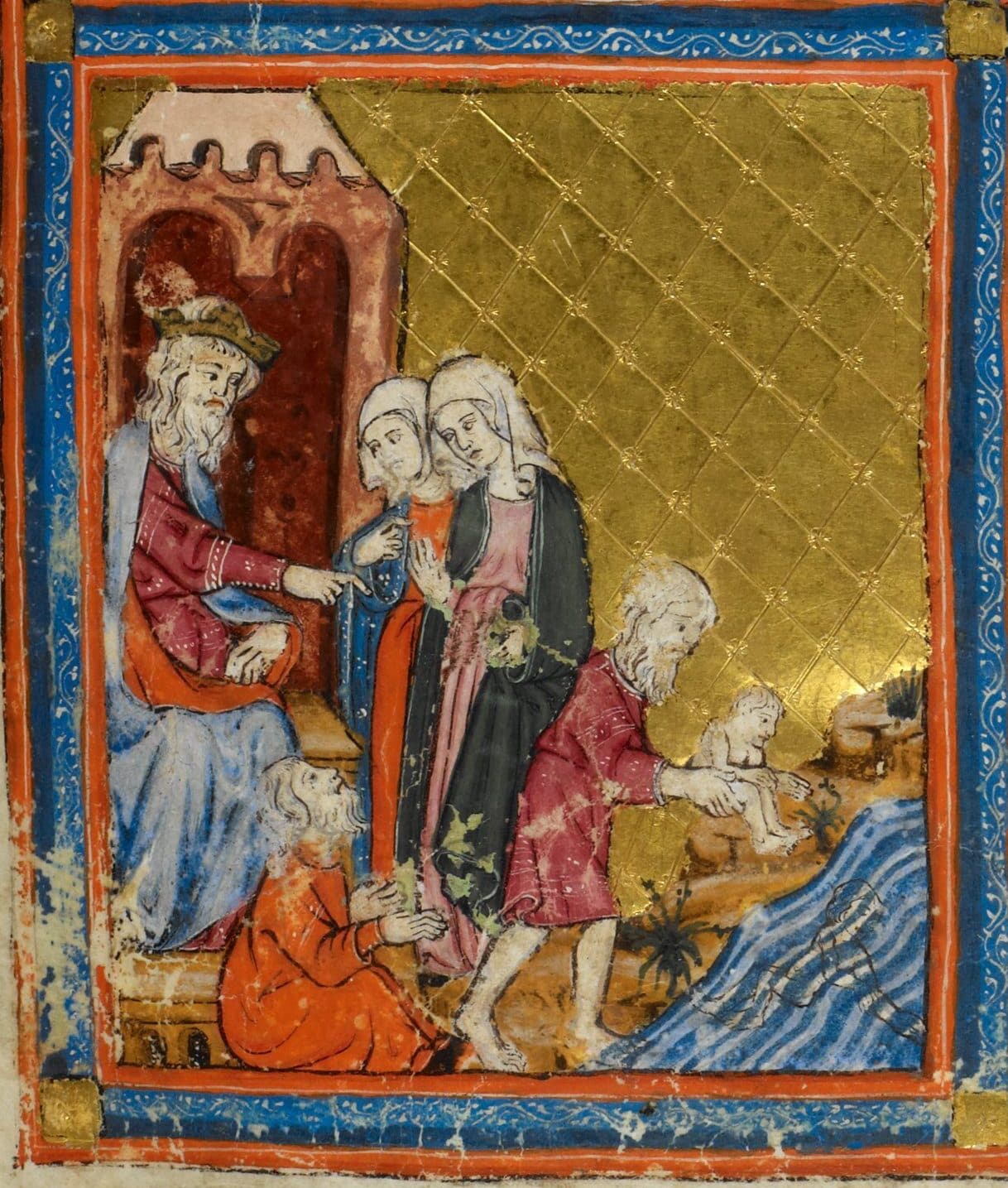
Pharaoh and the Midwives, miniature on vellum from the Golden Haggadah, Catalonia, about 1320, British Library, Additional MS 27210. Public domain by date.
THE ARTWORKThe illuminator painted Pharaoh enthroned and pointing at the two Hebrew midwives who stand before him.
Summary
The law forbids false witness in Exodus 20:16, and Paul forbids lying in Colossians 3:9.
- Augustine, Thomas Aquinas and John Calvin hold that every lie is a sin, even one told to save a life.
- Hugo Grotius holds that a false word to one who has lost the right to the truth wrongs no one, and he allows it where it is the only means of saving an innocent life.
- John Cassian likened a lie to a dangerous medicine taken only in mortal danger, and Norman Geisler gave the lesser-evil reading its modern form in Christian Ethics (1989).
The Texts Every Side Reads
Six passages, from the midwives in Egypt to the letters of Paul, carry the weight of the question.
The midwives, however, feared God and did not do as the king of Egypt had instructed; they let the boys live.The verse gives the midwives' fear of God as the reason they refused the king, and every reading starts from it.
The midwives answered Pharaoh, “The Hebrew women are not like the Egyptian women, for they are vigorous and give birth before a midwife arrives.”This is the answer the debate turns on, and its readers divide over whether it was false.
You shall not bear false witness against your neighbor.The ninth commandment forbids false witness, and the positions differ over whether it forbids every false word or the false word that wrongs a neighbor.
But the woman had taken the two men and hidden them. So she said, “Yes, the men did come to me, but I did not know where they had come from. At dusk, when the gate was about to close, the men went out, and I do not know which way they went. Pursue them quickly, and you may catch them!”Rahab hid the spies and sent the king's men after them on a false trail, and every position sets her answer beside the midwives' answer.
There are six things that the LORD hates, seven that are detestable to Him: haughty eyes, a lying tongue, hands that shed innocent blood,Both wrongs that the hard cases weigh against each other stand together in this list.
Therefore each of you must put off falsehood and speak truthfully to his neighbor, for we are all members of one another.Paul grounds the command to speak truthfully in the bond between members of one body, and the reading that lying is never right takes the command as a rule for every case.
Three Answers to One Question
The never reading, the hearer's-right reading and the lesser-evil reading each answer three questions in their own way.
| The question | Lying is never right | The hearer's right to the truth | The lesser evil |
|---|---|---|---|
| What is a lie? | Speech that signifies what is not in the speaker's mind, which is evil in its kind. | A false word that violates the right of the one addressed to the truth. | A false word, which is a wrong in itself and may still be the lesser of two wrongs. |
| May a person deceive a killer who asks where his victim is? | No. The person may keep silent or keep the truth back, and must not speak what is false. | Yes. The killer has lost the right to the truth, and the false word saves an innocent life. | Yes, where no other way saves the life, since the life outweighs the wrong of the word. |
| What does Exodus 1:21 credit? | Their fear of God and their mercy, while their false word was forgiven. | Their fear of God, which moved them both to save the boys and to answer the king as they did. | Their fear of God, by which they chose the higher duty of saving life. |
Each Position Stated
Each of the three positions rests on its own account of what a lie is and of when, if ever, a false word may be spoken.
Lying is never rightAugustine, Thomas Aquinas, John Calvin
Augustine wrote On Lying in about 395 and came back to the subject many years later in Against Lying. There he held that God's kindness to the midwives and to Rahab was given for their mercy toward His people, and that their deceit earned none of it. He held too that the midwives would have done better to refuse both the lie and the killing, even if they died for it.
Thomas Aquinas gave the reason from the nature of speech. Words are natural signs of what is in the mind, so to signify by words what is not in the mind is a wrong in its kind, and every lie is a sin. He counted a lie told to help another a venial sin.
John Calvin, commenting on Exodus 1:19, held that the two women lied and that, since lying displeases God, they sinned. He held as well that God, in His fatherly indulgence, still valued their good work as if it were pure.
Matthew Henry gave the reading its ground in the New Testament.
“Lying makes us like the devil (who is the father of lies ), and is a prime part of the devil's image upon our souls; and therefore we are cautioned against this sin by this general reason: Seeing you have put off the old man with his deeds, and have put on the new man,”
Matthew Henry · Commentary on the Whole Bible · on Colossians 3:9Puritan
The hearer's right to the truthHugo Grotius
Hugo Grotius, in The Rights of War and Peace, defined a lie in the strict sense as a violation of the existing right of the person addressed. That right is the liberty of judgment that people owe one another when they speak, and it may be lost. A false word to one who has lost it wrongs no one, and Grotius allowed such a word where it is the only means of saving the life of an innocent person.
Grotius set this reading beside the false witness to or against a neighbor that Scripture so often forbids.
The lesser evilJohn Cassian
John Cassian, in the seventeenth of his Conferences, likened a lie to hellebore, a poison that heals when a deadly disease threatens and kills when it is taken without need. He held that a lie may be used only under the pressure of a great danger, and he took Rahab as his example.
The site's tradition is Wesleyan-Pentecostal. John Wesley, from whom its Wesleyan stream comes, wrote on Joshua 2:4 that Rahab's answer was false and therefore sinful, though her intention was good. Scripture leaves this question open to more than one reading, and the site gives no verdict between the three positions.
The Midwives, Samuel and Rahab
Three cases set a ruler's power against an innocent life, and the positions read each one in their own way.
What God rewardedExodus 1:20 to 21
So God was good to the midwives, and the people multiplied and became even more numerous. And because the midwives feared God, He gave them families of their own.The text gives the midwives' fear of God as the reason He gave them families, and it names no other cause.
Thomas Aquinas read these verses as the never reading does. He placed the reward of the midwives in their fear of God and their good will, and he held that the lie itself could merit nothing eternal. Augustine, in On Lying, held that the midwives are spoken of with approval for the promise of growth they showed. Mercy that saves a mortal life, he wrote, is a step toward loving the eternal saving of the soul.
Jamieson, Fausset & Brown and Albert Barnes read the houses God made as families and offspring, so that the midwives married and became mothers in Israel, and the Berean text renders the verse that way. John Calvin read the pronoun as masculine and held that God made houses for the Israelites through the piety of these women.
Did the midwives lie?Exodus 1:19
Not every reader grants that the answer was false. Rashi read the word the Berean renders vigorous as a word for midwives, so that the Hebrew women were as skilled as midwives themselves. The rabbis of the Talmud, in Sotah 11b, read it as a comparison to the beasts of the field, which give birth without help.
Adam Clarke held that the answer stated what experience shows. Women who labor in the open air through their pregnancy give birth quickly, he wrote, and Exodus 1:14 records the work of the Hebrews in the fields. The note of the Calvin Translation Society on Exodus 1:18 reports that John Lightfoot wrote of the midwives' words as no lie and as a confession of their faith.
John Calvin rejected the rabbis' account that the midwives had warned the women of the king's design and so came too late.
The heifer and the sacrifice1 Samuel 16:1 to 3
“How can I go?” Samuel asked. “Saul will hear of it and kill me!” The LORD answered, “Take a heifer with you and say, ‘I have come to sacrifice to the LORD.’The LORD Himself tells Samuel what to say when Samuel fears that Saul will kill him, and every position must account for a concealment God commanded.
Adam Clarke, in his Commentary on the Bible, held that Samuel's word was strictly true, since Samuel did offer the sacrifice and could not have gathered the sons of Jesse without it. Gregory the Great, in his commentary on the books of Kings, read the verse as a pattern for eluding tyrants by a pious deception, in such a way that the guilt of lying is avoided.
Rahab and the spiesHebrews 11:31 and James 2:25
By faith the prostitute Rahab, because she welcomed the spies in peace, did not perish with those who were disobedient.Hebrews names Rahab's welcome of the spies as the act of her faith, which is the act every position praises.
In the same way, was not even Rahab the prostitute justified by her actions when she welcomed the spies and sent them off on another route?James counts the escape she gave the spies among her deeds of faith, and the readings ask whether her words to the king's men belong among them.
John Calvin held that Rahab's falsehood was done for a good purpose and was not free from fault, and that God willed the spies to be delivered without approving the falsehood that saved them. The page on Rahab and the Scarlet Cord sets out the argument over her answer in full.
The Ninth Commandment and the Law of Witness
Exodus 20:16 and 23:1 to 7 set the command against false witness inside the law of Israel's courts.
The Berean text of Deuteronomy 5:20 gives the ninth commandment in the same words as Exodus 20:16.
“You shall not spread a false report. Do not join the wicked by being a malicious witness. You shall not follow the crowd in wrongdoing. When you testify in a lawsuit, do not pervert justice by siding with the crowd.The Book of the Covenant applies the commandment to the courts, where a false report or a crowd could pervert justice.
Albert Barnes read the four commands of Exodus 23:1 to 3 as illustrations of the ninth commandment, given mainly for evidence in legal causes. Adam Clarke read the commandment more widely, as forbidding slander, tale-bearing and every false statement that injures another in goods, person or character.
John Wesley drew a duty for the one who hears a report from the margin's reading of the verse.
“Thou shalt not raise, the margin reads, Thou shalt not receive a false report, for sometimes the receiver in this case is as bad as the thief; and a backbiting tongue would not do so much mischief, if it were not countenanced.”
John Wesley · Explanatory Notes upon the Old Testament · on Exodus 23:1Evangelical
The Westminster Larger Catechism lists lying among the sins the ninth commandment forbids. It lists among them too the speaking of the truth unseasonably, or maliciously to a wrong end.
Stay far away from a false accusation. Do not kill the innocent or the just, for I will not acquit the guilty.The law sets a false accusation beside the killing of the innocent and the just in a single command.
How the Question Came Down
Ten dated marks trace the question from Augustine to the late twentieth century.
- About 395Augustine, On Lying, his first treatise.
- About 420Augustine, Against Lying, the second treatise, written to Consentius.
- Fifth centuryJohn Cassian, The seventeenth Conference, given in the name of Abbot Joseph.
- Thirteenth centuryThomas Aquinas, The Summa Theologiae, on the kinds of lie and their weight as sins.
- 1563John Calvin, The Harmony of the four last books of Moses, his commentary on Exodus to Deuteronomy.
- 1625Hugo Grotius, The Rights of War and Peace.
- The 1640sThe Westminster Assembly, The Larger Catechism, questions 144 and 145 on the ninth commandment.
- 1765John Wesley, Explanatory Notes upon the Old Testament.
- 1943Dietrich Bonhoeffer, "What Is Meant by Telling the Truth?", later printed in his Ethics.
- 1989Norman Geisler, Christian Ethics, with its account of graded absolutism.
A timeline of ten dated marks, each row naming the writer and the work on lying.
What the Text Leaves Unsaid
Exodus 1 leaves three questions about the midwives without an answer.
The text neither praises nor blames the words the midwives spoke to the king. It does not say whether the midwives were Hebrews or Egyptians, and Albert Barnes, reading the Hebrew as midwives of the Hebrew women, held that their names are Egyptian. It does not say whether Pharaoh believed them, and it records only that he next commanded all his people to throw every Hebrew son into the Nile.
What Every Side Holds
Every position shares four teachings about God, the devil and the truth owed among God's people.
GOD CANNOT LIE
Every side confesses with Paul that God, who cannot lie, promised eternal life before time began.
THE FATHER OF LIES
Every side reads Jesus' words that the devil is a liar and the father of lies.
TRUTH AMONG GOD'S PEOPLE
Every side holds the law's command that God's people must not lie or deceive one another.
FAITHFUL DEALING
Every side reads that lying lips are detestable to the LORD and that those who deal faithfully are His delight.
How the Teachers Read It
Three teachers, from the early church to the Puritans, speak to the source of lying and to the duty of truth.
Irenaeus on the first liarJohn 8:44
“He had indeed been already accustomed to lie against God, for the purpose of leading men astray.”
Irenaeus · Against Heresies Book V · on John 8:44Patristic
Ambrose on deceit toward a neighborPsalm 15
“In everything, therefore, good faith is seemly, justice is pleasing, due measure in equity is delightful. But what shall I say about contracts, and especially about the sale of land, or agreements or covenants? Are there not rules just for the purpose of shutting out all false deceit and to make him whose deceit is found out liable to double punishment? Everywhere, then, does regard for what is virtuous take the lead; it shuts out deceit, it expels fraud. Wherefore the prophet David has rightly stated his judgment in general, saying, ‘He has done no evil to his neighbor.’”
Ambrose of Milan · On the Duties of the Clergy 3.10.66 · on Psalm 15:2Patristic
Matthew Henry on the God who cannot lieTitus 1:2
“The faith and godliness of Christians lead to eternal life, and give hope and well-grounded expectation of it; for God, that cannot lie, hath promised it. It is the honour of God that he cannot lie or deceive: and this is the comfort of believers, whose treasure is laid up in his faithful promises.”
Matthew Henry · Commentary on the Whole Bible · on Titus 1:2Puritan
The Three Positions Weighed
Each position faces one objection that the other positions press hardest.
| Position | Held by | Tradition | Representative work |
|---|---|---|---|
| Lying is never right | Augustine; Thomas Aquinas; John Calvin; John Wesley | The Latin fathers, the medieval schools and the Reformers | Augustine, On Lying (about 395) and Against Lying; Aquinas, the second part of the second part, question 110 |
| The hearer's right to the truth | Hugo Grotius; Dietrich Bonhoeffer | Protestant natural law; the Confessing Church | Grotius, The Rights of War and Peace (1625), book 3, chapter 1; Bonhoeffer, "What Is Meant by Telling the Truth?" (1943) |
| The lesser evil | John Cassian; Norman Geisler | Early monastic teaching; modern evangelical ethics | Cassian, Conferences 17; Geisler, Christian Ethics (1989) |
Cassian's objection
Against the never reading, John Cassian pressed the case of Rahab. Had she spoken the truth to the king's men, he held, she and all her house would have perished. She would not then have been joined to the people of God or counted among the forebears of Christ.
Calvin's objection
Against the hearer's-right reading, John Calvin held that whatever is opposed to the nature of God is sinful, so that all dissimulation in word or deed is condemned whoever hears it. On this ground a false word is a wrong before God, whatever right its hearer has lost.
Augustine's objection
Against the lesser-evil reading, Augustine answered Rahab's case by naming a third way. She could have told the king's men that she knew where the spies were and feared God too much to betray them. The spies she had hidden so carefully might still not have been found. Thomas Aquinas allowed the truth to be hidden prudently by keeping it back, and he held that a lie may not be told to deliver another from any danger whatever.
Read the Great Books
These six works state the three positions in the words of their own holders, from Augustine to Grotius.
On Lying
Augustine · about 395
Augustine weighs the cases Scripture gives, the Hebrew midwives among them, against the rule that every lie is a sin.
READ IT FREE →Against Lying
Augustine · about 420
Augustine wrote it against Catholics who thought they should pretend to be Priscillianists in order to uncover that heresy.
READ IT FREE →Conferences
John Cassian · fifth century
In the seventeenth conference Abbot Joseph weighs whether a monk may break a promise and when the saints have used a lie.
READ IT FREE →Summa Theologiae, II-II, question 110
Thomas Aquinas · thirteenth century
Its articles ask how lies are divided, whether every lie is a sin and whether every lie is a mortal sin.
READ IT FREE →Commentaries on the Four Last Books of Moses Arranged in the Form of a Harmony
John Calvin · 1563
Calvin arranged Exodus to Deuteronomy as one harmony, and its first volume comments on the midwives of Exodus 1.
READ IT FREE →The Rights of War and Peace
Hugo Grotius · 1625
The first chapter of its third book sets out when a false word is a lie and when it is a lawful stratagem.
READ IT FREE →The Fear of God and the Truth
Exodus 1 and Colossians 3 ask two things of every reader, whatever view of the hard cases the reader holds.
The midwives feared God more than the king of Egypt. Paul tells those who have put on the new self not to lie to one another, since that self is being renewed in the image of its Creator.
Jesus answered, “I am the way and the truth and the life. No one comes to the Father except through Me.Keep studying
Studies10