
The Sects of Second Temple Judaism · Featured Study
The Samaritans
Two peoples read the same land two different ways. 2 Kings 17 tells how Assyria resettled the northern kingdom with foreign peoples who mixed worship of the LORD with their own gods. The Samaritans themselves have always told a different story: the true remnant of Israel, keeping the true Torah, at Israel's true mountain. Both accounts are given here, honestly, alongside the schism's history, the Samaritan Pentateuch as a real textual witness, and the gospel encounters at full strength.
Summary
The Samaritans trace back to the fall of Israel's northern kingdom in 722 BC, and their origin is told two ways: 2 Kings 17 as resettlement and mixed worship, the Samaritans' own account as the true Israelite remnant at Israel's true mountain, Gerizim. The gospels meet them at full strength, from the woman at the well to Philip's mission in Acts 8, and a small community still keeps the Torah on Gerizim today.
- 2 Kings 17 records Assyria resettling the land with foreign peoples who mixed worship of the LORD with their own gods after Israel's fall in 722 BC.
- Samaritans hold themselves the remnant of Ephraim and Manasseh who never left the land, keeping the Torah's original form at Gerizim, Israel's true sanctuary on their own account.
- The Samaritan Pentateuch is a real ancient textual witness, some of its readings agreeing with the Dead Sea Scrolls and the Septuagint against the Masoretic Text.
- Jesus meets a Samaritan woman at Jacob's well, tells the parable of the good Samaritan, and is thanked by only one of ten cleansed lepers, a Samaritan.
- Philip preaches in Samaria in Acts 8, and Jerusalem sends Peter and John to confirm it; a small community still keeps Passover on Mount Gerizim today.
The Two Accounts
2 Kings 17, and the Samaritans' own self-understanding
2 Kings 17:24
“Then the king of Assyria brought people from Babylon, Cuthah, Avva, Hamath, and Sepharvaim and settled them in the towns of Samaria to replace the Israelites. They took possession of Samaria and lived in its towns.” 2 Kings 17:24
Assyria resettles the land with foreign peoples after Israel's fall.
2 Kings 17:29
“Nevertheless, the people of each nation continued to make their own gods in the cities where they had settled, and they set them up in the shrines that the people of Samaria had made on the high places.” 2 Kings 17:29
Every nation makes its own gods and sets them beside the LORD's own worship.
2 Kings 17:33-41
“They worshiped the LORD, but they also served their own gods according to the customs of the nations from which they had been carried away. To this day they are still practicing their former customs. None of them worship the LORD or observe the statutes, ordinances, laws, and commandments that the LORD gave the descendants of Jacob, whom He named Israel. For the LORD had made a covenant with the Israelites and commanded them, “Do not worship other gods or bow down to them; do not serve them or sacrifice to them. Instead, worship the LORD, who brought you out of the land of Egypt with great power and an outstretched arm. You are to bow down to Him and offer sacrifices to Him. And you must always be careful to observe the statutes, ordinances, laws, and commandments He wrote for you. Do not worship other gods. Do not forget the covenant I have made with you. Do not worship other gods, but worship the LORD your God, and He will deliver you from the hands of all your enemies.” But they would not listen, and they persisted in their former customs. So these nations worshiped the LORD but also served their idols, and to this day their children and grandchildren continue to do as their fathers did.” 2 Kings 17:33-41
A worship mixed from the start, the text says, and carried by their children's children.
The biblical text is plain about what it records: Israel's northern kingdom fell to Assyria in 722 BC for its idolatry, and Assyria brought in foreign peoples from Babylon, Cuthah, Avva, Hamath, and Sepharvaim to resettle the land. Those peoples, the chapter says, feared the LORD and served their own gods at the same time, a mixed worship carried down through their descendants. Later Jewish tradition, recorded by Josephus in Antiquities 9.14.3 and 11.8.6, reads the Samaritans as descended from these foreign settlers and treats their claim to Israelite ancestry as false.
Samaritans have always told a different story about themselves. On their own account they are the remnant of the northern tribes, chiefly Ephraim and Manasseh, who never left the land at all, and who have kept the Torah in its original, uncorrupted form ever since. Where 2 Kings 17 names Jerusalem as the place the LORD chose, Samaritans hold that place to be Mount Gerizim, the site of Abraham's altar and Deuteronomy 27's blessing, and they read Jerusalem's claim as the later innovation, not their own.
The Schism's History
Ezra-Nehemiah, the Gerizim temple, and its destruction by Hyrcanus
The break between the two peoples hardens across several centuries rather than opening all at once. When the Jewish exiles return from Babylon to rebuild the Temple, Ezra and Nehemiah refuse help from the peoples already in the land, and the conflict over mixed worship and mixed marriage that runs through Ezra 4 and Nehemiah 4 and 13 marks the practical point where Samaritan and Jewish worship part ways for good.
Samaritans built their own temple on Mount Gerizim sometime in the Persian or early Hellenistic period, giving their worship a rival sanctuary to Jerusalem's. That temple stood for centuries until the Hasmonean high priest John Hyrcanus destroyed it around 111 to 107 BC, an act of open conquest against the Samaritan community. Both Samaritan tradition and most historians read this destruction as the deepest wound in the whole split, the moment division became something closer to enmity.
- 722 BCthe northern kingdom falls to Assyria
- 5th c. BCEzra and Nehemiah's rebuilding, and the break
- 111-107 BCHyrcanus destroys the Gerizim temple
- c. AD 30Jesus at Jacob's well in Samaria (John 4)
The Samaritan Pentateuch
a real ancient textual witness
Samaritans kept their own copy of the first five books of the Torah, written in their own form of the ancient Hebrew script. Scholars count roughly six thousand differences from the Masoretic Text most Jewish and Christian Bibles are based on, but most of these are minor: spelling, grammar, small harmonizations between parallel passages. The most significant and deliberate difference names Mount Gerizim, not a site near Jerusalem, as the place God chose for his sanctuary.
Why the Samaritan Pentateuch matters to textual scholarsAgreement with the Dead Sea Scrolls and the Septuagint
Some Samaritan Pentateuch readings agree with the Dead Sea Scrolls and with the ancient Greek Septuagint translation against the Masoretic Text, showing this text tradition preserves a genuinely old textual line rather than a late Samaritan invention. This does not settle the Gerizim question itself, which is a deliberate theological difference rather than a copying variant, but it does mean the Samaritan Pentateuch is treated as real evidence in the study of the Torah's textual history, not dismissed as a forgery.
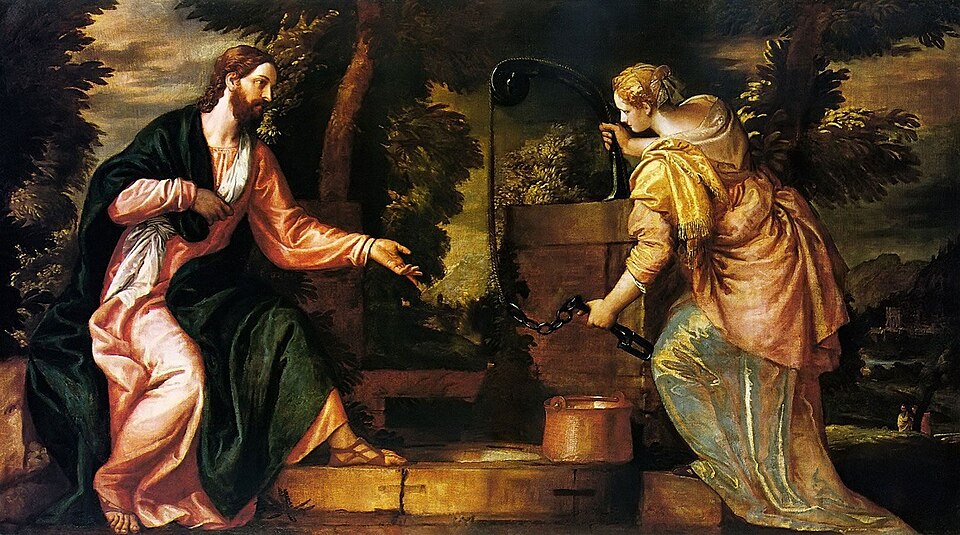
The Woman at the Well
John 4: the gospel meets the divide directly
John 4:4-6
“Now He had to pass through Samaria. So He came to a town of Samaria called Sychar, near the plot of ground that Jacob had given to his son Joseph. Since Jacob’s well was there, Jesus, weary from His journey, sat down by the well. It was about the sixth hour.” John 4:4-6
Jesus must pass through Samaria, the direct road from Judea to Galilee.
John 4:9
““You are a Jew,” said the woman. “How can You ask for a drink from me, a Samaritan woman?” (For Jews do not associate with Samaritans.)” John 4:9
The woman names the divide herself: Jews have no dealings with Samaritans.
“Two things this woman wonders at, 1. That he should ask this kindness; for it was the pride of the Jews that they would endure any hardship rather than be beholden to a Samaritan. It was part of Christ's humiliation that he was born of the Jewish nation, which was now not only in an ill state, subject to the Romans, but in an ill name among the nations.”
Matthew Henry · Commentary on the Whole Bible, 1710Nonconformist
John 4:9
John 4:20-23
“Our fathers worshiped on this mountain, but you Jews say that the place where one must worship is in Jerusalem.” “Believe Me, woman,” Jesus replied, “a time is coming when you will worship the Father neither on this mountain nor in Jerusalem. You worship what you do not know; we worship what we do know, for salvation is from the Jews. But a time is coming and has now come when the true worshipers will worship the Father in spirit and in truth, for the Father is seeking such as these to worship Him.” John 4:20-23
Neither this mountain nor Jerusalem: worship no longer tied to one place.
John 4:25-26
“The woman said, “I know that Messiah” (called Christ) “is coming. When He comes, He will explain everything to us.” Jesus answered, “I who speak to you am He.”” John 4:25-26
I that speak unto thee am he: the plainest self-disclosure Jesus makes to anyone in the Gospels.
“This was the place where the Samaritans used to worship in opposition to Jerusalem. And it was so near Sychar, that a man's voice might be heard from the one to the other. Our fathers worshipped - This plainly refers to Abraham and Jacob (from whom the Samaritans pretended to deduce their genealogy) who erected altars in this place: Gen. xii, 6, 7, and Gen. xxxiii, 18, 20.”
John Wesley · Explanatory Notes upon the New Testament, 1755Wesleyan
John 4:22
“But the most glorious thing here is the reason assigned, for salvation is of the Jews--intimating to her that Salvation was not a thing left to be reached by any one who might vaguely desire it of a God of mercy, but something that had been revealed, prepared, deposited with a particular people, and must be sought in connection with, and as issuing from them; and that people, ‘the Jews.’”
Jamieson, Fausset & Brown · Commentary Critical and Explanatory on the Whole Bible, 1871Reformed
John 4:22
John 4:39-42
“Many of the Samaritans from that town believed in Jesus because of the woman’s testimony, “He told me everything I ever did.” So when the Samaritans came to Him, they asked Him to stay with them, and He stayed two days. And many more believed because of His message. They said to the woman, “We now believe not only because of your words; we have heard for ourselves, and we know that this man truly is the Savior of the world.”” John 4:39-42
Many Samaritans believed, first on her word, then on his own: the Saviour of the world.
The chapter holds both of the passage's hardest lines without softening either. “Salvation is of the Jews” states plainly that God's revealed plan runs through a particular people, not a vague general mercy. In the same conversation, worship itself is freed from both Gerizim and Jerusalem, “in spirit and in truth,” and the chapter ends with Samaritans themselves believing, first on the woman's word and then on Jesus' own, and naming him “the Saviour of the world.”
The Good Samaritan and the Grateful Leper
Luke 10 and Luke 17: a Samaritan as the story's hero, twice
Luke 10:30-33
“Jesus took up this question and said, “A man was going down from Jerusalem to Jericho when he fell into the hands of robbers. They stripped him, beat him, and went away, leaving him half dead. Now by chance a priest was going down the same road, but when he saw him, he passed by on the other side. So too, when a Levite came to that spot and saw him, he passed by on the other side. But when a Samaritan on a journey came upon him, he looked at him and had compassion.” Luke 10:30-33
A priest and a Levite pass by; a Samaritan stops.
Luke 17:15-19
“When one of them saw that he was healed, he came back, praising God in a loud voice. He fell facedown at Jesus’ feet in thanksgiving to Him—and he was a Samaritan. “Were not all ten cleansed?” Jesus asked. “Where then are the other nine? Was no one found except this foreigner to return and give glory to God?” Then Jesus said to him, “Rise and go; your faith has made you well!”” Luke 17:15-19
Ten are cleansed. One returns to give thanks. He is a Samaritan.
Jesus tells both stories to a Jewish audience that shared the antipathy John 4 records, and in both a Samaritan is the one who gets it right: mercy shown where the priest and the Levite pass by, gratitude shown where nine healed Jews say nothing. The parable of the good Samaritan is expounded in full, verse by verse, on its own page.
Acts 8 in Samaria
Philip preaches, and Jerusalem sends Peter and John
Acts 8:5-8
“Philip went down to a city in Samaria and proclaimed the Christ to them. The crowds gave their undivided attention to Philip’s message and to the signs they saw him perform. With loud shrieks, unclean spirits came out of many who were possessed, and many of the paralyzed and lame were healed. So there was great joy in that city.” Acts 8:5-8
Philip preaches Christ in Samaria; the city receives him with much joy.
Acts 8:14
“When the apostles in Jerusalem heard that Samaria had received the word of God, they sent Peter and John to them.” Acts 8:14
Jerusalem hears Samaria has received the word, and sends Peter and John.
Acts 8:25
“And after Peter and John had testified and spoken the word of the Lord, they returned to Jerusalem, preaching the gospel in many of the Samaritan villages.” Acts 8:25
Peter and John preach the gospel to many villages of the Samaritans on their way back.
Persecution scatters the Jerusalem church, and Philip carries the gospel to the very people John 4 named as outside normal Jewish dealings. Samaria receives it, and the apostles at Jerusalem do not dismiss the report; they send Peter and John to see it for themselves, and the two return preaching in Samaritan villages along the way. Acts 1:8 had already named Samaria as a stage on the gospel's own road: Jerusalem, Judea, Samaria, and the ends of the earth.
The Living Remnant Today
a small community, still on Gerizim
A small Samaritan community, numbering several hundred, still keeps the Torah and the Samaritan Pentateuch today. Most live at Kiryat Luza on Mount Gerizim itself, near Nablus in the West Bank, with a smaller group in Holon, Israel. Each spring they still gather on the mountain to keep Passover with an actual lamb sacrifice, the way ancient Israel once did, a practice discontinued everywhere else in Judaism after the Second Temple's destruction. It is the oldest continuously practiced form of Israelite worship still kept on its original ground.
The Word Underneath
the New Testament's own name for them
The Voices
with the work named
Commentary on the Whole Bible (1710) · public domain
Names the Jewish pride behind the request for water in John 4:9, and Christ's own humiliation in coming from a nation held in ill repute among the nations.
Explanatory Notes upon the New Testament (1755) · public domain
Locates Gerizim precisely, and records the Samaritan claim to descend from Abraham and Jacob through the patriarchs' own altars there.
Commentary Critical and Explanatory on the Whole Bible (1871) · public domain
Reads “salvation is of the Jews” as revelation deposited with a particular people, not a vague mercy open to anyone's own idea of God.
Marcus Brown's own commentary leads above all; within a tier, all voices are equal. Josephus is cited for the Jewish account of Samaritan origins; the Samaritans' own self-understanding is presented on its own terms per the site's handling rule for a tradition outside the Christian and Jewish mainstream alike.
Where to Go Next
The other groups
- The Sects of Second Temple Judaism the survey this page belongs to.
- The Essenes the third school, and the group the New Testament never names.
The gospel encounters, in full
- The Good Samaritan the parable itself, verse by verse.
- Read Acts 8 Philip's mission to Samaria, in full.
Word studies
The Hebrew and Greek under this study, each word in its own room.
Keep Studying
Read it1
On this page
Studies5