
1 Kings 6 to 8 · Place · Featured Study
Solomon's Temple
The house Solomon built for the LORD in Jerusalem in seven years, which the Babylonians burned in 587 or 586 BC.
David paid fifty shekels of silver for a threshing floor, and his son raised the house of God on it.
- Today
- The Temple Mount, Jerusalem
- Region
- Jerusalem
- First named
- 1 Kings 6:1
- Last named
- 2 Kings 25:9
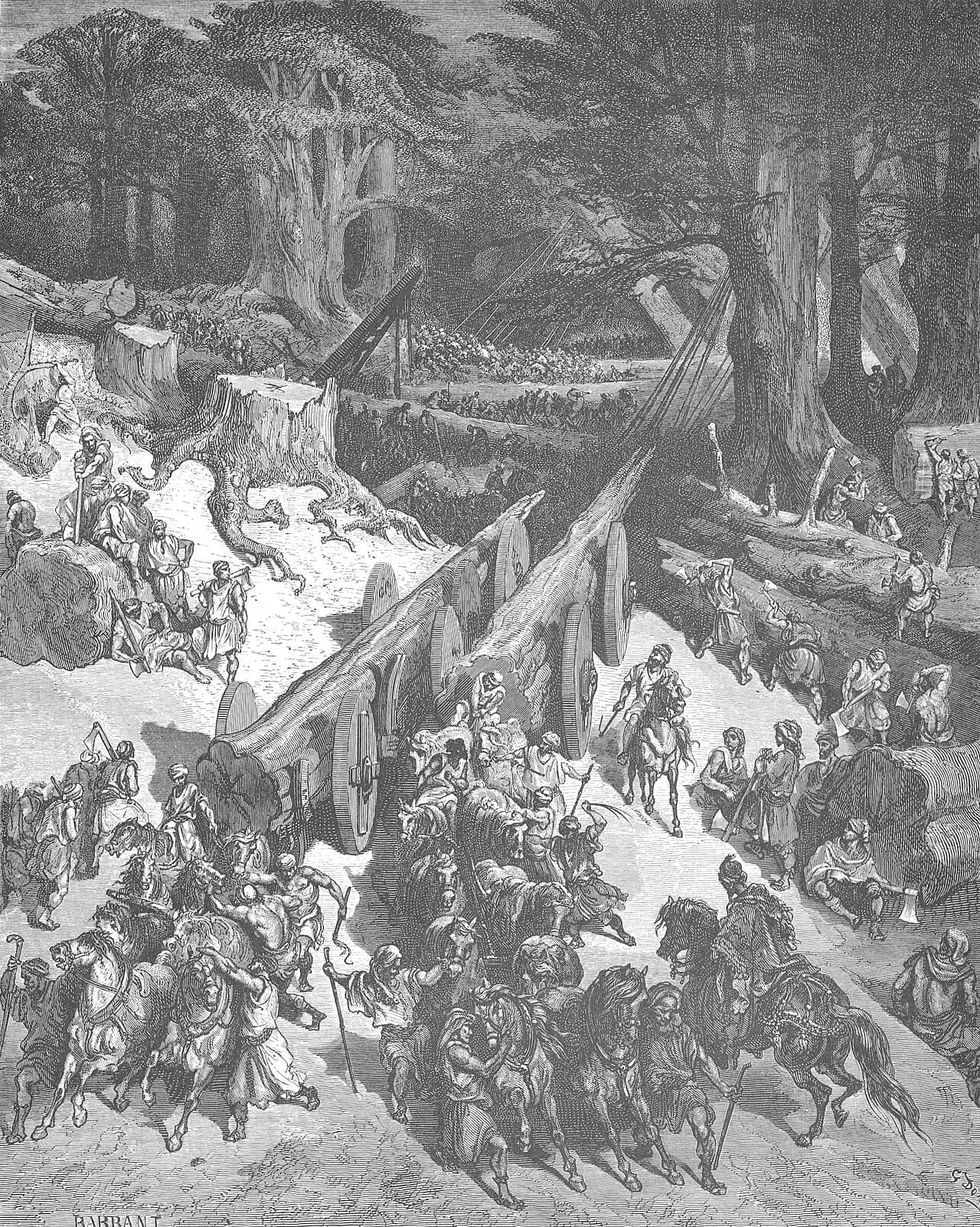
Gustave Doré, Cedars Are Cut Down for the Jerusalem Temple, 1866, from Doré's English Bible. Public domain.
THE ARTWORKDoré drew the cedar forest of Lebanon, with stumps in the clearing and horses hauling the trunks out on wheeled carts. The engraving illustrates 1 Kings 5, where Hiram of Tyre sends Solomon the timber for the house.
Summary
Solomon's temple was the house of the LORD in Jerusalem, toward which Israel prayed for about four hundred years.
- It stood on Mount Moriah, on the threshing floor David bought from Araunah the Jebusite.
- Its inner room was a cube of twenty cubits overlaid with pure gold, where the ark rested under two cherubim.
- Hiram of Tyre sent the cedar and cypress, and a bronze worker from Tyre named Huram cast its two pillars and the Sea.
- At its dedication a cloud filled the house, as it had filled the tabernacle in the wilderness.
- The Babylonians burned it and broke up its bronze in the nineteenth year of Nebuchadnezzar.
Where and When the Building Began
Two verses give the ground of the house and the year its building began.
Then Solomon began to build the house of the LORD in Jerusalem on Mount Moriah, where the LORD had appeared to his father David. This was the place that David had prepared on the threshing floor of Ornan the Jebusite.Chronicles names the ground: the threshing floor of Ornan.
In the four hundred and eightieth year after the Israelites had come out of the land of Egypt, in the month of Ziv, the second month of the fourth year of Solomon’s reign over Israel, he began to build the house of the LORD.Kings dates the start from the Exodus and from Solomon's reign.
The House Beside the Tabernacle
The measures of 1 Kings 6 stand against the frames of Exodus 26 in six rows.
| Part and verse | The tabernacle | The temple |
|---|---|---|
| Length and width, 1 Kings 6:2 | 30 cubits, 20 frames of 1.5 cubits (Exodus 26:16-18); the rear 6 frames and 2 corner frames (26:22-23) | 60 cubits long, 20 wide |
| Height, 1 Kings 6:2 | frames 10 cubits tall (Exodus 26:16) | 30 cubits |
| Main hall, 1 Kings 6:17 | the Holy Place, before the veil (Exodus 26:33) | 40 cubits long |
| Most Holy Place, 1 Kings 6:20 | behind the veil, its size not given (Exodus 26:33) | 20 by 20 by 20 cubits, overlaid with gold |
| Entrance, 1 Kings 6:3 | an embroidered curtain (Exodus 26:36) | a portico 20 cubits wide and 10 deep |
| Cherubim, 1 Kings 6:23 | two of hammered gold on the mercy seat (Exodus 25:18) | two more of olive wood, each 10 cubits high |
- Part and verse
- Length and width, 1 Kings 6:2
- The tabernacle
- 30 cubits, 20 frames of 1.5 cubits (Exodus 26:16-18); the rear 6 frames and 2 corner frames (26:22-23)
- The temple
- 60 cubits long, 20 wide
- Part and verse
- Height, 1 Kings 6:2
- The tabernacle
- frames 10 cubits tall (Exodus 26:16)
- The temple
- 30 cubits
- Part and verse
- Main hall, 1 Kings 6:17
- The tabernacle
- the Holy Place, before the veil (Exodus 26:33)
- The temple
- 40 cubits long
- Part and verse
- Most Holy Place, 1 Kings 6:20
- The tabernacle
- behind the veil, its size not given (Exodus 26:33)
- The temple
- 20 by 20 by 20 cubits, overlaid with gold
- Part and verse
- Entrance, 1 Kings 6:3
- The tabernacle
- an embroidered curtain (Exodus 26:36)
- The temple
- a portico 20 cubits wide and 10 deep
- Part and verse
- Cherubim, 1 Kings 6:23
- The tabernacle
- two of hammered gold on the mercy seat (Exodus 25:18)
- The temple
- two more of olive wood, each 10 cubits high
The Building and the Dedication
Six cards name who supplied each material, and two passages give the bronze pillars and the day the cloud filled the house.
GOLD, SILVER AND STONE
David had gathered a hundred thousand talents of gold and a million talents of silver for the house.
CEDAR AND CYPRESS
Hiram king of Tyre floated the logs from Lebanon by sea, and Solomon paid him in wheat and olive oil every year.
THE WORKMEN OF ISRAEL
Solomon sent thirty thousand men to Lebanon in monthly shifts, and kept seventy thousand porters and eighty thousand stonecutters in the hills.
STONE CUT AT THE QUARRY
The stones were finished at the quarry, so no hammer, chisel or iron tool was heard in the house while it was built.
BRONZE FROM HURAM OF TYRE
Huram, the son of a widow of Naphtali and a Tyrian father, cast the two pillars and the Sea.
SEVEN YEARS OF WORK
The foundation was laid in the month of Ziv of Solomon's fourth year, and the house was finished in the month of Bul of his eleventh.
Huram cast two hollow pillars of bronze, each eighteen cubits high and twelve round, with lily-shaped capitals ringed by rows of pomegranates.
Thus he set up the pillars at the portico of the temple. The pillar to the south he named Jachin, and the pillar to the north he named Boaz.The pillars are named: Jachin to the south, Boaz to the north.
John Wesley, in his notes on 2 Chronicles 3:17, reads Jachin as He shall establish and Boaz as In it is strength.
In the seventh month the priests carried the ark up from the City of David and set it in the inner room beneath the wings of the cherubim. Nothing was in the ark except the two stone tablets Moses had placed there at Horeb.
And when the priests came out of the Holy Place, the cloud filled the house of the LORD so that the priests could not stand there to minister because of the cloud; for the glory of the LORD filled the house of the LORD.The cloud fills the house, and the priests cannot stand to minister.
Kings and Chronicles Side by Side
The two accounts of the house give different figures in two places.
The height of the pillars
He cast two pillars of bronze, each eighteen cubits high and twelve cubits in circumference.Kings: each pillar eighteen cubits high.
In front of the temple he made two pillars, which together were thirty-five cubits high, each with a capital on top measuring five cubits.Chronicles: the two together thirty-five cubits high.
Kings gives the height of each pillar, and Chronicles the two pillars together. Jeremiah repeats the eighteen cubits of Kings when he lists what Babylon took.
The height of the portico
The portico at the front, extending across the width of the temple, was twenty cubits long and twenty cubits high. He overlaid the inside with pure gold.The Berean text reads the portico twenty cubits high.
The portico at the front of the main hall of the temple was twenty cubits long, extending across the width of the temple and projecting out ten cubits in front of the temple.Kings gives the portico's width and depth and no height.
The Hebrew text reads the portico a hundred and twenty cubits high, and the King James Version follows it. Adam Clarke notes that the Syriac, the Arabic and the Codex Alexandrinus of the Greek read twenty, and the Berean text gives twenty.
The Ground Named as Moriah
David purchased the ground from a Jebusite, and the LORD kept him from building on it.
The ground was a threshing floor owned by a Jebusite. When the LORD sent a plague on Israel after David's census, the prophet Gad told David to build an altar there.
Araunah offered it as a gift, and David refused to offer the LORD what cost him nothing. He paid fifty shekels of silver for the floor and the oxen, and the plague stopped.
“No,” replied the king, “I insist on paying a price, for I will not offer to the LORD my God burnt offerings that cost me nothing.” So David bought the threshing floor and the oxen for fifty shekels of silver.David pays for the ground.
Chronicles calls the owner Ornan and adds that David then declared the place to be the site of the house of the LORD.
David could not build the house himself. The LORD told him he had shed much blood, and that a son of his, a man of rest, would build it.
but this word of the LORD came to me: ‘You have shed much blood and waged great wars. You are not to build a house for My Name because you have shed so much blood on the ground before Me. But a son will be born to you who will be a man of rest. I will give him rest from all his enemies on every side; for his name will be Solomon, and I will grant to Israel peace and quiet during his reign.The reason David was kept from building, and the son who would build instead.
The Fall of the House
Babylon carried off the bronze, the gold and the silver, and two books date the burning.
What Babylon took
He burned down the house of the LORD, the royal palace, and all the houses of Jerusalem—every significant building.Nebuzaradan burns the house of the LORD.
Moreover, the Chaldeans broke up the bronze pillars and stands and the bronze Sea in the house of the LORD, and they carried the bronze to Babylon.The pillars, the stands and the Sea are broken up and the bronze carried to Babylon.
The gold vessels had gone eleven years before, when Nebuchadnezzar cut into pieces the gold articles Solomon had made. At the end the Chaldeans took the bronze, and the captain of the guard took every vessel of gold and silver that remained.
The date
On the seventh day of the fifth month, in the nineteenth year of Nebuchadnezzar’s reign over Babylon, Nebuzaradan captain of the guard, a servant of the king of Babylon, entered Jerusalem.Kings: the seventh day of the fifth month, Nebuchadnezzar's nineteenth year.
On the tenth day of the fifth month, in the nineteenth year of Nebuchadnezzar’s reign over Babylon, Nebuzaradan captain of the guard, a servant of the king of Babylon, entered Jerusalem.Jeremiah: the tenth day of the same month and year.
Kings gives the seventh day of the fifth month and Jeremiah the tenth, both in the nineteenth year of Nebuchadnezzar. Edwin Thiele's chronology of the kings, on which the standard dates rest, sets that year in 586 BC, and others reckon it 587 BC. The year turns on how Judah counted a king's first year, and the Babylonian Chronicle tablet that records the first capture of Jerusalem stops before this siege.
What the Text Leaves Unsaid
The record leaves two questions open.
The lists of what Babylon carried away name the pillars, the Sea, the stands and the bronze, gold and silver vessels. Neither list names the ark of the covenant, and no verse names it among the spoil.
Genesis sends Abraham to one of the mountains in the land of Moriah without saying which. Chronicles gives the temple's mountain the name Moriah and leaves the link to Abraham unstated.
A House Heaven Cannot Contain
Solomon's prayer and three New Testament passages say where God dwells.
In his prayer of dedication Solomon said the house could not hold God. He asked instead that the LORD's eyes be open toward it and that He hear from heaven.
But will God indeed dwell upon the earth? Even heaven, the highest heaven, cannot contain You, much less this temple I have built.Solomon's question: will God indeed dwell upon the earth?
The LORD answered with a condition. If Solomon's sons turned to other gods, He would cast the house from His sight and it would become a heap of rubble.
Stephen quoted the same point at his trial: Solomon built the house, yet the Most High does not dwell in houses made by hands. Jesus spoke of the temple of His body, and Hebrews says Christ entered heaven itself, the true sanctuary of which the made one was a copy.
Jesus answered, “Destroy this temple, and in three days I will raise it up again.” “This temple took forty-six years to build,” the Jews replied, “and You are going to raise it up in three days?” But Jesus was speaking about the temple of His body.Jesus names His body as the temple to be raised in three days.
Three Voices on the House
Three teachers read the house, from the third century to the nineteenth.
Clement of Alexandria, about AD 200, read Solomon's question as pointing to the flesh the Son of David would build up.
Solomon the son of David, in the books styled The Reigns of the Kings, comprehending not only that the structure of the true temple was celestial and spiritual but had also a reference to the flesh, which he who was both the son and the Lord of David was to build up, both for his own presence, where, as a living image, he resolved to make his shrine, and for the church that was to rise up through the union of faith, says expressly, "Will God in very deed dwell with humans on the earth?"
Clement of Alexandria · Fragments Not Given in the Oxford Edition · on 1 Kings 8:27Patristic
John Wesley, in his notes on 1 Kings 6:38, reads the finished house as a picture of the church built on Christ.
We are wonderfully made by the Divine Providence, but more wonderfully made anew by the Divine grace. And as Solomon's temple was built on a rock, so are we built on Christ. The church is a mystical temple, enriched and beautified, not with gold and precious stones, but with the gifts and graces of the spirit.
John Wesley · Explanatory Notes upon the Old Testament · on 1 Kings 6:38Evangelical
Jamieson, Fausset and Brown describe the inner rooms of 1 Kings 6, where the gold covered every surface.
The cedar-wood was beautifully embellished with figures in relievo, representing clusters of foliage, open flowers, cherubims, and palm trees. The whole interior was overlaid with gold, so that neither wood nor stone was seen; nothing met the eye but pure gold, either plain or richly chased.
Jamieson, Fausset & Brown · Commentary Critical and Explanatory on the Whole Bible · on 1 Kings 6:15-21Reformed
Where on the Mountain the House Stood
Three scholars place the house in three different spots on the mountain.
In 1871 Jamieson, Fausset and Brown quoted James Turner Barclay on the site. Barclay wrote that all topographers agreed the house stood somewhere inside the enclosure on Mount Moriah, and that they differed widely on its place there, from the center of the platform to its southwest corner.
On the rock under the Dome of the Rock
Leen Ritmeyer argues from a step cut in the bedrock and from the platform's geometry that the rock lay inside the Most Holy Place. He sets out the case in Biblical Archaeology Review 18:2 (1992) and in The Quest (2006), and most who place the house hold it.
The strongest objection is that the step and the geometry are read from the surface, since no one has dug beneath it.
North of the rock, near the Dome of the Spirits
Asher Kaufman argued in Biblical Archaeology Review 9:2 (1983) that the house stood north of the rock, on the line of a rock-cut surface near the small dome called the Dome of the Spirits.
The strongest objection is that the case rests on the alignment of one cut surface, which no excavation has tested.
South of the platform, over the Gihon spring
Ernest L. Martin argued in The Temples That Jerusalem Forgot (2000) that the house stood over the Gihon spring in the older city to the south, and that the platform was a Roman fort.
The strongest objection is the topographers' agreement that Barclay recorded.
Praying Toward the God Who Hears
Solomon overlaid the whole house with gold and then confessed that the highest heaven cannot contain God. His prayer asks the reader to pray to the God who hears from heaven and forgives, and John points the reader to the body of Jesus as the temple raised on the third day.
Keep studying
Places7
Show the next 1 title
Doctrines2