
John 4:24
in John 4God is Spirit, and His worshipers must worship Him in spirit and in truth.”
BSB
The same verse in ASV and KJV ▾
ASV
God is a Spirit: and they that worship him must worship in spirit and truth.
KJV
God is a Spirit: and they that worship him must worship him in spirit and in truth.
⋯
This verse in John 4
Commentary
40 notes on this verseGod is a Spirit - This is one of the first, the greatest, the most sublime, and necessary truths in the compass of nature! There is a God, the cause of all things - the fountain of all perfection - without parts or dimensions, for he is Eternal - filling the heavens and the earth - pervading, governing, and upholding all things: for he is an infinite Spirit!
This site's exposition
the true worshipers will worship the Father
on John 4:23-24
The hour is coming and has now come, so the shift has already begun. Worship in spirit and in truth rises from the person himself and answers to what God has shown, at any place on earth. God is Spirit, and He seeks worshipers like these.
The record, by era
The Church Fathers5 voices
A commentator
Dionysius of AlexandriaEpistle to Dionysius Bishop of Rome, From the First Book · Written before 264.
proposed
Since, therefore, the Father is eternal, the Son also is eternal, Light of Light. For where there is the begetter, there is also the offspring. And if there is no offspring, how and of what can He be the begetter? But both are, and always …
God is of an incorporeal nature and cannot be circumscribed into any one place. Rather, he is everywhere, and it is necessary that he be worshiped according to this understanding. The true worshiper is the one who honors him with the right intention and believes …
What, however, does the Lord teach the woman now, as one whose husband has begun to be present? "The woman saith unto Him, Sir, I perceive that thou art a prophet. Our fathers worshipped in this mountain; and ye say that in Jerusalem is the place where men ought to worship. Jesus saith unto her, Woman, believe me." For the Church will come, as it is said in the Song of Songs, "will come, and will pass over from the beginning of faith." She will come in order to pass through; and pass through she cannot, except from the beginning of faith. Rightly she now hears, the husband being present: "Woman, believe me." For there is that in thee now which can believe, since thy husband is present. Thou hast begun to be present with the understanding when thou calledst me a prophet. Woman, believe me; for if ye believe not, ye will not understand. Therefore, "Woman, believe me, for the hour will come when ye shall neither in this mountain nor in Jerusalem worship the Father. Ye worship ye know not what: we worship what we know; for salvation is of the Jews. But the hour will come." When? "And now is." Well, what hour? "When the true worshippers shall worship the Father in spirit and in truth," not in this mountain, not in the temple, but in spirit and in truth. "For the Father seeketh such to worship Him." Why does the Father seek such to worship Him, not on a mountain, not in the temple, but in spirit and in truth? "God is Spirit." If God were body, it were right that He should be worshipped on a mountain, for a mountain is corporeal; it were right He should be worshipped in the temple, for a temple is corporeal. "God is Spirit; and they that worship Him, must worship in spirit and in truth."
A commentator
IrenaeusFragments from the Lost Writings of Irenaeus, XXXVII · Written before 202.
proposed
Those who have become acquainted with the secondary (i.e., under Christ) constitutions of the apostles, are aware that the Lord instituted a new oblation in the new covenant, according to [the declaration of] Malachi the prophet. For, "from the rising of the sun even to the setting my name has been glorified among the Gentiles, and in every place incense is offered to my name, and a pure sacrifice;" as John also declares in the Apocalypse: "The incense is the prayers of the saints."
(Tr. xv. c. 25) O for a mountain to pray on, thou criest, high and inaccessible, that I may be nearer to God, and God may hear me better, for He dwelleth on high. Yes, God dwelleth on high, but He hath respect unto the humble. Wherefore descend that thou mayest ascend. "Ways on high are in their heart," (Ps. 74:7.) it is said, "passing in the valley of tears," and in "tears" is humility. Wouldest thou pray in the temple? pray in thyself; but first do thou become the temple of God.
33 more voices on this verse
The Church Fathers18 voices
We have heard, and it is manifest; we had gone out of doors, and we are sent inward. Would I could find, thou didst say, some high and lonely mountain! For I think that, because God is on high, He hears me the rather from a high place. Because thou art on a mountain, dost thou imagine thyself near to God. and that He will quickly hear thee, as if calling to Him from the nearest place? He dwells on high, but regards the lowly. "The Lord is near." To whom? To the high, perhaps? "To them who are contrite of heart." 'Tis a wonderful thing: He dwelleth on high, and yet is near to the lowly; "He hath regard to lowly things, but lofty things He knoweth from afar;" He seeth the proud afar off, and He is the less near to them the higher they appear to themselves to be. Didst thou seek a mountain, then? Come down, that thou mayest come near Him. But wouldest thou ascend? Ascend, but do not seek a mountain. "The ascents," it saith, "are in his heart, in the valley of weeping." The valley is humility. Therefore do all within. Even if perhaps thou seekest some lofty place, some holy place, make thyself a temple for God within time. "For the temple of God is holy, which temple are ye." Wouldest thou pray in a temple? Pray in thyself. But be thou first a temple of God, for He in His temple heareth him that prays.
A commentator
Hippolytus of RomeThe Refutation of All Heresies - Book 5 · Written before 235.
proposed
The Phrygians, however, further assert that the father of the universe is "Amygdalus," not a tree, he says, but that he is "Amygdalus" who previously existed; and he having in himself the perfect fruit, as it were, throbbing and moving in the depth, rent his breasts, and produced his now invisible, and nameless, and ineffable child. respecting whom we shall speak. For the word "Amyxai" signifies, as it were, to burst and sever through, as he says (happens) in the case of inflamed bodies, and which have in themselves any tumour; and when doctors have cut this, they call it "Amychai." In this way, he says, the Phrygians call him "Amygdalus," from which proceeded and was born the Invisible (One), "by whom all things were made, and nothing was made without Him." And the Phrygians say that what has been thence produced is "Syrictas" (piper), because the Spirit that is born is harmonious. "For God," he says, "is Spirit; wherefore," he affirms, "neither in this mountain do the true worshippers worship, nor in Jerusalem, but in spirit. For the adoration of the perfect ones," he says, "is spiritual, not carnal." The Spirit, however, he says, is there where likewise the Father is named, and the Son is there born from this Father. This, he says, is the many-named, thousand-eyed Incomprehensible One, of whom every nature-each, however, differently-is desirous. This, he says, is the word of God, which, he says, is a word of revelation of the Great Power. Wherefore it will be sealed, and hid, and concealed, lying in the habitation where lies the basis of the root of the universe, viz. Aeons, Powers, Intelligences, Gods, Angels, delegated Spirits, Entities, Nonentities, Generables, Ingenerables, Incomprehensibles, Comprehensibles, Years, Months, Days, Hours, (and) Invisible Point from which what is least begins to increase gradually. […]
In the language of the Gospel itself, it is declared that "God is a Spirit." … To the opinion of the woman that God is rightly worshiped according to the privileges of the different localities … the Savior answered that anyone who would follow the Lord must lay aside all preference for particular places. He expressed himself as follows: "The hour is coming when neither in Jerusalem nor on this mountain shall the true worshipers worship the Father. God is a Spirit, and they who worship him must worship him in spirit and in truth." Observe how logically he has joined together the spirit and the truth. He called God a Spirit so that he might distinguish him from bodies; and he named him the truth in order to distinguish him from a shadow or an image. For they who worshiped in Jerusalem worshiped God neither in truth nor in spirit, being in subjection to the shadow or image of heavenly things. And such also was the case with those who worshiped on Mount Gerizim. Having refuted, then, as well as we could, every notion that might suggest that we were to think of God as in any degree corporeal, we go on to say that, according to strict truth, God is incomprehensible and incapable of being measured.
A commentator
Origen of AlexandriaCOMMENTARY ON THE GOSPEL OF JOHN 13.140 · Written before 253.
proposed
Since we are made alive by the spirit as far as ordinary life is concerned—and what we usually mean by the term "life" concerns when the spirit that is in us draws, what is called, in the literal sense, the breath of life37—I suppose it has been understood from this that God, who brings us to true life, is called spirit. In the scriptures, the spirit is said to make alive. It is clear that this "making alive" refers not to the ordinary life, but to the more divine life. For the letter also kills and produces death, but it is not death in the sense of separation of the soul from the body, but death in the sense of the separation of the soul from God, and from the Lord himself, and from the Holy Spirit.
A commentator
Origen of AlexandriaCOMMENTARY ON THE GOSPEL OF JOHN 13.145-46 · Written before 253.
proposed
In the [First] Book of Kings, the Spirit of the Lord, who came to Elijah, makes the following suggestions concerning God: "For he said, you shall go out tomorrow and stand before the Lord on the mountain. Beyond, the Lord will pass by as a great and strong wind destroying mountains and crushing rocks before the Lord. The Lord is not in the wind (but in other texts we find: "in the spirit of the Lord"). After the wind, an earthquake; the Lord is not in the earthquake. And after the earthquake, a fire; the Lord is not in the fire. And after the fire, the sound of a gentle breeze." Perhaps, indeed, these words reveal how many must experience the fire of the direct apprehension of the Lord.… But who could more properly tell us about whom God is than the Son? "For no one has known the Father except the Son." We too aspire to know how God is spirit as the Son reveals it, and to worship God in the spirit that gives life and not in the letter that kills. We want to honor God in truth and no longer in types, shadows and examples even as the angels do not serve God in examples and the shadow of heavenly realities but in realities that belong to the spiritual and heavenly order.
A commentator
Origen of AlexandriaCOMMENTARY ON THE GOSPEL OF JOHN 13.109 · Written before 253.
proposed
If there are many who profess to worship the Creator, there are some who are no longer in the flesh but in the spirit, because they walk in the spirit and do not fulfill the desire of the flesh. And there are others who are not in the spirit but in the flesh and wage war according to the flesh. If this is so, then one must say that those who worship the Father in spirit and not in flesh, in truth and not in types, are the true worshipers, and that those who do not so worship are not true worshipers.
(tom. xiii. c. 20) But if the Father seeks, He seeks through Jesus, Who came to seek and to save that which was lost, and to teach men what true worship was. God is a Spirit; i. e. He constitutes our real life, just as our breath (spirit) constitutes our bodily life.
We see that the woman, her mind full of inherited tradition, thought that God must be worshiped either on a mountain, as at Samaria, or in a temple, as at Jerusalem.… The prejudices of both confined the all-embracing and illimitable God to the crest of a hill or the vault of a building. God is invisible, incomprehensible, immeasurable. The Lord said that the time had come when God should be worshiped neither on mountain nor in temple. For the Spirit cannot be shut up, as if in a cabin, or confined. It is omnipresent in space and time, and under all conditions it is present in its fullness. Therefore he said that they are the true worshipers who shall worship in the Spirit and in truth. And these who are to worship God the Spirit in the Spirit shall have the One for the means, the Other for the object, of their reverence. For each of the two stand in a different relation to the worshiper. The words "God is Spirit" do not alter the fact that the Holy Spirit has a name of his own and that he is the gift to us.… The imparted gift and the object of reverence were clearly shown when Christ taught that God, being Spirit, must be worshiped in the Spirit, and revealed what freedom and knowledge, what boundless scope for adoration, lay in this worship of God the Spirit, in the Spirit.
(ii. de Trin. c. 31) Or, by saying that God being a Spirit ought to be worshipped in spirit, He indicates the freedom and knowledge of the worshippers, and the uncircumscribed nature of the worship: according to the saying of the Apostle, Where the Spirit of the Lord is, there is liberty. (2 Cor. 3:17)
A commentator
Philoxenus of Mabbug13 Ascetic Discourses, Discourse 9 -- Second Discourse on Poverty · Written before 523.
proposed
And all his life is like unto theirs, and like unto them he crieth "Holy" in the spirit, and he singeth in the spirit, and he serveth God in spirit and in truth, even as it hath been said by the word of God concerning …
Of the wind also Amos says, "He that strengtheneth the thunder , and createth the wind, and declareth His Christ unto men; " thus showing that that wind was created which was reckoned with the formation of the earth, which was wafted over the waters, balancing and refreshing and animating all things: not (as some suppose) meaning God Himself by the spirit, on the ground that "God is a Spirit," because the waters would not be able to bear up their Lord; but He speaks of that spirit of which the winds consist, as He says by Isaiah, "Because my spirit went forth from me, and I made every blast.
It is, However, more credible that the soul has service rendered to it, and has the mastery, as being more proximate in character to God. This circumstance even redounds to the glory of the flesh, inasmuch as it both contains an essence nearest to God's, and renders itself a partake of (the soul's) actual sovereignty.
In what form of God? Of course he means in some form, not in none. For who will deny that God is a body, although "God is a Spirit? " For Spirit has a bodily substance of its own kind, in its own form.
Do not imagine, my beloved, that prayer consists solely of words or that it can be learned by means of words. No, listen to the truth of the matter from our Lord: spiritual prayer is not learned and does not reach fullness as a result …
The "worship in the Spirit" suggests the idea of the operation of our intelligence being carried on in the light, as may be learned from the words spoken to the woman of Samaria. Deceived as she was by the customs of her country into the belief that worship was local, our Lord, with the object of giving her better instruction, said that worship ought to be offered "in Spirit and in Truth," plainly meaning by the Truth, Himself. As then we speak of the worship offered in the Image of God the Father as worship in the Son, so too do we speak of worship in the Spirit as shewing in Himself the Godhead of the Lord. Wherefore even in our worship the Holy Spirit is inseparable from the Father and the Son. If you remain outside the Spirit you will not be able even to worship at all; and on your becoming in Him you will in no wise be able to dissever Him from God;—any more than you will divorce light from visible objects. For it is impossible to behold the Image of the invisible God except by the enlightenment of the Spirit, and impracticable for him to fix his gaze on the Image to dissever the light from the Image, because the cause of vision is of necessity seen at the same time as the visible objects. Thus fitly and consistently do we behold the "Brightness of the glory" of God by means of the illumination of the Spirit, and by means of the "Express Image" we are led up to Him of whom He is the Express Image and Seal, graven to the like.
Since God cannot be seen, his incorporeal nature follows directly on his invisibility. For if God is unseen, then he must be incorporeal. And if this is the case, then the Spirit spoken of here cannot be air that has been set in motion. For …
If you wish to pray, you have need of God, "who gives prayer to him who prays." Invoke him, then, saying, "Hallowed be thy name, thy kingdom come"49—that is, the Holy Spirit and your only begotten Son. For this is what he taught us, saying, …
"God is a Spirit." He declareth nothing else than His incorporeal Nature. Now the service of that which is incorporeal must needs be of the same character, and must be offered by that in us which is incorporeal, to wit, the soul, and purity of mind. Wherefore He saith, "they that worship Him, must worship Him in spirit and in truth." For because both Samaritans and Jews were careless about the soul, but took great pains about the body, cleansing it in divers ways, it is not, He saith, by purity of body, but by that which is incorporeal in us, namely the mind, that the incorporeal One is served. Sacrifice then not sheep and calves, but dedicate thyself to the Lord; make thyself a holocaust, this is to offer a living sacrifice. Ye must worship "in truth"; as former things were types, such as circumcision, and whole burnt offerings, and victims, and incense, they now no longer exist, but all is "truth." For a man must now circumcise not his flesh, but his evil thoughts, and crucify himself, and remove and slay his unreasonable desires.
The Medieval Church4 voices
Or, because many think that they worship God in the spirit, i. e. with the mind, who yet held heretical doctrines concerning Him, for this reason He adds, and in truth. May not the words too refer to the two kinds of philosophy among us, i. e. active and contemplative; the spirit standing for action, according to the Apostle, As many as are led by the Spirit of God; (Rom. 8:14) truth, on the other hand, for contemplation. Or, (to take another view,) as the Samaritans thought that God was confined to a certain place, and ought to be worshipped in that place; in opposition to this notion, our Lord may mean to teach them here, that the true worshippers worship not locally, but spiritually. Or again, all being a type and shadow in the Jewish system, the meaning may be that the true worshippers will worship not in type, but in truth. God being a Spirit, seeketh for spiritual worshippers; being the truth, for true ones.
Although we Jews surpass you Samaritans in the form of worship, the form of Jewish worship will also eventually come to an end. And the change will occur not only in the place, but also in the manner of worship, and this change is very …
"God is Spirit," not a body, as you believe: Isaiah 40: "To whom have you likened God? Or what image will you set up for him?" "And those who worship him must worship in spirit and truth:" so that they may be conformed to him, …
Then he shows that the third type of worship is appropriate from the very nature of God, saying, God is spirit. As is said in Sirach (13:19), "Every animal loves its like"; and so God loves us insofar as we are like him. But we …
The Puritans and the Awakening3 voices
God is a Spirit - Not only remote from the body, and all the properties of it, but likewise full of all spiritual perfections, power, wisdom, love, holiness. And our worship should be suitable to his nature. We should worship him with the truly spiritual worship of faith, love, and holiness, animating all our tempers, thoughts, words, and actions.
God is a spirit,....
The worshippers were generally carnal, and strangers to the inward part of divine worship. Note, It is possible that we may be better than our neighbours, and yet not so good as we should be. It concerns us to be right, not only in the object of our worship, but in the manner of it; and it is this which Christ here instructs us in.
The Nineteenth Century6 voices
THE WOMAN’S CONSCIENCE had been aroused by Christ’s declaration of her sin. He was touching upon matters of the most vital importance, and her depraved heart naturally shrunk from the lancet, From the truth which was becoming inconveniently personal she flew to that natural resort of the carnal mind, namely, to religions discourse upon points of outward observance. Instead of confessing her sin, and asking how it may be forgiven, she must needs say, “Our fathers worshipped in this mountain; and ye say, that in Jerusalem is the place where men ought to worship.”
A commentator
Jamieson, Fausset & Brown1802–1910
Commentary Critical and Explanatory on the Whole Bible (1871)
proposed
1Ti 2:8). worship the Father--She had talked simply of "worship"; our Lord brings up before her the great OBJECT of all acceptable worship--"THE FATHER."
quarantine:debris (2026-07-29) — unbalanced-parens
A commentator
J.C. Ryle1816–1900
Expository Thoughts on the Gospels: John (lightly modernized text, Grace Gems edition) (1869)
proposed
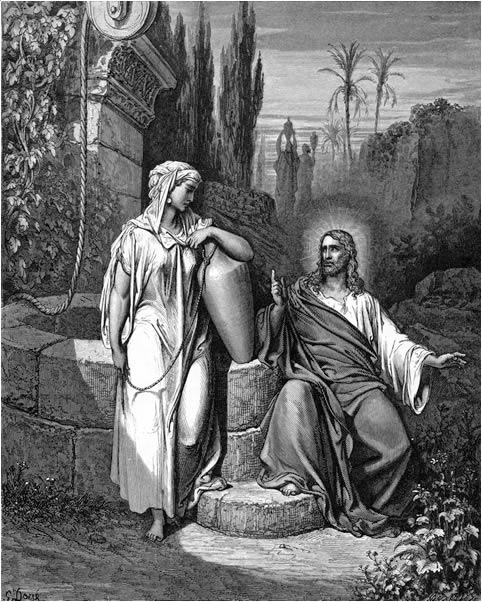
Conversation With a Samaritan Woman But he had to pass through Samaria. Now he came to a Samaritan town called Sychar, near the plot of land that Jacob had given to his son Joseph. Jacob’s well was there, so Jesus, since he was tired from the journey, sat right down beside the well. It was about noon. A Samaritan woman came to draw water. Jesus said to her, "Give me some water to drink." (For his disciples had gone off into the town to buy supplies.)
A commentator
J.C. Ryle1816–1900
Expository Thoughts on the Gospels: John (lightly modernized text, Grace Gems edition) (1869)
proposed
Conversation With a Samaritan Woman But he had to pass through Samaria. Now he came to a Samaritan town called Sychar, near the plot of land that Jacob had given to his son Joseph. Jacob’s well was there, so Jesus, since he was tired from the journey, sat right down beside the well. It was about noon. A Samaritan woman came to draw water. Jesus said to her, "Give me some water to drink." (For his disciples had gone off into the town to buy supplies.) So the Samaritan woman said to him, "How can you—a Jew—ask me, a Samaritan woman, for water to drink?" (For Jews use nothing in common with Samaritans.) Jesus answered her, "If you had known the gift of God and who it is who said to you, ‘Give me some water to drink,’ you would have asked him, and he would have given you living water." "Sir," the woman said to him, "you have no bucket and the well is deep; where then do you get this living water? Surely you’re not greater than our ancestor Jacob, are you? For he gave us this well and drank from it himself, along with his sons and his livestock." Jesus replied, "Everyone who drinks some of this water will be thirsty again. But whoever drinks some of the water that I will give him will never be thirsty again, but the water that I will give him will become in him a fountain of water springing up to eternal life." The woman said to him, "Sir, give me this water, so that I will not be thirsty or have to come here to draw water." He said to her, "Go call your husband and come back here." The woman replied, "I have no husband." Jesus said to her, "Right you are when you said, ‘I have no husband,’ for you have had five husbands and the man you are living with now is not your husband. This you said truthfully!" The woman said to him, "Sir, I see that you are a prophet.
THE WOMAN’S CONSCIENCE had been aroused by Christ’s declaration of her sin. He was touching upon matters of the most vital importance, and her depraved heart naturally shrunk from the lancet, From the truth which was becoming inconveniently personal she flew to that natural resort of the carnal mind, namely, to religions discourse upon points of outward observance. Instead of confessing her sin, and asking how it may be forgiven, she must needs say, “Our fathers worshipped in this mountain; and ye say, that in Jerusalem is the place where men ought to worship.” The carnal heart dreads the contact of spiritual truth, and finds a most convenient way of avoiding it by running to questions of holy places, holy times, and holy customs. Jesus, to her astonishment, informs her that the question which she had asked was of only temporary importance. There had been a time when it was well to know that salvation was of the Jews, and that the rival temple of the Samaritans was an imposture; but he says in effect to her, “Woman, believe me that question is of no importance now, for the hour cometh, yea and now is, when the external is to be abolished and the ritualistic is to be put away, and a purer, simpler, and more spiritual worship, is to take its place.” The worship which our Lord Jesus Christ established involved a change. That is implied in the expressions here used. He announced to her that the hour was just then come when all questions about this or that place must cease, and be superseded by spiritual worship. Our Lord gave a very brief, but I think a very instructive description of what this worship was to be. If you observe carefully the words, you will see that it was a distinguishing kind of worship, for he mentions true worshippers.
A commentator
Albert Barnes1798–1870
Notes, Explanatory and Practical, on the Old and New Testaments (1832-1869)
proposed
God is A spirit - This is the second reason why men should worship him in spirit and in truth. By this is meant that God is without a body; that he is not material or composed of parts; that he is invisible, in every place, pure and holy. This is one of the first truths of religion, and one of the sublimest ever presented to the mind of man. Almost all nations have had some idea of God as gross or material, but the Bible declares that he is a pure spirit. As he is such a spirit, he dwells not in temples made with hands Act 7:48, neither is worshipped with men’s hands as though he needed anything, seeing he giveth to all life, and breath, and all things, Act 17:25. A pure, a holy, a spiritual worship, therefore, is such as he seeks - the offering of the soul rather than the formal offering of the body - the homage of the heart rather than that of the lips.
Modern Voices2 voices
In John 4, Jesus' encounter with the Samaritan woman is itself a Purim-style reversal the rejected becomes chosen, the overlooked becomes entrusted, and the outsider becomes the first to hear a clear declaration of Messiah.
A commentator
Benny HinnWorship: The Atmosphere for Miracles (bennyhinn.org devotional) (2026)
proposed
When you lift your hands, open your heart, and begin to magnify the Lord—not simply for what He can do, but because of who He is—something powerful takes place.
The words behind it
13 Greek wordsEvery Greek word of this verse in the order it stands, with what it means and the door to its own study. The last column counts the times a word stands in the whole Bible: the rarer the word, the more the places it appears belong together.
| Greek | Sound | Meaning | Word study | In the Bible |
|---|---|---|---|---|
| πνεῦμα | pneuma | Spirit | G4151 → | 378 times |
| ὁ | ho | <the> | G3588 → | 19766 times |
| θεός, | theos | God [is], | G2316 → | 1312 times |
| καὶ | kai | and | G2532 → | 9120 times |
| τοὺς | tous | those | G3588 → | 19766 times |
| προσκυνοῦντας | proskunountas | worshiping | G4352 → | 60 times |
| αὐτὸν | auton | Him | G846 → | 5565 times |
| ἐν | en | in | G1722 → | 2738 times |
| πνεύματι | pneumati | spirit | G4151 → | 378 times |
| καὶ | kai | and | G2532 → | 9120 times |
| ἀληθείᾳ | aletheia | truth | G225 → | 109 times |
| δεῖ | dei | it behooves | G1163 → | 101 times |
| προσκυνεῖν.¶ | proskunein | to worship. | G4352 → | 60 times |
πνεῦμαSpirit
pneumaG4151 →378 times
ὁ<the>
hoG3588 →19766 times
θεός,God [is],
theosG2316 →1312 times
καὶand
kaiG2532 →9120 times
τοὺςthose
tousG3588 →19766 times
προσκυνοῦνταςworshiping
proskunountasG4352 →60 times
αὐτὸνHim
autonG846 →5565 times
ἐνin
enG1722 →2738 times
πνεύματιspirit
pneumatiG4151 →378 times
καὶand
kaiG2532 →9120 times
ἀληθείᾳtruth
aletheiaG225 →109 times
δεῖit behooves
deiG1163 →101 times
προσκυνεῖν.¶to worship.
proskuneinG4352 →60 times
A shaded row is a word that stands 400 times or fewer in the Bible.
The walk
8 stopsEach card is a verse this one points to, and under it the verses that one points to in turn. Where several paths arrive at the same place, that place is listed first: the text keeps returning to it.
Through
Psalms 51:17The sacrifices of God are a broken spirit; a broken and a contrite heart, O God, You will not despise.
it leads to
- Psalms 34:18
The LORD is near to the brokenhearted; He saves the contrite in spirit.
Reached by 2 separate paths from here.
- Psalms 147:3
He heals the brokenhearted and binds up their wounds.
Reached by 2 separate paths from here.
- Isaiah 66:2
Has not My hand made all these things? And so they came into being,” declares the LORD. “This is the one I will esteem: he who is humble and contrite in spirit, who trembles…
- Psalms 34:18
Through
2 Corinthians 3:17Now the Lord is the Spirit, and where the Spirit of the Lord is, there is freedom.
it leads to
- Romans 8:2
For in Christ Jesus the law of the Spirit of life set you free from the law of sin and death.
- John 8:32
Then you will know the truth, and the truth will set you free.”
- Galatians 5:13
For you, brothers, were called to freedom; but do not use your freedom as an opportunity for the flesh. Rather, serve one another in love.
- Galatians 4:6
And because you are sons, God sent the Spirit of His Son into our hearts, crying out, “Abba, Father!”
- Galatians 5:1
It is for freedom that Christ has set us free. Stand firm, then, and do not be encumbered once more by a yoke of slavery.
- Romans 8:2
Where this verse is studied
About John
This page draws on 37 works. Open the list of works
This page draws on Abraham of Nathpar, ON PRAYER AND SILENCE 1-2; Adam Clarke, Commentary on the Bible; Albert Barnes, Notes, Explanatory and Practical, on the Old and New Testaments (1832-1869); Augustine of Hippo, Tractates on John 15; Augustine of Hippo, Catena Aurea by Aquinas; Basil of Caesarea, ON THE SPIRIT 26.64; Benny Hinn, Worship: The Atmosphere for Miracles (bennyhinn.org devotional); Bonaventure, Commentary on John, Chapter 4; Charles Spurgeon, The Metropolitan Tabernacle Pulpit, Sermon No. 695: “The Axe at the Root—A Testimony Against Puseyite Idolatry” (lightly modernized text, CCEL edition); Didymus the Blind, FRAGMENTS ON JOHN 3; Dionysius of Alexandria, Epistle to Dionysius Bishop of Rome, From the First Book; Evagrius Ponticus, CHAPTERS ON PRAYER 59-61; Hilary of Poitiers, ON THE TRINITY 2.31; Hilary of Poitiers, Catena Aurea by Aquinas; Hippolytus of Rome, The Refutation of All Heresies - Book 5; Irenaeus, Fragments from the Lost Writings of Irenaeus, XXXVII; J.C. Ryle, Expository Thoughts on the Gospels: John (lightly modernized text, Grace Gems edition); Jamieson, Fausset & Brown, Commentary Critical and Explanatory on the Whole Bible; Jane Hamon, PURIM – A TIME FOR REVERSALS!!; John Calvin, Commentary on the Gospel according to John; John Chrysostom, Homily on the Gospel of John 33; John Gill, Exposition of the New Testament (1746-1748); John Wesley, Explanatory Notes upon the New Testament; Matthew Henry, Commentary on the Whole Bible; Origen of Alexandria, ON FIRST PRINCIPLES 1.1.4-5; Origen of Alexandria, COMMENTARY ON THE GOSPEL OF JOHN 13.140; Origen of Alexandria, COMMENTARY ON THE GOSPEL OF JOHN 13.145-46; Origen of Alexandria, COMMENTARY ON THE GOSPEL OF JOHN 13.109; Origen of Alexandria, Catena Aurea by Aquinas; Philoxenus of Mabbug, 13 Ascetic Discourses, Discourse 9 -- Second Discourse on Poverty; Tertullian, Against Hermogenes; Tertullian, On the Resurrection of the Flesh; Tertullian, Against Praxeas; Theodore of Mopsuestia, COMMENTARY ON JOHN 24.23-24; Theophylact of Ohrid, Catena Aurea by Aquinas; Theophylact of Ohrid, Commentary on John and Thomas Aquinas, Commentary on John.