

430 BCE – 6 CE · Featured Study · Malachi to Matthew
The Intertestamental Period
The Hebrew canon closes with Malachi’s promise of a forerunner, and the New Testament opens with Gabriel announcing him — but four hundred years pass in between, and they are not empty years. Persia gives way to Alexander, Alexander’s empire splits between the Ptolemies and the Seleucids, a Seleucid king desecrates the temple and a family of priests answers with revolt, a sovereign Jewish kingdom rises and falls, and Rome arrives to stay. In that same span the synagogue takes root, the Pharisees and Sadducees form as parties, the Hebrew Scriptures are translated into Greek, and the political and religious furniture of the Gospels — Herod’s temple, the Sanhedrin, the schools of interpretation — is built. “The 400 silent years” is the traditional name. It is true in one sense and misleading in several others, and both halves of that matter for reading the New Testament well.
James Tissot, Reconstruction of Jerusalem and the Temple of Herod, c. 1886-1894. Public domain.
Summary
The four centuries between Malachi and Matthew are walked as six eras drawn to scale, from Persian rule through Alexander, the Ptolemies and Seleucids, the Maccabean revolt, Hasmonean independence, and Rome. The page also covers the era's own literature, the synagogue and the parties it produced, and why 'the 400 silent years' is only partly true.
- A timeline drawn to scale shows how short Hasmonean independence was against the long Persian and Greek stretches
- The Maccabean revolt gets its own beat-by-beat crisis section, from Antiochus IV's desecration to the temple's cleansing
- The synagogue, the Pharisees and Sadducees, and the Septuagint all take shape in this span and carry straight into the Gospels
- The Apocrypha is presented as a bridge to the era's literature, never as canon
- The period closes on Galatians 4:4's fulness of time, setting the stage the New Testament opens into
Four Centuries, Six Eras
Persia to Rome, and the shape of the silence, drawn to scale
- Persia430 BC to 332 BC
- The Ptolemies332 BC to 200 BC
- The Seleucids200 BC to 167 BC
- Revolt167 BC to 142 BC
- Hasmonean independence142 BC to 63 BC
- Rome63 BC to AD 6
- 430 BCMalachi closes
- 332 BCAlexander takes the land
- 250 BCthe Septuagint begun
- 200 BCthe Seleucids take Judea (Panion)
- 167 BCAntiochus IV defiles the temple
- 164 BCthe temple cleansed
- 63 BCPompey enters Jerusalem
- 37 BCHerod made king
- AD 6Matthew opens
- Persian Period Overview539-332 BCEImperial era
The Persian period begins with Cyrus the Great's conquest of Babylon in 539 BCE and his decree permitting the Jewish exiles to return home and rebuild the temple. For roughly two centuries, Judea existed as a semi-autonomous province (Yehud) within the vast Achaemenid Empire, governed locally by a high priest and the hereditary priestly aristocracy, supervised by a Persian-appointed governor, and paying tribute to the Great King at Susa.
The fuller account, and its key dates8 dated events
This period saw the rebuilding of the temple (completed 516 BCE under Zerubbabel and Joshua the high priest, prompted by the prophets Haggai and Zechariah), the reforms of Ezra (c. 458 BCE, with his emphasis on Torah observance and the dissolution of mixed marriages) and Nehemiah (c. 445 BCE, who rebuilt the walls and reformed civic life), and the consolidation of the Hebrew canon's Torah and Prophets sections. Malachi, the last of the canonical Hebrew prophets, wrote in this period. The Persian period also saw the emergence of the synagogue as a local institution, Aramaic replacing Hebrew as the common language, and the Samaritan schism.
- 539 BCECyrus conquers Babylon
- 538 BCECyrus decree — first return under Sheshbazzar/Zerubbabel
- 516 BCESecond temple completed
- 458 BCEEzra's arrival and reforms
- 445 BCENehemiah rebuilds walls
- c. 430 BCEMalachi — last canonical Hebrew prophet
- c. 350 BCESamaritan temple at Mt. Gerizim
- 333-332 BCEAlexander's conquest ends Persian rule
- Hellenistic Period under the Ptolemies332-198 BCEImperial era
After Alexander the Great's death in 323 BCE, his empire was divided among his generals (the Diadochi). Judea fell to Ptolemy I Soter, founder of the Ptolemaic dynasty in Egypt, and remained under Ptolemaic rule until 198 BCE. This was a comparatively peaceful and culturally productive period for Judean Jews.
The fuller account, and its key dates6 dated events
Ptolemaic rule was light-handed. The high priesthood and Sanhedrin retained local authority; taxation was manageable; pilgrimage to Jerusalem continued; and the Ptolemies actively patronized Jewish literary culture. The Septuagint translation of the Torah was undertaken at the request of Ptolemy II Philadelphus in Alexandria (the Letter of Aristeas tradition), making the Hebrew Scriptures accessible to the enormous Greek-speaking Jewish community in Egypt. This is the period in which Ecclesiastes, Song of Songs, and probably the bulk of Psalms reached their final canonical form. Sirach was composed in Jerusalem (c. 196-175 BCE) near the end of the Ptolemaic period.
The Jewish community in Alexandria grew to possibly a million by the end of this period, becoming the largest Jewish population center outside Judea. Hellenistic culture — Greek language, architecture, education, philosophy — became increasingly attractive to the Jewish upper classes, setting up the later crisis.
- 332 BCEAlexander's conquest
- 323 BCEAlexander dies; empire divided
- 301 BCEPtolemy I secures Judea at Ipsus
- c. 280 BCELXX translation of Torah (Aristeas tradition)
- c. 196 BCESirach composed in Jerusalem
- 198 BCESeleucid victory at Panium ends Ptolemaic rule in Judea
- Hellenistic Period under the Seleucids198-142 BCEImperial era
Antiochus III ("the Great") defeated the Ptolemies at the Battle of Panium (198 BCE) and brought Judea under Seleucid rule. Initially benevolent — he granted Jews tax exemptions and confirmed their right to live according to ancestral laws — the Seleucid dynasty under Antiochus IV Epiphanes (175-164 BCE) precipitated the greatest religious crisis of the Second Temple period.
The fuller account, and its key dates8 dated events
The Hellenizing high priestly faction (led by Jason and Menelaus) purchased the high priesthood from Antiochus IV and attempted to transform Jerusalem into a Greek polis, building a gymnasium at the foot of the temple mount and suppressing Torah observance. After a failed expedition to Egypt, Antiochus IV vented his frustration on Jerusalem: he prohibited Sabbath observance, circumcision, and Torah reading; desecrated the temple by erecting an altar to Olympian Zeus over the altar of burnt offering (the "abomination of desolation," Dan 11:31); and forced unclean sacrifice (167 BCE). The Maccabean revolt erupted.
- 198 BCESeleucid victory at Panium
- 175 BCEAntiochus IV Epiphanes becomes king; Jason becomes high priest
- 172 BCEMenelaus displaces Jason
- 170 BCEAntiochus IV plunders temple
- 167 BCEAbomination of desolation; persecution begins
- 166 BCEMattathias begins the Maccabean revolt
- 164 BCEJudas Maccabeus rededicates the temple (Hanukkah institution)
- 142 BCESimon Maccabeus secures Judean independence
- Maccabean Revolt167-160 BCEConflict
The Maccabean revolt is the defining religious-political event of the Second Temple period. Sparked by Antiochus IV's 167 BCE decrees prohibiting Torah observance and forcing unclean sacrifice, the revolt began when the priest Mattathias of Modein refused to sacrifice and killed both a Jew who agreed to sacrifice and the royal official overseeing it. Mattathias and his five sons — Judas (Maccabeus, "the Hammer"), Jonathan, Simon, Eleazar, and John — fled to the hills and waged guerrilla warfare.
The fuller account, and its key dates6 dated events
Judas Maccabeus led the military phase. He defeated Seleucid generals Apollonius (166), Seron (166), Gorgias and Nicanor (165), and Lysias (164), culminating in the recapture of Jerusalem and the rededication of the temple on 25 Kislev 164 BCE (the festival of Hanukkah). Political independence came later — Jonathan, Simon, and ultimately John Hyrcanus (135-104 BCE) consolidated Hasmonean rule. The revolt established the first Jewish sovereign state since the Babylonian exile, fused the high priesthood with civil rule (a fateful development), and created the theological template of armed resistance to religious oppression that would shape subsequent Jewish self-understanding.
- 167 BCEAntiochus IV's decrees; Mattathias's refusal at Modein
- 166 BCEJudas Maccabeus takes command
- 165 BCEVictory at Emmaus
- 164 BCERededication of temple; Hanukkah instituted
- 162 BCEAntiochus V grants religious freedom
- 160 BCEJudas falls at Elasa
- Hasmonean Dynasty142-63 BCEImperial era
The Hasmonean dynasty emerged from the Maccabean revolt and ruled a sovereign Jewish kingdom for roughly eighty years. Simon Maccabeus (142-134 BCE) secured independence and was confirmed as high priest, ethnarch, and general "until a true prophet should appear" (1 Macc 14:41). His son John Hyrcanus (134-104 BCE) expanded Judean territory, conquered Idumea (forcibly converting the Edomites to Judaism), and destroyed the Samaritan temple at Mt. Gerizim.
The fuller account, and its key dates8 dated events
The dynasty's religious-political fusion (priestly and royal authority in one person) proved divisive. The Pharisees opposed it as a violation of the Davidic line; the Sadducees generally supported it; the Essenes separated entirely from it — and the Qumran community called the Hasmonean high priests "the Wicked Priest" who had persecuted the Teacher of Righteousness. Under Alexander Jannaeus (103-76 BCE) the kingdom reached its greatest extent but also suffered civil war (the Pharisees crucified under him). Queen Salome Alexandra (76-67 BCE) reigned in a rare period of stability and peace, favoring the Pharisees. The dynasty ended with a civil war between her sons Hyrcanus II and Aristobulus II, which invited Pompey's Roman intervention in 63 BCE.
- 142 BCESimon — independence secured
- 134 BCEJohn Hyrcanus succeeds
- 125 BCEEdom/Idumea forcibly converted
- 128 BCESamaritan temple destroyed
- 103 BCEAlexander Jannaeus — civil war
- 76 BCESalome Alexandra — period of peace
- 67 BCEHyrcanus II vs. Aristobulus II civil war
- 63 BCEPompey enters Jerusalem — Roman rule begins
- Roman Conquest of Judea63 BCE - 6 CEConflict
Pompey the Great intervened in the Hasmonean civil war in 63 BCE, besieged Jerusalem, and after a three-month siege entered the temple — penetrating even the Holy of Holies (which he found empty, causing him confusion). Pompey did not loot the temple, restored Hyrcanus II as high priest and ethnarch (but not king), and effectively ended Jewish sovereignty. For the next seven decades, Judea was ruled by client kings (most notably Herod the Great, 37-4 BCE) and Roman procurators.
The fuller account, and its key dates7 dated events
Herod the Great, an Idumean whose forebears had been forcibly converted to Judaism by John Hyrcanus, was appointed "King of the Jews" by the Roman Senate in 40 BCE and consolidated control by 37 BCE with Roman military support. His reign was brutal but building-extravagant: he rebuilt the temple on a vastly expanded platform (the Herodian temple Jesus knew), constructed Caesarea Maritima as a major port, built Masada, Herodium, and many other fortresses. His paranoid final years included the massacre of the innocents (Matt 2:16). After Herod's death in 4 BCE, his kingdom was divided among his sons; Judea proper came under direct Roman procuratorial rule in 6 CE.
- 63 BCEPompey besieges and enters Jerusalem
- 47 BCEJulius Caesar confirms Antipater (Herod's father) as procurator
- 40 BCERoman Senate appoints Herod King of the Jews
- 37 BCEHerod takes Jerusalem with Roman support
- 20 BCEHerodian temple construction begins
- 4 BCEHerod dies; kingdom divided
- 6 CERoman procuratorial rule established over Judea
- The "400 Silent Years" — Theological Framing430 BCE - 30 CETheological framing
Protestant Bible readers traditionally refer to the gap between Malachi (c. 430 BCE) and John the Baptist (c. 28 CE) as the "400 silent years" — silent in the sense that no canonical prophetic voice was heard. This framing is both true and misleading.
The fuller account, and its key dates5 dated events
It is true in the narrow sense: after Malachi, the Hebrew canon closes; no book that the Protestant tradition accepts as Scripture was composed (with the arguable exception of Daniel's final form) until the New Testament. The prophetic office in its classical Hebrew form ceased. The Maccabean appointment of Simon as high priest and ethnarch was explicitly provisional "until a true prophet should appear" (1 Macc 14:41), indicating the contemporary awareness that the prophetic voice had fallen silent.
It is misleading in several ways. First, the period was enormously productive of Jewish religious literature — the deuterocanonical and pseudepigraphal works, the Qumran library, Philo's corpus — much of which was considered inspired or near-inspired by significant Jewish communities. Second, the theological categories, messianic expectations, angelology, eschatology, and ethical vocabulary of the New Testament were forged in these "silent" years; without them, the New Testament would be largely unintelligible. Third, Jewish institutional life (synagogue, rabbinic academies in embryo, liturgical calendar) was being constructed. God's voice was not absent — it was being channeled through Scripture interpretation, liturgical life, and the preparation of the community to recognize the Messiah when he came. John the Baptist's eruption onto the scene in c. 28 CE was experienced as the reappearance of prophetic voice after that long silence — hence the intensity of the popular response.
- c. 430 BCEMalachi (end of canonical Hebrew prophecy)
- c. 200 BCESirach — explicit acknowledgment of tripartite canon (Law/Prophets/other)
- c. 165 BCEDaniel in its final form
- c. 142 BCESimon Maccabeus confirmed until a true prophet should appear
- c. 30-75 CENT period — prophetic voice renewed in John the Baptist and the apostolic community
The Revolt, Painted
Doré’s Maccabean plates: the fight that stands between the testaments
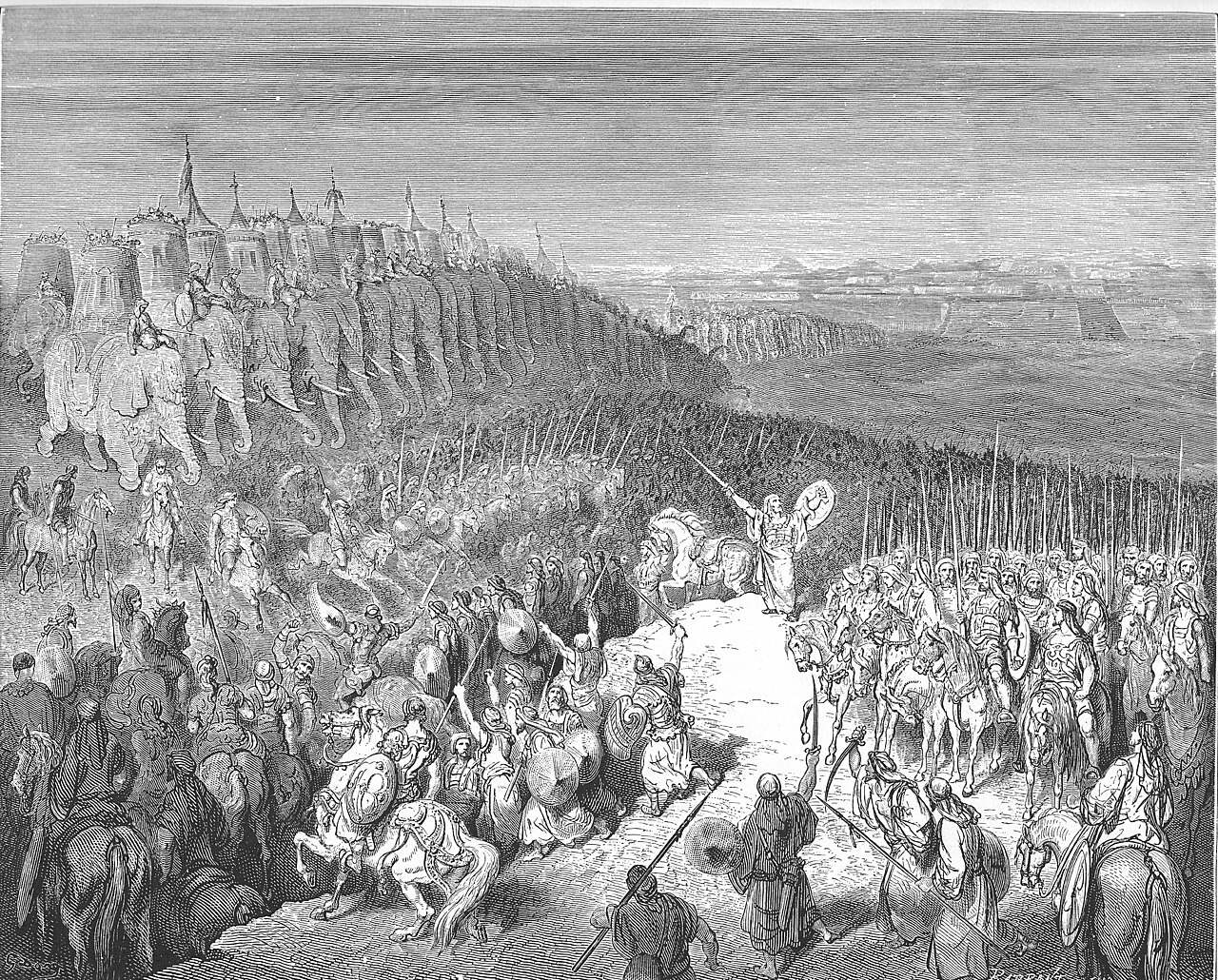
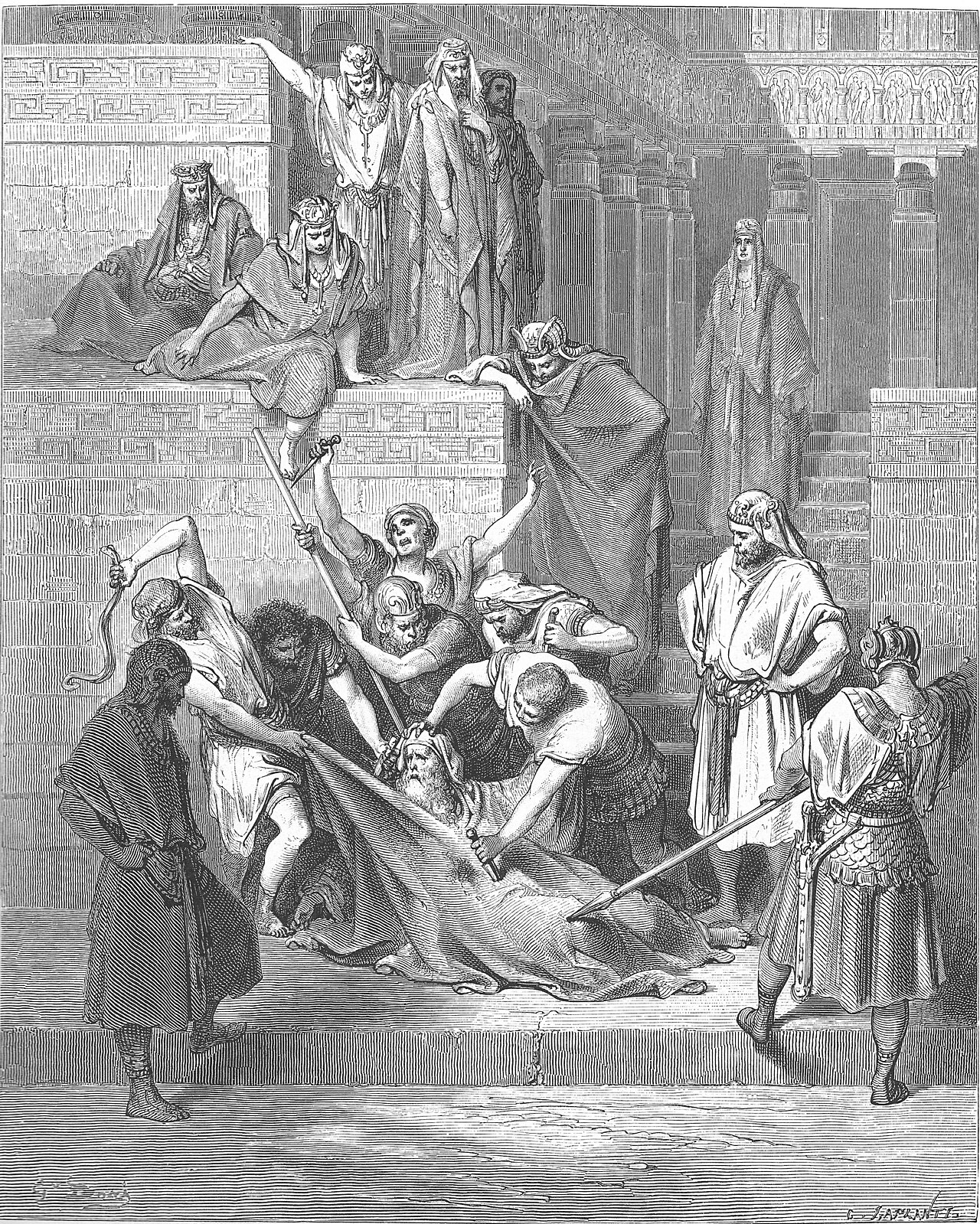
Gustave Doré, La Sainte Bible (1866), public domain.
The Crisis That Made a Revolt
Antiochus IV Epiphanes, 175–164 BCE: the era's hinge
Antiochus III had ruled Judea lightly. His son Antiochus IV, after a failed Egyptian campaign, did not. He plundered the temple treasury, outlawed Sabbath-keeping, circumcision, and Torah reading, and in 167 BCE erected an altar to Olympian Zeus over the altar of burnt offering — the “abomination of desolation” Daniel had named centuries in advance:
“And forces shall stand on his part, and they shall profane the sanctuary, even the fortress, and shall take away the continual burnt-offering, and they shall set up the abomination that maketh desolate.” Daniel 11:31
A priest named Mattathias, at Modein, refused to sacrifice and killed both a compliant Jew and the royal official overseeing it. His five sons carried the revolt from there; Judas “Maccabeus” (“the Hammer”) led its military phase, and on 25 Kislev 164 BCE the temple was recaptured and rededicated — the origin of Hanukkah, the feast Jesus himself is found keeping:
“And it was the feast of the dedication at Jerusalem…” John 10:22
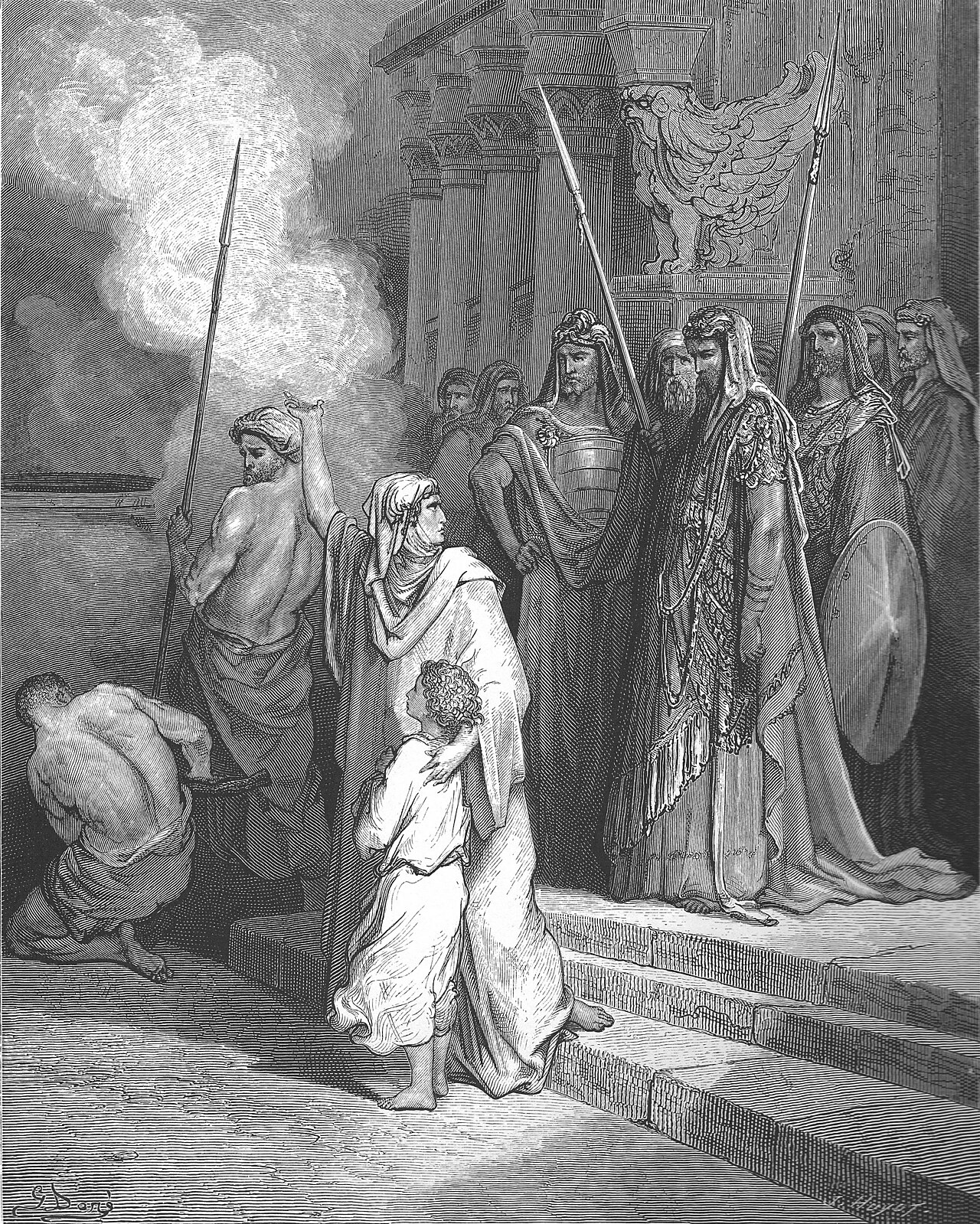
The persecution’s human cost is preserved in 2 Maccabees 7, the mother and her seven sons who chose death over unclean sacrifice — a narrative the author of Hebrews appears to allude to directly:
“Women received their dead by a resurrection: and others were tortured, not accepting their deliverance; that they might obtain a better resurrection.” Hebrews 11:35
Daniel 11’s run of Ptolemaic-Seleucid conflicts is often cited in the apologetic literature as prophecy written before the fact, matched against events historians can independently date — Chuck Missler’s survey teaching treats this chapter as one of Scripture’s clearest test cases for predictive prophecy (cited; see Daniel for the fuller treatment and the critical counter-reading).
The Crisis, Beat by Beat
a warning, a desecration, a revolt, a rededication, and a tyrant's end, in brief
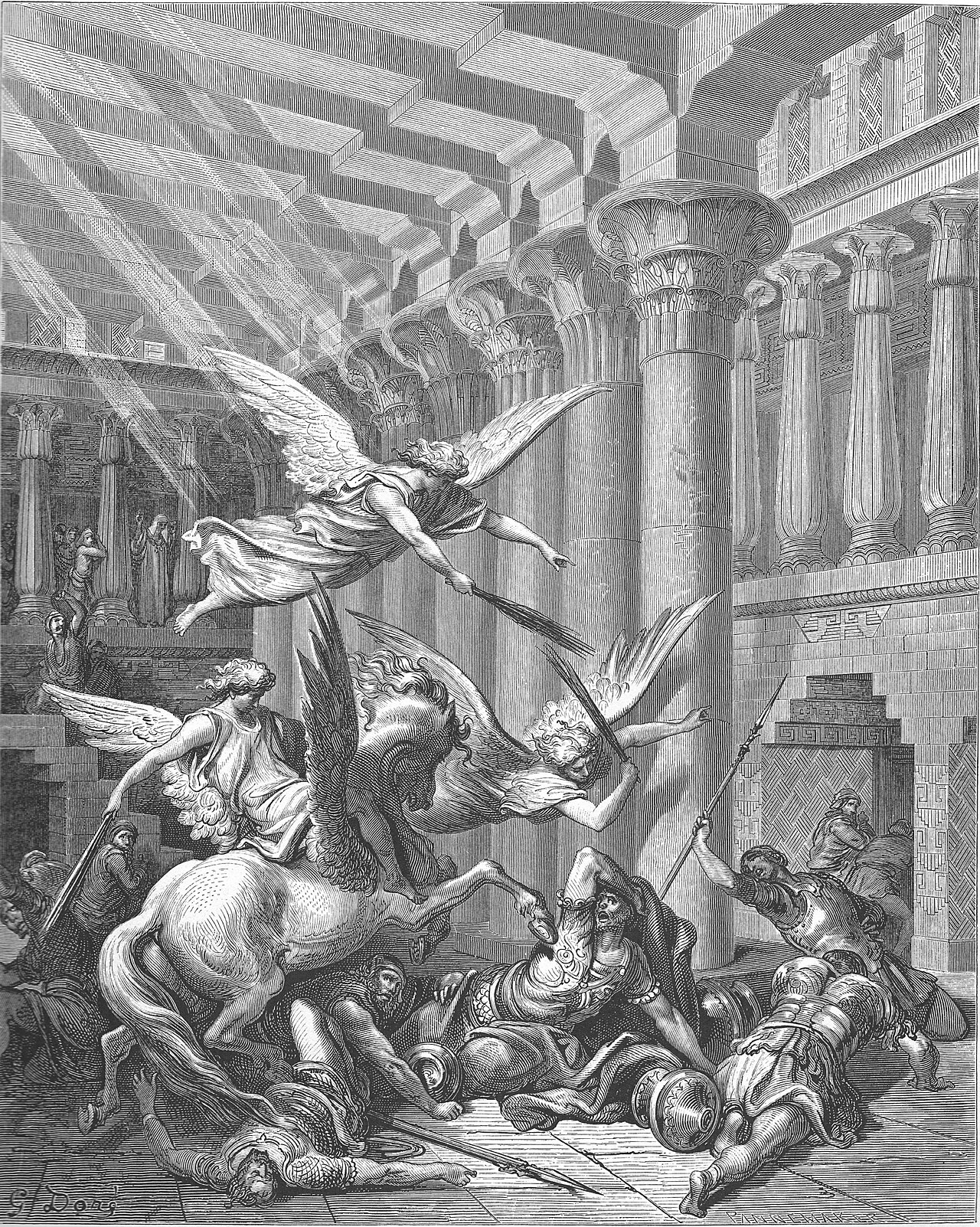
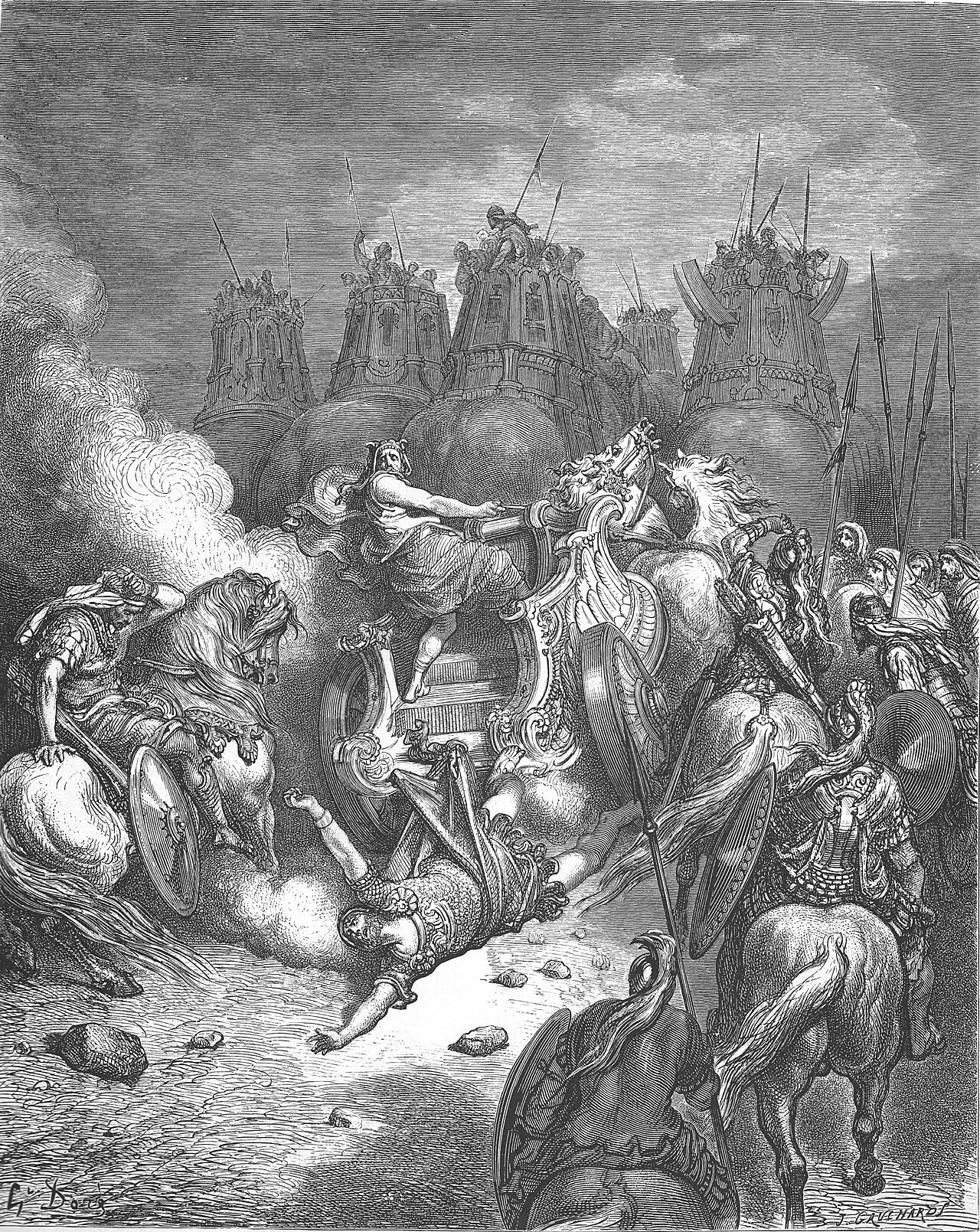
- c. 178 BCE, the warning.A Seleucid official named Heliodorus is sent to seize the temple treasury and, the account says, is struck down before he can take it — read by the text itself as a sign the temple still stood under divine protection, before it did not.
- 167 BCE, the desecration.Antiochus IV outlaws Sabbath-keeping, circumcision, and Torah reading, and sets up the “abomination of desolation” on the altar itself.
- 167 BCE, the refusal. Mattathias, at Modein, will not sacrifice, and his five sons carry the fight from there.
- 166–164 BCE, the campaign.Judas “the Hammer” wins a string of battles against Seleucid generals sent to put the revolt down.
- 25 Kislev, 164 BCE, the rededication. The temple is cleansed and the altar rebuilt — the origin of Hanukkah, the feast Jesus himself is found keeping at John 10:22, above.
- 164 BCE, the tyrant’s end. Antiochus IV dies on campaign in the east, in an illness both Maccabean accounts read as judgment (2 Macc 9; 1 Macc 6) — the persecution he started outlives him by decades, but he does not see it won.
- 164–63 BCE, the dynasty.Judas’s brothers Jonathan and Simon convert military success into a sovereign priest-kingdom — the Hasmonean state that lasts until Pompey ends it.
The World Malachi Never Saw
six things changed while the canon was quiet, and the Gospels open assuming all six
One People, No Altar
the synagogue rises
Emerges as a local institution during the Persian period, once Jews were scattered beyond a single temple’s reach. By the New Testament it is the default meeting place in every town — Jesus teaches in synagogues (Luke 4:16), and Paul opens his mission strategy in them (Acts 13:14; 17:1–2). Malachi never saw one; the Gospels never leave one.
The Bible the Apostles Quote
the Septuagint
Commissioned under Ptolemy II Philadelphus (the Letter of Aristeas tradition), the Greek translation of the Torah — later extended to the whole Hebrew Bible — made the Scriptures readable across the Greek-speaking Diaspora and became the Bible most New Testament writers quote from when they cite the Old Testament.
The Language on the Street
Aramaic replaces Hebrew
By the New Testament, Hebrew is the language of the synagogue reading, not the home — ordinary speech has shifted to Aramaic, the Persian Empire’s old administrative tongue. The Gospels preserve Jesus’s own words in it and then translate them: Talitha cumi (Mark 5:41), Eloi, Eloi, lama sabachthani (Mark 15:34), Abba (Mark 14:36). See How Greek Works for the trilingual world — Aramaic at home, Hebrew at synagogue, Greek in the street market — this era leaves behind.
Four Answers to Rome
the parties form
Pharisees, Sadducees, Essenes, and eventually Zealots form as parties under the Hasmoneans and after — alongside the scribes who copy and teach the text, and the Sanhedrin that governs what religious authority remains. All are still live in the Gospels’ pages. See the Sects of Second Temple Judaism for what each one believed and where each one collided with Jesus.
A Synagogue in Every City
the diaspora spreads
The Babylonian exile never fully reversed — by the New Testament, Jewish communities are established across Egypt, Asia Minor, Greece, and Rome itself, each one gathered around its own synagogue. That is why Acts 2:9–11 can name a dozen nations in one Jerusalem crowd, and why Paul’s missionary strategy is the same in city after city — walk into the synagogue first (Acts 13:14; 17:1–2).
A World Holding Its Breath
messianic expectation catches fire
Foreign occupation, a compromised priesthood, and Daniel’s own dated prophecy (see the Seventy Weeks) combine into a hope Josephus says fed more than one failed uprising (Gamaliel names two, Theudas and Judas of Galilee, at Acts 5:36–37). Luke shows the mood directly — Simeon in the temple, looking for the consolation of Israel(Luke 2:25), and Anna the prophetess beside him speaking of the child to everyone hoping for Jerusalem’s redemption (Luke 2:38) — and later a whole crowd wondering aloud whether John himself might be the Christ (Luke 3:15). This is the world the Baptist is born into.
Words the Silence Leaves Behind
three terms the Gospels use without ever explaining them
The Apocrypha: a Bridge, Never a Canon
the era's own literature, and where the traditions differ on its status
The silence left canonical Hebrew prophecy behind, but it did not leave Jewish religious writing behind. 1 and 2 Maccabees narrate the revolt itself; Sirach, Wisdom, Tobit, Judith, and the rest were composed or reached their final form across these same centuries. The traditions disagree sharply on what to do with them.
Roman Catholic
The Council of Trent (1546) defined seven of these books — Tobit, Judith, Wisdom, Sirach, Baruch, and 1–2 Maccabees, plus Greek additions to Esther and Daniel — as fully canonical “deuterocanonical” Scripture. The strongest case: they stood in the Septuagint the early Greek-speaking church read and cited.
Eastern Orthodox
Accepts the Catholic list and adds 1 Esdras, the Prayer of Manasseh, Psalm 151, and 3 Maccabees as “anagignoskomena” — worthy to be read, though held with a lower status than the Hebrew canon proper.
Ethiopian Orthodox Tewahedo
The broadest reception of all: an 81-book canon that alone receives 1 Enoch and Jubilees as Scripture — the only body in the world that does. See 1 Enoch for what it is and why Jude quotes it without treating it as canon.
MannaFest’s posture
Following the Reformation 66-book canon: excluded from Scripture, retained as a labeled study resource. Grounds include their absence from the Hebrew canon Jesus himself received (Luke 24:44), Josephus counting 22 books (Against Apion 1.8), and their absence from any New Testament citation formula.
“And he said unto them, These are my words which I spake unto you, while I was yet with you, that all things must needs be fulfilled, which are written in the law of Moses, and the prophets, and the psalms, concerning me.” Luke 24:44
The threefold shape Jesus names here — Law, Prophets, and Psalms/Writings — is the tripartite Hebrew canon, not the Septuagint’s longer Greek table of contents. The strongest case for the Apocrypha’s value stands regardless of its canonical status: it is the only surviving bridge across these four centuries, without which much of the New Testament’s vocabulary of resurrection, angelology, and messianic expectation would be harder to trace. See the Apocrypha collection for the full roster, each work carrying its own canonical-status banner.
The One Book the New Testament Quotes by Name
Every other Old Testament citation in the New Testament comes from the Hebrew canon. One passage breaks that pattern: Jude names his source outright, identifying Enoch as “the seventh from Adam,” and quotes him directly — see Jude 14–15 for the exact wording. The book he is quoting is 1 Enoch, and its own words survive in R. H. Charles’s 1917 translation, the source Jude’s quotation echoes:
“And behold! He cometh with ten thousands of His holy ones to execute judgement upon all, and to destroy all the ungodly.”1 Enoch 1:9, R. H. Charles translation (1917)
A second, quieter connection: when the Sadducees try to make resurrection sound absurd, Jesus answers that the resurrected neither marry nor are given in marriage, but live as the angels do (Matthew 22:29–30) — the same logic 1 Enoch 15:6–7 uses of the Watchers, that spirits are not given wives because marriage belongs to mortality. This page draws the line the founder has ruled on directly: Jesus is drawing on 1 Enoch’s reasoning, not calling it Scripture — “the sacred writings” here means the wider body of respected Jewish religious literature, and the 66-book canon stands untouched by the connection. The roster’s Watchers-stream voices work directly from this material — Timothy Alberino has edited an annotated modern edition of 1 Enoch’s Book of the Watchers, and George W. E. Nickelsburg’s 1 Enoch: A Commentary on the Book of 1 Enoch (Hermeneia, 2001) is the standard modern academic treatment (both cite-only). See 1 Enoch: the book Jude quotes for the full case, its Aramaic Qumran fragments, and its Ethiopian canonicity.
Four Hundred Years, and Not Silent
the traditional framing, and why it is both true and misleading
Protestant readers call the gap between Malachi (c. 430 BCE) and John the Baptist (c. 28 CE) the “400 silent years” — silent because no book the Reformation canon accepts as Scripture was written in them. Malachi closes the Hebrew prophetic office with a forerunner promised:
“Behold, I will send you Elijah the prophet before the coming of the great and awesome Day of the LORD.” Malachi 4:5
Four centuries later, Gabriel answers it in Malachi’s own vocabulary, naming a child not yet born:
“And he will go on before the Lord in the spirit and power of Elijah, to turn the hearts of the fathers to their children and the disobedient to the wisdom of the righteous, to make ready a people prepared for the Lord.” Luke 1:17
The label is misleading in at least three ways. First, the period was enormously productive of Jewish religious literature — the deuterocanonical and pseudepigraphal works, the Qumran library, Philo’s corpus — much of it considered inspired or near-inspired by significant communities at the time. Second, the theological vocabulary the New Testament assumes — messianic titles, angelology, the resurrection hope, synagogue liturgy — was forged in these same centuries; without them the New Testament is harder to read, not easier. Third, the awareness of the silence was itself contemporary: Simon Maccabeus was confirmed as high priest and ethnarch only “until a true prophet should appear” (1 Macc 14:41), a provisional title that shows the era knew exactly what it was waiting for.
Setting the Stage for the New Testament
every institution the Gospels open on, this era built
Pompey’s entry into Jerusalem in 63 BCE ends Jewish sovereignty and opens seven decades of client kings and Roman procurators. Herod the Great — an Idumean whose own ancestors had been forcibly converted to Judaism by the Hasmonean John Hyrcanus — rebuilds the temple on a vastly expanded platform, the very temple Jesus teaches in and predicts the fall of. His death in 4 BCE, division of his kingdom among his sons, and Judea’s conversion to direct Roman rule in 6 CE together supply the political furniture — procurators, tetrarchs, a Sanhedrin with limited authority — that the Gospels and Acts move through without ever having to explain. The Pharisees and Sadducees who argue with Jesus, the synagogues Paul preaches in first in every city, and the Greek Bible the apostles quote from are none of them New Testament inventions — they are this era’s legacy, inherited whole.
The Fullness of Time
Galatians 4:4, four centuries were not delay, they were preparation
“But when the fulness of the time came, God sent forth his Son, born of a woman, born under the law, that he might redeem them that were under the law, that we might receive the adoption of sons.” Galatians 4:4–5
Paul does not say God sent His Son eventually, or finally — he says the time was full, the way a cup fills before it pours. Everything this page has traced is the filling. Rome’s roads and Rome’s peace let a message travel from Jerusalem to the empire’s edge inside one generation. Greek — Alexander’s legacy, carried by the Septuagint’s translators — gave that message a single tongue almost anyone from Spain to Persia could read. The synagogue network the diaspora built gave it a doorway into nearly every city Paul ever entered, first stop, every time. And four centuries of occupation, disappointment, and Daniel’s own dated prophecy left a nation — and not only a nation — waiting for exactly this. None of it was wasted, and none of it was silence. It was the stage, and Malachi’s forerunner, and then the Child, arrived on it at the appointed hour.
Read the Great Books
the primary witnesses to this era, in the writers' own hands, go further than this page

Two public-domain primary sources carry almost everything historians know about this era’s politics and its literature. Two roster voices, cited here without their words quoted, carry the era’s meaning further than this page has room for.
Antiquities of the Jews
Flavius Josephus · c. AD 93–94
Books 12–13 narrate the Ptolemies, the Seleucids, Antiochus IV, and the Maccabean revolt from a Jewish historian writing a century after the fact, in Whiston’s classic English translation.
READ IT FREE AT WIKISOURCE →The Book of Enoch
tr. R. H. Charles · 1917
The book Jude quotes by name, in the standard public-domain English translation this site’s own quotation above is drawn from — the fullest ancient witness to this era’s angelology.
READ IT FREE AT WIKISOURCE →The Book of Daniel
Chuck Missler · verse-by-verse commentary
Marcus Brown’s formative teacher’s expository treatment of Daniel 11’s Ptolemaic-Seleucid detail as a test case for predictive prophecy — cited above, named here.
In print — find it wherever books are sold.
Introducing the Apocrypha
David A. deSilva · Baker Academic, 2002
The standard modern academic introduction to this era’s own literature — message, context, and significance, book by book.
In print — find it wherever books are sold.
Keep studying
On this page
Studies7
People1