

Jan Brueghel the Elder, Wooded Landscape with Abraham and Isaac, 1599. Public domain.
Genesis 22 · Place · Featured Study
Mount Moriah
On the third day of his walk, Abraham saw far off the place God had chosen for the offering.
Abraham carried the fire and the knife up the mountain and came down with his son.
“Take your son,” God said, “your only son Isaac, whom you love, and go to the land of Moriah. Offer him there as a burnt offering on one of the mountains, which I will show you.”
- Today
- the Temple Mount in Jerusalem, by the traditional reading
- Region
- the hill country of Judah
- Site
- 31.778, 35.235 (proposed)
- First named
- Genesis 22:2 “…offering on one of the mountains, which I…”
- Last named
- 2 Chronicles 3:1 “…the LORD in Jerusalem on Mount Moriah, where…”
Abraham carried the fire and the knife up the mountain and came down with his son.
Summary
The Chronicler gives the name Moriah to the hill where Solomon built the temple.
- The site has been read as the temple hill in Jerusalem and as Mount Gerizim near Shechem.
- David's altar on a Jebusite threshing floor became the ground of the temple.
- Hebrews reads the offering as Abraham's faith that God could raise the dead.
The Land of Moriah
Abraham named the place after what God did there.
Abraham was living at Beersheba in the chapters around the test, and he went back there afterward with his servants.
“Take your son,” God said, “your only son Isaac, whom you love, and go to the land of Moriah. Offer him there as a burnt offering on one of the mountains, which I will show you.”The command leaves the mountain to be shown, which is why its site has been debated.
And Abraham called that place The LORD Will Provide. So to this day it is said, “On the mountain of the LORD it will be provided.”The saying ties the place to a mountain of the LORD long before Solomon built there.
Abraham was living at Beersheba in the chapters around the test, and he went back there afterward with his servants.
And Abraham called that place The LORD Will Provide. So to this day it is said, “On the mountain of the LORD it will be provided.”The saying ties the place to a mountain of the LORD long before Solomon built there.
From Beersheba to Moriah on the Map
The Rand McNally plate of 1926 shows the hill country from the Negev to Samaria.
The temple hill lies about 70 kilometres north and east of Beersheba in a straight line.
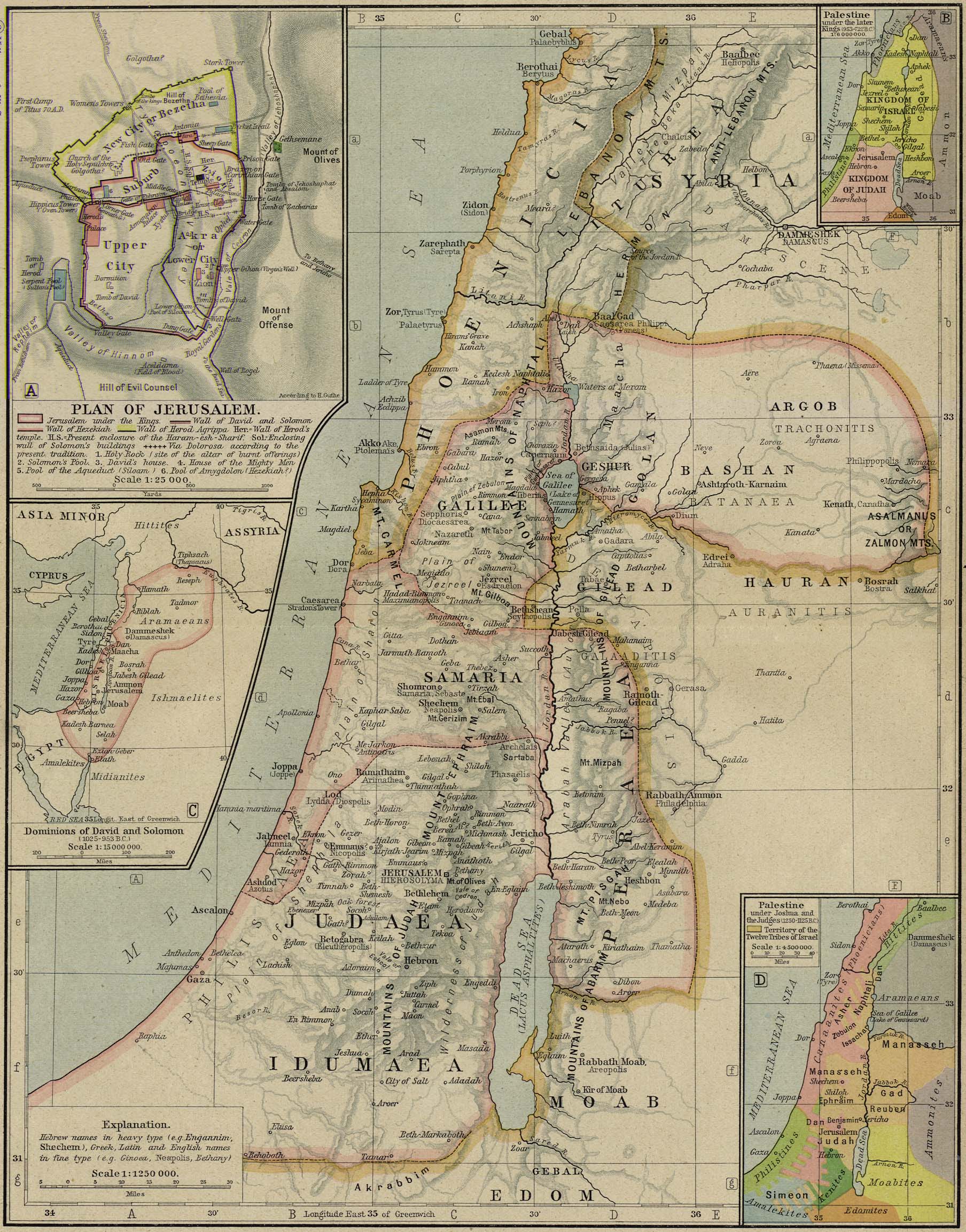
- Located: the site is known
- Proposed: a mountain put forward for the place of Genesis 22
- The route, in the order the text gives
- 1Beersheba, Abraham's home in the Negev Genesis 22:19
- 2?The temple hill, The Chronicler's Mount Moriah, OpenBible score 325 2 Chronicles 3:1
- 3?Mount Gerizim, The mountain of the Samaritan reading John 4:20
Base map: Reference map of ancient Palestine, Rand McNally reference map (1926), public domain. Places with a place page stand at its coordinates and the others at the point cited for each, set on the plate by Jerusalem and Damascus, as the plate prints them.
Three places; the line joins Beersheba to the temple hill, the traditional reading of the place, and the dotted ring carries OpenBible's score for Moriah out of 1,000.
Moriah Through Time
The hill tradition calls Moriah held an altar, two temples and later the Dome of the Rock.
The hill has been a place of worship for about three thousand years.
- The days of AbrahamThe offering of IsaacGenesis 22:1 to 2
- The reign of DavidThe plague of the census ends at an altar on the hill2 Samuel 24:25
- The reign of SolomonSolomon's temple is begun
- 586 BCBabylon burns the first temple2 Kings 25:9
- The reign of Herod the GreatHerod builds supporting walls that enlarge the temple platform
- AD 70Rome destroys the second temple
- After AD 638Under early Islamic rule the Dome of the Rock is built on the platform
Seven events in order; the rows from Scripture carry their references.
The Threshing Floor of Araunah
The prophet Gad sent David to a Jebusite's threshing floor while a plague struck Israel.
The plague came after David's census of the fighting men.
“No,” replied the king, “I insist on paying a price, for I will not offer to the LORD my God burnt offerings that cost me nothing.” So David bought the threshing floor and the oxen for fifty shekels of silver. And there he built an altar to the LORD and offered burnt offerings and peace offerings. Then the LORD answered the prayers on behalf of the land, and the plague upon Israel was halted.The purchase is the reason the temple hill belonged to Israel's king.
Then Solomon began to build the house of the LORD in Jerusalem on Mount Moriah, where the LORD had appeared to his father David. This was the place that David had prepared on the threshing floor of Ornan the Jebusite.This verse alone joins the name Moriah to the threshing floor and the temple.
The Name in the Old Translations
The old versions read the name of Genesis 22:2 in at least four ways.
In 2 Chronicles 3:1 every ancient translation keeps the word as a name.
The Greek of the SeptuagintGenesis 22:2 and 2 Chronicles 3:1
The Septuagint renders the place in Genesis as the high land and the hill in Chronicles as the mount of Amoria.
The land of visionThe Samaritan Pentateuch, Symmachus and Jerome's Vulgate
The Samaritan Pentateuch spells the name as the land of vision, from the root meaning to see. Symmachus's Greek gives the land of appearance, and Jerome's Latin gives in terram Visionis.
The land of worshipTargum Pseudo-Jonathan
The Aramaic Targum Pseudo-Jonathan takes the name to mean the land of worship.
Where It Points
Abraham's answer on the way up, and three New Testament passages that look back to Abraham and the lamb.
Abraham answered, “God Himself will provide the lamb for the burnt offering, my son.” And the two walked on together.The answer anticipates the name Abraham gave the place in verse 14.
By faith Abraham, when he was tested, offered up Isaac on the altar. He who had received the promises was ready to offer his one and only son, even though God had said to him, “Through Isaac your offspring will be reckoned.” Abraham reasoned that God could raise the dead, and in a sense, he did receive Isaac back from death.This is the New Testament's fullest comment on what Abraham believed on the mountain.
Your father Abraham rejoiced that he would see My day. He saw it and was glad.”Jesus sets Himself as the day Abraham hoped for.
The next day John saw Jesus coming toward him and said, “Look, the Lamb of God, who takes away the sin of the world!The lamb Abraham said God would provide is the title John gives to Jesus.
John 8:56, John 1:29
The Voices
Three teachers on the faith of Abraham and the altar on the threshing floor, from Athanasius to Matthew Henry.
296 to 373 · Athanasius of Alexandria
FESTAL LETTERS 6.8
Abraham worshipped the Son of God
The quotation1 quotation
“Here is a man of true faith, for when the Lord asked him to sacrifice Isaac, his only son, he was willing to do so. By faith he offered up the one through whom the Lord had given him the promise of a nation of descendants. And in offering his son he worshiped the Son of God.”
Athanasius of Alexandria · Festal Letters 6.8 · on Hebrews 11:17Patristic
died 542 · Caesarius of Arles
SERMON 122.1
The altar was set on Gentile ground
The quotation1 quotation
“Notice, brothers, that no place in the land of the Jews was found worthy for the altar of the Lord to be built; but in the land of the Gentiles a place is chosen where the angel is seen and the altar of the Lord …”
Caesarius of Arles · SERMON 122.1 · on 2 Samuel 24:18 to 21Patristic
1662 to 1714 · Matthew Henry
Commentary on the Whole Bible
Peace is made by sacrifice
The quotation1 quotation
“God's encouraging us to offer to him spiritual sacrifices is a comfortable evidence of his reconciling us to himself. That peace is made between God and sinners by sacrifice, and not otherwise, even by Christ the great propitiation, of whom all the legal sacrifices were types. It is for his sake that the destroying angel is told to stay his hand.”
Matthew Henry · Commentary on the Whole Bible · on 2 Samuel 24:18Puritan
Where Was the Mountain?
Two readings of the mountain God showed Abraham, each with its holders.
The temple hill in JerusalemFlavius Josephus
The objection: Genesis 14:18 gives Abraham's day a king of Salem, and if Salem is Jerusalem a city already stood on that ridge.
Mount Gerizim, near ShechemThe Samaritans, in their Pentateuch
The Samaritans hold that the offering took place on Mount Gerizim, the mountain their fathers worshipped on in John 4:20.
The objection: Gerizim lies about 115 kilometres from Beersheba, much farther than the temple hill at about 70.
Books to Read Next
One of these three works can be read free online.
Antiquities of the Jews, Book 1, chapter 13
Flavius Josephus, translated by William Whiston · the first century AD
Josephus retells the offering and gives Isaac's age as twenty-five.
Read at Project GutenbergThe Book of Genesis, Cambridge Bible for Schools and Colleges
Herbert Edward Ryle · 1921
Ryle comments on Genesis 22 verse by verse in this school commentary.
Moriah, in The Jewish Encyclopedia
Joseph Jacobs and M. Seligsohn · 1901 to 1906
The article sets out the rabbinic explanations of the name.
The LORD Will Provide
On Moriah a father was spared his son because God provided a ram in his place.
The reader is called to trust the God who, as Romans 8:32 says, did not spare His own Son but gave Him up for us all.
Sources
Scripture is the Berean Standard Bible.
- Strong's Hebrew dictionary, h4179 and h3070.
- OpenBible.info, Bible Geocoding Data, ancient.jsonl, CC BY.
- Flavius Josephus, Antiquities of the Jews 1.13.1 to 2, translated by William Whiston, public domain.
- H. E. Ryle, The Book of Genesis, Cambridge Bible for Schools and Colleges (1921), on Genesis 22.
- Joseph Jacobs and M. Seligsohn, Moriah, The Jewish Encyclopedia (1901 to 1906)
- Athanasius of Alexandria, Festal Letters 6.8, on Hebrews 11:17.
- Caesarius of Arles, Sermon 122.1, on 2 Samuel 24:18 to 21.
- Matthew Henry, Commentary on the Whole Bible, 1710, on 2 Samuel 24:18.
- Rand McNally atlas reference map, 1926, public domain.
Keep Studying
Read it4
Places7
Symbols1