
MANNAFEST

The Prayer Book of Israel · Psalms

An Anatomy of the Soul

The Psalms are the one book of the Bible written to God rather than only about Him — where the whole range of the human heart, from the pit of lament to unbroken praise, is taught to speak. Its deep design carries the reader from the collapse of the Davidic throne to the bedrock confession that the LORD reigns, and every road runs, at last, to the King on Zion who is Christ.

Title
Tehillim — 'Praises'
Authors
David, Asaph, Korah, Moses, Solomon…
Span
Moses (Ps 90) → post-exile
Shape
150 psalms · 5 books · 8 acrostics
"All things must be fulfilled, which were written… in the psalms, concerning me."— Jesus, Luke 24:44 (ASV)

The Five Books — the shape is the argument

The Psalter is deliberately arranged (Gerald Wilson, The Editing of the Hebrew Psalter, 1985): royal psalms stand at the seams, and Book III ends on the catastrophe of the broken Davidic covenant — to which Book IV is the answer. When the human throne fails, God is still King.

The great turn

Book III closes with the throne in ruins — "Lord, where are thy former lovingkindnesses…?" (89:49). Book IV answers not with a new king but with the King: it opens with Moses (Ps 90, older than the monarchy) and proclaims "The LORD reigneth" (93; 95–99).

Christ in the Psalms

the royal psalms find their horizon in the Son of David

The Messianic Psalms — the full study →

Themes

01

The kingship of YHWH — 'the LORD reigns' (the theological spine)

02

The two ways — the righteous and the wicked (Ps 1)

03

The LORD as refuge — rock, fortress, shield, wing, hiding-place

04

Ḥesed — the steadfast covenant love that 'endureth for ever'

05

Zion & the Temple — the dwelling of God, the pilgrim's longing

06

Creation & the Creator's glory (Ps 8, 19, 104, 148)

07

The word of God — the delight of Ps 1, 19, and all 176 verses of Ps 119

08

Lament & the depths — anguish brought honestly to God (the Psalter's pastoral genius)

09

Praise as the goal — the book that ends in five pure Hallelujahs

10

The Shepherd — Ps 23; 80; 100 (→ 'I am the good shepherd,' John 10)

The Genres of the Heart

every mode of prayer has its form
Hymn / praise8, 19, 29, 100, 103, 145–150
Individual lament3, 6, 13, 22, 42–43, 51, 88, 130
Communal lament44, 74, 79, 80, 83, 137
Thanksgiving (todah)30, 32, 34, 40, 116, 118, 138
Royal2, 18, 20, 45, 72, 89, 110, 132
Enthronement (YHWH malak)47, 93, 95–99
Wisdom / Torah1, 19, 37, 49, 73, 119, 127
Songs of Zion46, 48, 76, 84, 87, 122
Penitential6, 32, 38, 51, 102, 130, 143
Imprecatory35, 58, 69, 83, 109, 137
Songs of Ascents120–134 (the pilgrim collection)
Hallel113–118 · 136 · 146–150

How Hebrew Poetry Works

the second line always adds

Hebrew poetry rhymes thoughts, not sounds. Its engine is parallelism — a first line answered by a second that echoes, sharpens, or completes it. The old rule "the second line just repeats" is wrong: B always adds.

"The heavens declare the glory of God;

and the firmament sheweth his handywork." (Ps 19:1)

— the second line moves from the heavens to what fills them, from declaring to showing the work of His hands.

The Acrostics

poems built on the alphabet — order as worship

Eight psalms run through the 22 letters of the Hebrew alphabet in order — Psalm 119 gives eight verses to every letter (22 × 8 = 176). Psalm 145 is missing its nun verse in the Hebrew — restored from the Dead Sea Scrolls and the Greek: a text-critical case you can see.

The Singers

a thousand years of one people's prayers

Places

Original Language

the keynote Hebrew words

Contested Points

every view at full strength, flag primary

Davidic authorship & the superscriptions

MannaFest flag: Received as reliable & part of the inspired text; the NT's own attribution (Ps 110, 16, 2) is decisive

The imprecatory psalms (Ps 137:9; 69; 109)

MannaFest flag: Named honestly (Lewis's discomfort) beside justice-deferred-to-God & the Christ-prayed reading (Bonhoeffer) — never license for human vengeance

Psalm 22:16 — 'pierced' vs. 'like a lion'

MannaFest flag: Both witnesses shown: MT 'like a lion' vs. LXX + Dead Sea Scroll 'they pierced' — a visible text-criticism case

Read the Psalms

the featured studies

Open the Psalms reader →

Keep studying

— more from Poetry & Wisdom

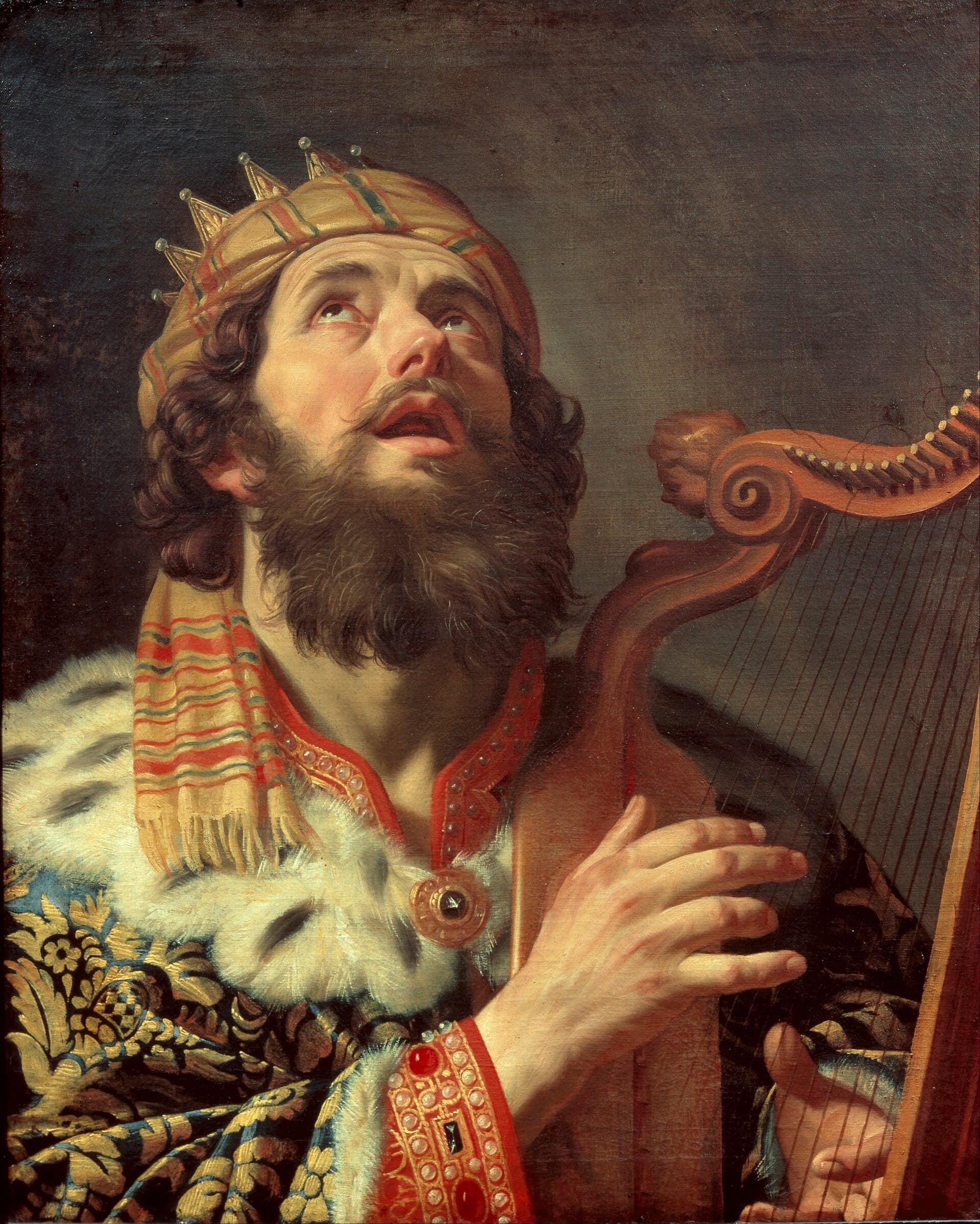
Artwork: Gerard van Honthorst, King David Playing the Harp (1622) — public domain. Analysis drafted from the MannaFest canon study of Psalms (public-domain commentators — Spurgeon's Treasury of David, Calvin, Delitzsch — and the founder's approved-voices roster); Scripture ASV.