
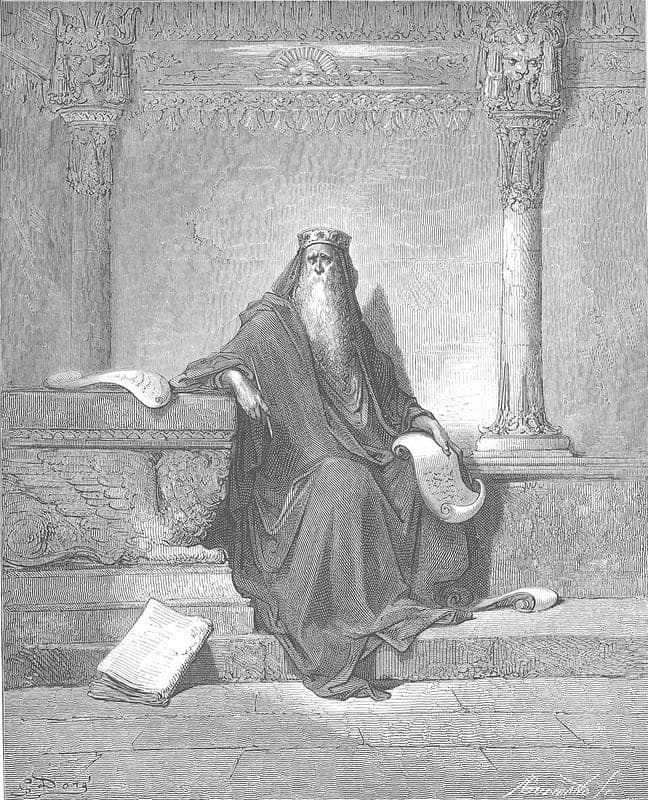
King Solomon in Old Age, Gustave Doré, 1866. Public domain.
Old Testament · Book 21 of 66
Ecclesiastes
Ecclesiastes records the Teacher's search for meaning in work, pleasure, wisdom and wealth under the sun. He finds them all fleeting, and the book ends by calling the reader to fear God and keep his commandments.
Ecclesiastes records the Teacher's search for meaning in work, pleasure, wisdom and wealth under the sun. He finds them all fleeting, and the book ends by calling the reader to fear God and keep his commandments.
What is Ecclesiastes about?
Ecclesiastes is the report of the Teacher, a son of David and king in Jerusalem, who used his wisdom to search out everything done under the sun. He tests pleasure, great works, wealth and wisdom, and finds each one futile, because the same death comes to the wise man and the fool. He watches the times God appoints, the tears of the oppressed and the riches that never satisfy. His counsel returns often: eat, drink and enjoy the work God gives. The book ends by calling the young to remember their Creator, and a closing voice gives its conclusion: “Fear God and keep His commandments” (12:13).
All 12 chapters
Every chapter of the book, in one grid. Each cell opens that chapter.
- The questionEcclesiastes 1 to 2
- The timesEcclesiastes 3 to 6
- The wise and the foolEcclesiastes 7 to 10
- Remember your CreatorEcclesiastes 11 to 12
The colour is the movement of the book the chapter stands in, and every cell opens that chapter's Study level.
Who wrote it, where, when, for whom, and why?
The book names its speaker only by a title, the Teacher, and calls him the son of David, king in Jerusalem (1:1). He says he was king over Israel in Jerusalem (1:12) and grew in wisdom beyond all who were over Jerusalem before him (1:16). The closing verses speak of him in the third person: he taught the people, weighed and arranged many proverbs, and wrote words of truth (12:9 and 10). Kings says that Solomon composed three thousand proverbs (1 Kings 4:32), and no other book of Scripture names Ecclesiastes.
These are the words of the Teacher, the son of David, king in Jerusalem:
Ecclesiastes 1:1, Berean Standard Bible.
The Teacher reigns in Jerusalem (1:12). There he built houses, planted vineyards and made gardens, parks and reservoirs (2:4 to 6). He speaks of the house of God where vows are paid (5:1 and 4), the city where the wicked are praised at their burial (8:10) and a small city saved by a poor wise man (9:14 and 15).
The book gives no year. Its speaker is a son of David who reigned over Israel from Jerusalem (1:1 and 12), with more herds, silver and gold than anyone in Jerusalem before him (2:7 to 9). When the words were written down is argued under the Hard Questions.
The Teacher taught the people knowledge (12:9). He speaks to a young man in the days of his youth (11:9 and 12:1), warns a reader he calls my son (12:12), and counsels a worshipper who goes to the house of God with vows and sacrifices (5:1 to 7).
The book says why at its end. The Teacher sought delightful sayings and accurate words of truth (12:10), words that goad like the words of the wise (12:11), and the conclusion of the matter is to fear God and keep his commandments, because God will bring every deed into judgment (12:13 and 14).
When all has been heard, the conclusion of the matter is this: Fear God and keep His commandments, because this is the whole duty of man.
Ecclesiastes 12:13, Berean Standard Bible.
The book looks at the world every reader knows: the sun, the wind and the rivers that go round and return (1:5 to 7), courts where wickedness sits in the place of justice (3:16), officials watched by higher officials (5:8), a king whose word none can question (8:4), and Sheol, where there is no work or planning (9:10).
Sources. Ecclesiastes 1:1, 1:5 to 7, 1:12, 1:16, 2:4 to 9, 3:16, 5:1 to 8, 8:4, 8:10, 9:10, 9:14 and 15, 11:9, 12:1, 12:9 to 14; 1 Kings 4:32. Every verse is read in the Berean Standard Bible.
How is Ecclesiastes arranged, and what is it for?
The four movements the book falls into, then what it teaches and what it was written to do.
- The questionEcclesiastes 1 to 2, 44 verses
The motto, the round of nature, and the king's test of wisdom, pleasure and work.
The turn: The motto the book opens with and closes on at 12:8.
- The timesEcclesiastes 3 to 6, 70 verses
A time for everything, the oppressed, the house of God, and riches that do not satisfy.
The turn: God's order of times, and eternity set in a heart that cannot fathom his work.
- The wise and the foolEcclesiastes 7 to 10, 84 verses
Sayings that weigh one thing against another, the king, one fate for all, and the fool.
The turn: The first of the sayings that weigh one thing as better than another.
- Remember your CreatorEcclesiastes 11 to 12, 24 verses
Counsel for the young, the house that fails in old age, and the end of the matter.
The turn: The conclusion the closing voice gives to the whole book.
The theme
The Teacher looks at everything done under the sun and calls it futile: breath that cannot be held, work that passes to another, wisdom that dies with the fool. Yet the same book calls food, drink and work the gift of God, says that God has made everything beautiful in its time, and names the fear of God as the whole duty of man. The book holds the two together, a world that cannot satisfy and a God who gives and judges.
The purpose
Ecclesiastes was written so that a reader would see the limits of life under the sun before spending a life to learn them. It turns the reader from grasping at gain to receiving each day as a gift, and from the search itself to the fear of God, because God will bring every deed into judgment. It stands in the canon beside Proverbs and Job as the wisdom that has looked at death.
The book's count of its own words
| Chapter | Futility and under the sun | Enjoy |
|---|---|---|
| 1 | 6 futility 3 under the sun | |
| 2 | 8 futility 6 under the sun | 2:24 |
| 3 | 1 futility 1 under the sun | 3:12, 3:22 |
| 4 | 4 futility 4 under the sun | |
| 5 | 2 futility 2 under the sun | 5:18 |
| 6 | 4 futility 2 under the sun | |
| 7 | 2 futility 0 under the sun | |
| 8 | 3 futility 4 under the sun | 8:15 |
| 9 | 0 futility 6 under the sun | 9:7 |
| 10 | 0 futility 1 under the sun | |
| 11 | 1 futility 0 under the sun | |
| 12 | 3 futility 0 under the sun |
How to read it
- The first bar in each row counts futile, futility and futilities in that chapter.
- The second bar counts the phrase under the sun.
- 2:24The last column names the verses where the Teacher says to eat, drink and enjoy the gift of God.
- The mark beside each chapter number is the colour of its movement on the chapter grid.
- futility
- 34
- under the sun
- 29
- enjoy stations
- 6
The question, Ecclesiastes 1 to 2
What the text says in these 2 chapters, and the pages they open on.
The Teacher opens with his motto, futility of futilities, and asks what a man gains from all his labor under the sun (1:2 and 3). The sun, the wind and the rivers go round and return, and there is nothing new. As king in Jerusalem he sets out to search by wisdom, and learns that much wisdom brings much sorrow (1:18). He tests pleasure, then great works: houses, vineyards, gardens, servants, silver and gold. When he weighs it all, nothing has been gained (2:11). The wise man dies like the fool, and his work passes to a man who did not labor for it. The chapter ends on the book's first counsel: nothing is better than to eat, drink and enjoy one's work, and this is from the hand of God (2:24).
“Futility of futilities,” says the Teacher, “futility of futilities! Everything is futile!”
- Study
Ecclesiastes 1the motto, the round of nature, and wisdom's sorrowShow the summary and 4 pagesShow summary, 4 pagesHide the summary
The Teacher states his motto, that everything is futile, and asks what a man gains from his labor. The sun, the wind and the rivers go round and return, and nothing is new. As king in Jerusalem he searches by wisdom and finds that more wisdom brings more sorrow.
On this chapter (4)
- Vanity under the sun
The book's refrain, and what the word means.
- Did Solomon write Ecclesiastes, and who is the Teacher?
Answered under Where do readers disagree, lower on this page, with each reading and who holds it.
- What does the word the Berean text renders futility mean?
Answered under Where do readers disagree, lower on this page, with each reading and who holds it.
- Ecclesiastes 1:2
The verse on its own page, with the commentators on it by era.
- Vanity under the sun
- Study
Ecclesiastes 2pleasure, great works and wealth tested, and the first counselShow the summary and 3 pagesShow summary, 3 pagesHide the summary
The Teacher tests pleasure, wine, great works, servants, silver and gold, and finds nothing gained. Wisdom is better than folly, yet the wise man dies like the fool, and his labor passes to another. He ends on the first counsel of the book, to eat, drink and enjoy one's work as a gift from God.
On this chapter (3)
- Vanity under the sun
The book's refrain, and what the word means.
- Wisdom
The wisdom of Israel's books, and its limits.
- Ecclesiastes 2:24
The verse on its own page, with the commentators on it by era.
- Vanity under the sun
The round of chapter 1: everything returns
- 1The sun Ecclesiastes 1:5“The sun rises and the sun sets”
- 2The wind Ecclesiastes 1:6“round and round it swirls”
- 3The rivers Ecclesiastes 1:7“All the rivers flow into the sea, yet the sea is never full”
- The centre Ecclesiastes 1:9“there is nothing new under the sun”
Characters (4)
Who the text names. A name with a page carries its door.
- The Teacher
The speaker of the book, the son of David, king over Israel in Jerusalem (1:1, 1:12).
- Solomon
The son of David whose wisdom, building and wealth the Teacher's words recall (1 Kings 4:29 to 34).
- David
The father the first verse names (1:1).
- The heir
The man who comes after and takes all the Teacher's labor, wise or foolish (2:18 and 19).
Places (2)
Where the chapters stand.
- Jerusalem
Where the Teacher reigns and builds (1:12, 2:9).
- The gardens and parks
The vineyards, groves and reservoirs he made for himself (2:4 to 6).
Themes (3)
What these chapters raise, each on its own page where one stands.
- Vanity under the sun
The book's refrain, and what the word means.
- Wisdom
The wisdom of Israel's books, and its limits.
- Toil
Work that wearies and passes to another (2:18 to 23).
No New Testament passage quotes or names Ecclesiastes. The fold below holds the one parallel these chapters carry, marked for what it is, with the evidence and who holds it.
Where the New Testament uses these chapters (1)each marked as a quotation or an allusion, with the evidence
- Probable allusionFutility, Ecclesiastes 1:2 at Romans 8:20. Paul says the creation was subjected to futility in hope. His Greek word for futility is the word the Greek Old Testament uses for the refrain of Ecclesiastes 1:2. Held by Origen, On First Principles 1.7.5, and by Jamieson, Fausset and Brown on 1:2.
The times, Ecclesiastes 3 to 6
What the text says in these 4 chapters, and the pages they open on.
Chapter 3 sets fourteen pairs of times, from birth and death to war and peace, and says God has made everything beautiful in its time and set eternity in the human heart (3:11). What God does endures, and nothing can be added to it or taken from it (3:14). The Teacher sees wickedness in the place of justice, and man and beast going to one place (3:19 and 20). He sees the tears of the oppressed, labor driven by envy and a man alone who never rests, and he says two are better than one. Chapter 5 turns to the house of God: listen, keep your vows, let your words be few, and fear God. Money never satisfies the one who loves it, and chapter 6 ends with a man who has riches he cannot enjoy.
He has made everything beautiful in its time. He has also set eternity in the hearts of men, yet they cannot fathom the work that God has done from beginning to end.
- Study
Ecclesiastes 3a time for everything, and eternity in the heartShow the summary and 3 pagesShow summary, 3 pagesHide the summary
The Teacher sets fourteen pairs of times in order, from birth and death to war and peace. God has made everything beautiful in its time and set eternity in the human heart, and what God does endures. Man and beast go to one place, so a man should enjoy his work, for that is his lot.
On this chapter (3)
- The fear of the LORD
The beginning of wisdom, and the whole duty of man.
- Does 3:21 doubt the afterlife?
Answered under Where do readers disagree, lower on this page, with each reading and who holds it.
- Ecclesiastes 3:11
The verse on its own page, with the commentators on it by era.
- The fear of the LORD
- Study
Ecclesiastes 4the oppressed, the envious, and two better than oneShow the summary and 1 pageShow summary, 1 pageHide the summary
The Teacher sees the tears of the oppressed with no one to comfort them. Labor springs from envy, and a man alone toils without end. Two are better than one, and a poor wise youth is better than an old and foolish king.
On this chapter (1)
- Ecclesiastes 4:12
The verse on its own page, with the commentators on it by era.
- Ecclesiastes 4:12
- Study
Ecclesiastes 5vows in the house of God, and money that never satisfiesShow the summary and 3 pagesShow summary, 3 pagesHide the summary
The worshipper is to go to the house of God to listen, keep his vows and let his words be few. The lover of money is never satisfied, and a man leaves the world as naked as he came. To eat, drink and find joy in one's labor is the gift of God.
On this chapter (3)
- The fear of the LORD
The beginning of wisdom, and the whole duty of man.
- Jesus on money
What Jesus taught about riches.
- Ecclesiastes 5:10
The verse on its own page, with the commentators on it by era.
- The fear of the LORD
- Study
Ecclesiastes 6riches a man cannot enjoy, and who knows what is goodShow the summary and 1 pageShow summary, 1 pageHide the summary
God gives a man riches, wealth and honor but does not let him enjoy them, and a stranger enjoys them instead. A stillborn child has more rest than a man who lives long without enjoying his good. No one can tell a man what will come after him under the sun.
On this chapter (1)
- Ecclesiastes 6:12
The verse on its own page, with the commentators on it by era.
- Ecclesiastes 6:12
The 14 pairs of times, set against each other
- 1a time to be borna time to die
- 2a time to planta time to uproot
- 3a time to killa time to heal
- 4a time to break downa time to build
- 5a time to weepa time to laugh
- 6a time to mourna time to dance
- 7a time to cast away stonesa time to gather stones together
- 8a time to embracea time to refrain from embracing
- 9a time to searcha time to count as lost
- 10a time to keepa time to discard
- 11a time to teara time to mend
- 12a time to be silenta time to speak
- 13a time to lovea time to hate
- 14a time for wara time for peace
Characters (4)
Who the text names. A name with a page carries its door.
- The oppressed
Those whose tears the Teacher sees, with no one to comfort them (4:1).
- The man alone
The man with no son or brother who toils without end (4:8).
- The poor wise youth
The youth who comes from prison to the throne and is then forgotten (4:13 to 16).
- The worshipper
The one who goes to the house of God and makes a vow (5:1 to 7).
Places (3)
Where the chapters stand.
- The house of God
Where the worshipper is to listen and keep his vow (5:1).
- The place of justice
Where the Teacher finds wickedness (3:16).
- The one place
Where man and beast go at death, from dust to dust (3:20).
Themes (3)
What these chapters raise, each on its own page where one stands.
- The fear of the LORD
Fear God, the counsel at 3:14 and 5:7.
- Jesus on money
What Jesus taught about riches, beside 5:10 to 17.
- Time
The times God appoints and the eternity he sets in the heart (3:1 to 15).
No New Testament passage quotes or names these chapters.
The wise and the fool, Ecclesiastes 7 to 10
What the text says in these 4 chapters, and the pages they open on.
Chapter 7 opens a run of sayings that weigh one thing against another: a good name is better than fine perfume, the house of mourning than the house of feasting, the end of a matter than its beginning. The Teacher sets wisdom against folly and finds wisdom a shelter, yet beyond his reach (7:23 and 24). He counsels keeping the king's command (8:2), sees the wicked praised at their burial, and grants that no one can find out the work of God (8:17). One fate comes to the righteous and the wicked (9:2), time and chance happen to all, and a poor wise man saves a city and is forgotten (9:15). Chapter 10 closes with dead flies in the perfumer's oil and the talk of the fool.
A good name is better than fine perfume, and one’s day of death is better than his day of birth.
- Study
Ecclesiastes 7the better-than sayings, and wisdom out of reachShow the summary and 2 pagesShow summary, 2 pagesHide the summary
The chapter weighs one thing as better than another: a good name, the house of mourning, sorrow, a wise rebuke and the end of a matter. The Teacher warns against being too righteous or too wicked and says there is no one on earth who never sins. He finds that God made men upright, but they have sought out many schemes.
On this chapter (2)
- Wisdom
The wisdom of Israel's books, and its limits.
- Ecclesiastes 7:20
The verse on its own page, with the commentators on it by era.
- Wisdom
- Study
Ecclesiastes 8the king's command, and the work of God past findingShow the summary and 2 pagesShow summary, 2 pagesHide the summary
A man's wisdom brightens his face, and the wise keep the king's command. The Teacher sees the wicked praised at their burial and the righteous treated as the wicked deserve. He commends the enjoyment of life and grants that no one can find out the work of God.
On this chapter (2)
- The fear of the LORD
The beginning of wisdom, and the whole duty of man.
- Ecclesiastes 8:15
The verse on its own page, with the commentators on it by era.
- The fear of the LORD
- Study
Ecclesiastes 9one fate for all, and the poor wise manShow the summary and 2 pagesShow summary, 2 pagesHide the summary
One fate comes to the righteous and the wicked, and the dead know nothing. The living are to eat their bread with joy, enjoy life with the wife they love and work with all their might before Sheol. A poor wise man saves a small city, and no one remembers him.
On this chapter (2)
- Wisdom
The wisdom of Israel's books, and its limits.
- Ecclesiastes 9:10
The verse on its own page, with the commentators on it by era.
- Wisdom
- Study
Ecclesiastes 10dead flies, the fool's words, and the kingShow the summary and 2 pagesShow summary, 2 pagesHide the summary
A little folly outweighs wisdom, as dead flies spoil the perfumer's oil. The Teacher sees folly set in high places and slaves on horseback while princes walk. The fool multiplies words, and a land is blessed whose king is noble and whose princes feast at the proper time.
On this chapter (2)
- Christ our wisdom
The wisdom of God the New Testament names in Christ.
- Ecclesiastes 10:1
The verse on its own page, with the commentators on it by era.
- Christ our wisdom
Better than: the sayings of chapter 7
A good name is better than fine perfume, and one’s day of death is better than his day of birth.
Ecclesiastes 7:1. It weighs a name over perfume, the day of death over the day of birth.It is better to enter a house of mourning than a house of feasting, since death is the end of every man, and the living should take this to heart.
Ecclesiastes 7:2. It weighs mourning over feasting.Sorrow is better than laughter, for a sad countenance is good for the heart.
Ecclesiastes 7:3. It weighs sorrow over laughter.It is better to heed a wise man’s rebuke than to listen to the song of fools.
Ecclesiastes 7:5. It weighs a wise rebuke over the song of fools.The end of a matter is better than the beginning, and a patient spirit is better than a proud one.
Ecclesiastes 7:8. It weighs the end over the beginning, patience over pride.
Characters (4)
Who the text names. A name with a page carries its door.
- The wise man
Whose wisdom brightens his face, and who dies like the fool (8:1, 2:16).
- The fool
Whose laughter is thorns crackling under a pot, and who multiplies words (7:6, 10:14).
- The king
Whose word is supreme and whose command is kept (8:2 to 4).
- The poor wise man
Who saves a small city by his wisdom, and no one remembers him (9:15).
Places (3)
Where the chapters stand.
- The small city
Besieged by a mighty king and saved by the poor wise man (9:14 and 15).
- Sheol
Where there is no work or planning or knowledge or wisdom (9:10).
- The house of mourning
Where the heart of the wise is found (7:2 and 4).
Themes (3)
What these chapters raise, each on its own page where one stands.
- Wisdom
The wisdom of Israel's books, weighed here against folly.
- Christ our wisdom
The wisdom of God the New Testament names in Christ.
- Death
The one fate that comes to all (9:2 and 3).
No New Testament passage quotes or names Ecclesiastes. The fold below holds the one parallel these chapters carry, marked for what it is, with the evidence and who holds it.
Where the New Testament uses these chapters (1)each marked as a quotation or an allusion, with the evidence
- Later Christian readingEat, drink and be merry, Ecclesiastes 8:15 at Luke 12:19 to 20. The rich fool says to himself, eat, drink and be merry, and God answers that his life is required that night. The same three words stand in the Berean text of 8:15, where the Teacher commends the enjoyment God gives. Held by Bede, On the Gospel of Luke, on 12:19, who sets the two passages side by side.
Remember your Creator, Ecclesiastes 11 to 12
What the text says in these 2 chapters, and the pages they open on.
The last two chapters turn to counsel. Cast your bread on the waters, divide your portion, and sow in the morning and the evening, for no one knows which will prosper (11:1 to 6). Light is sweet, and the young are to rejoice, knowing that God will bring them to judgment (11:9). Chapter 12 calls them to remember their Creator before the days of trouble, and pictures old age and death as a house that fails, until the dust returns to the ground and the spirit to God who gave it (12:7). The motto returns (12:8), and a closing voice speaks of the Teacher and gives the conclusion: fear God and keep his commandments (12:13).
When all has been heard, the conclusion of the matter is this: Fear God and keep His commandments, because this is the whole duty of man.
- Study
Ecclesiastes 11cast your bread, sow, and rejoice in your youthShow the summary and 2 pagesShow summary, 2 pagesHide the summary
The Teacher counsels casting bread upon the waters and dividing one's portion, since no one knows what disaster may come. Sow in the morning and the evening, for no one knows which will prosper. Light is sweet, and the young are to rejoice while knowing that God will bring them to judgment.
On this chapter (2)
- What does the book say of judgment after death?
Answered under Where do readers disagree, lower on this page, with each reading and who holds it.
- Ecclesiastes 11:9
The verse on its own page, with the commentators on it by era.
- What does the book say of judgment after death?
- Study
Ecclesiastes 12remember your Creator, and the end of the matterShow the summary and 5 pagesShow summary, 5 pagesHide the summary
The young are called to remember their Creator before the days of trouble, pictured as a house that fails and a lamp and a well that break. The dust returns to the ground and the spirit to God who gave it, and the motto returns. A closing voice commends the Teacher and gives the conclusion: fear God and keep his commandments, for God will judge every deed.
On this chapter (5)
- The fear of the LORD
The beginning of wisdom, and the whole duty of man.
- Eternal life
What the New Testament says lies past the grave.
- Is the book pessimistic, or is the frame of 12:9 to 14 its verdict?
Answered under Where do readers disagree, lower on this page, with each reading and who holds it.
- How did the book enter the canon, and what did the rabbis debate?
Answered under Where do readers disagree, lower on this page, with each reading and who holds it.
- Ecclesiastes 12:13
The verse on its own page, with the commentators on it by era.
- The fear of the LORD
The house that fails: 12:1 to 7 and its traditional readings
- 1“the keepers of the house tremble” 12:3Read as the hands and arms (C, W).
- 2“the strong men stoop” 12:3Read as the legs (C, B).
- 3“those grinding cease because they are few” 12:3Read as the teeth (C, B).
- 4“those watching through windows see dimly” 12:3Read as the eyes (C, B).
- 5“the doors to the street are shut” 12:4Read as the lips (C).
- 6“the almond tree blossoms” 12:5Read as white hair, the sign of old age (C, B).
- 7“the silver cord is snapped” 12:6Read as the spinal marrow (C), or the cord a lamp hangs by (B).
- 8“the golden bowl is crushed” 12:6Read as the lamp's bowl of oil (B).
- 9“the pitcher is shattered at the spring” 12:6Read as the veins (J).
- 10“the wheel is broken at the well” 12:6Read as the great artery from the heart (J).
- C
- Adam Clarke, Commentary on the Bible
- W
- John Wesley, Explanatory Notes upon the Old Testament
- B
- Albert Barnes, Notes on the Old Testament
- J
- Jamieson, Fausset and Brown, Commentary Critical and Explanatory
Characters (3)
Who the text names. A name with a page carries its door.
- The young man
Called to rejoice and to remember his Creator (11:9, 12:1).
- The Teacher
Spoken of by the closing voice as one who taught the people (12:9 and 10).
- My son
The reader the closing voice warns (12:12).
Places (3)
Where the chapters stand.
- The field
Where seed is sown in the morning and the evening (11:4 to 6).
- The house
The house of 12:3 whose keepers tremble, a picture of old age.
- The eternal home
Where man goes while the mourners walk the streets (12:5).
Themes (3)
What these chapters raise, each on its own page where one stands.
- The fear of the LORD
The whole duty of man (12:13).
- Eternal life
What the New Testament says lies past the grave.
- Joy
The light that is sweet, and the youth to rejoice in (11:7 to 9).
No New Testament passage quotes or names these chapters.
- Author
- Solomon, king in Jerusalem (per 1:1, 1:12; the site's position): writing under the Hebrew title *Qoheleth*, ''the Assembler/Preacher.''
- Date
- Solomon's reign, c. 940s–931 BC: the site's position. (A minority of modern scholars propose a later, Persian-period date on linguistic grounds.)
- Audience
- The wisdom community; all readers who have noticed that life under the sun does not answer its own questions.
Where do readers disagree?
One list: the readings with their holders, and what the evidence does not settle.
Did Solomon write Ecclesiastes, and who is the Teacher?
- Solomon, under a title. Held by Jerome in his Commentary on Ecclesiastes (about 389), on 1:1, who names Qoheleth as one of Solomon's three names, and by Gregory Thaumaturgus, A Metaphrase of the Book of Ecclesiastes (about 270).
- A later writer in Solomon's voice. Held by Franz Delitzsch, Commentary on the Song of Songs and Ecclesiastes (1875), and by Choon-Leong Seow, Ecclesiastes, Anchor Bible (1997).
- The language does not settle the date. Held by Daniel C. Fredericks, Qoheleth's Language: Re-evaluating Its Nature and Date (1988).
What the evidence does not settle: Whether the book's Hebrew dates its first writing or a later copying of it. The Babylonian Talmud (Bava Batra 15a) says Hezekiah and his company wrote it down, and a copy found at Qumran is dated to the second century before Christ, which sets the latest date.
The argument in full
Solomon, under a title. The book calls its speaker the son of David, king in Jerusalem (1:1), and his wisdom, building and wealth match Solomon's in Kings (1 Kings 4:29 to 34, 10:14 to 27). The closing voice says he arranged many proverbs (12:9), and Kings says Solomon composed three thousand (1 Kings 4:32).
A later writer in Solomon's voice. The Hebrew of the book is late, with Aramaic forms and two Persian words, the park of 2:5 and the sentence of 8:11. The speaker says he was king (1:12), and the book never gives him Solomon's name.
The language does not settle the date. The features called late are found in earlier Hebrew or in the speech of the north, so they fit an earlier writer as well as a later one.
What does the word the Berean text renders futility mean?
Vanity under the sun→- Vanity, emptiness. Held by Jerome in his Commentary on Ecclesiastes, on 1:2, and by the Latin Vulgate and the King James Version, which render it vanity.
- Breath, what passes. Held by Albert Barnes, Notes on the Old Testament, on 1:2, and by Daniel C. Fredericks, Coping with Transience (1993).
- The absurd. Held by Michael V. Fox, Qohelet and His Contradictions (1989).
What the evidence does not settle: Whether one sense governs every use in the book, or the word bends with its setting; the Berean text itself uses futile, futility and fleeting for it.
The argument in full
Vanity, emptiness. The world God made is good (Genesis 1:31), so the word judges the use men make of it: set in God's place, every good thing is empty.
Breath, what passes. The word first means a breath or a light wind. It is the name of Abel, whose life was short, and the Berean text itself renders it fleeting at 6:12, 9:9 and 11:10.
The absurd. The Teacher uses the word where what happens does not match what should follow: the righteous get what the wicked deserve (8:14).
Is the book pessimistic, or is the frame of 12:9 to 14 its verdict?
- An honest pessimism. Held by James L. Crenshaw, Ecclesiastes, Old Testament Library (1987).
- A preacher of joy. Held by R. N. Whybray, Qoheleth, Preacher of Joy, Journal for the Study of the Old Testament 23 (1982).
- The frame gives the verdict. Held by Tremper Longman III, The Book of Ecclesiastes, New International Commentary on the Old Testament (1998), and by Jamieson, Fausset and Brown on 12:14.
What the evidence does not settle: Whether the closing voice corrects the Teacher or confirms him, since the Teacher already says to fear God (5:7) and that it will go well with those who fear him (8:12).
The argument in full
An honest pessimism. The Teacher hated life (2:17), praised the dead above the living (4:2) and found no gain under the sun, and the book lets those words stand.
A preacher of joy. Seven times the Teacher commends eating, drinking and enjoying one's work as God's gift (2:24, 3:12, 3:22, 5:18, 8:15, 9:7, 11:7 to 9), and these are the book's counsel.
The frame gives the verdict. The closing voice speaks of the Teacher from outside his words and ends with the fear of God and the judgment (12:13 and 14), which is the test of what is futile.
Does 3:21 doubt the afterlife?
- Few consider the difference. Held by Jamieson, Fausset and Brown, on 3:21, and by John Wesley, Explanatory Notes upon the Old Testament, on 3:21.
- The spirit of man goes upward. Held by Matthew Henry, Commentary on the Whole Bible, on 3:21, and by the King James Version, which follows the Hebrew vowels in reading the spirit of man that goeth upward.
- A real question left open. Held by Jerome in his Commentary on Ecclesiastes, on 3:21.
What the evidence does not settle: Whether the verse is a question or a statement, which turns on how its Hebrew is pointed; the Berean text prints it as a question.
The argument in full
Few consider the difference. The verse asks who takes to heart the difference between man and beast, and the book answers it at 12:7: the spirit returns to God who gave it.
The spirit of man goes upward. Read as the Hebrew vowels point it, the verse states that man's spirit rises while the beast's goes down, and asks only who knows it.
A real question left open. The Teacher does not deny the difference; by asking who knows, he shows how hard the matter is for one who sees only under the sun.
What does the book say of judgment after death?
- A judgment to come after death. Held by Matthew Henry, Commentary on the Whole Bible, on 12:14, and by Adam Clarke, Commentary on the Bible, on 12:14.
- The judgment the body already names. Held by Jamieson, Fausset and Brown, on 11:9.
- A later hand adds the judgment. Held by James L. Crenshaw, Ecclesiastes, Old Testament Library (1987).
What the evidence does not settle: When the judgment falls, since the book names it (3:17, 11:9, 12:14) and names Sheol (9:10) without joining the two.
The argument in full
A judgment to come after death. God will bring every deed into judgment with every hidden thing (12:14), a day when each person's eternal state is settled.
The judgment the body already names. The Teacher says God will judge the righteous and the wicked (3:17) and will bring the young to judgment (11:9), so 12:14 closes a line already drawn.
A later hand adds the judgment. The last verses speak of the Teacher in the third person and are read as a second epilogue from a later editor.
How did the book enter the canon, and what did the rabbis debate?
- The school of Hillel held it holy. Held by Hillel and his school against the school of Shammai, as recorded in the Mishnah Tractate Yadayim at 3:5 (about AD 200): Shammai's school said the book does not render the hands unclean, and Hillel's said it does.
- Kept because it begins and ends in the Law. Held by Rav, as Rav Judah son of Rav Samuel bar Shilat reports him in the Babylonian Talmud Tractate Shabbat at 30b.
- Received in the church's lists. Held by Melito of Sardis, whose list of the Old Testament books (about 170) Eusebius preserves in his Ecclesiastical History, 4.26.
What the evidence does not settle: Whether the sages doubted the book's authority or only its difficulty, since the record gives both its apparent contradictions and its Solomonic claim as matters raised.
The argument in full
The school of Hillel held it holy. The formula marks a holy book, and Hillel's ruling stood.
Kept because it begins and ends in the Law. The sages sought to withdraw the book because its words seem to contradict one another, and kept it because its beginning and its end are words of Torah.
Received in the church's lists. The earliest Christian list of the Hebrew books names Ecclesiastes beside Proverbs and the Song of Songs.
The Text and the Spade
- The six-chambered gates at Megiddo, Hazor, and Gezerexcavated from the 1920s onward; dating disputed
Monumental gates and casemate walls at the three cities named together in 1 Kings 9:15, bearing on the royal building program the book describes from the inside: 'I expanded my pursuits. I built houses and planted vineyards for myself' (2:4). Yigael Yadin dated the gates to Solomon's reign in the tenth century BC; Israel Finkelstein's Low Chronology lowers them by roughly a century to the Omride kings, and the dispute is unsettled. Either way the finds show that a Judean or Israelite crown could build on the scale chapter 2 assumes.
- The pools south of Bethlehem traditionally called Solomon's PoolsHellenistic and Roman construction
A case where the archaeology corrects the tradition rather than confirming it. The three reservoirs long associated with 'I built reservoirs to water my groves of flourishing trees' (2:6) were built centuries after Solomon, most of the visible work Hasmonean and Herodian. The verse is not thereby disproved; it simply has no surviving monument, which is the ordinary situation for this book.
- Yehud stamp impressions and Persian-period administration in Judahc. 6th to 4th century BC
Jar handles and seal impressions marking the Persian province of Yehud, along with Persian-period coinage from Judah. They document the administrative world whose vocabulary supplies the loanword argument for a late date, pardes at 2:5 and pitgam at 8:11. This is background evidence for the dating debate rather than evidence about the book, and Ecclesiastes offers archaeology very little else to work with: it names no battle, no treaty, and no king but its own speaker.
The pages Ecclesiastes opens on
Studies24
Places1
Words6
Books beside it4
Sources for this page
The painting in the band is King Solomon in Old Age, Gustave Doré, 1866. Public domain. The movements, the chapter entries, the graphics and the Context are read off the text of Ecclesiastes, and the counts from the store by scripts/count-ecclesiastes-refrains.mjs. The works behind the readings under Where do readers disagree and in the graphics are the Mishnah, tractate Yadayim; the Babylonian Talmud, tractates Shabbat and Bava Batra; Gregory Thaumaturgus, A Metaphrase of the Book of Ecclesiastes (about 270); Origen, On First Principles; Melito of Sardis in Eusebius, Ecclesiastical History; Jerome, Commentary on Ecclesiastes; Bede, On the Gospel of Luke; Matthew Henry, Commentary on the Whole Bible (1710); John Wesley, Explanatory Notes upon the Old Testament (1765); Adam Clarke, Commentary on the Bible (1832); Albert Barnes, Notes on the Old Testament, 1832 to 1869; Robert Jamieson, A. R. Fausset and David Brown, Commentary Critical and Explanatory on the Whole Bible (1871); Franz Delitzsch, Commentary on the Song of Songs and Ecclesiastes (1875); R. N. Whybray, Qoheleth, Preacher of Joy (1982); James L. Crenshaw, Ecclesiastes (1987); Daniel C. Fredericks, Qoheleth's Language (1988) and Coping with Transience (1993); Michael V. Fox, Qohelet and His Contradictions (1989); Choon-Leong Seow, Ecclesiastes (1997); and Tremper Longman III, The Book of Ecclesiastes (1998). Every verse quoted on this page is the Berean Standard Bible, read from the store.