
Psalms 9 and 10, 25, 34, 37, 111, 112, 119 and 145
The Acrostic Psalms
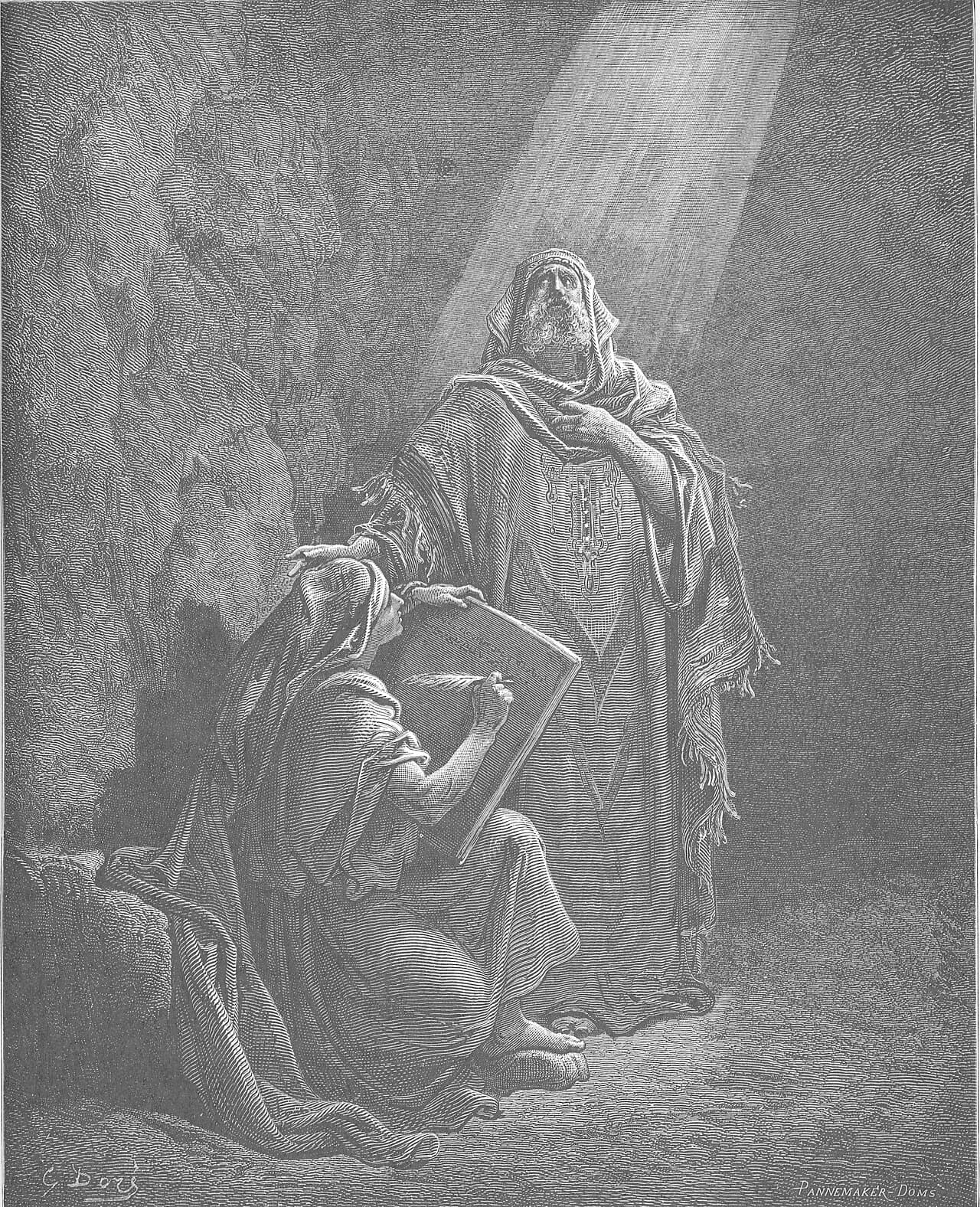
Gustave Doré, Baruch Writes Jeremiah's Prophecies, from La Grande Bible de Tours, 1866. Public domain.
THE ARTWORKAn acrostic is a scribe's craft before it is a reader's pleasure, and it is visible only to someone holding the letters. Doré draws the scribe at the work in Jeremiah 36, a pen in the hand and the scroll under it. The plate is shown whole.
Summary
Summary
An alphabetic acrostic runs the first letters of its lines through the Hebrew alphabet in order. Nine psalms do it, eight poems in all, and the gaps in the scheme are as informative as the scheme.
- Nine psalms, eight acrostics: Psalms 9 and 10 are one poem cut in two by the Hebrew chapter break.
- Psalm 119 is the only one with a perfect scheme, 22 stanzas of 8 verses each, checked verse by verse.
- Psalms 25 and 34 both close with a verse outside the scheme, on the same letter and the same root.
- Psalm 145 has no nun verse in the Hebrew, and the Berean Standard Bible carries the line anyway.
How the Form Works
the first letter of each line, in the order of the alphabet
An alphabetic acrostic assigns each unit of a poem to a letter and runs the units through the alphabet in order. The unit varies. In Psalm 34 it is one verse to a letter. In Psalm 37 it is two. In Psalms 111 and 112 it is a single half line, which is the finest grain the form allows. In Psalm 119 it is a stanza of eight verses, every one of which opens on the same letter.
The pattern lives in the first consonant of the line, so it survives translation nowhere. An English reader of Psalm 145 sees twenty-one verses of praise. Nothing in the English shows that the poem is walking an alphabet, or that one letter of it is missing. That is what this page and the grid below are for.
Blessed are those whose way is blameless, who walk in the Law of the LORD.The first verse of the first stanza. In the Hebrew this word and the seven that open the verses after it all begin with aleph.
The Twenty-Two Letters
the alphabet every one of these psalms is walking, in order
א
Aleph
1. ʾ
ב
Bet
2. b
ג
Gimel
3. g
ד
Dalet
4. d
ה
He
5. h
ו
Waw
6. w
ז
Zayin
7. z
ח
Het
8. ḥ
ט
Tet
9. ṭ
י
Yod
10. y
כ
Kaf
11. k
ל
Lamed
12. l
מ
Mem
13. m
נ
Nun
14. n
ס
Samek
15. s
ע
Ayin
16. ʿ
פ
Pe
17. p / f
צ
Tsade
18. ṣ
ק
Qof
19. q
ר
Resh
20. r
ש
Shin
21. š / ś
ת
Taw
22. t / th
Each letter opens its own room in the Hebrew section of this site. The order above is the order the acrostics keep, and a departure from it is one of the irregularities named in the table below.
The Nine, Scheme by Scheme
8 acrostics across 9 psalms, every row computed from the Hebrew
Read it whole
One acrostic across two psalms, about two verses to a letter
Six letters have no verse at all: dalet, mem, nun, samek, pe and tsade. Ayin stands at 10:13, after qof rather than before it. Psalm 9:19 and 9:20 open with qof and shin, out of sequence. Psalm 10 carries no superscription, and the Greek and Latin traditions count the two as one psalm. That is why their numbering runs one behind the Hebrew from here to Psalm 147.
Read it whole
One verse to a letter, 22 verses
Three letters fail. Bet has no verse, because verse 2 opens with a word for God and the bet word stands second. Waw has none, and qof has none. Resh is doubled at verses 18 and 19. Verse 22 stands outside the scheme and opens on pe.
Read it whole
One verse to a letter, 22 verses
Waw has no verse. Verse 22 stands outside the scheme and opens on pe. It matches Psalm 25:22 in the letter and in the Hebrew root behind it, which is the strongest evidence that one hand shaped both psalms.
Read it whole
Two verses to a letter, 40 verses
Four letters take one verse instead of two: dalet at 37:7, kaf at 37:20, qof at 37:34, and the ayin slot at 37:29, whose Hebrew opens on tsade. Eighteen doubled letters and four single ones give the forty verses.
Read it whole
One half line to a letter, 22 lines over 10 verses
The opening Halleluyah stands outside the scheme. Verses 1 to 8 carry two lettered half lines each and verses 9 and 10 carry three each, which gives the twenty-two.
Read it whole
One half line to a letter, 22 lines over 10 verses
The same shape as Psalm 111, half line for half line. The two psalms are a matched pair, the first on the works of God and the second on the man who fears him.
Read it whole
22 stanzas of 8 verses, 176 verses, every verse in a stanza opening on that stanza's letter
None. All twenty-two stanzas were checked verse by verse against the Hebrew and every one is uniform. It is the only psalm in this table with a perfect scheme.
Read it whole
One verse to a letter, 21 verses
Nun has no verse in the Hebrew: verse 13 is mem and verse 14 is samek. The acrostic starts after the two superscription words inside verse 1. A nun line does stand in the Septuagint, in the Syriac, and in the Qumran Psalms scroll from cave 11, siglum 11Q5.
The count is nine psalms and eight poems. Psalms 9 and 10 carry one broken alphabet between them. That is why the Greek and Latin traditions read them as a single psalm, and why their numbering runs one behind the Hebrew from that point onward.
Two Endings That Match
Psalms 25 and 34 both close on a line outside the alphabet
Redeem Israel, O God, from all its distress.The twenty-third verse of a twenty-two letter poem. It stands outside the scheme and opens on pe.
The LORD redeems His servants, and none who take refuge in Him will be condemned.The same position in the companion psalm, the same letter, and the same Hebrew root behind the opening word.
Both psalms drop the waw line, and both add a line at the end that the alphabet does not account for, on the same letter and from the same root. Two poems built to one plan is the plainest reading of that, and it is a fact about the Hebrew that no English translation can show.
The Letter That Is Missing
Psalm 145 has no nun verse in the Hebrew, and the Berean carries one
Psalm 145 runs the alphabet and reaches twenty-one verses. Verse 13 is the mem line and verse 14 is the samek line, so nun, which belongs between them, has no verse in the Hebrew text the Masoretes handed on.
A nun line does stand in three other witnesses: the Septuagint, the Syriac, and the Psalms scroll from Qumran cave 11, catalogued as 11Q5. What is certain is that the line is absent from the Masoretic text and present in those three. Whether it fell out of the Hebrew or was supplied in the versions is unsettled, and this page leaves it unsettled.
Your kingdom is an everlasting kingdom, and Your dominion endures through all generations. The LORD is faithful in all His words and kind in all His actions.The Berean Standard Bible prints the nun line as the second half of verse 13, on the witness of the versions and the scroll.
What the Form Was For
4 readings, each with the work named
This is one of those psalms which are composed alphabetically (as Ps. 25 and 34, &c.), that it might be the more easily committed to memory, and kept in mind.
Matthew Henry· Commentary on the Whole Bible, on Psalm 145
The memory reading, and the oldest of the three. A poem whose lines run in a fixed order can be recovered a line at a time, and the alphabet supplies the order for anyone who has it.
there is something curious too in the composition, for it is what is called an alphabetical psalm, that is, a psalm in which every verse begins with each letter in its order as it stands in the Hebrew alphabet
Matthew Henry· Commentary on the Whole Bible, on Psalm 34
The plainest definition of the form in the store's records, written on the psalm that keeps it most closely, with one letter missing.
Perhaps the penman found it of use to himself to observe this method, as it obliged him to seek for thoughts, and search for them, that he might fill up the quota of every part
Matthew Henry· Commentary on the Whole Bible, on Psalm 119
The discipline reading. The form works on the writer before it works on the reader, by requiring a thought for every letter whether or not one came easily.
Some have called it the saints' alphabet; and it were to be wished we had it as ready in our memories as the very letters of our alphabet, as ready as our A B C.
Matthew Henry· Commentary on the Whole Bible, on Psalm 119
What the form is for, stated as a wish. The alphabet is the one sequence every reader already carries, and the psalm borrows it.
Taste and see that the LORD is good; blessed is the man who takes refuge in Him!The best known line in any of these psalms stands in the tet slot, which is a reminder that the form is a frame and the content fills it.
Word studies
The Hebrew and Greek under this study, each word in its own room.
Keep studying
On this page
Symbols1
Words1
Doctrines1
Go further2