
Psalm 90
17 verses · Wisdom psalm
Lord, You have been our dwelling place through all generations.
Introduction
Moses, the Span of a Life, Book 4: The LORD reigns, Poetry, Psalms Overview.
Moses, who led Israel out of Egypt and through forty years in the desert, is named at the head of this prayer. It was prayed among a people living in tents, a generation that watched its own members die before reaching the land. Set right after the fall of David's throne, it takes the reader back before there was any king at all. Listen for the contrast between God, who has no beginning, and people whose lives pass quickly, and for what the prayer asks in the light of it. Read it as a lesson in counting your days.
Context
- Who
- People walking toward their own graves with no land yet to bury them in
- What
- A prayer that sets the shortness of a human life against the eternity of God.
- Where
- The camp of Israel in the Sinai and Negev wilderness, where a whole generation was dying off
- When
- The wilderness years, about 1445 to 1406 BC, on the traditional reading of its heading.
- Why
- To teach a people under judgment to use their few years wisely before God.
Historical context
This is the only psalm credited to Moses, and it is headed as a prayer, which only a few psalms are; on the traditional reading of the superscriptions it is the oldest psalm in the collection by four centuries. It opens the fourth section of the book, right after the third ended with a crown thrown on the ground, so the oldest voice in Israel stands after the collapse of the monarchy. Its place is a camp, among people who owned no land at all, which is why calling God their dwelling place through all generations was a claim about the only permanent address they had. The wilderness generation was under a judgment of forty years for refusing to enter the land, so the psalm is doing arithmetic on a punishment, and its line about God returning man to dust restates the sentence spoken in the garden. The figure of the grass is exact for the climate, where winter rains raise green grass across the hills in days and the first hot wind off the eastern desert browns a slope in an afternoon. The seventy years of the psalm is an honest average for someone who reached old age, in a world where infant deaths were common.
Significance
A homeless nation sang that God had been their dwelling place in all generations, and it was the only address they held. The prayer at the end asks for the years to count rather than for more of them, so people with a short future asked to be taught to number their days and asked that the work of their hands be established, which is a request for something that would outlast them.
This chapter in Jewish lifeWhat this chapter is in Jewish life and reading.
How it is read
Psalm 90 opens Book IV of the Psalter, and it carries the oldest name in the book, a prayer of Moses the man of God. Rashi takes the heading further than the one psalm. He holds that Moses recited the eleven psalms from here to Psalm 100, and that they answer to the eleven blessings Moses gave eleven tribes in Deuteronomy 33 (Rashi on Psalms 90:1:1). The crushing of man in verse 3 he reads as a summons rather than a sentence. God brings a man near to death and tells him by those very pains to return from his evil ways (Rashi on Psalms 90:3:1). On the thousand years of verse 4 he works out an arithmetic that the rabbis had drawn from Genesis. A thousand years of man are one day of God with a little of the night beside it. Adam was warned that he would die on the day he ate, and died within a thousand years at nine hundred and thirty (Rashi on Psalms 90:4:1). The seventy years of verse 10 he reads as shortened by the sins the psalm has just named (Rashi on Psalms 90:10:1). The prayer at the end he reads of the redemption still owed. The morning of verse 14 is the day of redemption after the night of trouble. The gladness asked for in verse 15 is gladness "in the days of our Messiah", measured out against the days of affliction in the exiles (Rashi on Psalms 90:14:1 and 90:15:1). Ibn Ezra stands in the corpus on this psalm five times, cited by reference alone. Rashi is quoted here from the Judaica Press complete Tanach with Rashi, translated by A. J. Rosenberg, under CC-BY.
What the rabbis say
The corpus records forty places where the Midrash and the Talmud draw on this psalm, cited here by reference. Verse 2, on God before the mountains were born, is read at Bereshit Rabbah 1:4 and 12:7. Verse 4, the thousand years, stands at Bereshit Rabbah 22:1 and Bamidbar Rabbah 5:4 and 14:12. Verse 12, on numbering our days, is drawn into the Babylonian Talmud at Bava Batra 12a:14. Verse 3 is read in the Jerusalem Talmud at Chagigah 2:1:10, and verse 16 at Kiddushin 1:7:3. Verse 8, on the secret sins set in the light of God's face, is carried into Pirkei DeRabbi Eliezer 15:3 and 43:1 and Tractate Soferim 7:2. Verse 15, the gladness measured against the affliction, is read at Pesikta Rabbati 1:1 and Midrash Tanchuma, Eikev 7:1. Midrash Tehillim treats the psalm at 90:8 and cites its verses at 13:1 and 85:1.
Sources: Rashi, Rashi on Psalms 90:1 to 90:17, the Judaica Press complete Tanach with Rashi, translated by A. J. Rosenberg, CC-BY, 1040 to 1105; Bereshit Rabbah, 1:4, 12:7 and 22:1, cited by reference; Babylonian Talmud, Bava Batra 12a:14 and Tractate Soferim 7:2, cited by reference; Jerusalem Talmud, Chagigah 2:1:10 and Kiddushin 1:7:3, cited by reference; Midrash Tehillim, 90:8, 13:1 and 85:1, cited by reference; The Sefaria corpus, scripts/data/sources/sefaria/psalms/90.json, fetched 2026-09-19, 2026; MannaFest, the shape of the Psalter, src/components/book/dossier-content/psalms-structure.ts, on Book IV opening at Psalm 90, 2026.
Psalms 90:1-2
You have been our dwelling place: God is the dwelling place, and He has been that through all generations. Verse 2 sets Him before the mountains were born and before the earth was brought forth. From everlasting to everlasting runs in both directions at once.
Psalms 90:1
“Lord, thou hast been our dwelling place in all generations. We must consider the whole Psalm as written for the tribes in the desert, and then we shall see the primary meaning of each verse. Moses, in effect, says—wanderers though we be in the howling wilderness, yet we find a home in thee, even as our forefathers did when they came out of Ur of the Chaldees and dwelt in tents among the Canaanites. To the saints the Lord Jehovah, the self existent God, stands instead of mansion and rooftree; he shelters, comforts, protects, preserves, and cherishes all his own.”
Charles Spurgeon · The Treasury of David, Vol. 4 (1874)Particular Baptist
Before the mountains were born: Albert Barnes noted that were born is the literal Hebrew, and the mountains stand as the oldest things in creation. Charles Spurgeon heard birth language in brought forth too. Matthew Henry set this verse against the next: mortal people take comfort in an everliving God.
Psalms 90:2
“Before the mountains were brought forth. Before those elder giants had struggled forth from nature's womb, as her dread firstborn, the Lord was glorious and self sufficient. Mountains to him, though hoar with the snows of ages, are but new born babes, young things whose birth was but yesterday, mere novelties of an hour. Or ever thou hadst formed the earth and the world. Here too the allusion is to a birth. Earth was born but the other day, and her solid land was delivered from the flood but a short while ago.”
Charles Spurgeon · The Treasury of David, Vol. 4 (1874)Particular Baptist
1 more voice on this verse
Psalms 90:2
“Before the mountains were brought forth - The mountains and hills appear to have been everlasting; but as they were brought forth out of the womb of eternity, there was a time when they were not: but Thou hast been ab aeternitate a parte ante, ad aeternitatem a parte post; fram the eternity that is past, before time began; to the eternity that is after, when time shall have an end. This is the highest description of the eternity of God to which human language can reach.”
Adam Clarke · Commentary on the Bible (1810-1826)evangelical
Psalms 90:3-6
You return man to dust: Verse 3 sends man back to dust, and Genesis 3:19 says the same, to dust you shall return. A thousand years measure out as one day in verse 4, and 2 Peter 3:8 says it both ways round. The grass is up at dawn and withered by evening.
Psalms 90:3
“Thou turnest man to destruction - In contradistinction from his own unchangeableness and eternity. Man passes away; God continues ever the same. The word rendered “destruction” - דכא dakkâ' - means properly anything beaten or broken small or very fine, and hence, “dust.” The idea here is, that God causes man to return to dust; that is, the elements which compose the body return to their original condition, or seem to mingle with the earth. Gen 3:19: “dust thou art, and unto dust shalt thou return.” The word “man” here, of course, refers to man in general - all people.”
1 more voice on this verse
Psalms 90:3
“Thou turnest man to destruction, or "to dust." Man's body is resolved into its elements, and is as though it had been crushed and ground to powder. And sayest, Return, ye children of men, i.e., return even to the dust out of which ye were taken. The frailty of man is thus forcibly set forth; God creates him out of the dust, and back to dust he goes at the word of his Creator. God resolves and man dissolves. A word created and a word destroys.”
Charles Spurgeon · The Treasury of David, Vol. 4 (1874)Particular Baptist
a watch of the night: Jerome explained a watch as one of the night's four watches, three hours each, so the comparison shrinks from a day to a few hours. Albert Barnes noted that Methuselah came near a thousand years. Even the longest human life is one day to God.
Psalms 90:4
“God will say, at the great day, to those whom he has turned to destruction, Return--Arise you dead. But it might be objected against the doctrine of the resurrection that it is a long time since it was expected and it has not yet come. Let that be no difficulty, for a thousand years, in God's sight, are but as one day.”
Matthew Henry · Commentary on the Whole Bible (1707-1721)puritan
1 more voice on this verse
Psalms 90:4
“For a thousand years in thy sight are but as yesterday when it is past. A thousand years! This is a long stretch of time. How much may be crowded into it, —the rise and fall of empires, the glory and obliteration of dynasties, the beginning and the end of elaborate systems of human philosophy, and countless events, all important to household and individual, which elude the pens of historians.”
Charles Spurgeon · The Treasury of David, Vol. 4 (1874)Particular Baptist
You whisk them away: Whisk them away is one Hebrew verb, zaram, which Albert Barnes glossed as to pour or wash away like a torrent. Death, he said, takes no account of rank or age. Charles Spurgeon took the sleep as a picture of how brief a life looks before God, like a dream.
Psalms 90:5
“In the morning let it pass like grass, in the morning let it flower and pass away: in the evening let it fall, harden, and wither. O the mysteries of the Scriptures! In the morning let it pass like grass. Our Lord and Savior also speaks in the Gospel about the hay, which springs up in one day and withers in one day.”
Jerome · written before 420 · Homily 19, on Psalm 89patristic
2 more voices on this verse
Psalms 90:5
Thou carriest them away as with a flood. As when a torrent rushes down the river bed and bears all before it, so does the Lord bear away by death the succeeding generations of men. As the hurricane sweeps the clouds from the sky, so time removes the children of men. They are as a sleep. Before God men must appear as unreal as the dreams of the night, the phantoms of sleep. Not only are our plans and devices like a sleep, but we ourselves are such. "We are such stuff as dreams are made of."
Charles Spurgeon · The Treasury of David, Vol. 4 (1874)Particular Baptist
Psalms 90:5
“Thou carriest them away as with a flood - The original here is a single verb with the suffix - זרמתם zerametâm. The verb - זרם zâram - means, to flow, to pour; then, to pour upon, to overwhelm, to wash away. The idea is, that they were swept off as if a torrent bore them from the earth, carrying them away without regard to order, rank, age, or condition. So death makes no discrimination.”
in the morning it springs up new: Albert Barnes noted that new here repeats the Hebrew word that closes verse 5, and that the whole span is a single day. Charles Spurgeon traced the history of the grass in one line: sown, grown, blown, mown, gone. He said the history of man is little more.
Psalms 90:6
“In the morning it flourisheth, and groweth up. Blooming with abounding beauty till the meadows are all besprent with gems, the grass has a golden hour, even as man in his youth has a heyday of flowery glory. In the evening it is cut down, and withereth. The scythe ends the blossoming of the field flowers, and the dews at flight weep their fall. Here is the history of the grass—sown, grown, blown, mown, gone; and the history of man is not much more.”
Charles Spurgeon · The Treasury of David, Vol. 4 (1874)Particular Baptist
Psalms 90:7-9
we are consumed by Your anger: Verse 7 puts the dying and the anger in one sentence. Verse 8 sets the secret sins in the light of God's presence, where nothing stays hidden. The years end with a sigh, and the Hebrew word there is hegeh, a muttering or a moan.
Psalms 90:7
“This mortality is not accidental, neither was it inevitable in the original of our nature, but sin has provoked the Lord to anger, and therefore thus we die. For we are consumed by thine anger. This is the scythe which mows and the scorching heat which withers. This was specially the case in reference to the people in the wilderness, whose lives were cut short by justice on account of their waywardness; they failed, not by a natural decline, but through the blast of the well deserved judgments of God.”
Charles Spurgeon · The Treasury of David, Vol. 4 (1874)Particular Baptist
1 more voice on this verse
Psalms 90:7
“In your anger we have failed. Because through our sins we have earned your anger, we have lost in Adam the immortality you had given, from whom sin has been handed down to us, as it were naturally, by hereditary right. And in your fury we have been troubled. Beautifully he said, troubled: for one who is troubled does not perish, but is shaken with terror, so that he may feel the power of him whom by sinning he had scorned, and may flee, humble and submissive, to repentance. And in your fury we have been troubled.”
Jerome · written before 420 · Homily 67, on Psalm 89 (Alternate Series)patristic
our secret sins: Albert Barnes read set before You as sins arrayed in God's mind as the reason for cutting life short. Matthew Henry took secret sins as those of the heart, which lie beneath every outward act. Adam Clarke pictured a candle carried into a dark room.
Psalms 90:8
“Thou hast set our iniquities before thee. Hence these tears! Sin seen by God must work death; it is only by the covering blood of atonement that life comes to any of us. When God was overthrowing the tribes in the wilderness he had their iniquities before him, and therefore dealt with them in severity. He could not have their iniquities before him and not smite them. Our secret sins in the fight of thy countenance. There are no secrets before God; he unearths man's hidden things, and exposes them to the light.”
Charles Spurgeon · The Treasury of David, Vol. 4 (1874)Particular Baptist
2 more voices on this verse
Psalms 90:8
“You have set our iniquities in your sight. Nothing is hidden from you: that is, neither does night hide our sins, nor do shadows envelop them: all things shine bright before you. Our age in the illumination of your countenance. It stands better in the Hebrew: "Our faults in the illumination of your countenance." Whatever we do, whatever we think we are doing in secret, lies open in your eyes.”
Jerome · written before 420 · Homily 19, on Psalm 89patristic
Psalms 90:8
“For their more secret departures from him: " Thou hast set our secret sins (those which go no further than the heart, and which are at the bottom of all the overt acts) in the light of thy countenance; that is, thou hast discovered these, and brought these also to the account, and made us to see them, who before overlooked them." Secret sins are known to God and shall be reckoned for.”
Matthew Henry · Commentary on the Whole Bible (1707-1721)puritan
all our days decline: Decline renders panah, which Albert Barnes glossed as to turn, as if our days turn their backs and leave us. John Gill pictured a day sinking toward evening. The old versions read the second line with a spider, which Adam Clarke found in no Hebrew copy.
Psalms 90:9
“For all our days are passed away in thy wrath. Justice shortened the days of rebellious Israel; each halting place became a graveyard; they marked their march by the tombs they left behind them. Because of the penal sentence their days were dried up, and their lives wasted away. We spend our years as a tale that is told. Yea, not their days only, but their years flew by them like a thought, swift as a meditation, rapid and idle as a gossip's story.”
Charles Spurgeon · The Treasury of David, Vol. 4 (1874)Particular Baptist
2 more voices on this verse
Psalms 90:9
“When they came out of Egypt there was not one feeble person among their tribes ( Ps. cv. 37 ); but now they were feeble. Their joyful prospect of a prosperous glorious life in Canaan was turned into the melancholy prospect of a tedious inglorious death in the wilderness; so that their whole life was now as impertinent a thing as ever any winter-tale was.”
Matthew Henry · Commentary on the Whole Bible (1707-1721)puritan
Psalms 90:9
“For all our days are passed away in thy wrath - Margin, “turned.” The Hebrew word - פנה pânâh - means to “turn;” then, to turn to or “from” anyone; and hence, to turn away as if to flee or depart. Here it means that our days seem to turn from us; to give the back to us; to be unwilling to remain with us; to leave us. This seems to be the fruit or result of the anger of God, as if he were unwilling that our days should attend us any longer.”
The length of our days: The span given is seventy years, and eighty for the strong. Their pride is called labor and sorrow, and the Hebrew behind pride is rohab. They shear off quickly, which is the verb guz, and we fly away.
Psalms 90:10
“Threescore years and ten - See the note on the title of this Psalm 90 (note). This Psalm could not have been written by Moses, because the term of human life was much more extended when he flourished than eighty years at the most. Even in David’s time many lived one hundred years, and the author of Ecclesiasticus, who lived after the captivity, fixed this term at one hundred years at the most (Sirach 18:9); but this was merely a general average, for even in our country we have many who exceed a hundred years.”
Adam Clarke · Commentary on the Bible (1810-1826)evangelical
2 more voices on this verse
Psalms 90:10
“The days of our years are threescore years and ten. Moses himself lived longer than this, but his was the exception not the rule: in his day life had come to be very much the same in duration as it is with us. This is brevity itself compared with the men of the elder time; it is nothing when contrasted with eternity. Yet is life long enough for virtue and piety, and all too long for vice and blasphemy.”
Charles Spurgeon · The Treasury of David, Vol. 4 (1874)Particular Baptist
Psalms 90:10
“Moses' life was an exception (De 34:7). it is . . . cut off--or, "driven," as is said of the quails in using the same word (Nu 11:31). In view of this certain and speedy end, life is full of sorrow.”
Jamieson, Fausset & Brown · Commentary Critical and Explanatory on the Whole Bible (1871)reformed
Psalms 90:11-12
Who knows the power of Your anger?: Verse 11 asks who knows the power of God's anger, and the psalm lets the question stand. Verse 12 asks God to teach the counting of days. The second half asks that a heart of wisdom be brought in, where the Hebrew verb is bo, to bring.
Psalms 90:11
“Who knoweth the power of thine anger? Moses saw men dying all around him: he lived among funerals, and was overwhelmed at the terrible results of the divine displeasure. He felt that none could measure the might of the Lord's wrath. Even according to thy fear, so is thy wrath.”
Charles Spurgeon · The Treasury of David, Vol. 4 (1874)Particular Baptist
2 more voices on this verse
Psalms 90:11
“Thy fear - According to the fear of thee; according to that fear which sinful men have of a just God. So - It bears full proportion to it, nay indeed doth far exceed it.”
John Wesley · Explanatory Notes upon the Old Testament (1765)evangelical
Psalms 90:11
“Who knoweth the power of thine anger? - Who can measure it, or take a correct estimate of it, as it is manifest in cutting down the race of people? If the removal of people by death is to be traced to thine anger - or is, in any proper sense, an expression of thy wrath - who can measure it, or understand it?”
teach us to number our days: So ties the prayer to the span in verse 10. Charles Spurgeon observed that counting is a child's sum, yet the best of men need the Lord to teach them this one. Matthew Henry recalled the man in the Gospel who counted on many years and died that night.
Psalms 90:12
“So teach us to number our days. Instruct us to set store by time, mourning for that time past wherein we have wrought the will of the flesh, using diligently the time present, which is the accepted hour and the day of salvation, and reckoning the time which lieth in the future to be too uncertain to allow us safely to delay any gracious work or prayer. Numeration is a child's exercise in arithmetic, but in order to number their days aright the best of men need the Lord's teaching.”
Charles Spurgeon · The Treasury of David, Vol. 4 (1874)Particular Baptist
2 more voices on this verse
Psalms 90:12
“Make your right hand thus known, and those fettered in heart in wisdom. Your right hand, with which you made the world, enlighten the world. "For the arm of the Lord, to whom has it been revealed?" Your right hand, with which you made man, let it itself take up and save the human body. And those fettered in heart in wisdom. It can be understood thus: those who before wandered freely, let them be fettered by your wisdom.”
Jerome · written before 420 · Homily 67, on Psalm 89 (Alternate Series)patristic
Psalms 90:12
“So teach us to number our days - Let us deeply consider our own frailty, and the shortness and uncertainty of life, that we may live for eternity, acquaint ourselves with thee and be at peace; that we may die in thy favor and live and reign with thee eternally.”
Adam Clarke · Commentary on the Bible (1810-1826)evangelical
Psalms 90:13-15
Return, O LORD!: Return in verse 13 is the verb of verse 3, now turned on God. Verse 14 asks to be filled in the morning, where verse 6 had the grass withering by evening. Verse 15 measures the glad days by the afflicted ones.
Psalms 90:13
“Return, O Lord - Come back to thy people; show mercy by sparing them. It would seem probable from this that the psalm was composed in a time of pestilence, or raging sickness, which threatened to sweep all the people away - a supposition by no means improbable, as such times occurred in the days of Moses, and in the rebellions of the people when he was leading them to the promised land. How long? - How long shall this continue? How long shall thy wrath rage? How long shall the people still fall under thy hand?”
2 more voices on this verse
Psalms 90:13
“Turn back, O Lord, how long? We have sinned much, you turn away your face, our sins are not worthy to be seen by your eyes, and therefore we pray: Turn back, O Lord, how long? Behold, now so many ages have flowed by: the prophets have always proclaimed to the nations that you would come, and still you have not come. And direct the sons of men. We who are crooked, may we be set straight by you. And direct the sons of men. Well did he say, direct the sons of men.”
Jerome · written before 420 · Homily 19, on Psalm 89patristic
Psalms 90:13
Return, O Lord, how long? Come in mercy, to us again. Do not leave us to perish. Suffer not our lives to be both brief and bitter. Thou hast said to us, "Return, ye children of men", and now we humbly cry to thee, "Return, thou preserver of men." Thy presence alone can reconcile us to this transient existence; turn thou unto us. As sin drives God from us, so repentance cries to the Lord to return to us. When men are under chastisement they are allowed to expostulate, and ask "how long?"
Charles Spurgeon · The Treasury of David, Vol. 4 (1874)Particular Baptist
Satisfy us in the morning: All our days here answers verse 9, where all our days decline in God's fury. Albert Barnes saw affliction as night and mercy as its dawn. Charles Spurgeon recalled that the manna fell in the morning, and heard Moses asking for God's favor as daily food.
Psalms 90:14
“And we have exulted and been delighted. After the joy of the resurrection of our Lord, by which we now believe both that we have been redeemed and that we shall rise again, for the remaining days of our life, rejoicing in this confidence, we exult, and with hymns and spiritual songs we render praise to God through Jesus Christ our Lord: to whom is glory unto the ages of ages. Amen.”
Jerome · written before 420 · Homily 67, on Psalm 89 (Alternate Series)patristic
1 more voice on this verse
Psalms 90:14
“O satisfy us early with thy mercy. Since they must die, and die so soon, the psalmist pleads for speedy mercy upon himself and his brethren. Good men know how to turn the darkest trials into arguments at the throne of grace. He who has but the heart to pray need never be without pleas in prayer.”
Charles Spurgeon · The Treasury of David, Vol. 4 (1874)Particular Baptist
Make us glad: Charles Spurgeon heard Moses behind the request, a man who watched a whole generation die through forty years in the wilderness. Adam Clarke placed the psalm later and counted the seventy years of the captivity. Either way the prayer asks God to fill the other scale.
Psalms 90:15
“Make us glad according to the days wherein thou hast afflicted us - Let the one correspond with the other. Let our occasions of joy be measured by the sorrows which have come upon us. As our sufferings have been great, so let our joys and triumphs be. And the years wherein we have seen evil - Affliction and sorrow. They have been continued through many wearisome years; so let the years of peace and joy be many also.”
1 more voice on this verse
Psalms 90:15
“Make us glad according to the days wherein thou hast afflicted us, and the years wherein we have seen evil. None can gladden the heart as thou canst, O Lord, therefore as thou hast made us sad be pleased to make us glad. Fill the other scale. Proportion thy dispensations. Give us the lamb, since thou has sent us the bitter herbs. Make our days as long as our nights.”
Charles Spurgeon · The Treasury of David, Vol. 4 (1874)Particular Baptist
Psalms 90:16-17
May Your work be shown: The prayer asks that the servants see God's work and that their children see His splendor. Verse 17 asks for His favor to rest on them, and then asks twice for the work of their hands to be established. The Hebrew says establish twice.
Psalms 90:16
“Let thy work appear unto thy servants. See how he dwells upon that word servants. It is as far as the law can go, and Moses goes to the full length permitted him henceforth Jesus calls us not servants but friends, and if we are wise we shall make full use of our wider liberty. Moses asks for displays of divine power and providence conspicuously wrought, that all the people might be cheered thereby. They could find no solace in their own faulty works, but in the work of God they would find comfort. And thy glory unto their children.”
Charles Spurgeon · The Treasury of David, Vol. 4 (1874)Particular Baptist
1 more voice on this verse
Psalms 90:16
"Let thy work appear, and in it thy glory will appear to us and those that shall come after us." In praying for God's grace God's glory must be our end; and we must therein have an eye to our children as well as to ourselves, that they also may experience God's glory appearing upon them, so as to change them into the same image, from glory to glory.
Matthew Henry · Commentary on the Whole Bible (1707-1721)puritan
May the favor of the Lord: Albert Barnes glossed the word behind favor, noam, as pleasantness, then beauty and splendor. Adam Clarke found the repeated line missing from the Septuagint. Charles Spurgeon heard a dying generation asking that its work last when they are in the grave.
Psalms 90:17
“And let the beauty of the Lord our God be upon us. Even upon us who must not see thy glory in the land of Canaan; it shall suffice us if in our characters the holiness of God is reflected, and if over all our camp the lovely excellences of our God shall cast a sacred beauty. Sanctification should be the daily object of our petitions. And establish thou the work of our hands upon us; yea, the work of our hands establish thou it.”
Charles Spurgeon · The Treasury of David, Vol. 4 (1874)Particular Baptist
2 more voices on this verse
Psalms 90:17
“Thus, if Isaiah says, "The everlasting God, the Creator of the ends of the earth"; and Susanna said, "O everlasting God";42 and Baruch wrote, "I will cry to the Everlasting in my days," and shortly after, "My hope is in the Everlasting, that he will have you, and joy is come to me from the holy One"; yet forasmuch as the apostle, writing to the Hebrews, says, "Who being the radiance of his glory and the expression of his person";44 and David too in the ninetieth psalm, "And the brightness of the Lord be on us," and, "In your light…”
Athanasius of Alexandria · written before 373 · Discourses Against the Arians 1.4.12patristic
Psalms 90:17
“And let the beauty of the Lord our God be upon us - The word translated “beauty” - נעם nô‛am - means properly “pleasantness;” then, beauty, splendor; then grace or layout. The Septuagint renders it here, λαμπρότης lamprotēs, “splendor;” and so the Latin Vulgate.”
How this psalm is built
The form: A prayer of Moses the man of God, one of the four psalms headed as a prayer, as Jerome classes it.
The patterns in this chapter
| Device | What it does | Where to see it |
|---|---|---|
| The two spans set side by side | Verse 2 gives God from everlasting to everlasting, before the mountains were born. Verse 10 gives man seventy years, or eighty if he is strong. The psalm states both measures plainly and puts nothing between them except the account of what happens in the gap. | Psalm 90:2, Psalm 90:10 |
| The morning that comes twice | Verses 5 and 6 use the morning for what is briefest, the new grass that springs up and fades by evening. Verse 14 asks to be satisfied in the morning with God's loving devotion. The same hour stands once for how short a life is and once for where the psalm asks its gladness to begin. | Psalm 90:5, Psalm 90:6, Psalm 90:14 |
| The turn at the word so | Verses 1 to 11 state the case and address God without asking Him for anything. Verse 12 is the first petition, and it asks for a lesson rather than for a change: teach us to number our days. Every request in the psalm stands after that verse. | Psalm 90:11, Psalm 90:12, Psalm 90:13 |
| The work of our hands, said twice in one verse | The last verse asks God to establish for us the work of our hands, and then asks it again in the same breath. The psalm that opened on what God has been through all generations closes on whether anything a man does will last, and it puts the request twice. | Psalm 90:1, Psalm 90:17 |
Psalm 90 opens the fourth book of the Psalter, immediately after Psalm 89 has left the throne of David in the dust. The arrangement is one of the clearest editorial statements in the book: the answer to the fall of the house is a psalm from four centuries earlier, which says that God was the dwelling place of His people before there was a house or a throne to lose.
10 more paragraphs on the patterns
The psalm's vocabulary belongs to the books of Moses. Returning man to dust at verse 3 is the sentence of Genesis 3:19, the anger and the iniquity set before God at verses 7 and 8 belong to the wilderness, and the seventy years of verse 10 stand against the far longer lives recorded in Genesis 5.
Inside the psalm the pattern is a comparison that will not resolve into either despair or comfort. God is everlasting and man is grass, and the psalm draws neither of the two conclusions a reader expects. It does not ask for a longer life and it does not renounce this one. It asks for a way of counting, and then for the work of the hands to be established, which is a request that the short life leave something behind.
The New Testament's use
Verse 4 is taken up at 2 Peter 3:8. The apostle tells his readers not to let one thing escape their notice, that with the Lord a day is like a thousand years and a thousand years are like a day, and he uses it to answer those who ask why the promise of the Lord's coming is delayed. The psalm's line about God's reckoning of time becomes the New Testament's answer to a question about patience.
No other verse of the psalm is quoted with a citation formula. Its language of grass that withers stands close to 1 Peter 1:24 and to James 1:10, both of which quote Isaiah 40 rather than this psalm.
The debated point
The heading assigns the psalm to Moses, and whether it is his is the psalm's standing question. The traditional view, which the older commentators the site cites hold, takes the superscriptions as early and reliable, which makes this the oldest psalm in the book and places it in the wilderness years. Matthew Henry reads verses 7 to 11 that way, as written while a generation was dying in the desert under a sentence, and the seventy years of verse 10 fit a span that a wilderness generation would measure itself by.
The second dispute is what verse 10 is asserting. One position reads it as a statement of the ordinary human span, given as a fact. The other reads it as the span of that particular generation under judgment, given as a sentence rather than as a rule. Albert Barnes sets the verse against the longest life on record, the nearly thousand years of Methuselah at Genesis 5:27, and reads the psalm as saying that even that would be a day in God's sight, which leaves the question of the rule open. Both readings are held by teachers the site cites.
Where to go deeper
The generation the psalm may be written from is set out at the wilderness generation and the wilderness. The sentence of verse 3 is set out at the fall. The wisdom asked for at verse 12 stands with wisdom before Christ, and the vanity of verse 10 with vanity under the sun.
Keep studying
Sources for this chapter
The summary
Jamieson, Fausset & Brown, Commentary Critical and Explanatory; John Calvin, Commentaries; John Wesley, Notes on the Old Testament and Matthew Henry, Complete Commentary.
The form and classifications
Albert Barnes, Notes, Explanatory and Practical, on the Old and New Testaments, 1832 to 1869, on Psalm 90:4; Jerome, Homily on Psalm 89, 420 and Matthew Henry, Commentary on the Whole Bible, 1710, on Psalm 90:7.
The exposition
Adam Clarke, Commentary on the Bible; Albert Barnes, Notes on the Book of Psalms; Charles Spurgeon; Franz Delitzsch, Biblical Commentary on the Psalms; Jamieson, Fausset and Brown, Commentary Critical and Explanatory on the Whole Bible; Jerome, Homily 67, on Psalm 89; John Gill, Exposition of the Old Testament and Matthew Henry, Commentary on the Whole Bible.
The painting
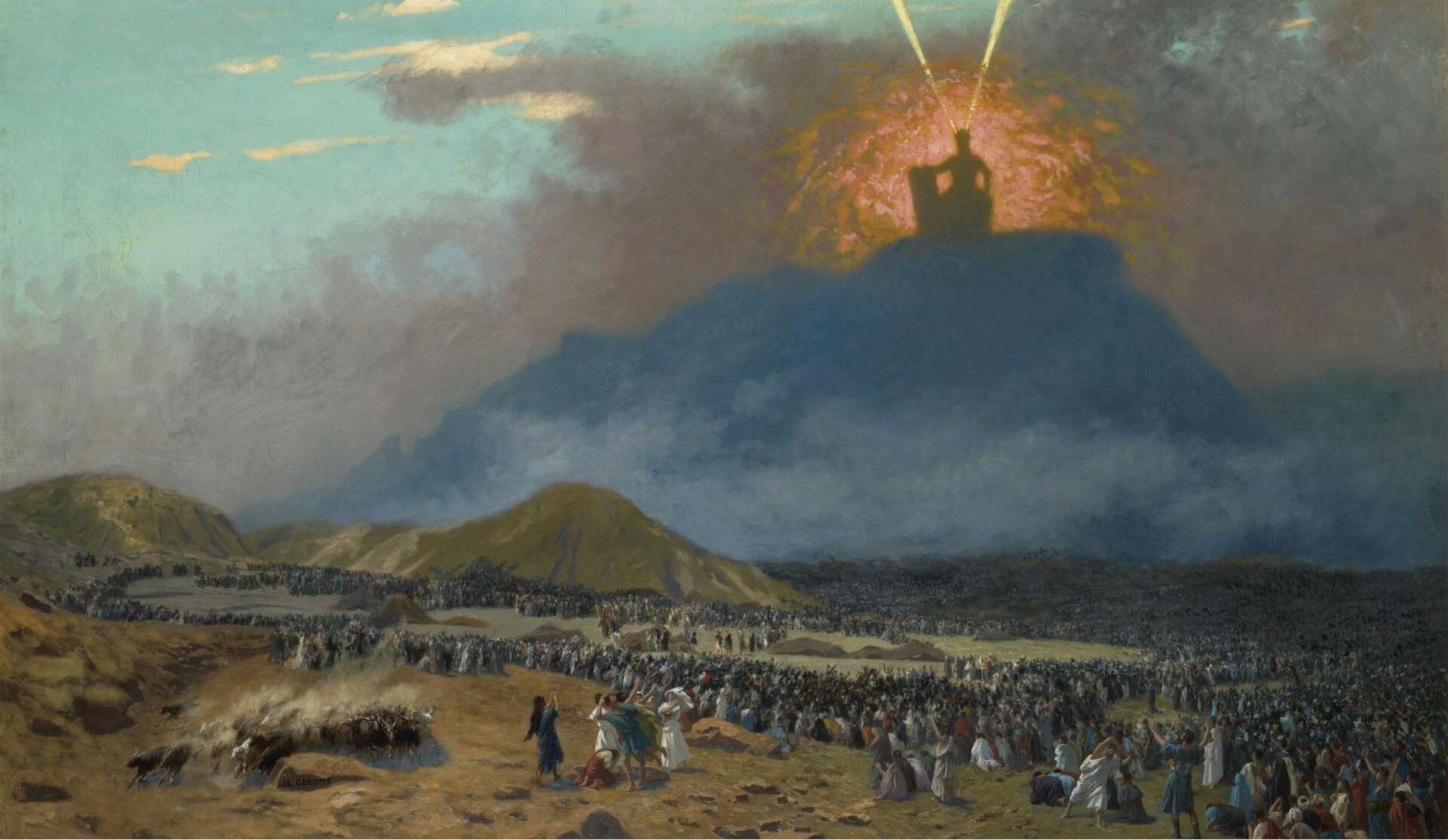
Moses on Mount Sinai. Jean-Léon Gérôme, 1895-1900. Wikimedia Commons. Public domain.