
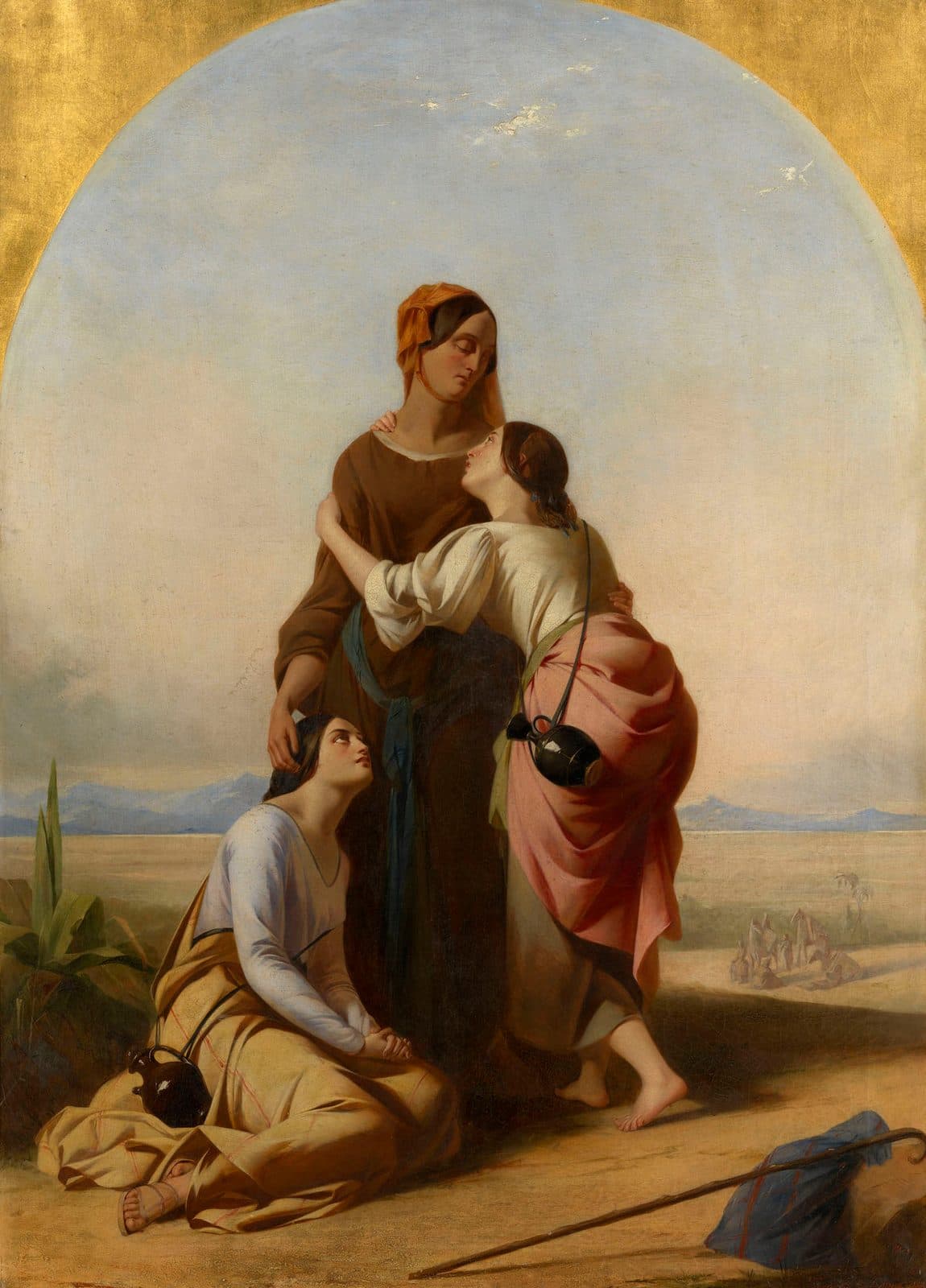
Ruth 1 · Story · Grief and Loss
Naomi: Call Me Mara
Naomi came home to Bethlehem from Moab a widow and asked the women of the town to call her Mara.
Naomi left Bethlehem in a famine and came back at the beginning of the barley harvest.
“Do not call me Naomi,” she replied. “Call me Mara, because the Almighty has dealt quite bitterly with me.
- Where
- Bethlehem, Moab
- Who
- Naomi, Ruth, Boaz
Summary
The book of Ruth lets a grieving widow speak bitterly of God and records no rebuke of her words. The LORD answers her slowly, over the months of one harvest, through the faithfulness of a Moabite daughter-in-law and a relative of her husband's clan. Grief and trust stand together in one household until the end of the book.
- Naomi's husband and both her sons died in Moab, where the family had gone in a time of famine (Ruth 1:1 to 5).
- Naomi spoke of her losses as the work of the LORD and the Almighty (Ruth 1:13 and Ruth 1:20 to 21).
- Ruth, a Moabite, chose to stay with Naomi and to take the LORD, Naomi's God, as her own (Ruth 1:16 to 17).
- The book ends with Naomi nursing Ruth's son Obed in her own home (Ruth 4:16).
A Widow Comes Home
The book of Ruth opens with three deaths and a return to Bethlehem.
Grief and loss, the trial this study belongs to, fills the first chapter of the book of Ruth, and Naomi is the one who carries it. Her losses come in five verses, and the rest of the book answers them.
The question this study answers is how Naomi spoke of her grief, to God and to others, and how the LORD answered it. It sets her story on a timeline from the famine to the birth of Obed and tells its scenes in order. It reads the words she used of God and the names Naomi and Mara, and it traces the quiet provision that ends the book.
From Moab to the Birth of Obed
The book dates these events only to the days when the judges ruled (Ruth 1:1).
Naomi's story runs from a famine and three graves to a grandson in her lap.
- A famine drives Elimelech's family from Bethlehem to Moab"there was a famine in the land"Ruth 1:1 to 2
- Elimelech dies in Moab"Then Naomi’s husband Elimelech died"Ruth 1:3
- The sons marry Moabite women"after they had lived in Moab about ten years"Ruth 1:4
- Mahlon and Chilion die"Naomi was left without her two sons and without her husband"Ruth 1:5
- Naomi hears that the LORD has given food and sets out"the LORD had attended to His people by providing them with food"Ruth 1:6 to 7
- Orpah turns back and Ruth stays"but Ruth clung to her"Ruth 1:14
- Bethlehem sees Naomi again"Can this be Naomi?"Ruth 1:19 to 21
- Naomi hears the name of Boaz"He is one of our kinsman-redeemers."Ruth 2:20
- Ruth bears a son to Boaz"the LORD enabled her to conceive, and she gave birth to a son"Ruth 4:13
- The women bless the LORD before Naomi"who has not left you this day without a kinsman-redeemer"Ruth 4:14
- Naomi takes the child"placed him on her lap, and became a nurse to him"Ruth 4:16
- Obed stands in the line of David"He became the father of Jesse, the father of David."Ruth 4:17
A timeline of twelve events, each card carrying words of its verse from the Berean text.
Bethlehem sees Naomi again, Naomi hears the name of Boaz, Ruth bears a son to Boaz, The women bless the LORD before Naomi, Naomi takes the child, Obed stands in the line of David
The Story Told in Order
Five scenes take Naomi from Moab to the birth of Obed.
Three deaths in MoabRuth 1:1 to 5
Naomi sent her daughters-in-law homeRuth 1:6 to 18
Naomi set out for Judah with both young widows and on the road urged them to go back to their mothers' homes (Ruth 1:6 to 8).
would you wait for them to grow up? Would you refrain from having husbands? No, my daughters, it grieves me very much for your sakes that the hand of the LORD has gone out against me.”Naomi names her loss as the hand of the LORD gone out against her, the way of speaking she uses again at Bethlehem.
Orpah kissed her mother-in-law goodbye, and Ruth refused to leave her (Ruth 1:14 to 17).
Naomi came home emptyRuth 1:19 to 21
I went away full, but the LORD has brought me back empty. Why call me Naomi? After all, the LORD has testified against me, and the Almighty has afflicted me.”The verse stands here because in it Naomi gives the town her own account of her loss.
A relative named BoazRuth 2:1 to 3
Naomi had a relative on her husband's side named Boaz, and Ruth went out to glean and came to the part of the field that belonged to him (Ruth 2:1 to 3).
The women's blessingRuth 4:13 to 17
He will renew your life and sustain you in your old age. For your daughter-in-law, who loves you and is better to you than seven sons, has given him birth.”The verse stands here because the women name Ruth, the daughter-in-law who loves Naomi, as the one who gave her this grandson.
What Naomi Said of God
Naomi's complaint at Bethlehem used words that Job also spoke.
In Ruth 1:20 to 21 Naomi names the LORD twice and the Almighty twice, and each time He is the one who has acted.
Her words in Ruth 1:20 are hēmar Šadday, the Almighty has made bitter. Job uses the same two words for the Almighty who has made his soul bitter.
“As surely as God lives, who has deprived me of justice—the Almighty, who has embittered my soul—A righteous man in his suffering speaks of the Almighty in the words Naomi used, and Scripture records both complaints.
Naomi and Mara
Naomi's request turns on what her old name and her new one mean.
Adam Clarke explained the two names in his Commentary on the Bible. Naomi means "beautiful or pleasant", and Mara means "bitter; one whose life is grievous to her".
The name Naomi stands in 20 verses, all of them in the book of Ruth, and the name Mara stands in one, Ruth 1:20. In that verse Mara stands beside the verb hēmar, he has made bitter, from mārar, and the two words share the letters m and r.
The townswomen never use the new name. When Obed is born, the narrator and the women both call her Naomi (Ruth 4:14 and Ruth 4:17).
The LORD's Quiet Provision
The book shows how the LORD cared for a widow in Bethlehem.
In the chapters between Naomi's return and the birth of Obed, the help Naomi receives comes through Ruth and Boaz. Boaz told his young men to let Ruth gather among the sheaves (Ruth 2:15), and Ruth brought what she had gleaned home to Naomi (Ruth 2:18).
A father of the fatherless, and a defender of the widows, is God in His holy habitation. God settles the lonely in families; He leads the prisoners out to prosperity, but the rebellious dwell in a sun-scorched land.The psalm names God as the defender of widows who settles the lonely in families, the care Naomi received in Bethlehem.
Empty, Then Full
The book that began with Naomi's emptiness ends with a child in her arms.
Naomi's grief at her return was answered with a family, and the book sets that grief beside the LORD's faithfulness.
You turned my mourning into dancing; You peeled off my sackcloth and clothed me with joy,The psalm names the turn from mourning to joy that the book of Ruth tells in a family.
Sources
Scripture is the Berean Standard Bible.
- STEP Bible, the Translators Amalgamated Hebrew Old Testament (TAHOT), Tyndale House, Cambridge, CC BY 4.0.
- STEP Bible, the Brief lexicon of Extended Strongs for Hebrew (TBESH), Tyndale House, Cambridge, CC BY 4.0.
- Adam Clarke, Commentary on the Bible, on Ruth 1:20.