
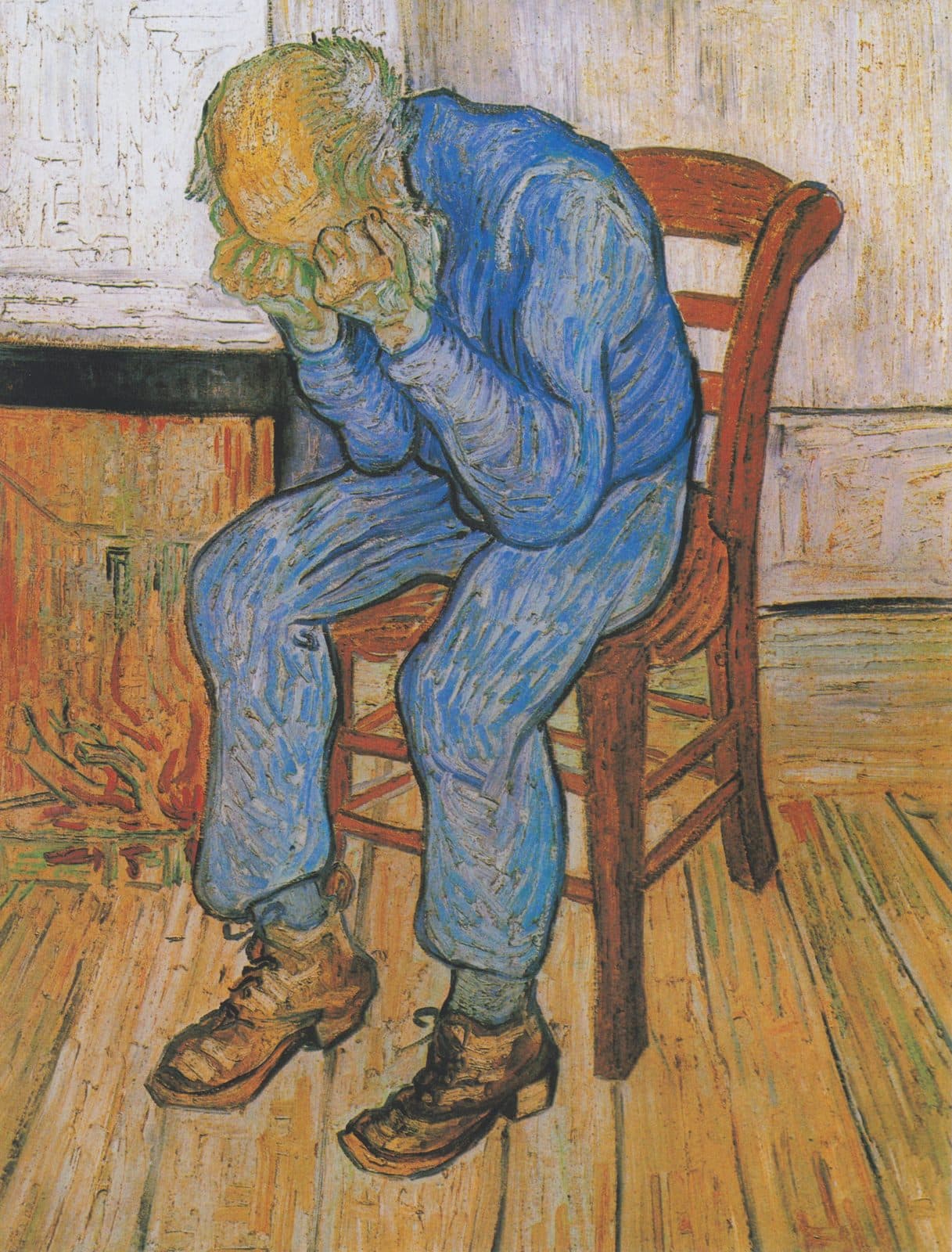
Psalm 31 · Subject · Grief and Loss
Grief and the Body
Eight studies of bereavement measured the heart, the immune system, sleep and lasting grief after a death.
A psalmist in affliction wrote, "I have eaten ashes like bread and mixed my drink with tears" (Psalm 102:9).
Be merciful to me, O LORD, for I am in distress; my eyes fail from sorrow, my soul and body as well.
- Book
- Psalms
Summary
Scripture speaks of grief in the eyes, the bones and the appetite, and medical research has since measured what a death does to those who mourn. The studies find the heart, the immune response and sleep all affected in groups of the bereaved, and a lasting, disabling grief in a minority. Those findings confirm the weight of grief that the psalmists carried to God.
- In a review in the Lancet, Margaret Stroebe and her colleagues wrote that grief is not a disease and that most people adjust without professional help.
- Bereavement is linked with a raised risk of death and of heart attack, sharpest in the first day and the first months.
- Prolonged grief disorder now stands in both the DSM-5-TR of 2022 and the ICD-11, and the two manuals measure its time differently.
- Whether lasting grief should be named a disorder is disputed among the researchers themselves.
What Scripture Says of Grief in the Body
Psalms 6, 31 and 102 and Lamentations 3 speak of failing eyes, wasting bones and a lost appetite.
The question here is what grief does to the body and the mind, and what the medical research on bereavement adds to what Scripture says of it. The question belongs to the trial of grief and loss, because the mourners of the psalms speak of their bodies as well as their souls, and the bereaved today often feel the same.
The page sets the studies side by side, explains how a raised risk should be read, separates ordinary grief from the disorder the diagnostic manuals now name, and states what the research leaves unmeasured. Scripture stands first, as the ground.
In the next verse of Psalm 31 the singer says, "For my life is consumed with grief and my years with groaning" (Psalm 31:10). In Psalm 6 the failing of the eyes is named again: "My eyes fail from grief" (Psalm 6:7).
For my days vanish like smoke, and my bones burn like glowing embers. My heart is afflicted, and withered like grass; I even forget to eat my bread. Through my loud groaning my flesh clings to my bones.The prayer of an afflicted man names the bones, the heart, the appetite and the flesh in three verses, so grief is described in the whole body.
The poet of Lamentations, writing after the fall of Jerusalem, says of the LORD's hand on him, "He has worn away my flesh and skin; He has shattered my bones" (Lamentations 3:4).
Eight Studies Side by Side
The studies were published between 2005 and 2021.
Four studies tie bereavement and sudden stress to the heart and to death, and one puts the prevalence of prolonged grief disorder near one bereaved adult in ten.
| Study | Who or what was studied | What was found |
|---|---|---|
| Moon, Kondo, Glymour and Subramanian, PLoS One, 2011 | A meta-analysis of 15 prospective cohort studies of 2,263,888 people | Widowhood raised the risk of death, with a relative risk of 1.41 in the first six months and 1.14 after; for men 1.23, and for women 1.04, which did not differ significantly from no effect |
| Mostofsky, Maclure, Sherwood, Tofler, Muller and Mittleman, Circulation, 2012 | 1,985 patients interviewed in hospital after a heart attack between 1989 and 1994 | Heart attacks began 21.1 times more often in the 24 hours after the death of a significant person, and the rate fell on each day after |
| Wittstein, Thiemann, Lima and seven others, New England Journal of Medicine, 2005 | 19 patients whose heart muscle failed after sudden emotional stress | Severe weakness of the left ventricle that resolved in all of them; 18 of the 19 had no significant coronary disease; median age 63, and 95 percent were women |
| Templin, Ghadri, Diekmann and colleagues, New England Journal of Medicine, 2015 | 1,750 patients of the International Takotsubo Registry, from 26 centres in Europe and the United States | 89.8 percent were women; an emotional trigger was found in 27.7 percent, a physical trigger in 36.0 percent, and no evident trigger in 28.5 percent |
| Phillips, Carroll, Burns, Ring, Macleod and Drayson, Brain, Behavior, and Immunity, 2006 | 184 older people given the yearly influenza vaccine | Bereavement in the year before was linked with a weaker antibody response at one month to two of the vaccine's three strains |
| Lancel, Stroebe and Eisma, Sleep Medicine Reviews, 2020 | A systematic review of 85 articles on 12,294 participants | Disturbed sleep was common in bereavement and went with more intense grief, and the first evidence pointed to a causal link between grief and sleep |
| Lundorff, Holmgren, Zachariae, Farver-Vestergaard and O'Connor, Journal of Affective Disorders, 2017 | A meta-analysis of 14 studies of adults bereaved by deaths that were not violent | A pooled prevalence of prolonged grief disorder of 9.8 percent |
| Prigerson, Boelen, Xu, Smith and Maciejewski, World Psychiatry, 2021 | 672 bereaved people at Yale, Utrecht and Oxford, first assessed 12 to 24 months after the loss | The DSM-5-TR criteria proved reliable and stable, and distinct from post-traumatic stress, major depression and generalized anxiety |
Lundorff, Holmgren, Zachariae, Farver-Vestergaard and O'Connor, Journal of Affective Disorders, 2017, Prigerson, Boelen, Xu, Smith and Maciejewski, World Psychiatry, 2021
Reading a Raised Risk
A multiplied risk of a rare event remains a small risk for most people.
Mostofsky's team turned their multiplied risk into numbers of people. Within a week of a death, they estimated one extra heart attack for every 1,394 bereaved people at low cardiac risk, and one for every 320 at high risk. Their abstract concludes that the impact may be greatest among people already at high cardiovascular risk.
The heart failure of Wittstein's patients is the condition cardiologists call takotsubo or stress cardiomyopathy. His team judged that "exaggerated sympathetic stimulation is probably central" to its cause, a surge of the stress hormones called catecholamines, which the team measured in the blood.
Ordinary Grief and Prolonged Grief
The diagnostic manuals separate the grief most people pass through from a grief that disables a life.
Stroebe's review found that bereavement is linked with ill health and with more use of medical services. It set apart a few people for whom "mental disorders or complications in the grieving process ensue" from the many who adjust. Prigerson's team described prolonged grief disorder as "an attachment disturbance featuring yearning for the deceased, loss of meaning and identity disruption."
The time each manual requiresDSM-5-TR and ICD-11, as Eisma prints them
The DSM-5-TR requires "The death, at least 12 months ago, of a person who was close to the bereaved (for children and adolescents, at least 6 months ago)" before the diagnosis is made. The ICD-11 asks that the grief response has "persisted for an atypically long period of time following the loss" and does not count a grief of less than six months. In its words, such responses "should not be regarded as meeting this requirement."
Sleep and the Immune System
Two studies looked past the heart to the body's defences and its rest.
In the vaccine study, other stressful events and the amount of social support made no measured difference to the antibody response, while bereavement and marriage did. The review of sleep found that no treatment study had yet aimed at the sleep problems of the bereaved, though grief therapy improved sleep in part.
The Limits of the Research
The studies measure risks across groups and associations over time.
A raised risk across a group cannot say what will happen to one widow or one grieving father. The takotsubo registry shows grief as one trigger among several, and the authors of the widowhood analysis call for study of the mechanisms behind the effect they measured.
Chest pain after a death, sleep that does not return, thoughts of self-harm, or grief that disables a life for months are reasons to see a doctor at once. Prayer belongs beside that care.
Should Lasting Grief Be a Diagnosis?
Researchers who built the criteria and a researcher who questions them disagree on the evidence and the risks.
For the diagnosisPrigerson, Boelen, Xu, Smith and Maciejewski, World Psychiatry, 2021
In the validation data of Prigerson, Boelen, Xu, Smith and Maciejewski, the diagnosis went with depression, post-traumatic stress, suicidal thinking and impaired functioning, both at the first assessment and months later. They argue that the symptoms of prolonged grief "can endure, prove distressing and disabling, and require targeted treatment."
Against the present criteriaEisma, Australian and New Zealand Journal of Psychiatry, 2023
Eisma lists concerns about "the medicalization of grief, development and adverse effects of pharmacotherapy and stigmatization" and asks that the two sets of criteria be brought together. He names "an important gap in the validity evidence: the distinction of prolonged grief disorder from normal grief."
Near to the Brokenhearted
The comfort the psalms give rests on who the LORD is.
The psalms that name grief in the body are prayers addressed to God, and Psalm 34 tells the mourner where the LORD stands.
The LORD is near to the brokenhearted; He saves the contrite in spirit.The verse places the LORD beside the brokenhearted, the ground of comfort that no study measures.
Sources
Scripture is the Berean Standard Bible.
- Margaret Stroebe, Henk Schut and Wolfgang Stroebe, Health outcomes of bereavement, Lancet 370, no. 9603 (2007): 1960 to 1973.
- John Robert Moon, Naoki Kondo, M. Maria Glymour and S. V. Subramanian, Widowhood and mortality: a meta-analysis, PLoS One 6, no. 8 (2011): e23465.
- Elizabeth Mostofsky, Malcolm Maclure, Jane B. Sherwood, Geoffrey H. Tofler, James E. Muller and Murray A. Mittleman, Risk of acute myocardial infarction after the death of a significant person in one's life: the Determinants of Myocardial Infarction Onset Study, Circulation 125, no. 3 (2012): 491 to 496.
- Ilan S. Wittstein and nine others, Neurohumoral features of myocardial stunning due to sudden emotional stress, New England Journal of Medicine 352, no. 6 (2005): 539 to 548.
- Christian Templin and others, Clinical features and outcomes of takotsubo (stress) cardiomyopathy, New England Journal of Medicine 373, no. 10 (2015): 929 to 938.
- Anna C. Phillips, Douglas Carroll, Victoria E. Burns, Christopher Ring, John Macleod and Mark Drayson, Bereavement and marriage are associated with antibody response to influenza vaccination in the elderly, Brain, Behavior, and Immunity 20, no. 3 (2006): 279 to 289.
- Marike Lancel, Margaret Stroebe and Maarten C. Eisma, Sleep disturbances in bereavement: a systematic review, Sleep Medicine Reviews 53 (2020): 101331.
- Marie Lundorff, Helle Holmgren, Robert Zachariae, Ingeborg Farver-Vestergaard and Maja O'Connor, Prevalence of prolonged grief disorder in adult bereavement: a systematic review and meta-analysis, Journal of Affective Disorders 212 (2017): 138 to 149.
- Holly G. Prigerson, Paul A. Boelen, Jiehui Xu, Kirsten V. Smith and Paul K. Maciejewski, Validation of the new DSM-5-TR criteria for prolonged grief disorder and the PG-13-Revised (PG-13-R) scale, World Psychiatry 20, no. 1 (2021): 96 to 106.
- Maarten C. Eisma, Prolonged grief disorder in ICD-11 and DSM-5-TR: challenges and controversies, Australian and New Zealand Journal of Psychiatry 57, no. 7 (2023): 944 to 951, Table 1.
Keep Studying
Doctrines4
In this trial6
Trials of life1