

Warrior
David
King, Man After God's Heart · United Kingdom · c. 1040-970 BC
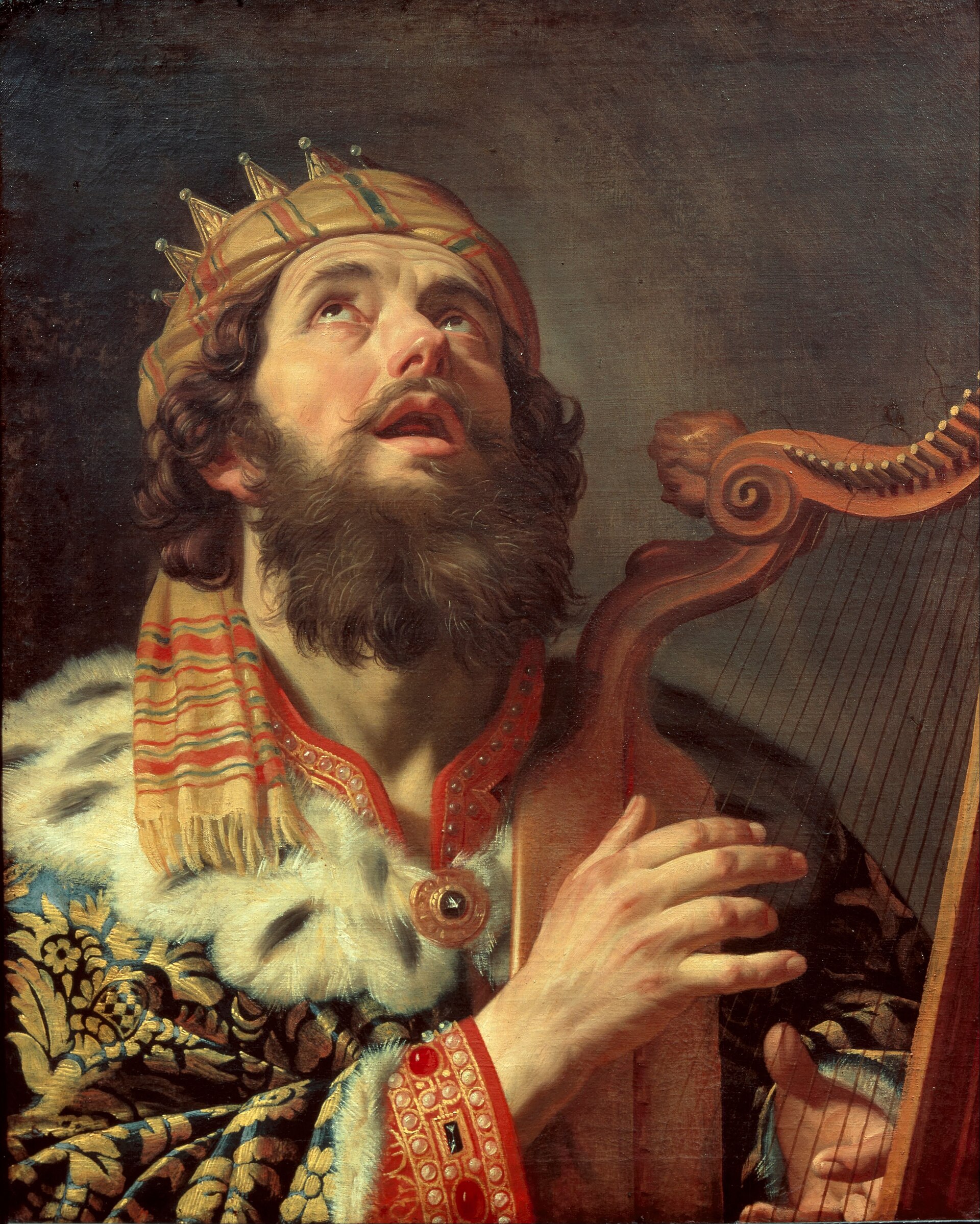
King David Playing the Harp, Gerard van Honthorst
Summary
David was Israel's greatest king, a warrior, poet, and man after God's own heart. Despite grievous sins, his repentance and devotion made him the model for all kings and the ancestor of Christ.
- David was anointed king while he was still out with the sheep, and about fifteen years passed between the horn of oil and a crown.
- He would not take the throne by killing for it, and he spared Saul twice while his own men told him God had handed the king over.
- God promised him at 2 Samuel 7 that his house and his throne would stand forever, and Gabriel carries that promise to Christ at Luke 1:32-33.
- The same books record that he took Uriah's wife and had Uriah killed to cover it, and 2 Samuel 11:27 gives the verdict in one sentence.
- Nathan told him a story about a poor man's lamb, he answered in six words, and Psalm 51 is that confession at length.
On this page
Start here
But now your kingdom will not endure; the LORD has sought a man after His own heart and appointed him ruler over His people, because you have not kept the command of the LORD.”
1 Samuel 13:14→- 7 key events in order
- 908 verses name David, across 28 books
In Scripture
- Verses
- 908
- Books
- 28
David
- Role
- King, Man After God's Heart
- Era
- United Kingdom
- Dates
- c. 1040-970 BC
- Tribe
- Judah
- Father
- Jesse
- Mother
- Unknown
- Spouse
- Michal, Abigail, Bathsheba, others
- Children
- Amnon, Absalom, Solomon, many others
The life in order
in the order the canon tells it
- Samuel is sent to Bethlehem with a horn of oil1 Samuel 16:1Now the LORD said to Samuel, “How long are you going to mourn for Saul, since I have rejected him as king over Israel? Fill your horn with oil and go. I am sending you to Jesse of Bethlehem, for I have selected from his sons a king for Myself.”
- The LORD looks at the heart, not at the height1 Samuel 16:7But the LORD said to Samuel, “Do not consider his appearance or height, for I have rejected him; the LORD does not see as man does. For man sees the outward appearance, but the LORD sees the heart.”
- Anointed among his brothers, and Samuel goes home to Ramah1 Samuel 16:13So Samuel took the horn of oil and anointed him in the presence of his brothers, and the Spirit of the LORD rushed upon David from that day forward. Then Samuel set out and went to Ramah.
- He answers the Philistine champion in the name of the LORD of Hosts1 Samuel 17:45But David said to the Philistine, “You come against me with sword and spear and javelin, but I come against you in the name of the LORD of Hosts, the God of the armies of Israel, whom you have defied.
- Jonathan's soul is knit to his1 Samuel 18:1After David had finished speaking with Saul, the souls of Jonathan and David were knit together, and Jonathan loved him as himself.
- A fugitive is given the consecrated bread at Nob1 Samuel 21:6So the priest gave him the consecrated bread, since there was no bread there but the Bread of the Presence, which had been removed from before the LORD and replaced with hot bread on the day it was taken away.
- Four hundred distressed men gather to him at Adullam1 Samuel 22:2And all who were distressed or indebted or discontented rallied around him, and he became their leader. About four hundred men were with him.
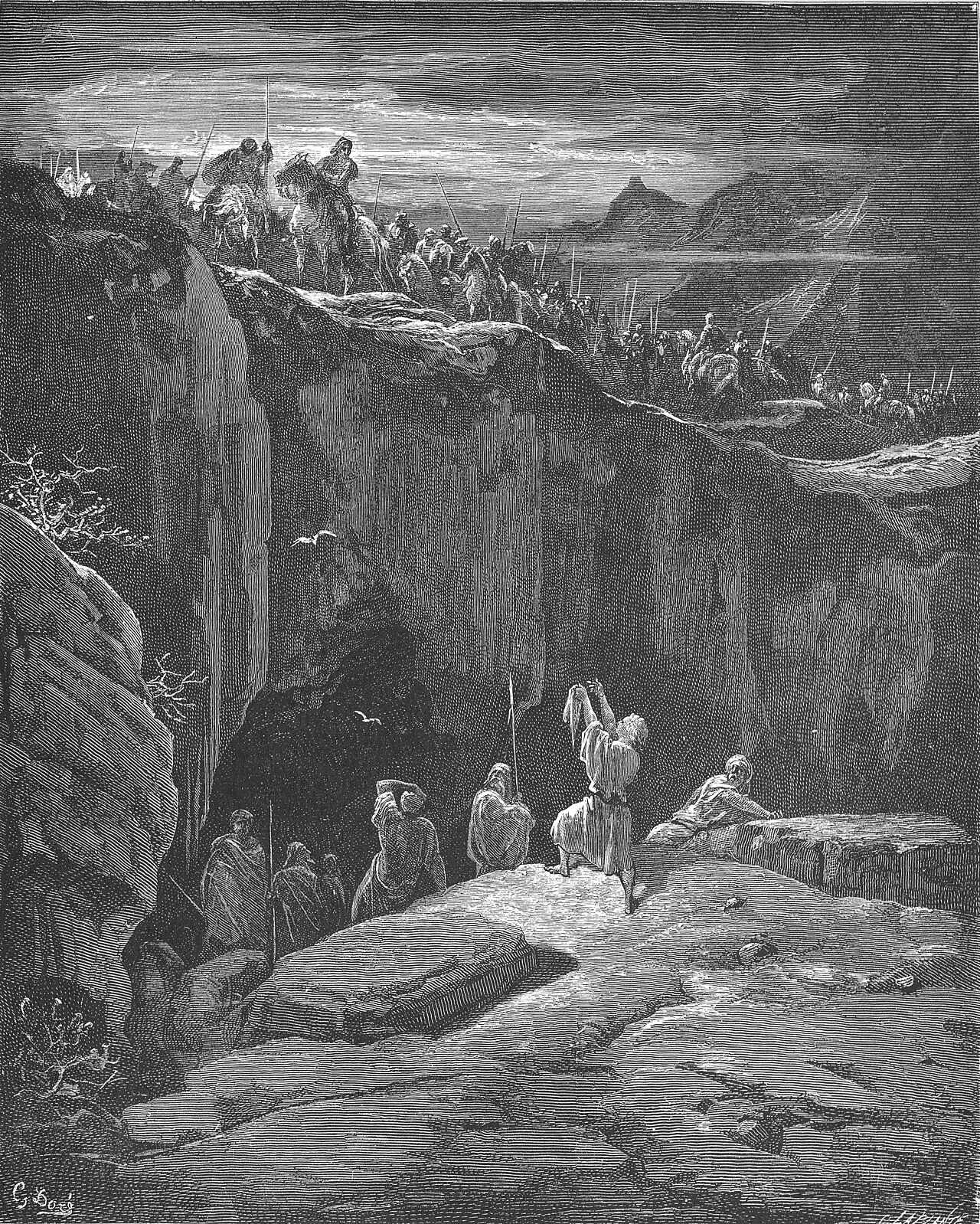
- He spares Saul in the cave and will not lift a hand1 Samuel 24:6So he said to his men, “The LORD forbid that I should do such a thing to my master, the LORD’s anointed. May I never lift my hand against him, since he is the LORD’s anointed.”
- Ziklag is burned and his own men speak of stoning him1 Samuel 30:6And David was greatly distressed because the people spoke of stoning him, because the soul of every man grieved for his sons and daughters. But David found strength in the LORD his God.
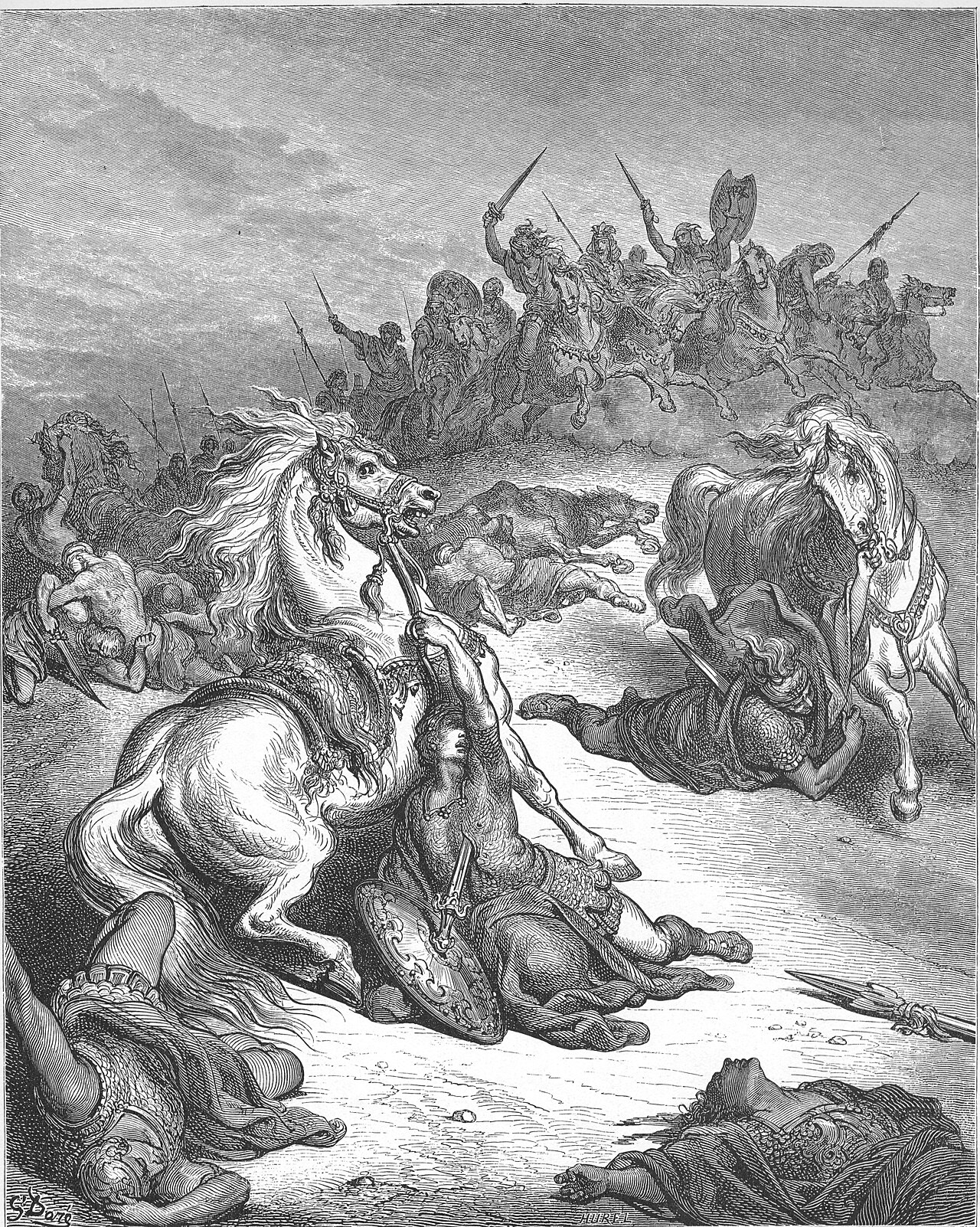
- Saul and his sons die on Mount Gilboa1 Samuel 31:6So Saul, his three sons, his armor-bearer, and all his men died together that same day.
- He laments the king who hunted him and the friend who saved him2 Samuel 1:19“Your glory, O Israel, lies slain on your heights. How the mighty have fallen!
- The men of Judah anoint him king at Hebron2 Samuel 2:4Then the men of Judah came to Hebron, and there they anointed David king over the house of Judah. And they told David, “It was the men of Jabesh-gilead who buried Saul.”
- He captures the fortress of Zion and makes it his capital2 Samuel 5:7Nevertheless, David captured the fortress of Zion (that is, the City of David).
- He dances before the ark in a linen ephod2 Samuel 6:14And David, wearing a linen ephod, danced with all his might before the LORD,
- The promise: his house and his throne will stand forever2 Samuel 7:16Your house and kingdom will endure forever before Me, and your throne will be established forever.”
- Mephibosheth eats at the king's table for Jonathan's sake2 Samuel 9:7“Do not be afraid,” said David, “for surely I will show you kindness for the sake of your father Jonathan. I will restore to you all the land of your grandfather Saul, and you will always eat at my table.”
- He weeps for Absalom at the gate2 Samuel 18:33The king was shaken and went up to the gate chamber and wept. And as he walked, he cried out, “O my son Absalom! My son, my son Absalom! If only I had died instead of you, O Absalom, my son, my son!”
- He longs for water from the well at Bethlehem2 Samuel 23:15David longed for water and said, “Oh, that someone would get me a drink of water from the well near the gate of Bethlehem!”
- He refuses to offer God what costs him nothing2 Samuel 24:24“No,” replied the king, “I insist on paying a price, for I will not offer to the LORD my God burnt offerings that cost me nothing.” So David bought the threshing floor and the oxen for fifty shekels of silver.
- He swears the throne to Solomon1 Kings 1:30I will carry out this very day exactly what I swore to you by the LORD, the God of Israel: Surely your son Solomon will reign after me, and he will sit on my throne in my place.”
Why David matters
David was the youngest son of a Bethlehem farmer, and Scripture introduces him as the son nobody thought to call in from the field. Samuel came to the house with a horn of oil, seven brothers walked past the prophet, and the LORD said of the oldest that He does not see as man sees. The son who was sent for was anointed in front of his family, and then he went back to the sheep. The crown took about fifteen years to reach him. He came to the army carrying food to his brothers and left it as the man who had killed the Philistine champion. He married into Saul's family, served at Saul's court, and then spent years running from Saul through the caves and border towns of Judah with four hundred distressed and indebted men behind him. Twice he had the king asleep in front of him and twice he refused, and both times the argument for killing came from his own men and was dressed as God's providence. He was thirty at his coronation and he reigned forty years, seven of them at Hebron over Judah alone and thirty-three at Jerusalem over the whole nation. He took the fortress of Zion from the Jebusites and made it his capital. He brought the ark of God up to that city, dancing in front of it in a linen ephod while his wife watched from a window and despised him for it. Then God made him a promise. David wanted to build a house for the ark, and 2 Samuel 7 turns the offer around. God would build David a house instead, a descendant from his own body, a throne established forever, and a loving devotion that would not be taken away as it had been taken from Saul. David went in and sat down before the LORD to answer it, which no other man in the Hebrew Bible does. What he got right is written down. He fought for God's name rather than his own reputation. He mourned the man who hunted him in the same poem as the friend who saved him. He kept an oath sworn to Jonathan by seating Jonathan's lame son at his own table for life, years after Jonathan died. He corrected the ark procession the moment he learned what he had done wrong. He refused to drink water three men had risked their lives to fetch, and he refused a free threshing floor because he would not offer God something that cost him nothing. What he got wrong is written down in the same books and at the same weight. He stayed home from the war, sent for another man's wife, and then had her husband killed to hide what he had done, and the narrator ends that chapter by saying the thing David had done was evil in the sight of the LORD. He lied at Nob and eighty-five priests died for it, and he said out loud that their blood was on him. He counted his fighting men and called the act foolish afterward. He was furious when Amnon violated Tamar and he did nothing, and Absalom's revenge and revolt grew out of that silence. When Nathan told him the story of the poor man's lamb, David pronounced the sentence on the guilty man himself: he must pay for the lamb four times over. Four of David's own sons died before he did: the infant of 2 Samuel 12:14, then Amnon, then Absalom, then Adonijah, put to death in the first days of Solomon's reign. He wrote a large part of Israel's hymnbook, and the psalms that carry his name run from Psalm 23 through Psalm 51 to the psalms the New Testament reads of Christ. He died old and was buried in the city he had taken. Long after the throne in Jerusalem went dark, the promise made to him kept being quoted, and the New Testament opens by calling Jesus the son of David and closes with Jesus calling Himself the Root and the Offspring of David.
Biography
David, the youngest son of Jesse of Bethlehem, was anointed by Samuel while still a shepherd boy, chosen when God rejected Saul. His rise began when he slew the giant Goliath with a sling and stone, declaring, "The battle is the LORD's." Under Saul, David's early years held it all at once — success in battle, a deep friendship with Jonathan, and relentless persecution from the king he served. Saul's jealousy drove David into exile, where he gathered a band of outcasts who became his mighty men. Twice David spared Saul's life, refusing to harm "the LORD's anointed." After Saul died, David became king — first over Judah, then over all Israel. He conquered Jerusalem, brought the ark to the city, and received God's promise that his throne would last forever. His reign united the tribes and secured the borders; many call it Israel's golden age, though Scripture gives the wealth and the great building to his son Solomon. Yet David's great sin with Bathsheba and murder of Uriah brought devastating consequences. The prophet Nathan confronted him, and David's repentant psalm (Psalm 51) became the model of confession. Forgiveness came, but the consequences still followed: the death of their child, a fractured family, and his own son Absalom's rebellion. David is remembered as Israel's ideal king, the sweet psalmist of Israel, and the ancestor of Christ. His life demonstrates that God's grace is greater than our failures—though consequences remain.
But now your kingdom will not endure; the LORD has sought a man after His own heart and appointed him ruler over His people, because you have not kept the command of the LORD.”
God chose a man after His own heart
The roof, the letter, and the prophet
2 Samuel 11 and 12, in the order it happens
- The army goes out and the king stays home2 Samuel 11:1In the spring, at the time when kings march out to war, David sent out Joab and his servants with the whole army of Israel. They destroyed the Ammonites and besieged Rabbah, but David remained in Jerusalem.
- He sees her, and he is told whose wife she is2 Samuel 11:2-3One evening David got up from his bed and strolled around on the roof of the palace. And from the roof he saw a woman bathing—a very beautiful woman. So David sent and inquired about the woman, and he was told, “This is Bathsheba, the daughter of Eliam and the wife of Uriah the Hittite.”
- He sends messengers and takes her2 Samuel 11:4Then David sent messengers to get her, and when she came to him, he slept with her. (Now she had just purified herself from her uncleanness.) Then she returned home.
- Uriah will not sleep in his own house2 Samuel 11:11Uriah answered, “The ark and Israel and Judah are dwelling in tents, and my master Joab and his soldiers are camped in the open field. How can I go to my house to eat and drink and sleep with my wife? As surely as you live, and as your soul lives, I will not do such a thing!”
- The order is carried by the man it kills2 Samuel 11:14-15The next morning David wrote a letter to Joab and sent it with Uriah. In the letter he wrote: “Put Uriah at the front of the fiercest battle; then withdraw from him, so that he may be struck down and killed.”
- The verdict, in one sentence2 Samuel 11:27And when the time of mourning was over, David had her brought to his house, and she became his wife and bore him a son. But the thing that David had done was evil in the sight of the LORD.
- Nathan tells him about a poor man's lamb2 Samuel 12:3but the poor man had nothing except one small ewe lamb that he had bought. He raised it, and it grew up with him and his children. It shared his food and drank from his cup; it slept in his arms and was like a daughter to him.
- You are that man2 Samuel 12:7Then Nathan said to David, “You are that man! This is what the LORD, the God of Israel, says: ‘I anointed you king over Israel, and I delivered you from the hand of Saul.
- I have sinned against the LORD2 Samuel 12:13Then David said to Nathan, “I have sinned against the LORD.” “The LORD has taken away your sin,” Nathan replied. “You will not die.
- The same confession at lengthPsalms 51:3-4For I know my transgressions, and my sin is always before me. Against You, You only, have I sinned and done what is evil in Your sight, so that You may be proved right when You speak and blameless when You judge.
This is a chain of decisions rather than one bad night. The king stays home, he sends, he takes, he tries to cover it, and when the cover-up fails he writes the order that kills the man and sends it to his commander Joab by Uriah's own hand. Between the conception and Nathan's visit the child is carried nearly to term, so the silence lasted the better part of a year. The narrator withholds every word of comment for twenty-six verses and then spends one sentence. He gives Bathsheba three verbs in the whole chapter, she came, she conceived, and she mourned her husband, while almost every other verb in it belongs to David. Psalm 51 carries the superscription tying it to Nathan's visit, and the last beat prints two of its verses. The public domain art this site holds has no image of Bathsheba, of Uriah, or of Nathan confronting the king, so this account runs on the text alone.
David and Bathsheba: the full studyKey events
- 1Anointed by Samuel1 Samuel 16:1-13→
Samuel anointed the youngest son of Jesse
Read the verse here
1 Samuel 16:1-13Now the LORD said to Samuel, “How long are you going to mourn for Saul, since I have rejected him as king over Israel? Fill your horn with oil and go. I am sending you to Jesse of Bethlehem, for I have selected from his sons a king for Myself.”
- 2Defeated Goliath1 Samuel 17:32-51→
Killed the giant with a sling and stone
Read the verse here
1 Samuel 17:32-51And David said to Saul, “Let no man’s heart fail on account of this Philistine. Your servant will go and fight him!”
- 3Spared Saul twice1 Samuel 24, 26→
Refused to kill the LORD's anointed
- 4Made king2 Samuel 5:1-5→
All Israel made David king
Read the verse here
2 Samuel 5:1-5Then all the tribes of Israel came to David at Hebron and said, “Here we are, your own flesh and blood.
- 5Davidic covenant2 Samuel 7:12-16→
God promised David an eternal throne
Read the verse here
2 Samuel 7:12-16And when your days are fulfilled and you rest with your fathers, I will raise up your descendant after you, who will come from your own body, and I will establish his kingdom.
- 6Sin with Bathsheba2 Samuel 11→
Committed adultery and arranged Uriah's death
- 7Absalom's rebellion2 Samuel 15-18→
David's son rebelled and died
More key verses
Text: Berean Standard Bible.
“Create in me a clean heart, O God, and renew a right spirit within me.”
“After removing Saul, He raised up David as their king and testified about him: ‘I have found David son of Jesse a man after My own heart; he will carry out My will in its entirety.’”
What they got right, and what they got wrong
Strengths
Heart devoted to God, courage in battle, leadership ability, musical and poetic gifts, deep repentance
Weaknesses
Adultery with Bathsheba, murder of Uriah, failed to discipline sons, pride in numbering Israel
Lessons
God looks at the heart, not at what a person looks like from the outside. Even great saints can fall hard — and real repentance brings them back, though the consequences do not simply disappear.
Spiritual significance
David exemplifies a heart for God that repents when confronted with sin. His life shows that God's grace is greater than our failures, though consequences remain.
How David points to Jesus
The promise of 2 Samuel 7 is where the line to Christ starts, and the New Testament draws it in its own words. Gabriel tells Mary, He will be great and will be called the Son of the Most High. The Lord God will give Him the throne of His father David, and He will reign over the house of Jacob forever. His kingdom will never end!” Hebrews 1:5 sets Psalm 2:7 beside the father and son line of 2 Samuel 7:14 and applies both to the Son. I will be his Father, and he will be My son. When he does wrong, I will discipline him with the rod of men and with the blows of the sons of men. Tertullian was already reading the promise past Solomon in the early third century, in Against Marcion, on the ground that a throne forever and a house built for God's Name suit Christ rather than a temporal king. Basil of Caesarea read the throne of David in the fourth century as the indestructible kingdom the Lord sits on, and noted that by the time Christ came the kingdom of Judea had passed to Herod. The New Testament calls Jesus the son of David more often than it calls Him almost anything else. Matthew opens with it. This is the record of the genealogy of Jesus Christ, the son of David, the son of Abraham: Four verses later the genealogy refuses to tidy the story up. and Jesse the father of David the king. Next: David was the father of Solomon by Uriah’s wife, Paul begins Romans with a descendant of David according to the flesh. Revelation closes the canon with Jesus naming Himself twice over. Then one of the elders said to me, “Do not weep! Behold, the Lion of the tribe of Judah, the Root of David, has triumphed to open the scroll and its seven seals.” “I, Jesus, have sent My angel to give you this testimony for the churches. I am the Root and the Offspring of David, the bright Morning Star.” He is the source David came from and the descendant who came from David, which is the point Jesus Himself pressed at Matthew 22:41-45 when He asked how David could call his own son Lord. The psalms carry the same weight in the New Testament's hands. Jesus quotes Psalm 110:1 at Matthew 22:44, Peter quotes it at Pentecost, and the letters return to it again and again. The LORD said to my Lord: “Sit at My right hand until I make Your enemies a footstool for Your feet.” Psalm 22 supplies the cry from the cross at 22:1 and the dividing of the garments at 22:18, and the Gospels quote both at the crucifixion. Peter's argument at Acts 2:29-31 is the plainest case of all. David's tomb was still in Jerusalem, so the psalm he wrote was not about himself. Foreseeing this, David spoke about the resurrection of the Christ, that He was not abandoned to Hades, nor did His body see decay. The shepherd runs through the life before any commentator touches it. God says He took David from the pasture: Now then, you are to tell My servant David that this is what the LORD of Hosts says: I took you from the pasture, from following the flock, to be the ruler over My people Israel. Chronicles puts it as a charge. Even in times past, while Saul was king, you were the one who led Israel out and brought them back. And the LORD your God said, ‘You will shepherd My people Israel, and you will be ruler over them.’” In the census David uses the figure of himself and of the nation: When David saw the angel striking down the people, he said to the LORD, “Surely I, the shepherd, have sinned and acted wickedly. But these sheep, what have they done? Please, let Your hand fall upon me and my father’s house.” Psalm 23 is a shepherd's psalm written by a shepherd about the LORD, and it opens The LORD is my shepherd; I shall not want. Ezekiel names the figure directly, centuries after David's death: I will appoint over them one shepherd, My servant David, and he will feed them. He will feed them and be their shepherd. John 10 takes the figure to Christ. Origen read Psalm 23:4 in the middle of the third century as movement rather than settlement, a man walking through the shadow and not sitting down in it, because the Lord goes through it with him. The early Christian readings are named here with their centuries rather than with a single year, because the dates of several of these works could not be confirmed in this lane. Justin Martyr read the promise to David as fulfilled in Christ in the second century. Hippolytus of Rome read the prayer of Psalm 51:10 in the early third century as a prayer for the Holy Spirit, and set it beside Pentecost. Cyril of Jerusalem held David up in the fourth century as the catechumen's example of repentance. Ambrose of Milan used Nathan's word to David as a rebuke to an emperor in the late fourth century. Augustine of Hippo read Psalm 51 in the fifth century as the model of penitence, and set David's confession beside Saul's identical words. None of this moves the promise away from Israel. Psalm 89:34 has God refuse to break what He swore. I will not violate My covenant or alter the utterance of My lips. The covenant with David's line is not transferred to anyone, and this site does not teach that the church has replaced Israel. Where a reading here is typological it is presented as a reading, offered by named men. Where this site teaches a coming visible reign of Christ on David's throne it teaches it as this site's tradition, in the same words its Revelation and end times pages use, and never as a verdict stamped on a reader.
David's kingdom points forward to Christ's. Jesus is called the "Son of David" — the shepherd boy who became king pictures the Good Shepherd who reigns forever. Charles Spurgeon reads the shepherd psalms this way throughout The Treasury of David.
The voices
each quoted from the work named
This character was given of him before he was first anointed, 1 Sam. xiii. The Lord hath sought out a man after his own heart, such a one as he would have. Thirdly, That his conduct was divine, and under divine direction: He shall fulfil all my will.
The Lord’s anointed - However unworthily Saul was now acting, he had been appointed to his high office by God himself, and he could only be removed by the authority which placed him on the throne. Even David, who knew he was appointed to reign in his stead, and whose life Saul had often sought to destroy, did not conceive that he had any right to take away his life; and he grounds the reasons of his forbearance on this - He is my master, I am his subject.
That new dispensation, then, which is found in Christ now, will prove to be what the Creator then promised under the appellation of "the sure mercies of David," which were Christ's, inasmuch as Christ sprang from David, or rather his very flesh itself was David's "sure mercies," consecrated by religion, and "sure" after its resurrection. Accordingly the prophet Nathan, in the first [book] of Kings [Samuel], makes a promise to David for his seed, "which shall proceed," he says, "from your own body." Now, if you explain this simply of Solomon, you will send me into a fit of laughter. For David will evidently have brought forth Solomon! But is not Christ here designated the seed of David, as of that womb which was derived from David, that is, Mary's? Now, because Christ rather than any other was to build the temple of God, that is to say, a holy manhood, wherein God's Spirit might dwell as in a better temple, Christ rather than David's son Solomon was to be looked for as the Son of God. Then, again, the throne forever with the kingdom forever is more suited to Christ than to Solomon, a mere temporal king.
4 more teachers on these versesGregory the Dialogist · Augustine of Hippo · Charles Spurgeon · John Wesley
But sometimes, when the powerful of this world are taken to task, they are first to be searched by certain similitudes, as on a matter not concerning them; and, when they have pronounced a right sentence as against another man, then in fitting ways they are to be smitten with regard to their own guilt; so that the mind puffed up with temporal power may in no wise lift itself up against the reprover, having by its own judgment trodden on the neck of pride, and may not try to defend itself, being bound by the sentence of its own mouth.
Similarity of words, dissimilarity of hearts. We may hear the similarity of the words with our ears, but we can only know the dissimilarity of hearts by the angel's declaration. David sinned, and when he was rebuked by the prophet, he said, "I have sinned," and was immediately told, "Your sin has been forgiven you." Saul sinned, and when he was rebuked by the prophet, he said, "I have sinned," and his sin was not forgiven, but the wrath of God remained upon him. What can this mean but similarity of words, dissimilarity of hearts? Human beings can hear words, God inspects hearts.
Have mercy upon me, O God. He appeals at once to the mercy of God, even before he mentions his sin. The sight of mercy is good for eyes that are sore with penitential weeping. Pardon of sin must ever be an act of pure mercy, and therefore to that attribute the awakened sinner flies. "According to thy lovingkindness." Act, O Lord, like thyself; give mercy like thy mercy. Show mercy such as is congruous with thy grace.
Thee only - Which is not to be, understood absolutely, because he had sinned against Bathsheba and Uriah, and many others; but comparatively. So the sense is, though I have sinned against my own conscience, and against others; yet nothing is more grievous to me, than that I have sinned against thee.
David in Scripture
Open a book to read its mentions here. Text: Berean Standard Bible. Names repeat in Scripture, so some of these verses may speak of another person called David. The two marks are drawn from the chapters this page's own references stand in.
Old TestamentNew Testamentsegment width = share of mentions
Old Testament19 books · 853 mentions
Ruth2 mentions
1 Samuel234 mentions
- 1 Samuel 16:13So Samuel took the horn of oil and anointed him in the presence of his brothers, and the Spirit of the LORD rushed upon David from that day forward. Then Samuel set out and went to Ramah.
- 1 Samuel 16:19So Saul sent messengers to Jesse and said, “Send me your son David, who is with the sheep.”
- 1 Samuel 16:20And Jesse took a donkey loaded with bread, a skin of wine, and one young goat, and sent them to Saul with his son David.
- 1 Samuel 16:21When David came to Saul and entered his service, Saul admired him greatly, and David became his armor-bearer.
- 1 Samuel 16:22Then Saul sent word to Jesse, saying, “Let David remain in my service, for I am pleased with him.”
229 further mentions in 1 Samuel, read them in the book.
2 Samuel226 mentions
- 2 Samuel 1:1After the death of Saul, David returned from the slaughter of the Amalekites and stayed in Ziklag two days.
- 2 Samuel 1:2On the third day a man with torn clothes and dust on his head arrived from Saul’s camp. When he came to David, he fell to the ground to pay him homage.
- 2 Samuel 1:3“Where have you come from?” David asked. “I have escaped from the Israelite camp,” he replied.
- 2 Samuel 1:4“What was the outcome?” David asked. “Please tell me.” “The troops fled from the battle,” he replied. “Many of them fell and died. And Saul and his son Jonathan are also dead.”
- 2 Samuel 1:5Then David asked the young man who had brought him the report, “How do you know that Saul and his son Jonathan are dead?”
221 further mentions in 2 Samuel, read them in the book.
1 Kings75 mentions
- 1 Kings 1:1Now King David was old and well along in years, and though they covered him with blankets, he could not keep warm.
- 1 Kings 1:5At that time Adonijah, David’s son by Haggith, began to exalt himself, saying, “I will be king!” And he acquired chariots and horsemen and fifty men to run ahead of him.
- 1 Kings 1:8But Zadok the priest, Benaiah son of Jehoiada, Nathan the prophet, Shimei, Rei, and David’s mighty men would not join Adonijah.
- 1 Kings 1:11Then Nathan said to Bathsheba the mother of Solomon, “Have you not heard that Adonijah son of Haggith has become king, and our lord David does not know it?
- 1 Kings 1:13Go at once to King David and say, ‘My lord the king, did you not swear to your maidservant, “Surely your son Solomon will reign after me, and he will sit on my throne”? Why then has Adonijah become king?’
70 further mentions in 1 Kings, read them in the book.
2 Kings18 mentions
- 2 Kings 8:19Yet for the sake of His servant David, the LORD was unwilling to destroy Judah, since He had promised to maintain a lamp for David and his descendants forever.
- 2 Kings 8:24And Jehoram rested with his fathers and was buried with them in the City of David. And his son Ahaziah reigned in his place.
- 2 Kings 9:28Then his servants carried him by chariot to Jerusalem and buried him with his fathers in his tomb in the City of David.
- 2 Kings 11:10Then the priest gave to the commanders of hundreds the spears and shields of King David from the house of the LORD.
- 2 Kings 12:21His servants Jozabad son of Shimeath and Jehozabad son of Shomer struck him down, and he died. And they buried him with his fathers in the City of David, and his son Amaziah reigned in his place.
13 further mentions in 2 Kings, read them in the book.
1 Chronicles168 mentions
- 1 Chronicles 2:15Ozem sixth, and David seventh.
- 1 Chronicles 3:1These were the sons of David who were born to him in Hebron: The firstborn was Amnon by Ahinoam of Jezreel; the second was Daniel by Abigail of Carmel;
- 1 Chronicles 3:4These six sons were born to David in Hebron, where he reigned seven years and six months. And David reigned in Jerusalem thirty-three years,
- 1 Chronicles 3:6David’s other sons were Ibhar, Elishua, Eliphelet,
- 1 Chronicles 3:9These were all the sons of David, besides the sons by his concubines. And Tamar was their sister.
163 further mentions in 1 Chronicles, read them in the book.
2 Chronicles66 mentions
- 2 Chronicles 1:1Now Solomon son of David established himself securely over his kingdom, and the LORD his God was with him and highly exalted him.
- 2 Chronicles 1:4Now David had brought the ark of God from Kiriath-jearim to the place he had prepared for it, because he had pitched a tent for it in Jerusalem.
- 2 Chronicles 1:8Solomon replied to God: “You have shown much loving devotion to my father David, and You have made me king in his place.
- 2 Chronicles 1:9Now, O LORD God, let Your promise to my father David be fulfilled. For You have made me king over a people as numerous as the dust of the earth.
- 2 Chronicles 2:3Then Solomon sent word to Hiram king of Tyre: “Do for me as you did for my father David when you sent him cedars to build himself a house to live in.
61 further mentions in 2 Chronicles, read them in the book.
Ezra3 mentions
- Ezra 3:10When the builders had laid the foundation of the temple of the LORD, the priests in their apparel with trumpets, and the Levites (the sons of Asaph) with cymbals, took their positions to praise the LORD, as David king of Israel had prescribed.
- Ezra 8:3from the descendants of David, Hattush of the descendants of Shecaniah; from the descendants of Parosh, Zechariah, and with him were registered 150 men;
- Ezra 8:20They also brought 220 of the temple servants, all designated by name. David and the officials had appointed them to assist the Levites.
Nehemiah7 mentions
- Nehemiah 3:15The Fountain Gate was repaired by Shallun son of Col-hozeh, ruler of the district of Mizpah. He rebuilt it, roofed it, and installed its doors, bolts, and bars. He also repaired the wall of the Pool of Shelah near the king’s garden, as far as the stairs that descend from the City of David.
- Nehemiah 3:16Beyond him, Nehemiah son of Azbuk, ruler of a half-district of Beth-zur, made repairs up to a point opposite the tombs of David, as far as the artificial pool and the House of the Mighty.
- Nehemiah 12:24The leaders of the Levites were Hashabiah, Sherebiah, and Jeshua son of Kadmiel, along with their associates, who stood across from them to give praise and thanksgiving as one section alternated with the other, as prescribed by David the man of God.
- Nehemiah 12:36and his associates—Shemaiah, Azarel, Milalai, Gilalai, Maai, Nethanel, Judah, and Hanani—with the musical instruments prescribed by David the man of God. Ezra the scribe led the procession.
- Nehemiah 12:37At the Fountain Gate they climbed the steps of the City of David on the ascent to the wall and passed above the house of David to the Water Gate on the east.
2 further mentions in Nehemiah, read them in the book.
Psalms14 mentions
- Psalms 18:50Great salvation He brings to His king. He shows loving devotion to His anointed, to David and his descendants forever.
- Psalms 72:20Thus conclude the prayers of David son of Jesse.
- Psalms 78:70He chose David His servant and took him from the sheepfolds;
- Psalms 78:72So David shepherded them with integrity of heart and guided them with skillful hands.
- Psalms 89:3You said, “I have made a covenant with My chosen one, I have sworn to David My servant:
9 further mentions in Psalms, read them in the book.
Proverbs1 mention
Ecclesiastes1 mention
Song of Solomon1 mention
Isaiah10 mentions
- Isaiah 7:2When it was reported to the house of David that Aram was in league with Ephraim, the hearts of Ahaz and his people trembled like trees in the forest shaken by the wind.
- Isaiah 7:13Then Isaiah said, “Hear now, O house of David! Is it not enough to try the patience of men? Will you try the patience of my God as well?
- Isaiah 9:7Of the increase of His government and peace there will be no end. He will reign on the throne of David and over his kingdom, to establish and sustain it with justice and righteousness from that time and forevermore. The zeal of the LORD of Hosts will accomplish this.
- Isaiah 16:5in loving devotion a throne will be established in the tent of David. A judge seeking justice and hastening righteousness will sit on it in faithfulness.
- Isaiah 22:9You saw that there were many breaches in the walls of the City of David. You collected water from the lower pool.
5 further mentions in Isaiah, read them in the book.
Jeremiah15 mentions
- Jeremiah 13:13then you are to tell them that this is what the LORD says: ‘I am going to fill with drunkenness all who live in this land—the kings who sit on David’s throne, the priests, the prophets, and all the people of Jerusalem.
- Jeremiah 17:25then kings and princes will enter through the gates of this city. They will sit on the throne of David, riding in chariots and on horses with their officials, along with the men of Judah and the residents of Jerusalem, and this city will be inhabited forever.
- Jeremiah 21:12O house of David, this is what the LORD says: ‘Administer justice every morning, and rescue the victim of robbery from the hand of his oppressor, or My wrath will go forth like fire and burn with no one to extinguish it because of their evil deeds.
- Jeremiah 22:2saying, ‘Hear the word of the LORD, O king of Judah, who sits on the throne of David—you and your officials and your people who enter these gates.
- Jeremiah 22:4For if you will indeed carry out these commands, then kings who sit on David’s throne will enter through the gates of this palace riding on chariots and horses—they and their officials and their people.
10 further mentions in Jeremiah, read them in the book.
Ezekiel4 mentions
- Ezekiel 34:23I will appoint over them one shepherd, My servant David, and he will feed them. He will feed them and be their shepherd.
- Ezekiel 34:24I, the LORD, will be their God, and My servant David will be a prince among them. I, the LORD, have spoken.
- Ezekiel 37:24My servant David will be king over them, and there will be one shepherd for all of them. They will follow My ordinances and keep and observe My statutes.
- Ezekiel 37:25They will live in the land that I gave to My servant Jacob, where your fathers lived. They will live there forever with their children and grandchildren, and My servant David will be their prince forever.
Hosea1 mention
Amos2 mentions
Zechariah5 mentions
- Zechariah 12:7The LORD will save the tents of Judah first, so that the glory of the house of David and of the people of Jerusalem may not be greater than that of Judah.
- Zechariah 12:8On that day the LORD will defend the people of Jerusalem, so that the weakest among them will be like David, and the house of David will be like God, like the angel of the LORD going before them.
- Zechariah 12:10Then I will pour out on the house of David and on the people of Jerusalem a spirit of grace and prayer, and they will look on Me, the One they have pierced. They will mourn for Him as one mourns for an only child, and grieve bitterly for Him as one grieves for a firstborn son.
- Zechariah 12:12The land will mourn, each clan on its own: the clan of the house of David and their wives, the clan of the house of Nathan and their wives,
- Zechariah 13:1“On that day a fountain will be opened to the house of David and the people of Jerusalem, to cleanse them from sin and impurity.
New Testament9 books · 55 mentions
Matthew15 mentions
- Matthew 1:1This is the record of the genealogy of Jesus Christ, the son of David, the son of Abraham:
- Matthew 1:6and Jesse the father of David the king. Next: David was the father of Solomon by Uriah’s wife,
- Matthew 1:17In all, then, there were fourteen generations from Abraham to David, fourteen from David to the exile to Babylon, and fourteen from the exile to the Christ.
- Matthew 1:20But after he had pondered these things, an angel of the Lord appeared to him in a dream and said, “Joseph, son of David, do not be afraid to embrace Mary as your wife, for the One conceived in her is from the Holy Spirit.
- Matthew 9:27As Jesus went on from there, two blind men followed Him, crying out, “Have mercy on us, Son of David!”
10 further mentions in Matthew, read them in the book.
Mark7 mentions
- Mark 2:25Jesus replied, “Have you never read what David did when he and his companions were hungry and in need?
- Mark 10:47When he heard that it was Jesus of Nazareth, he began to cry out, “Jesus, Son of David, have mercy on me!”
- Mark 10:48Many people admonished him to be silent, but he cried out all the louder, “Son of David, have mercy on me!”
- Mark 11:10“Blessed is the coming kingdom of our father David!” “Hosanna in the highest!”
- Mark 12:35While Jesus was teaching in the temple courts, He asked, “How can the scribes say that the Christ is the Son of David?
2 further mentions in Mark, read them in the book.
Luke12 mentions
- Luke 1:27to a virgin pledged in marriage to a man named Joseph, who was of the house of David. And the virgin’s name was Mary.
- Luke 1:32He will be great and will be called the Son of the Most High. The Lord God will give Him the throne of His father David,
- Luke 1:69He has raised up a horn of salvation for us in the house of His servant David,
- Luke 2:4So Joseph also went up from Nazareth in Galilee to Judea, to the city of David called Bethlehem, since he was from the house and line of David.
- Luke 2:11Today in the city of David a Savior has been born to you. He is Christ the Lord!
7 further mentions in Luke, read them in the book.
John1 mention
Acts11 mentions
- Acts 1:16“Brothers, the Scripture had to be fulfilled which the Holy Spirit foretold through the mouth of David concerning Judas, who became a guide for those who arrested Jesus.
- Acts 2:25David says about Him: ‘I saw the Lord always before me; because He is at my right hand, I will not be shaken.
- Acts 2:29Brothers, I can tell you with confidence that the patriarch David died and was buried, and his tomb is with us to this day.
- Acts 2:31Foreseeing this, David spoke about the resurrection of the Christ, that He was not abandoned to Hades, nor did His body see decay.
- Acts 2:34For David did not ascend into heaven, but he himself says: ‘The Lord said to my Lord, “Sit at My right hand
6 further mentions in Acts, read them in the book.
Romans3 mentions
- Romans 1:3regarding His Son, who was a descendant of David according to the flesh,
- Romans 4:6And David speaks likewise of the blessedness of the man to whom God credits righteousness apart from works:
- Romans 11:9And David says: “May their table become a snare and a trap, a stumbling block and a retribution to them.
2 Timothy1 mention
Hebrews2 mentions
- Hebrews 4:7God again designated a certain day as “Today,” when a long time later He spoke through David as was just stated: “Today, if you hear His voice, do not harden your hearts.”
- Hebrews 11:32And what more shall I say? Time will not allow me to tell of Gideon, Barak, Samson, Jephthah, David, Samuel, and the prophets,
Revelation3 mentions
- Revelation 3:7To the angel of the church in Philadelphia write: These are the words of the One who is holy and true, who holds the key of David. What He opens no one can shut, and what He shuts no one can open.
- Revelation 5:5Then one of the elders said to me, “Do not weep! Behold, the Lion of the tribe of Judah, the Root of David, has triumphed to open the scroll and its seven seals.”
- Revelation 22:16“I, Jesus, have sent My angel to give you this testimony for the churches. I am the Root and the Offspring of David, the bright Morning Star.”
Common questions
What does a man after God's own heart actually mean?
It is God's own description of the man He was choosing, and it is spoken before David has appeared in the book. Samuel says it to Saul at 1 Samuel 13:14, and Paul repeats it at Acts 13:22 with the clause that he will carry out My will in its entirety. It describes God's choice and the commission that came with it rather than a verdict on David's record.
Matthew Henry makes the same point on Acts 13:22, that the character was given of him before he was first anointed. The books that carry the phrase also carry 2 Samuel 11, and they soften neither one.
Was Bathsheba to blame?
The chapter gives her three verbs. She came, she conceived, and she mourned her husband. Every act of initiative in 2 Samuel 11 belongs to David, who sent, inquired, sent again, took, and wrote the letter. Nathan's parable puts her in the position of the poor man's one ewe lamb and names one guilty party.
The chapter never states her consent and never states her refusal, and the silence runs in both directions. Several older commentators in this site's own quote pool read her as willing or as designing. Those readings are not printed on this page, because they add to the text what the text does not say.
Why was David forgiven when Saul was not?
Both men said the same four words to a prophet's face. Augustine preached on that pair in the fifth century and put the difference where Scripture puts it, in the hearts behind identical words, since people hear words and God inspects hearts. Beyond that the text does not explain itself, and this page does not manufacture an explanation.
What the text does say is that forgiveness came at once. "The LORD has taken away your sin," Nathan replied. "You will not die." It also says the announced consequences were not lifted. The sword would not depart from his house at 12:10, and the child died at 12:14. Scripture holds forgiveness and consequence together and never says one cancels the other.
Which psalms are David's, and what does the New Testament do with them?
Many psalms carry his name in their headings, and 2 Samuel 23:1 calls him the sweet psalmist of Israel. Psalm 23 is a shepherd's psalm written by a shepherd about the LORD. Psalm 51 is the confession of 2 Samuel 12 set out at length, and its superscription ties it to Nathan's visit.
The New Testament reads several of them as speaking about Christ rather than about David. Jesus quotes Psalm 110:1 at Matthew 22:44, Peter quotes it at Pentecost, and the letters return to it repeatedly. Psalm 22 supplies the cry from the cross and the dividing of the garments. Peter's argument at Acts 2:29-31 is that David died and was buried and his tomb was still in the city, so the psalm he wrote spoke of the resurrection of the Christ.
Is the throne promised to David a throne still to be filled?
The New Testament states the promise in its own words. Gabriel tells Mary that the Lord God will give Jesus the throne of His father David and that He will reign over the house of Jacob forever. Hebrews 1:5 quotes the father and son line of 2 Samuel 7:14 of the Son. Revelation names Him the Lion of the tribe of Judah and the Root of David at 5:5, and the Root and the Offspring of David at 22:16.
This site's Revelation and end times pages read the kingdom promises as a coming visible reign of Christ on the earth, and the throne of David is stated here the way those pages state it. It is offered as this site's tradition rather than as a verdict pressed on a reader.
The covenant itself never rested on David's performance. 2 Samuel 7:15 says the loving devotion would not be removed as it was removed from Saul, and David's last words at 23:5 rest on the covenant rather than on his record.
Who moved David to take the census, and what did the threshing floor cost?
Readers differ; the positions are named
2 Samuel 24:1 says the anger of the LORD burned against Israel and He stirred up David to number them. 1 Chronicles 21:1 says Satan rose up against Israel and incited David. Readers have taken three routes. Some hold that God permitted what Satan proposed, on the pattern of Job 1 and 2. Some hold that the Hebrew of Samuel leaves the subject of the verb open and that Chronicles supplies it. Some hold that the two books record one event from two angles, one looking at God's government and the other at the agent. Both books say the guilt was David's, and David says so himself at 24:10.
The price differs too. Samuel says fifty shekels of silver and Chronicles says six hundred shekels of gold. Jamieson, Fausset and Brown read the smaller sum as the price of the floor, the oxen and the wooden gear, and the larger as the price of the whole hill, bought afterward for the temple site. Albert Barnes offers a second route, that the fifty were gold shekels of higher value. Neither reading is forced by the text and this page settles neither.
Why was David not allowed to build the temple?
Because he had shed much blood. He gives the reason himself twice in Chronicles, at 1 Chronicles 22:8 and again at 28:3, and both times he reports it as a word from the LORD rather than as his own judgment. The blood in view is the wars of the kingdom, since that is what both verses name.
2 Samuel 7 states it as a reversal rather than a rebuke. David asked to build God a house and God answered that He would build David a house instead. Solomon built the building, and the promise ran on past him.
Is there any evidence outside the Bible that David existed?
Readers differ; the positions are named
One inscription names his dynasty. The Tel Dan Stele came out of the mound at the head of the Jordan in fragments in 1993 and 1994, is dated to about 840 to 835 BC, and is held by the Israel Museum. On it an Aramean king boasts of killing kings of Israel and of the House of David. It was carved by an enemy, and it was cut within about 150 years of David's lifetime.
It names the dynasty and not the king. It does not describe him, quote him, or confirm any particular story about him. Philip Davies argued that the letters bytdwd could be a place name rather than a dynasty, since they are written without a word divider, and Niels Peter Lemche and Thomas Thompson argued that the stone will not carry the weight put on it. Most epigraphers read it as the house of David, on the ground that Aramaic inscriptions routinely write compound names without dividers and that a king of Israel is named beside it. This site's Dan page carries both readings. The other ninth-century royal inscription a reader will meet is the Mesha Stele, a Moabite king's own account of his own victory, which this site carries on its Mount Nebo page. Epigrapher Andre Lemaire proposed in 1994 that the Mesha Stele's own broken line 31 also reads bt[d]wd, house of David; Lemaire and Jean-Philippe Delorme argue new photographs confirm it, while Matthieu Richelle and Andrew Burlingame answer that key letters are missing from the stone and cautiously propose the name Balak instead. That reading stays disputed in a way the Tel Dan Stele's does not.
The oldest Jewish portrait of David outside Scripture is Sirach 47, a Second Temple work this site labels a study resource rather than Scripture. Sirach 47:11 reads: "The Lord took away his sins, and exalted his horn for ever: he gave him a covenant of kings, and a throne of glory in Israel." As for his grave, 1 Kings 2:10 buries him in the City of David on the eastern ridge, and Peter told the Pentecost crowd that the tomb was with them that day. The tomb shown on the western hill is a medieval identification with no clear witness before Benjamin of Tudela, who reported it about 1170. It is an old and honoured tradition standing on the hill that took the name Zion later.
Was Goliath the only giant of his kind?
No. 2 Samuel 21:15-22 records four more men out of Gath falling to David and his servants, one of them a man of great stature with six fingers on each hand and six toes on each foot. Verse 22 gives the four a common ancestor, Rapha.
That is why the fight in the valley is not read here as a single strange episode. The champion Israel met came out of a stock Scripture keeps placing in Gath, and Joshua had already left Anakim in that city. The fight itself is told in full at the Goliath page and on the ground at the Valley of Elah.
Did David kill Goliath, or did Elhanan?
Readers differ; the positions are named
2 Samuel 21:19 says Elhanan son of Jair the Bethlehemite killed the brother of Goliath the Gittite. 1 Chronicles 20:5 names the man Elhanan killed as Lahmi the brother of Goliath, the shaft of whose spear was like a weaver's beam, the same detail 1 Samuel 17:7 gives for Goliath's own spear.
Readers have taken the Chronicles wording as preserving a word, brother of, that dropped out of Samuel's line in copying. Others have held that Elhanan was David's own birth name before he took the name David, or that two men bearing the same family name fell to two different giants in the same wars. What the chapter's own point does not depend on: 2 Samuel 21:15-22 records four separate descendants of Rapha out of Gath falling to David and his men, so Goliath was never the only giant in that line.
Notable art
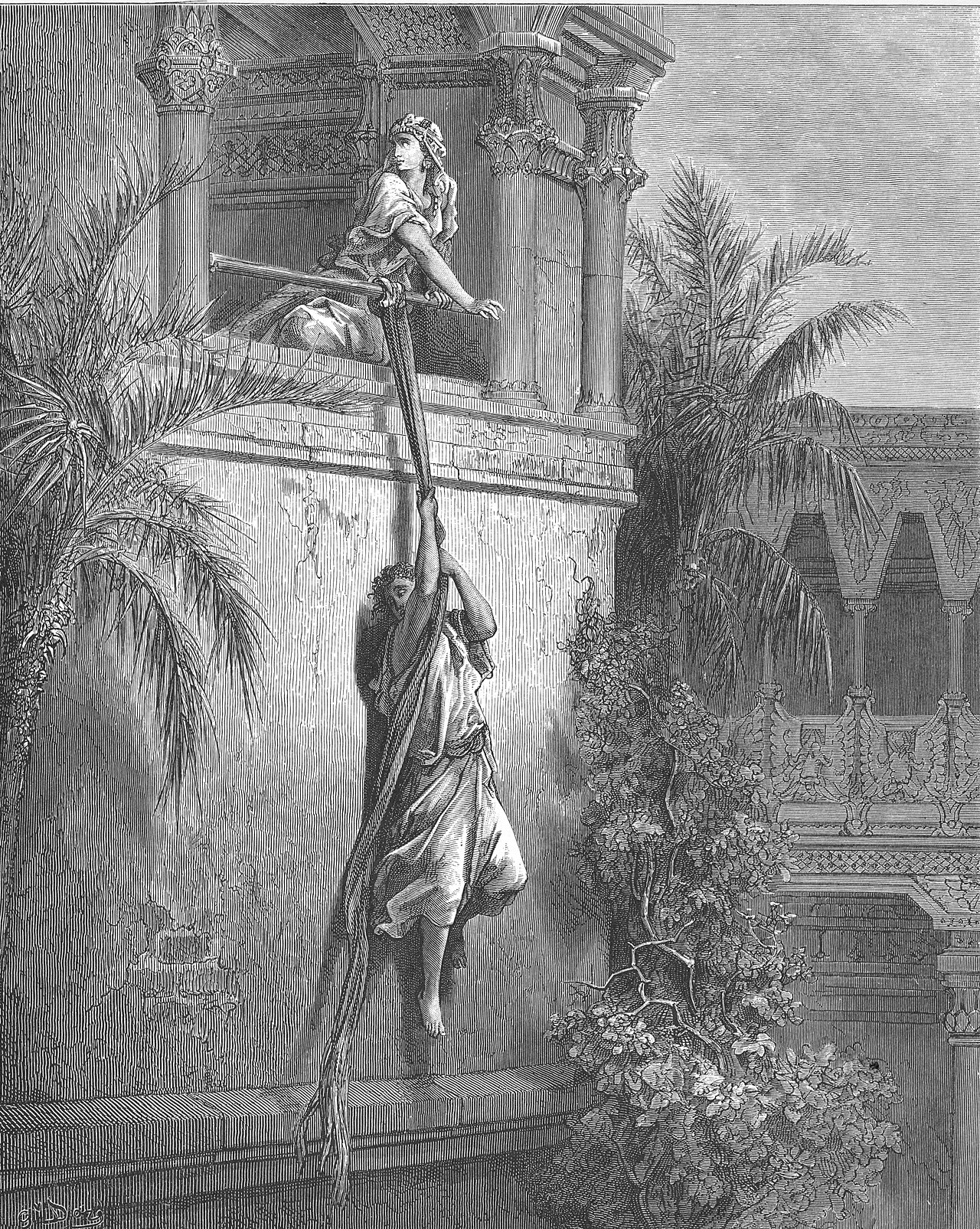
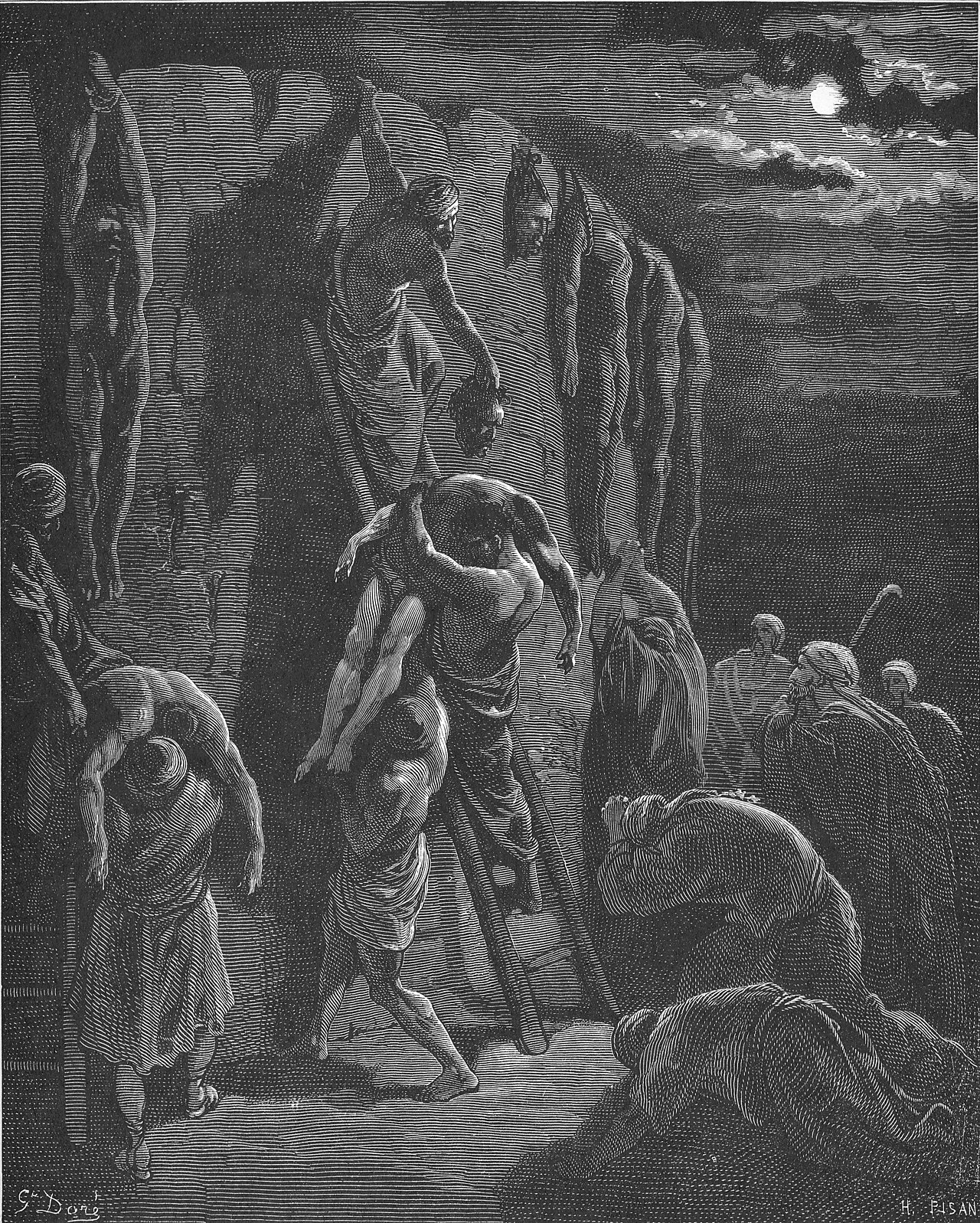
13 verified pieces depicting David
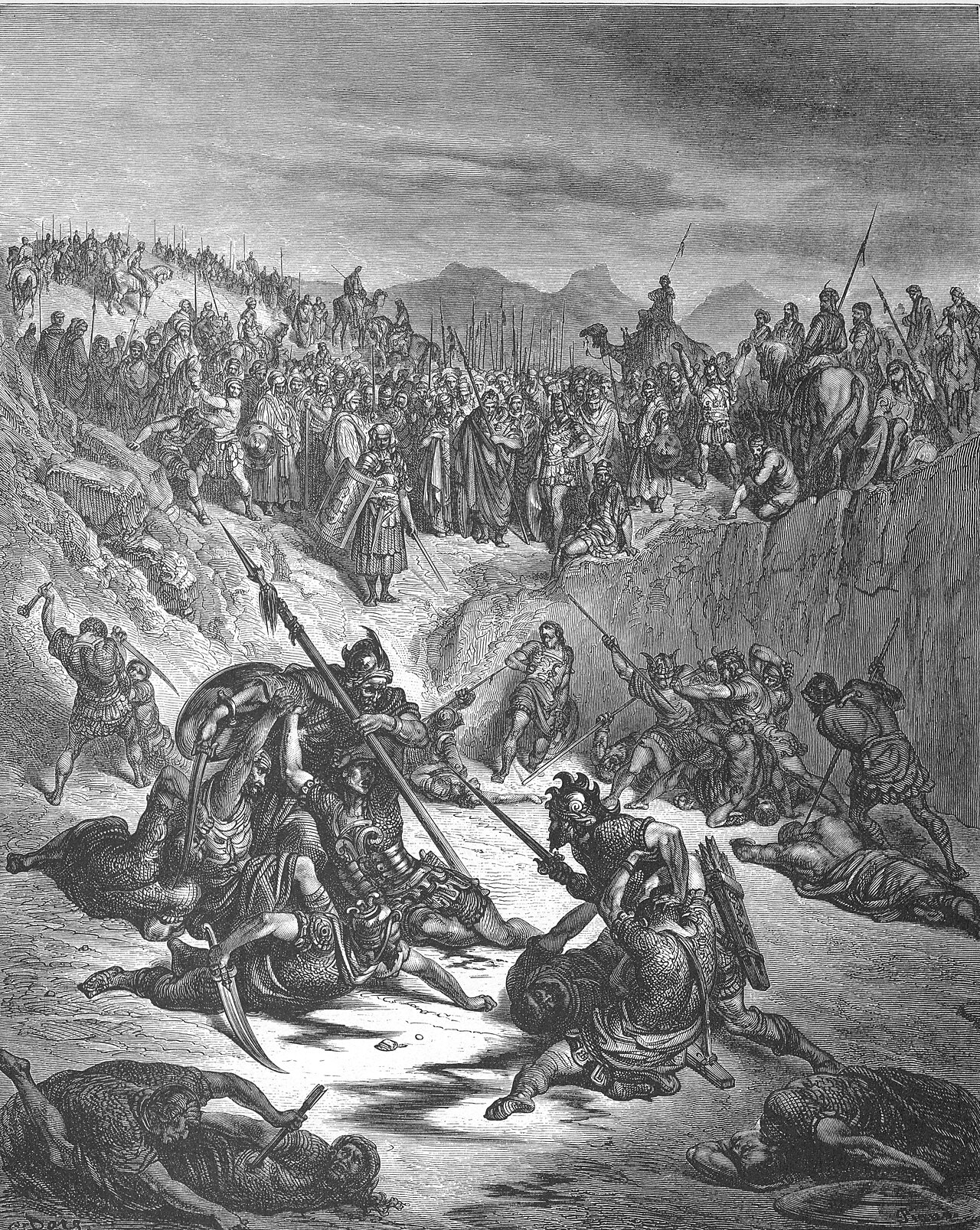
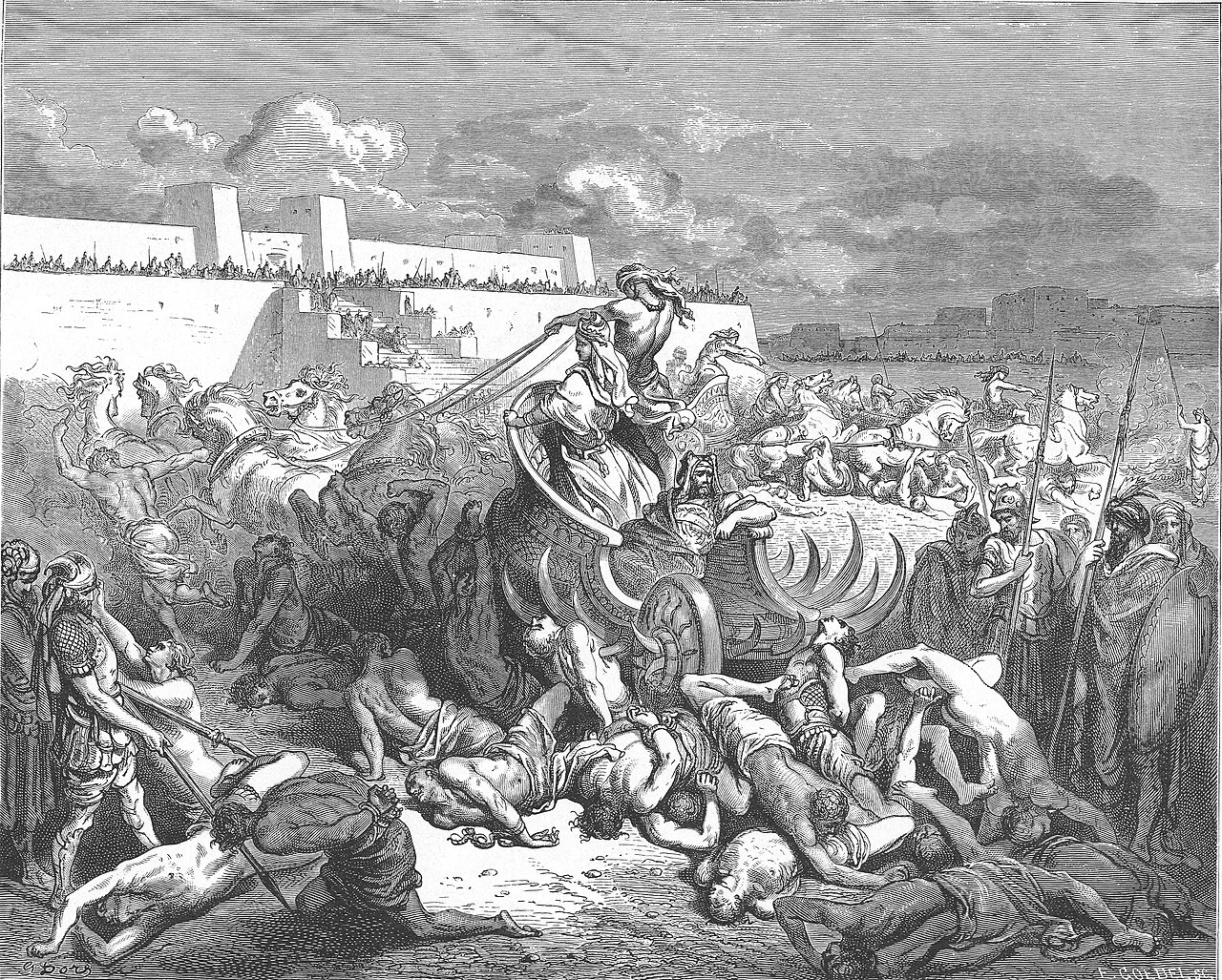
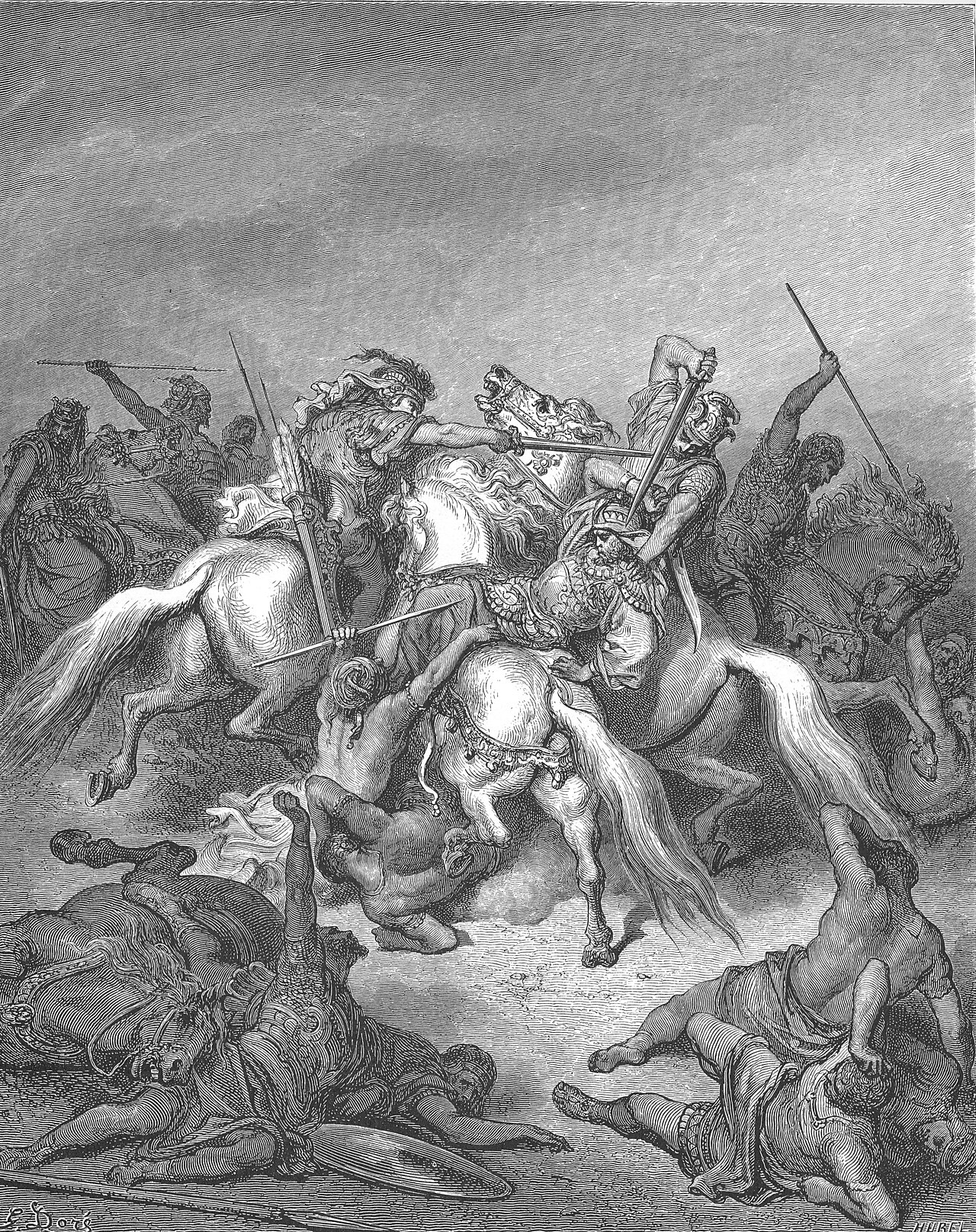
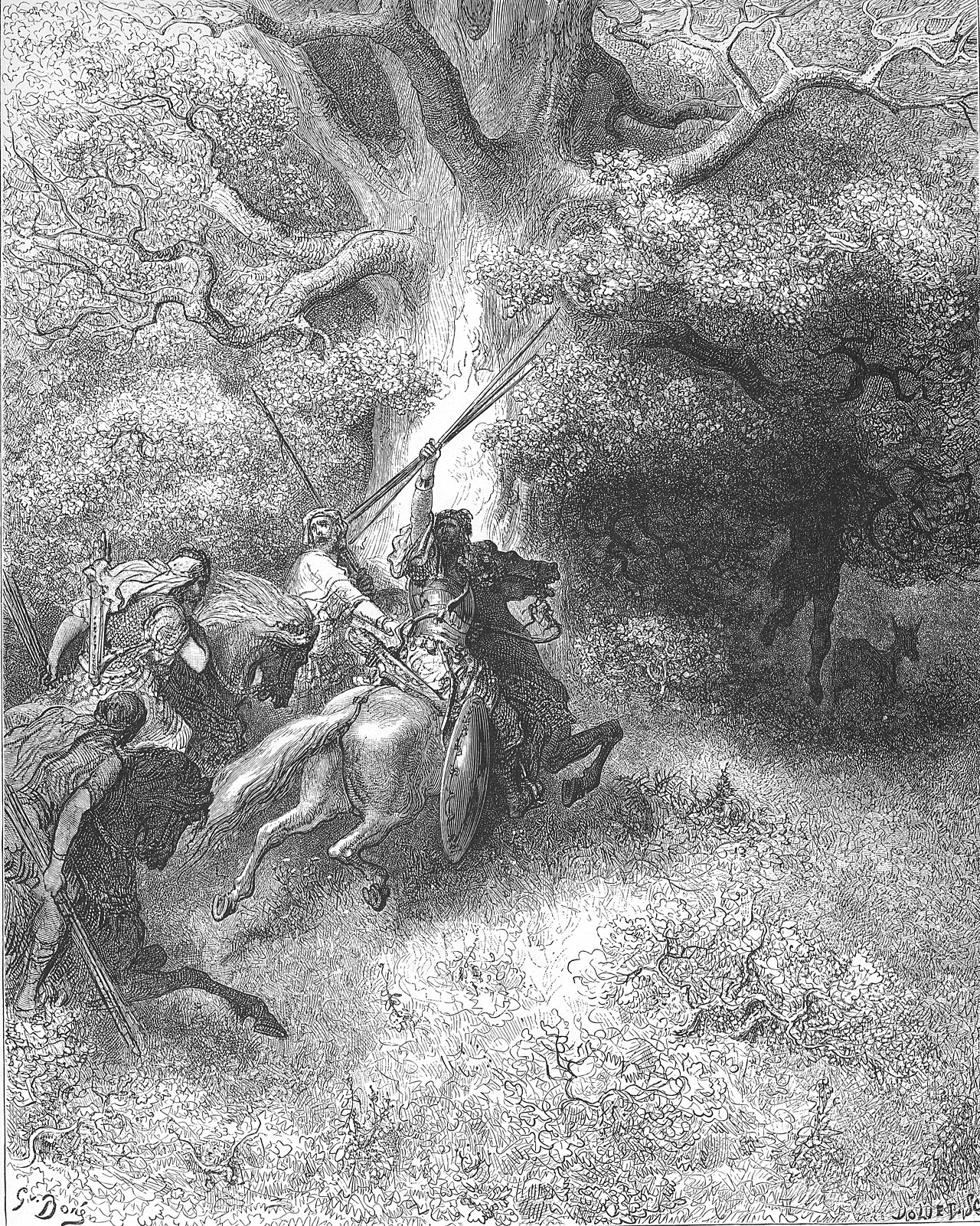
Sources cited
The story below is Scripture's own, read with the commentators MannaFest leans on. These are the works behind this page. Go to them.
- C. H. Spurgeon, The Treasury of David (1869–1885): his verse-by-verse work on the Psalms, including Psalm 23 and Psalm 51.Public domain, free to read in full.
- Matthew Henry, An Exposition of the Old and New Testament (1708–1710) — on 2 Samuel 7, the promise of a throne that would last forever.Public domain, free to read in full.
- Jamieson, Fausset & Brown, Commentary Critical and Explanatory on the Whole Bible (1871) — on 1 Samuel 16–17, the anointing and Goliath.Public domain.
- Chuck Missler, Learn the Bible in 24 Hours, the session on the covenant God made with David.Cited, not quoted.
- Edwin R. Thiele, The Mysterious Numbers of the Hebrew Kings (3rd ed., 1983), the source of the 1010–970 BC reign dates used across MannaFest.
- Berean Standard BibleEvery verse quoted on this page, byte for byte, from this site's own verse store. Public domain since 2023.
- King James Version with Apocrypha, standardized 1769 text, eBible.org USFX editionThe text of Sirach 47 quoted in the questions. Labelled a study resource rather than Scripture. Public domain.
- Tertullian, Against Marcion, and Gregory the Great, The Book of Pastoral Rule, in the Ante-Nicene and Nicene and Post-Nicene FathersTwo of the early Christian readings quoted here. Dates are given as centuries because the works' own dates could not be confirmed in this lane; the stored years are the authors' death years.
- Augustine of Hippo, Sermon 291The reading of 2 Samuel 12:13 set beside Saul's identical words. Public domain, CCEL edition.
- Matthew Henry, Commentary on the Whole Bible (1710)Quoted on Acts 13:22, for the phrase spoken before David was anointed. Public domain.
- John Wesley, Explanatory Notes upon the Old Testament (1765)Quoted on Psalm 51:4, on what David meant by sinning against God only. Public domain.
- Adam Clarke, Commentary on the Bible (1832)Quoted on 1 Samuel 24:6, on why David would not lift a hand against Saul. Public domain.
- Albert Barnes, Notes, Explanatory and Practical, on the Old and New Testaments (1832-1869)Cited for the second reading of the threshing floor price and for the absence of 2 Samuel 11 and 12 from Chronicles. Public domain.
- MannaFest, DanThe Tel Dan Stele, its date and its find, and the readings of bytdwd argued by Biran, Davies, Lemche and Thompson. This page states the stone no more strongly than that page does.
- MannaFest, ZionThe eastern ridge and the City of David, the burial of 1 Kings 2:10, and the later identification of the tomb on the western hill.
- MannaFest, Mount NeboThe Mesha Stele, read as a king's own account of his own victory. This page repeats nothing from that inscription that the site does not hold.
- MannaFest, David and GoliathThe fight itself, and the verified rabbinic material on the four descendants of Rapha, handled there as reception history.
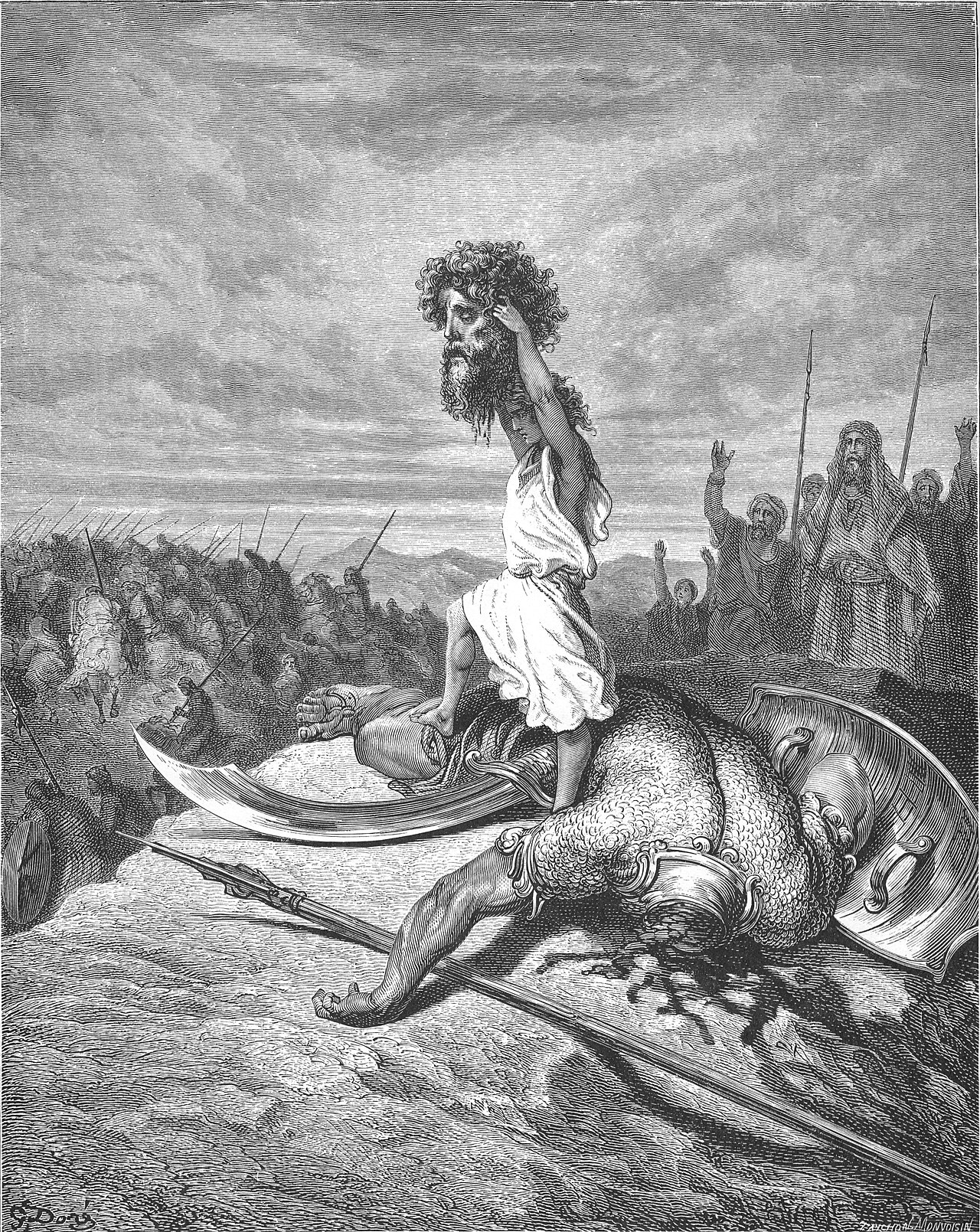
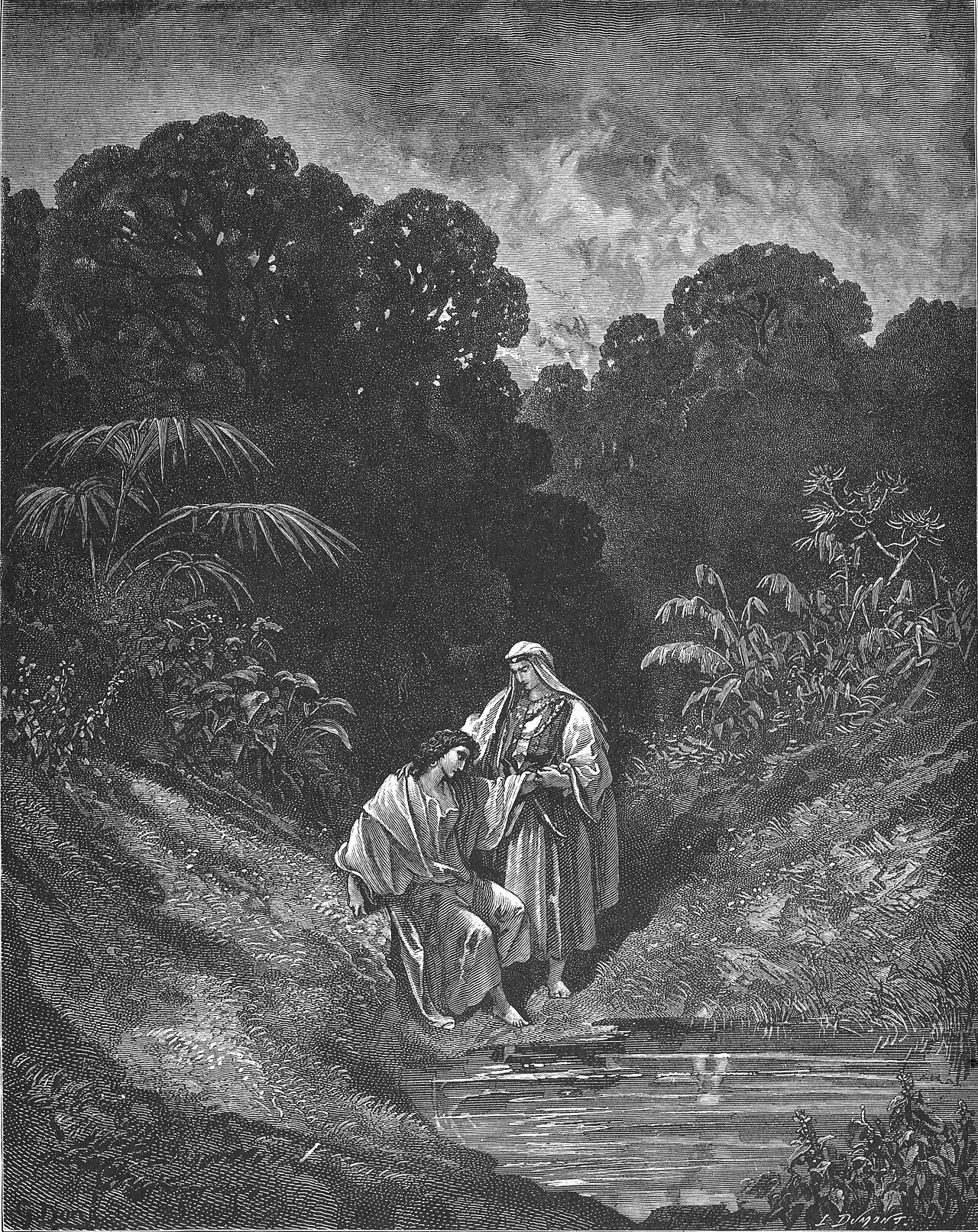
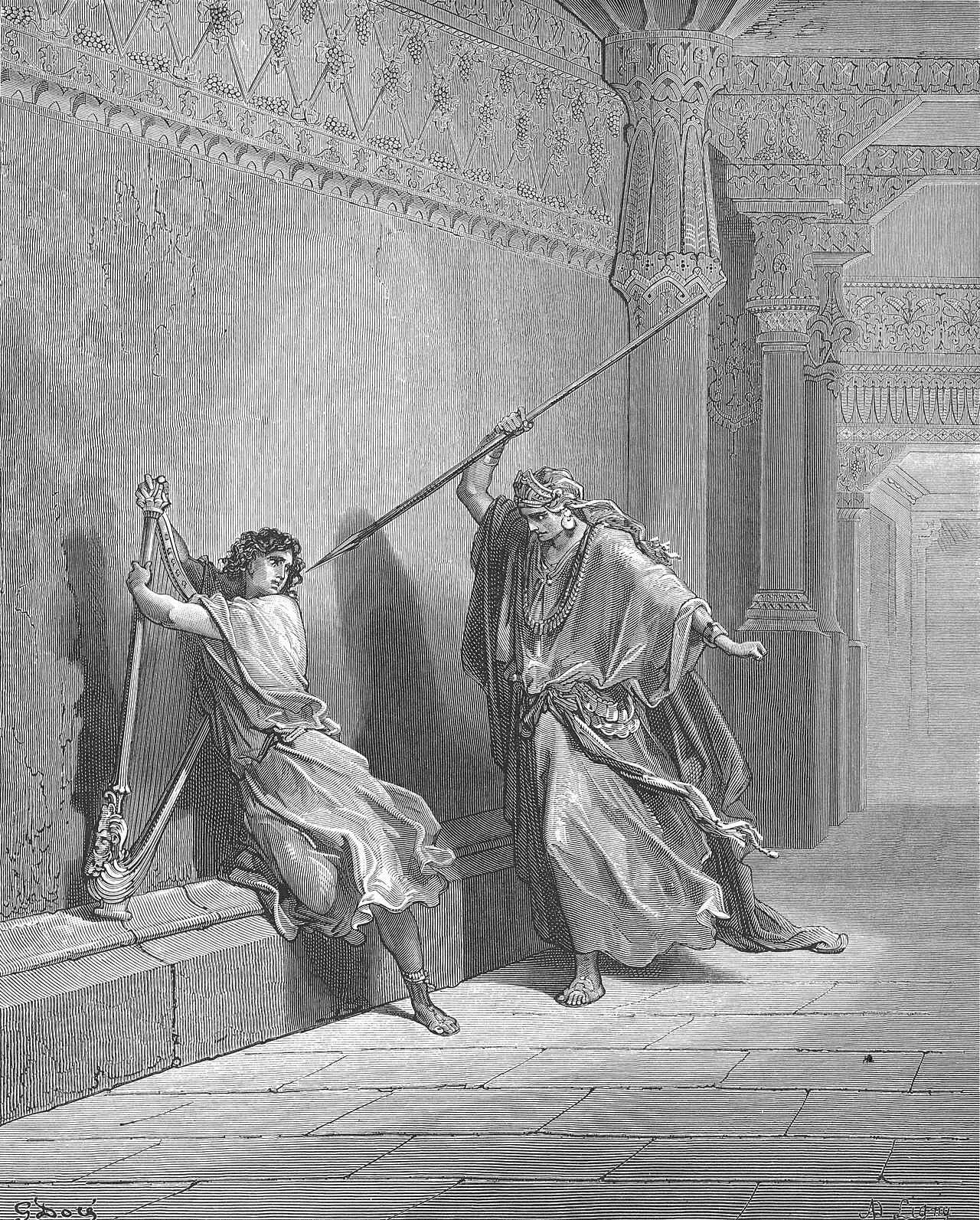
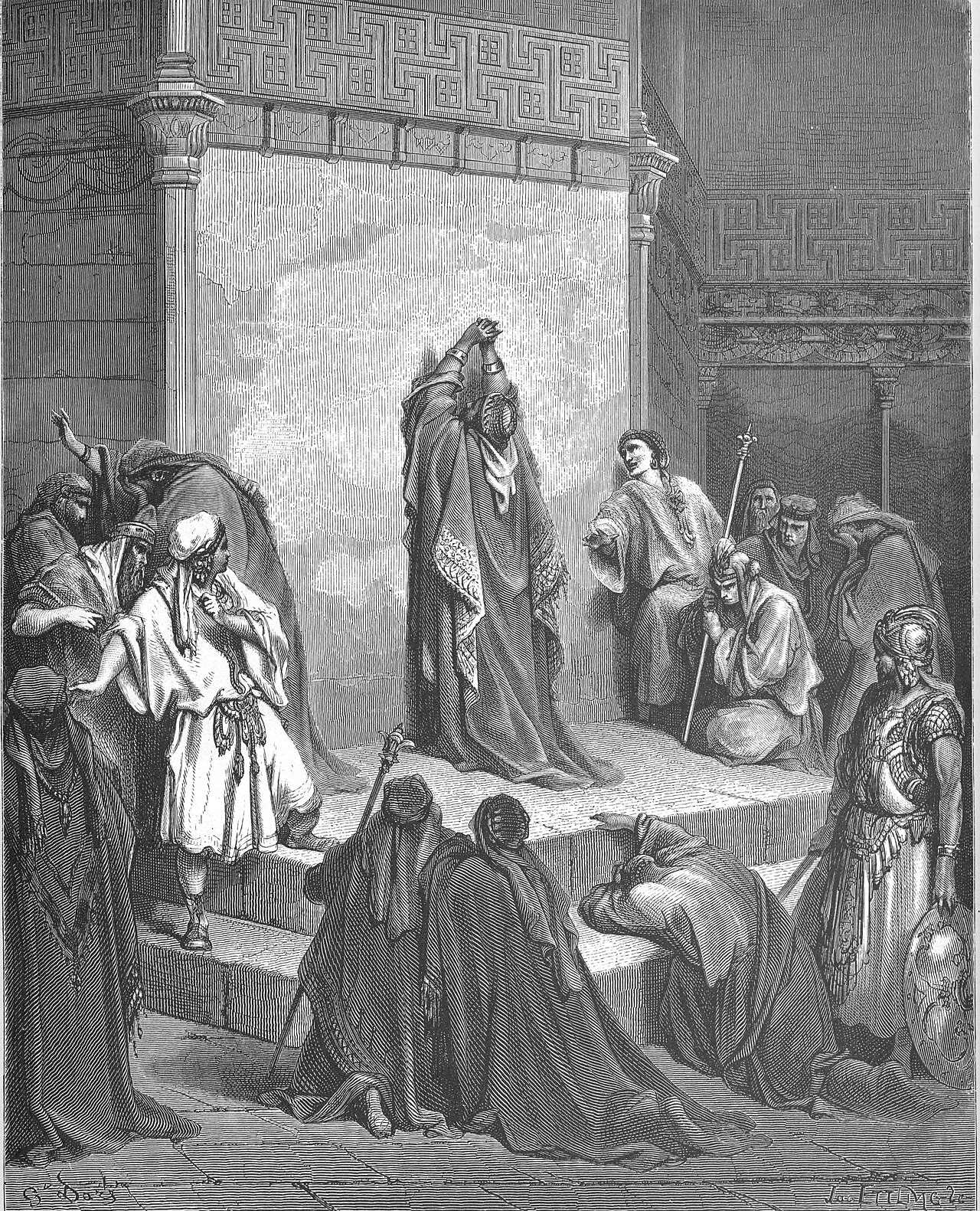
- Gustave Doré, The Holy Bible (1866)The twelve engravings on this page, ordered by the life rather than by plate number. Public domain.
- Wikimedia Commons, for the HonthorstGerard van Honthorst, King David Playing the Harp (1622). Public domain, licence verified at Commons.
- Andre Lemaire, "'House of David' Restored in Moabite Inscription," Biblical Archaeology Review 20:3 (1994)The original proposal that the Mesha Stele's broken line 31 reads house of David, cited on this page beside the scholars who dispute it.
- Matthieu Richelle and Andrew Burlingame, "Restoring Line 31 in the Mesha Stele: The 'House of David' or Biblical Balak?", Tel Aviv 46 (2019)The case against the house of David reading of line 31, proposing Balak instead.
Keep studying
On this page
Studies22
On this person
On this passage
Every page that names them1
Books26
Doorway1
Keep this page