
1725 to 1807 · Story · Repentance
John Newton and Amazing Grace
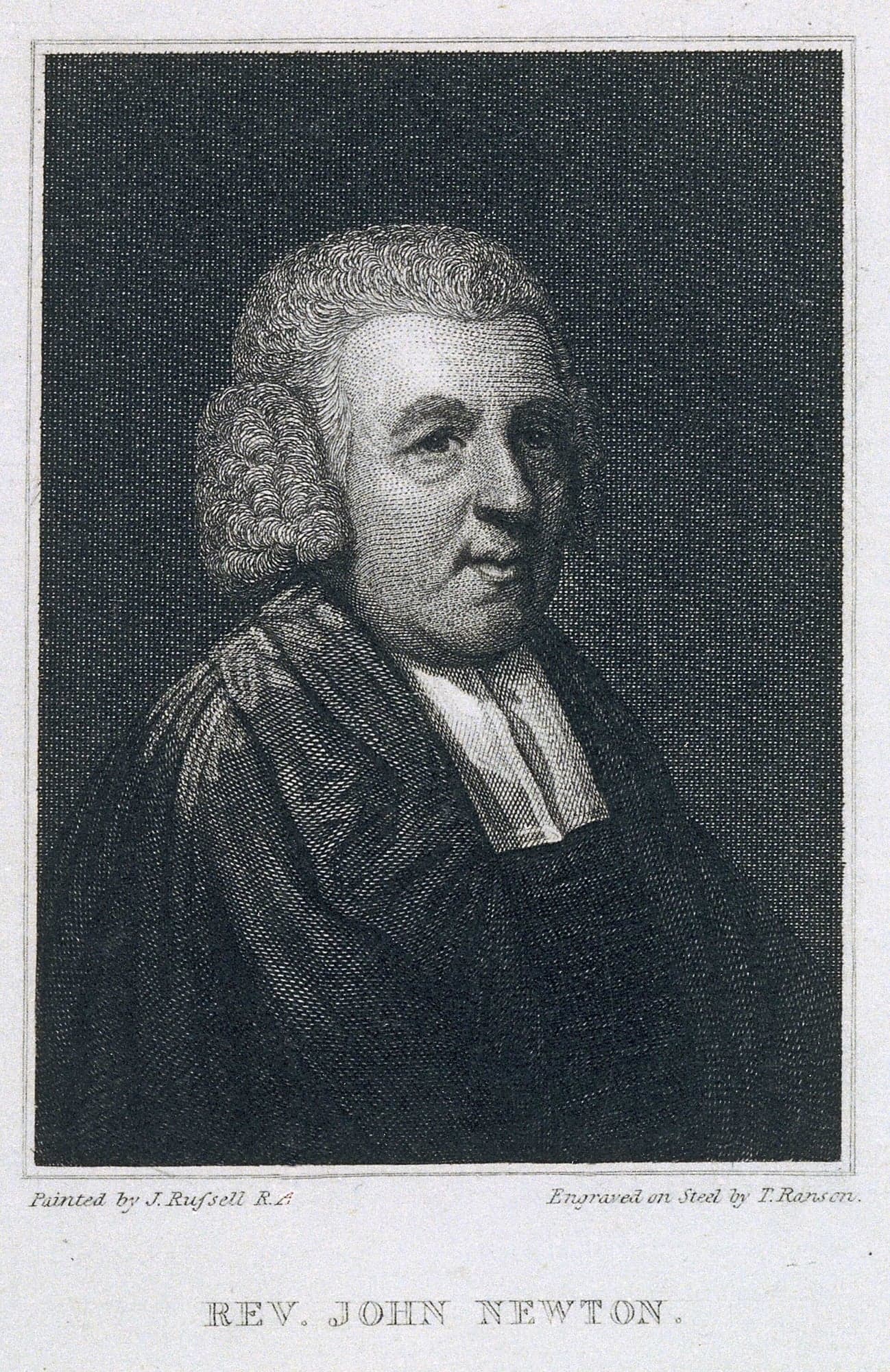
John Newton (1725 to 1807) commanded ships in the trade in enslaved people before he became curate of Olney, where he composed the hymn now called Amazing Grace.
Newton wrote his own epitaph, and it calls him once an infidel and libertine and a servant of slaves in Africa.
Then King David went in, sat before the LORD, and said, “Who am I, O LORD God, and what is my house, that You have brought me this far?
- When
- 1725 to 1807 AD
Summary
John Newton's life shows repentance as a turn that began in a moment and took years to reach every part of a man's life. He told both stages of it himself and hid neither. His first cry for mercy and his judgment on the trade he had served stand decades apart in his own writings.
- In a storm on the voyage home from Africa, on 21 March 1748 by the modern calendar, Newton spoke his first prayer for mercy in many years (An Authentic Narrative, Letter VIII).
- He later judged that the storm only began his return to God, and that he became a true believer some time after it (An Authentic Narrative, Letter IX).
- From 1750 he commanded slave ships on three voyages to the Windward Coast of Africa. By his account in Thoughts upon the African Slave Trade (1788), he took his last leave of that coast in 1754.
- In Thoughts upon the African Slave Trade (1788) he called the trade unlawful and wrong, and wrote that he had never had a scruple about it while he served it.
- Olney Hymns, which he published with William Cowper in 1779, prints the hymn as number 41 of its first book and sets it on 1 Chronicles 17:16 to 17.
A Life Told by Himself
His life ran from the sea and the coast of Africa to Liverpool, Olney and London.
This is the story of John Newton, sailor, master of slave ships, minister of the Church of England and writer of hymns. It belongs to repentance, the turn from sin back to God, and it matters to any reader who has turned to God and still finds old ways standing in his life.
The question it answers is how a man who had cried to God for mercy could go on in the slave trade, and what repentance came to mean in his life. It follows his life from his birth to his burial, as far as possible in his own words. It prints the hymn as the edition of 1779 gives it, weighs two readings of when he turned, and names the books in which he told it.
Newton in Dates, 1725 to 1807
The dates run from his birth in 1725 to his burial in 1807, each fixed by his own writings or by the Life of 1830.
Six years passed between the storm that began Newton's return to God and his last voyage to Africa, and forty between the storm and his confession in print.
| Event | Date | What fixes the date |
|---|---|---|
| Newton is born | 24 July 1725 AD | Known from An Authentic Narrative, Letter II |
| He first sees the coast of Guinea | 1745 AD | Known to the year from Thoughts upon the African Slave Trade (1788) |
| A storm at sea brings the first cry for mercy he had made in years | 21 March 1748 AD | Known from An Authentic Narrative, Letter VIII, which gives 10 March in the old style and 21 March in the new |
| He reaches Liverpool | May 1748 AD | Known to the month from Thoughts upon the African Slave Trade (1788) |
| He marries Mary Catlett | 1 February 1750 AD | Known from An Authentic Narrative, Letter XI |
| He sails from Liverpool as commander of a slave ship | August 1750 AD | Known to the month from An Authentic Narrative, Letter XI |
| He arrives at Liverpool from his last voyage | August 1754 AD | Known to the month from An Authentic Narrative, Letter XIII |
| A sudden illness ends his plan for a fourth voyage | 1754 AD | Known to the year from Thoughts upon the African Slave Trade (1788) |
| He settles at Liverpool | October 1755 AD | Known to the month from An Authentic Narrative, Letter XIV |
| An Authentic Narrative is first published, and he takes the curacy of Olney | 1764 AD | Known to the year from the Life of 1830, its note before Letter I and its further particulars |
| Olney Hymns is published | 1779 AD | Known to the year from the title page, M DCC LXXIX, and the preface signed at Olney on 15 February 1779 |
| Thoughts upon the African Slave Trade is published | 1788 AD | Known to the year from the title page, M.DCC.LXXXVIII |
| Mary Newton dies | 15 December 1790 AD | Known from the epitaph Newton wrote, printed in the Life of 1830 |
| Newton is buried in the vault of St Mary Woolnoth | 31 December 1807 AD | Known from the Life of 1830 |
He arrives at Liverpool from his last voyage, A sudden illness ends his plan for a fourth voyage, He settles at Liverpool, An Authentic Narrative is first published, and he takes the curacy of Olney, Olney Hymns is published, Thoughts upon the African Slave Trade is published, Mary Newton dies, Newton is buried in the vault of St Mary Woolnoth
The Life in Six Scenes
Newton tells each scene in his own letters and pamphlet, and the Life of 1830 adds his years at Olney.
A sea captain's son who went to Africa1725 to 1748
Newton's mother died when he was something under seven years old, and his father, a commander at sea, was away when she died (An Authentic Narrative, Letter II).
In his pamphlet against the trade, printed in 1788, he wrote of about eighteen months on the coast of Guinea. In that time he was "in effect, though without the name, a Captive and a Slave myself".
The storm of March 1748An Authentic Narrative, Letters VII and VIII
On the voyage home the ship was nearly lost in a storm, and Newton worked at the pumps from three in the morning till near noon. He wrote that he said, "almost without any meaning", the words "If this will not do, the Lord have mercy on us."
He added that the words were "the first desire I had breathed for mercy for the space of many years". Of the day itself he wrote, "on that day the Lord sent from on high and delivered me out of deep waters".
He reached down from on high and took hold of me; He drew me out of deep waters.Newton's words for the day of the storm echo this verse of David's song of deliverance.
Mate and master of slave ships1748 to 1754
Newton wrote in Thoughts upon the African Slave Trade (1788) that he soon went back to the place of his captivity as mate of a ship. In 1750 he was appointed commander, "in which capacity I made three voyages to the Windward Coast, for Slaves".
As commander he led public worship on board twice every Lord's day (An Authentic Narrative, Letter XI). He also wrote that he "considered myself as a sort of gaoler or turnkey", and that he was "sometimes shocked with an employment that was perpetually conversant with chains, bolts, and shackles" (Letter XIII).
An illness ended his voyages1754 to 1755
He had fitted out for a fourth voyage and was within two days of sailing when he was seized with a fit that, in his words, "deprived me of sense and motion" (Letter XIII). He gave up the ship to another captain, and from October 1755 he was settled at Liverpool (Letter XIV).
Curate of Olney1764 to the move to London
The Life of 1830 records that in 1764 the curacy of Olney in Buckinghamshire was proposed to him, and that Lord Dartmouth recommended him to the bishop of Lincoln for orders. It says that he served there nearly sixteen years before he was presented to the rectory of St Mary Woolnoth in London.
At Olney he worked beside the poet William Cowper. In the preface of Olney Hymns Newton wrote that the book was meant "as a monument, to perpetuate the remembrance of an intimate and endeared friendship". He marked each of Cowper's hymns with the letter C.
A confession in printThoughts upon the African Slave Trade (1788)
By 1788 Newton was rector of St Mary Woolnoth, and he published his testimony against the trade. Of the years he served it he wrote, "I think I should have quitted it sooner, had I considered it, as I now do, to be unlawful and wrong. But I never had a scruple upon this head at the time."
Faith's Review and Expectation
The hymn stands among the hymns of the first book, each of which is set on a text of Scripture.
The table of contents names the hymn Faith's review and expectation. Its text is David's prayer after God promised him a house (1 Chronicles 17:16 to 17).
And as if this was a small thing in Your eyes, O God, You have spoken about the future of the house of Your servant and have regarded me as a man of great distinction, O LORD God.David looks from what God has done to what He has promised for the future, and the hymn moves from the review of grace to the expectation of it in the same order.
The first stanza joins two lines of the Gospels. The father of Luke 15 says of his son that he was lost and is found, and the man born blind says in John 9:25, "I was blind, but now I see!"
The six stanzas as the edition of 1779 prints themOlney Hymns, Book I, Hymn 41
Amazing grace! (how sweet the sound) That saved a wretch like me! I once was lost, but now am found, Was blind, but now I see.
'Twas grace that taught my heart to fear, And grace my fears relieved; How precious did that grace appear, The hour I first believed!
Through many dangers, toils and snares, I have already come; 'Tis grace has brought me safe thus far, And grace will lead me home.
The LORD has promised good to me, His word my hope secures; He will my shield and portion be, As long as life endures.
Yes, when this flesh and heart shall fail, And mortal life shall cease, I shall possess, within the veil, A life of joy and peace.
The earth shall soon dissolve like snow, The sun forbear to shine; But GOD, who called me here below, Will be for ever mine.
When Did Newton Turn?
Newton's own writings support two readings of when his repentance began and when it was complete.
The prayer at the pumps was his turningAn Authentic Narrative, Letter VIII
Newton called the day of the storm "a day much to be remembered by me", and he wrote that he had never let it pass wholly unnoticed since 1748. On this reading the prayer at the pumps was the moment he turned to God.
Against it stands the rest of his own narrative, which does not count the storm as the end of his turning.
The storm began a turn that took yearsAn Authentic Narrative, Letter IX, and Thoughts upon the African Slave Trade (1788)
In his ninth letter he called the storm "the beginning of my return to God, or rather of his return to me". He went on, "but I cannot consider myself to have been a believer (in the full sense of the word) till a considerable time afterward".
In the same letter he says that he learned the truths of the gospel "here a little and there a little, by my own painful experience". On this reading his repentance reached the trade he served only when he judged it in 1788.
Against it stands the weight he gave the storm in the letter before.
Books to Read Next
Each of these three works was printed between 1764 and 1788 and can be read free online.
An Authentic Narrative of Some Remarkable and Interesting Particulars in the Life of John Newton
John Newton · 1764
Newton wrote these fourteen letters to Thomas Haweis, and they tell his life from his birth to his settling at Liverpool in 1755.
Read the 1830 American edition free at archive.orgOlney Hymns, in Three Books
John Newton and William Cowper · 1779
Newton and Cowper printed their hymns together in it, with Newton's hymn on 1 Chronicles 17 among them.
Read it free at the Christian Classics Ethereal LibraryThoughts upon the African Slave Trade
John Newton · 1788
Newton's pamphlet gives his testimony against the trade he had served as mate and master.
Read it free at archive.orgGrace That Taught My Heart
The hymn's last stanza names God as Newton's for ever.
His own books show that the turn took most of his life.
This is a trustworthy saying, worthy of full acceptance: Christ Jesus came into the world to save sinners, of whom I am the worst.Paul counts himself the worst of the sinners Christ came to save, and Newton's hymn speaks of a wretch saved by grace in the same spirit.
Sources
Scripture is the Berean Standard Bible.
- John Newton, An Authentic Narrative (first published 1764), Letters I to XIV to the Rev. T. Haweis, as printed in The Life of the Rev. John Newton, Rector of St. Mary Woolnoth, London (New York: American Tract Society, 1830)
- John Newton, An Authentic Narrative of Some Remarkable and Interesting Particulars in the Life of ******** (London, 1765), Letters VII and VIII.
- The Life of the Rev. John Newton, Rector of St. Mary Woolnoth, London, with some further particulars added (New York: American Tract Society, 1830), the note before Letter I, the account of Olney, the account of his death and the epitaph.
- John Newton, Thoughts upon the African Slave Trade (London: J. Buckland and J. Johnson, 1788), pages 2 to 4.
- John Newton and William Cowper, Olney Hymns, in Three Books (London: W. Oliver, 1779), the title page, the preface, the contents and Book I, Hymn 41.
Keep Studying
Studies5
People and groups1
Doctrines2