

Genesis 49 · Symbol · Featured Study
The Lion
A symbol study of the lion, with the Hebrew and Greek words, the voices of the church and two readings in dispute.
Jacob called his son Judah a young lion, and an elder in heaven gives the title to Christ.
- The word
- אַרְיֵה (aryeh), H738
- First appears
- Genesis 49:9 “Judah is a young lion—my son, you…”
Lucas Cranach the Elder, Samson's Fight with the Lion, 1520 to 1525. Public domain.
Summary
Scripture uses the lion for strength that no one dares to rouse, for danger on the road, for the voice of the LORD and for the adversary who prowls.
- Jacob's blessing of Judah uses three Hebrew words for the animal: gur for the cub, aryeh for the lion and lavi for the lioness.
- Samson tore a lion apart with his bare hands, and David killed lions while he kept his father's sheep.
- Peter likens the devil to a roaring lion, and in Revelation the elder announces a Lion and John sees a Lamb.
Judah, a Young Lion
Jacob gives Judah the lion, and Numbers 23:24 gives it to all Israel.
Judah is a young lion—my son, you return from the prey. Like a lion he crouches and lies down; like a lioness, who dares to rouse him?Jacob says this in his last words to his sons, between the praise of Judah in verse 8 and the scepter of verse 10.
Behold, the people rise like a lioness; they rouse themselves like a lion, not resting until they devour their prey and drink the blood of the slain.”Balak hired Balaam to curse Israel, and his second oracle gives the people the lioness rising to the hunt.
Jacob's blessing holds the one verse of Genesis that names the lion. Balaam repeats its words over all Israel in Numbers 24:9, after which Balak's anger burned against Balaam, as Numbers 24:10 says.
Samson and the Lion
The panel has five parts that answer to verses of Judges 14 and 15.
Cranach painted the moment when the Spirit of the LORD came powerfully upon Samson.
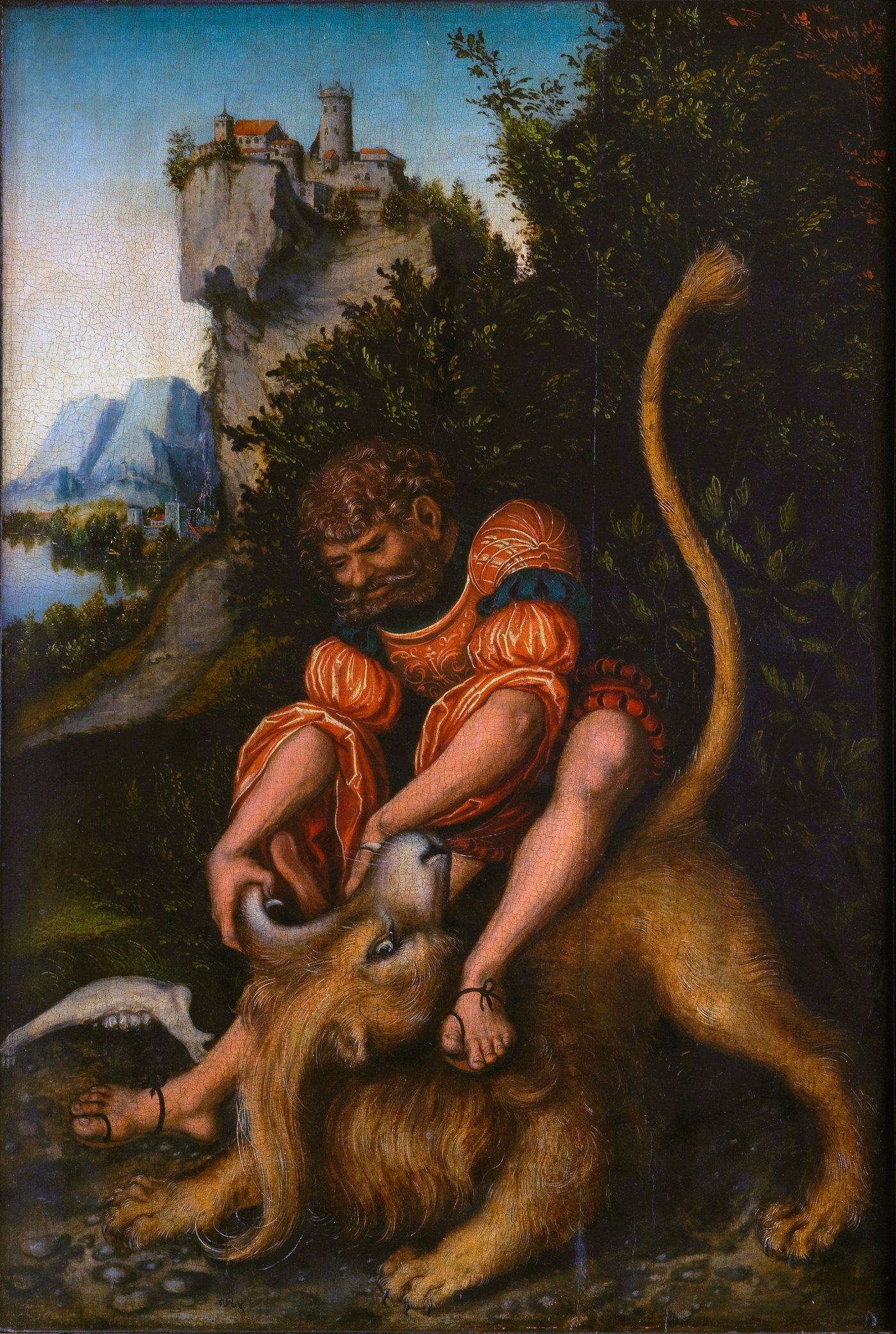
- SamsonSamson kneels astride the lion in a red doublet and pulls its jaws apart with both hands.Judges 14:6
- The young lionThe lion lies pinned under him with its mane spread on the ground and its tail raised.Judges 14:5
- The jawboneA white jawbone lies on the stones at the left.Judges 15:15
- The roadA pale road runs down the hillside behind the fight.Judges 14:8
- The castle on the cragCranach set a walled castle of his own country on the rock above, where Judges 14:1 has Samson go down to Timnah.Judges 14:1
Lucas Cranach the Elder, Samson's Fight with the Lion, 1520 to 1525. Public domain.
The jawbone at the left belongs to the fight of Judges 15:15, which comes later in the story.
The Lion Through Scripture
Thirteen verses in canon order each name a lion.
Eleven of the thirteen stops stand in the Old Testament, and two in the New.
- GenesisJudah a young lion, in Jacob's blessing
- NumbersIsrael rises like a lioness, Numbers 23:24
- JudgesSamson tears a lion apart, Judges 14:6
- 1 SamuelDavid strikes the lion down, 1 Samuel 17:35
- 1 KingsA lion on the road, 1 Kings 13:24
- PsalmsSave me from the mouth of the lion, Psalm 22:21
- ProverbsThe righteous are as bold as a lion, Proverbs 28:1
- IsaiahThe calf and the young lion together, Isaiah 11:6
- HoseaThe LORD will roar like a lion, Hosea 11:10
- AmosThe lion has roared, Amos 3:8
- DanielThe mouths of the lions shut, Daniel 6:22
- 1 PeterThe adversary like a roaring lion, 1 Peter 5:8
- RevelationThe Lion of the tribe of Judah, Revelation 5:5
Each stop opens its verse in the reader.
The LORD likened to a lionIsaiah 31:4 and Hosea 5:14
For this is what the LORD has said to me: “Like a lion roaring or a young lion over its prey—and though a band of shepherds is called out against it, it is not terrified by their shouting or subdued by their clamor—so the LORD of Hosts will come down to do battle on Mount Zion and its heights.Isaiah speaks against those in Judah who went down to Egypt for horses, as Isaiah 31:1 says.
For I am like a lion to Ephraim and like a young lion to the house of Judah. I, even I, will tear them to pieces and then go away. I will carry them off where no one can rescue them.The same image turns against Ephraim and Judah, whom the LORD will tear and carry off.
Said Outright, and Heard by Readers
Three verses that state what the lion stands for, and three readings often heard.
BOLD AS A LION
Solomon sets the lion's boldness beside the righteous man who has nothing to flee from.
MIGHTY AMONG BEASTS
Agur counts the lion among four things that are impressive in their walk.
THE LORD ROARS
Hosea uses the roar to call the LORD's scattered children home.
Lion verses as they are often readIsaiah 11:6, 1 Peter 5:8 and Daniel 6:16
Isaiah names the young lion with the calf, Peter makes a comparison, and Daniel 6 gives no age.
| Verse | The reading | What the text says |
|---|---|---|
| Isaiah 11:6 | The lion will lie down with the lamb. | Isaiah 11:6 sets the wolf with the lamb and the young lion with the calf, and Isaiah 65:25 has the lion eat straw like the ox. |
| 1 Peter 5:8 | The devil is a lion. | Peter says the adversary prowls around like a roaring lion, and he makes the comparison to tell his readers to stay alert. |
| Daniel 6:16 | Daniel was a young man in the den. | Daniel 6 gives no age, and Daniel 1:1 to 6 counts Daniel among the young men taken in the third year of Jehoiakim, long before the reign of Darius in Daniel 6. |
Lions in the Land
The thickets of the Jordan and the wild country of Judah, where the lions of Scripture lived.
Jamieson, Fausset and Brown, in their Commentary Critical and Explanatory, on Judges 14:5, place most or all the lions of Scripture in the wild mountain passes of Judah. Amos 3:12 speaks of a shepherd who snatches two legs or a piece of an ear from a lion's mouth, and Exodus 22:13 told a keeper to bring a torn animal as evidence.
Behold, one will come up like a lion from the thickets of the Jordan to the watered pasture. For in an instant I will chase Edom from her land. Who is the chosen one I will appoint for this? For who is like Me, and who can challenge Me? What shepherd can stand against Me?”Jeremiah uses a lion coming up from the Jordan's thickets as the picture of the LORD coming against Edom.
David replied, “Your servant has been tending his father’s sheep, and whenever a lion or a bear came and carried off a lamb from the flock, I went after it, struck it down, and delivered the lamb from its mouth. If it reared up against me, I would grab it by its fur, strike it down, and kill it.David tells Saul what he did when a lion took a lamb, as his reason for facing Goliath.
Ari, Kephir, Lavi, Gur and Leon
Five words name the lion and its young, and the table gives the count of each.
James Strong's concordance explains the second sense of kephir as a place covered in by walls. The Greek leon names both the devil and Christ in the New Testament.
ari or aryeh
a lion
kephir
a young lion; also a village
lavi
a lion, a lioness
gur
a cub, still in the lair
leon
a lion
The lexicon in full1 table or figure
Ari is used 80 times, more than the other four words together.
| Word | Meaning | Uses |
|---|---|---|
| ari or aryeh, H738 | a lion | 80 |
| kephir, H3715 | a young lion; also a village | 32 |
| lavi, H3833 | a lion, a lioness | 14 |
| gur, H1482 | a cub, still in the lair | 7 |
| leon, G3023 | a lion | 9 |
What Scripture Does Not Say
Three things about the lion that the text leaves open.
The Lion Who Is a Lamb
Revelation 5 shows the Lamb who was slain, and Peter and the psalmist name lions that roar against God's people.
Then I saw a Lamb who appeared to have been slain, standing in the center of the throne, encircled by the four living creatures and the elders. The Lamb had seven horns and seven eyes, which represent the seven Spirits of God sent out into all the earth.The Lamb appears here for the first time in Revelation, and in the next chapter He opens the seals.
And they sang a new song: “Worthy are You to take the scroll and open its seals, because You were slain, and by Your blood You purchased for God those from every tribe and tongue and people and nation.The song of the living creatures and the elders answers the question the angel asked in Revelation 5:2.
“Again, he is called a Lion; not a man eater, but, as it were, showing by this title his kingly, strong and resolute nature, Then too, he is called a Lion in opposition to the lion, our adversary who roars and devours those who have been deceived. For the Savior came, not having changed his own gentle nature, and yet as the mighty lion of the tribe of Judah, saving them that believe but trampling upon the adversary.”
Cyril of Jerusalem · Catechetical Lecture 10:3 · on Genesis 49:9Patristic
Peter's warning and the psalm of the cross1 Peter 5:8 and Psalm 22:13
Be sober-minded and alert. Your adversary the devil prowls around like a roaring lion, seeking someone to devour.Peter writes this after telling his readers to cast all their anxiety on God, and before he speaks of their suffering.
They open their jaws against me like lions that roar and maul.The psalm whose first verse Jesus cried from the cross likens the psalmist's enemies to roaring lions.
Voices on the Lion
Four teachers from the sixth century to the eighteenth on the lion.
died 542 · Caesarius of Arles
Caesarius of Arles, in his Sermon 119, on Judges 14:5, says that many of the fathers had spoken of Samson's lion. He adds that some read it as a figure of Christ, and he calls the reading fitting.
died 735 · Bede
Bede, in his Commentary on Proverbs, on Proverbs 28:1, writes that the lion does not tremble before the beasts, because it knows it prevails over all. He compares the security of the righteous to it.
1662 to 1714 · Matthew Henry
Matthew Henry, in his Commentary on the Whole Bible, on Numbers 24:9, follows Bishop Patrick: lions lie down anywhere to sleep, since none dares meddle with them, and Israel was as secure in Canaan.
1703 to 1791 · John Wesley
John Wesley, in his Explanatory Notes upon the Old Testament, on Daniel 6:22, writes that the angel's presence made even the lions' den a stronghold for Daniel.
Matthew Henry, John Wesley
Where Careful Readers Differ
Two questions about the lion that readers answer in different ways.
Who the lion of Genesis 49:9 isJohn Wesley, Matthew Henry, Cyril of Jerusalem and Ambrose of Milan
John Wesley, in his Explanatory Notes upon the Old Testament, reads the verse of the tribe of Judah, which would win great victories and then enjoy them in peace. Matthew Henry, in his Commentary on the Whole Bible, compares Judah to a lion lying at rest after its success, which troubles no one. The objection is that Revelation 5:5 takes the title of the verse for Christ.
Cyril of Jerusalem, in his Catechetical Lecture 10, and Ambrose of Milan, in On the Blessings of the Patriarchs, read the verse of Christ. Ambrose takes the lion lying down as Christ at rest in the tomb, and Henry gives the reading of Christ beside his first. The objection is that Genesis 49:1 sets Jacob's words about what will happen to his sons in the days to come.
The mouth of the lion in 2 Timothy 4:17John Chrysostom, Adam Clarke, and Jamieson, Fausset and Brown
At my first defense, no one stood with me, but everyone deserted me. May it not be charged against them. But the Lord stood by me and strengthened me, so that through me the message would be fully proclaimed, and all the Gentiles would hear it. So I was delivered from the mouth of the lion.Paul writes this after saying in 2 Timothy 4:6 that the time of his departure is at hand.
John Chrysostom, in his Homily 10 on 2 Timothy, holds that Paul calls Nero a lion for his ferocity. Adam Clarke, in his Commentary on the Bible, reads it of the danger of that hour, perhaps the prefect who held power while Nero was away, unless the words are a proverb. The objection is that verse 18 moves from one danger to every evil action.
Jamieson, Fausset and Brown, in their Commentary Critical and Explanatory, read the lion as Satan, the roaring lion of 1 Peter 5:8, and take verse 18 as their support. The objection is that verse 16 sets the danger at a human court.
Books to Read Next
Two public domain works, each with a free copy to read.
Catechetical Lectures
Cyril of Jerusalem · fourth century
Cyril gave the lectures in Jerusalem, and Lecture 10 sets out the titles of Christ.
Read at New AdventCommentary on the Whole Bible
Matthew Henry · 1708 to 1710
The first volume is a verse by verse commentary on Genesis to Deuteronomy.
Read at CCELWorthy Is the Lamb
The praise of the Lamb grows from the elders to many angels and then to every creature, in Revelation 5:11 to 13.
In a loud voice they were saying: “Worthy is the Lamb, who was slain, to receive power and riches and wisdom and strength and honor and glory and blessing!”John hears this after the scroll has passed from the hand of the One on the throne.
Sources
Scripture is the Berean Standard Bible.
- James Strong, Exhaustive Concordance of the Bible, 1890, entries H738, H3715, H3833, H1482 and G3023.
- John Wesley, Explanatory Notes upon the Old Testament, 1765, on Genesis 49:9; on Daniel 6:22.
- Matthew Henry, Commentary on the Whole Bible, 1710, on Genesis 49:9; on Numbers 24:9.
- Cyril of Jerusalem, Catechetical Lecture 10.3, on Genesis 49:9.
- Ambrose of Milan, On the Blessings of the Patriarchs, on Genesis 49:9.
- Caesarius of Arles, Sermon 119.1, on Judges 14:5.
- Bede, Commentary on Proverbs, on Proverbs 28:1.
- Jamieson, Fausset and Brown, Commentary Critical and Explanatory on the Whole Bible, 1871, on Judges 14:5; on 2 Timothy 4:17.
- John Chrysostom, Homily 10 on 2 Timothy, on 2 Timothy 4:17.
- Adam Clarke, Commentary on the Bible, 1832, on 2 Timothy 4:17.