
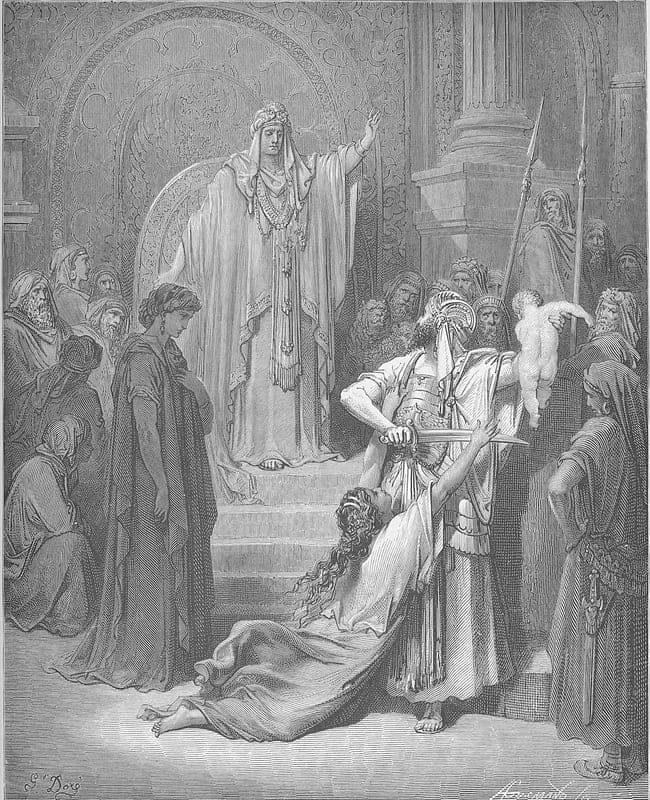
The Judgment of Solomon, Gustave Doré, 1866. Public domain.
Old Testament · Book 20 of 66
Proverbs
Proverbs gathers short sayings and longer teachings, many credited to Solomon, on how to live wisely. It sets the fear of the LORD as the beginning of knowledge and closes with the portrait of a capable and godly wife.
Proverbs gathers short sayings and longer teachings, many credited to Solomon, on how to live wisely. It sets the fear of the LORD as the beginning of knowledge and closes with the portrait of a capable and godly wife.
What is Proverbs about?
Proverbs is a book of instruction for living wisely before God. It opens with a father teaching his son and with Wisdom calling out in the street, and it states its ground at once: “The fear of the LORD is the beginning of knowledge” (1:7). Then come the short sayings of Solomon, two lines each, setting the wise beside the fool and the righteous beside the wicked. The words of the wise follow, then more of Solomon's proverbs copied by King Hezekiah's scribes. The book closes with the sayings of Agur, the charge of Lemuel's mother, and a poem on a woman of worth who fears the LORD.
All 31 chapters
Every chapter of the book, in one grid. Each cell opens that chapter.
- The father's callProverbs 1 to 9
- Solomon's proverbsProverbs 10 to 22
- The words of the wiseProverbs 23 to 24
- Hezekiah's menProverbs 25 to 29
- Agur, Lemuel and the woman of worthProverbs 30 to 31
The colour is the movement of the book the chapter stands in, and every cell opens that chapter's Study level. The grid colours whole chapters: the words of the wise begin inside chapter 22, at 22:17, and a second set of sayings of the wise begins at 24:23.
Who wrote it, where, when, for whom, and why?
The book names its own writers in its headings. The proverbs are Solomon's at 1:1 and 10:1, the sayings of the wise at 22:17 and 24:23, more of Solomon's proverbs copied by the men of Hezekiah king of Judah at 25:1, the words of Agur son of Jakeh at 30:1, and the words of Lemuel that his mother taught him at 31:1. The history of the kings says that Solomon spoke three thousand proverbs (1 Kings 4:32).
These are additional proverbs of Solomon, which were copied by the men of Hezekiah king of Judah:
Proverbs 25:1, Berean Standard Bible.
The book is set where people live: the street, the square and the city gate where Wisdom calls (1:20 and 21, 8:3), the house and its window (7:6), the field and the vineyard of the sluggard (24:30), and the court of the king (25:6).
Its own headings give two reigns. Solomon son of David is named at 1:1, and the men of Hezekiah king of Judah copied a further collection at 25:1, so the book was still being gathered in Hezekiah's day. The history of the kings sets Hezekiah on the throne of Judah when Samaria fell (2 Kings 18:1 and 10). Agur and Lemuel are not dated.
The book is spoken to a son by his father and his mother (1:8). It is written to give prudence to the simple and knowledge to the young (1:4), and it adds that the wise will hear and increase in learning (1:5). Lemuel's words are a mother's teaching to a king (31:1).
The first verses state the purpose: for gaining wisdom and discipline, for comprehending words of insight, and for receiving instruction in righteousness, justice and equity (1:2 and 3). The words of the wise give their reason in their own opening, so that the reader's trust may be in the LORD (22:19).
Sources. Proverbs 1:1 to 8, 1:20 and 21, 7:6, 8:3, 10:1, 22:17, 22:19, 24:23, 24:30, 25:1, 25:6, 30:1 and 31:1; 1 Kings 4:32; 2 Kings 18:1 and 10. Every verse is read in the Berean Standard Bible.
How is Proverbs arranged, and what is it for?
The five movements the book falls into, then what it teaches and what it was gathered to do.
- The father's call1:1 to 9:18, 256 verses, the turn at 1:7
A father's lectures to his son, and Wisdom and Folly calling from two houses.
- Solomon's proverbs10:1 to 22:16, 375 verses, the turn at 10:1
Two-line sayings that set the righteous beside the wicked, one verse each.
- The words of the wise22:17 to 24:34, 82 verses, the turn at 22:17
Thirty sayings of counsel and knowledge, then a few more sayings of the wise.
- Hezekiah's men25:1 to 29:27, 138 verses, the turn at 25:1
More proverbs of Solomon, copied by the scribes of King Hezekiah.
- Agur, Lemuel and the woman of worth30:1 to 31:31, 64 verses, the turn at 31:10
Agur's sayings in numbers, a queen mother's charge, and the poem of the woman of worth.
The theme
The fear of the LORD is where wisdom begins, and wisdom is the skill of living in his world as he made it. The book says so at its opening (1:7), again at the close of the first collection (9:10), and in its last poem (31:30). Between those three places it works the same truth out in the tongue, the heart, work and wealth, the home, friendship and the king's court, by setting the wise beside the fool, one saying at a time.
The purpose
Proverbs was gathered to train a young person in wisdom and to keep training the wise. It hands a father's teaching on to a son and sets two ways before him, each with its end. Its sayings describe how life ordinarily runs under God, and its own pairs show that the reader must judge which saying fits the hour (26:4 and 5). Job and Ecclesiastes stand beside it in the Writings.
The book is a library of collections, and the headings are its shelves
- 1The proverbs of Solomon: the father's call1:1 to 9:18256 sayings
These are the proverbs of Solomon son of David, king of Israel,
1:1 - 2The proverbs of Solomon10:1 to 22:16375 sayings
The proverbs of Solomon: A wise son brings joy to his father, but a foolish son grief to his mother.
10:1 - 3The words of the wise22:17 to 24:2270 sayings
Incline your ear and hear the words of the wise—apply your mind to my knowledge—
22:17 - 4These also are sayings of the wise24:23 to 3412 sayings
These also are sayings of the wise: To show partiality in judgment is not good.
24:23 - 5Proverbs of Solomon copied by Hezekiah's men25:1 to 29:27138 sayings
These are additional proverbs of Solomon, which were copied by the men of Hezekiah king of Judah:
25:1 - 6The words of Agur son of Jakeh30:1 to 3333 sayings
These are the words of Agur son of Jakeh—the burden that this man declared to Ithiel: “I am weary, O God, and worn out.
30:1 - 7The words of King Lemuel31:1 to 3131 sayings
These are the words of King Lemuel—the burden that his mother taught him:
31:1
The father's call, Proverbs 1 to 9
What the text says in these chapters, and the pages they open on.
The book opens with its purpose and its ground: the fear of the LORD is the beginning of knowledge (1:7). A father then speaks to his son in ten lectures, urging him to listen, to trust the LORD, to guard his heart and to keep away from the forbidden woman. Between the lectures Wisdom herself calls out in the street and at the city gates, and in chapter 8 she tells how she was with the LORD before the world was made. Chapter 9 sets two houses side by side. Wisdom has built hers on seven pillars, and the woman named Folly sits at her door, and both call to the simple with the same words (9:4 and 9:16).
The fear of the LORD is the beginning of knowledge, but fools despise wisdom and discipline.
- Study
Proverbs 1the purpose of the book, the fear of the LORD, and Wisdom calling in the streetShow the summary and 3 pagesShow summary, 3 pagesHide the summary
The book states its purpose (to know wisdom and instruction) and its keystone: 'The fear of the LORD is the beginning of knowledge, but fools despise wisdom and discipline' (1:7). A father warns his son against the enticement of sinners ('if sinners entice you, do not yield to them'), and Wisdom herself cries in the streets: because they refused her call, they shall eat of the fruit of their own way: 'But whoever listens to me will dwell in safety, secure from the fear of evil.'
- The first nine chapters open here, and the fear of the LORD at 1:7 is their ground.
- Wisdom speaks for the first time in the book, in the street.
On this chapter (3)
- The fear of the LORD
Where wisdom begins, from Proverbs to the church.
- Did Solomon write Proverbs, and what are the collections?
Answered under Where do readers disagree, lower on this page, with each reading and who holds it.
- Proverbs 1:7
The verse on its own page, with the commentators on it by era.
- Study
Proverbs 2wisdom sought like silver, and the rescue from the forbidden womanShow the summary and 2 pagesShow summary, 2 pagesHide the summary
The search worth everything: if you seek wisdom as silver and search for her as for hid treasures, 'then you will discern the fear of the LORD and discover the knowledge of God. For the LORD gives wisdom; from His mouth come knowledge and understanding.' He is a shield to them that walk in integrity. Wisdom delivers from the man who speaks perverse things and from the strange woman that flattereth with her words, whose house sinketh down to death. Walk in the way of good men; the perfect shall dwell in the land.
On this chapter (2)
- Who is the strange woman?
Answered under Where do readers disagree, lower on this page, with each reading and who holds it.
- Proverbs 2:6
The verse on its own page, with the commentators on it by era.
- Who is the strange woman?
- Study
Proverbs 3trust in the LORD, honour him with wealth, and the discipline of a fatherShow the summary and 2 pagesShow summary, 2 pagesHide the summary
'Trust in the LORD with all your heart, and lean not on your own understanding; in all your ways acknowledge Him, and He will make your paths straight' (3:5-6). Honor Jehovah with your substance; despise not his chastening, 'for the LORD disciplines the one He loves' (Hebrews 12 quotes it). Wisdom's gain is better than silver: 'She is a tree of life to those who embrace her, and those who lay hold of her are blessed.' By wisdom Jehovah founded the earth. Withhold not good from them to whom it is due; the curse of Jehovah is in the house of the wicked, but he blesseth the habitation of the righteous.
On this chapter (2)
- The fear of the LORD
Where wisdom begins, from Proverbs to the church.
- Proverbs 3:5
The verse on its own page, with the commentators on it by era.
- The fear of the LORD
- Study
Proverbs 4a father hands on what his father taught him: guard your heartShow the summary and 3 pagesShow summary, 3 pagesHide the summary
A father hands on what his own father gave him: 'Get wisdom, get understanding … Wisdom is supreme; so acquire wisdom.' Two paths diverge sharply, the path of the righteous 'is like the first gleam of dawn, shining brighter and brighter until midday'; the way of the wicked is as darkness. The chapter's crown jewel: 'Guard your heart with all diligence, for from it flow springs of life.' Put away a wayward mouth; ponder the path of your feet.
- The father's teaching is handed down through three generations in this chapter.
On this chapter (3)
- The two ways
The way of the righteous and the way of the wicked.
- The heart
The heart in Scripture, and what guards it.
- Proverbs 4:23
The verse on its own page, with the commentators on it by era.
- Study
Proverbs 5the forbidden woman's honeyed lips, and joy in the wife of your youthShow the summary and 3 pagesShow summary, 3 pagesHide the summary
The first extended warning against adultery. The strange woman's lips drop honey, 'in the end she is bitter as wormwood, sharp as a double-edged sword. Her feet go down to death; her steps lead straight to Sheol.' Remove your way far from her, lest you give your years to the cruel and mourn at the last when flesh and body are consumed. The remedy is covenant delight: 'Drink water from your own cistern … rejoice in the wife of your youth'. For the ways of man are before the eyes of Jehovah.
On this chapter (3)
- Marriage and family
Marriage and the home across Scripture.
- Who is the strange woman?
Answered under Where do readers disagree, lower on this page, with each reading and who holds it.
- Proverbs 5:18
The verse on its own page, with the commentators on it by era.
- Marriage and family
- Study
Proverbs 6surety, the ant, the six things the LORD hates, and the adulteressShow the summary and 2 pagesShow summary, 2 pagesHide the summary
Four snares in one chapter: the rash pledge (deliver thyself as a roe from the hand of the hunter); the sluggard sent to the ant ('consider her ways, and be wise'; the worthless person who winketh and soweth discord; and the six things Jehovah hateth, yea seven that are an abomination), haughty eyes, a lying tongue, hands that shed innocent blood, a wicked-devising heart, mischief-running feet, a false witness, and he that soweth discord among brethren. Then back to adultery: 'Can a man take fire in his bosom, and his clothes not be burned?'
- The chapter gathers four warnings before it returns to adultery.
- The six things, then seven, are the book's first numbered saying.
On this chapter (2)
- Numbered sayings
Six things, seven; three things, four.
- Proverbs 6:16
The verse on its own page, with the commentators on it by era.
- Study
Proverbs 7a young man without judgment follows the adulteress to her houseShow the summary and 3 pagesShow summary, 3 pagesHide the summary
The seduction watched from a window: a young man void of understanding passes near her corner in the twilight, and the woman meets him, the flattering invitation, the spread couch, the husband away till full moon. 'He goeth after her straightway, as an ox goeth to the slaughter… as a bird hasteth to the snare, and knoweth not that it is for his life.' Her house is the way to Sheol, going down to the chambers of death.
- The father tells the story as a scene he watched from his window.
On this chapter (3)
- Lust and adultery of the heart
Jesus on the heart behind the act.
- Who is the strange woman?
Answered under Where do readers disagree, lower on this page, with each reading and who holds it.
- Proverbs 7:25
The verse on its own page, with the commentators on it by era.
- Study
Proverbs 8Wisdom speaks at the gates and tells of her place at creationShow the summary and 4 pagesShow summary, 4 pagesHide the summary
Lady Wisdom's great self-portrait, answering chapter 7's seductress. She cries at the gates: her instruction is better than silver; by her kings reign; she loves them that love her. Then the deep past: 'Jehovah possessed me in the beginning of his way, before his works of old… When he established the heavens, I was there… I was daily his delight, rejoicing always before him', the passage the church has long read toward Christ our wisdom (with the Arian controversy over 8:22 handled on the Christ Our Wisdom study). 'Whoso findeth me findeth life.'
On this chapter (4)
- Christ our wisdom
Wisdom beside God at creation, and Christ the wisdom of God.
- Wisdom before Christ
Wisdom in Israel's books before the Gospel.
- Is Wisdom in Proverbs 8 a person, and is she Christ?
Answered under Where do readers disagree, lower on this page, with each reading and who holds it.
- Proverbs 8:22
The verse on its own page, with the commentators on it by era.
- Christ our wisdom
- Study
Proverbs 9Wisdom's house of seven pillars and the house of the woman named FollyShow the summary and 3 pagesShow summary, 3 pagesHide the summary
Two houses, two feasts. Wisdom has builded her house, hewn out her seven pillars, mingled her wine: 'Whoever is simple, let him turn in here! … Leave your folly behind, and you will live; walk in the way of understanding.' The fear of Jehovah is the beginning of wisdom. Opposite her sits the foolish woman, clamorous, calling the same passers-by: 'Stolen water is sweet': 'But they do not know that the dead are there, that her guests are in the depths of Sheol.' Between the two invitations the whole book stands.
On this chapter (3)
- The fear of the LORD
Where wisdom begins, from Proverbs to the church.
- The two ways
The way of the righteous and the way of the wicked.
- Proverbs 9:10
The verse on its own page, with the commentators on it by era.
- The fear of the LORD
Two women call to the same hearer
Wisdom (4)
In the street and the square
Wisdom calls out in the street, she lifts her voice in the square;
1:20At the gates, beside the way
Does not wisdom call out, and understanding raise her voice?
8:1From her own house of seven pillars
Wisdom has built her house; she has carved out her seven pillars.
9:1Her invitation
“Whoever is simple, let him turn in here!” she says to him who lacks judgment.
9:4
Characters (6)
Who the text names. A name with a page carries its door.
- Solomon
Son of David and king of Israel, named in the book's first verse.
- The father and the mother
The father teaches and the mother's teaching is not to be forsaken (1:8).
- Lady Wisdom
Calls in the street, speaks of creation, and builds her house (1:20, 8:1, 9:1).
- The woman named Folly
Loud and naive, calling to the simple from her door (9:13).
Show the next 2
- The forbidden woman
The stranger with smooth words whose house leads down to death (2:16 to 18, 7:5).
- The simple
The young and untaught, the one both women call (1:4, 9:4, 9:16).
Places (3)
Where the chapters stand.
- The street and the square
Where Wisdom lifts her voice (1:20).
- The city gate
Where Wisdom makes her speech (1:21, 8:3).
- The house with seven pillars
Wisdom's house, where her table is set (9:1 and 2).
Themes (5)
What these chapters raise, each on its own page.
- The fear of the LORD
Where wisdom begins (1:7, 9:10).
- Christ our wisdom
Wisdom beside God at creation, and Christ the wisdom of God.
- The two ways
The path of the righteous and the way of the wicked (4:18 and 19).
- The heart
Guard your heart, for from it flow springs of life (4:23).
Show the next 1
- Marriage and family
The wife of your youth, and a father's teaching (5:18).
Where the New Testament uses these chapters (2)each marked as a quotation or an allusion, with the evidence
- Explicit quotationThe discipline of the LORD, Proverbs 3:11 to 12 at Hebrews 12:5 to 6. Hebrews calls the saying the exhortation that addresses you as sons and quotes it whole: the Lord disciplines the one he loves. Held by The writer to the Hebrews.
- Explicit quotationGrace to the humble, Proverbs 3:34 at James 4:6; 1 Peter 5:5. James introduces it with this is why it says, and Peter gives it as the reason for humility: God opposes the proud, but gives grace to the humble. Held by James and Peter.
Solomon's proverbs, Proverbs 10:1 to 22:16
What the text says in these chapters, and the pages they open on.
At 10:1 a new heading begins the proverbs of Solomon, and the book changes form. Each verse is now a saying of its own, two lines long, and they run to 22:16. In chapters 10 to 15 most set two kinds of people side by side, joined by but: the wise son and the foolish, the diligent hand and the slack, the righteous and the wicked. From chapter 16 the sayings more often compare or build, and the LORD's hand over human plans comes forward (16:9). The sayings touch the tongue, work, wealth, friendship, anger and the king.
The proverbs of Solomon: A wise son brings joy to his father, but a foolish son grief to his mother.
- Study
Proverbs 10the first of Solomon's two-line sayings: the righteous and the wickedShow the summary and 2 pagesShow summary, 2 pagesHide the summary
The proverbs of Solomon proper begin, the two-line antitheses. 'A wise son maketh a glad father.' Treasures of wickedness profit nothing, 'but righteousness delivereth from death.' The memory of the righteous is blessed. 'Hatred stirs up dissension, but love covers all transgressions' (10:12; 1 Peter 4:8 echoes it). In the multitude of words there wanteth not transgression. 'The blessing of Jehovah, it maketh rich; and he addeth no sorrow therewith.' The fear of Jehovah prolongeth days.
On this chapter (2)
- Did Solomon write Proverbs, and what are the collections?
Answered under Where do readers disagree, lower on this page, with each reading and who holds it.
- Proverbs 10:12
The verse on its own page, with the commentators on it by era.
- Did Solomon write Proverbs, and what are the collections?
- Study
Proverbs 11honest scales, the generous soul, and the fruit of the righteousShow the summary and 1 pageShow summary, 1 pageHide the summary
'A false balance is an abomination to Jehovah; but a just weight is his delight.' When pride cometh, then cometh shame. Riches profit not in the day of wrath. 'Where no wise guidance is, the people falleth; but in the multitude of counsellors there is safety.' The liberal soul shall be made fat, 'and he that watereth shall be watered also himself.' As a ring of gold in a swine's snout, so is a fair woman without discretion. 'He that winneth souls is wise.'
On this chapter (1)
- Proverbs 11:1
The verse on its own page, with the commentators on it by era.
- Proverbs 11:1
- Study
Proverbs 12the tongue that pierces and the tongue that heals, and the diligent handShow the summary and 2 pagesShow summary, 2 pagesHide the summary
'Whoso loveth correction loveth knowledge; but he that hateth reproof is brutish.' A worthy woman is the crown of her husband. 'A righteous man regardeth the life of his beast.' The words of the wicked are a lying-in-wait for blood; there is that speaketh rashly like the piercings of a sword, 'but the tongue of the wise is health.' Lying lips are an abomination to Jehovah. 'In the way of righteousness is life; and in the pathway thereof there is no death.'
- Nearly every saying in the chapter sets the righteous against the wicked in two lines.
On this chapter (2)
- The tongue
Death and life in the power of the tongue.
- Proverbs 12:18
The verse on its own page, with the commentators on it by era.
- Study
Proverbs 13hope deferred, the rod spared, and walking with the wiseShow the summary and 1 pageShow summary, 1 pageHide the summary
'He that guardeth his mouth keepeth his life.' Hope deferred maketh the heart sick, 'but when the desire cometh, it is a tree of life.' Wealth gotten by vanity shall be diminished. 'He that walketh with wise men shall be wise; but the companion of fools shall smart for it.' The rod verse stands here in its sternest form: 'He that spareth his rod hateth his son; but he that loveth him chasteneth him betimes.' The righteous eateth to the satisfying of his soul.
- Nearly every saying in the chapter sets two kinds of people side by side.
On this chapter (1)
- Proverbs 13:24
The verse on its own page, with the commentators on it by era.
- Study
Proverbs 14the wise woman's house, and a way that seems right to a manShow the summary and 2 pagesShow summary, 2 pagesHide the summary
'Every wise woman builds her house, but a foolish one tears it down with her own hands.' There is a way which seemeth right to a man, 'but its end is the way of death' (14:12, repeated at 16:25). The heart knoweth its own bitterness. 'The fear of the LORD is a fountain of life, turning a man from the snares of death.' He that oppresseth the poor reproacheth his Maker, 'but whoever is kind to the needy honors Him.' 'Righteousness exalts a nation, but sin is a disgrace to any people.'
- The chapter opens on the wise and the foolish woman and closes on the nation.
On this chapter (2)
- The fear of the LORD
Where wisdom begins, from Proverbs to the church.
- Proverbs 14:12
The verse on its own page, with the commentators on it by era.
- Study
Proverbs 15a gentle answer, the eyes of the LORD, and a better littleShow the summary and 2 pagesShow summary, 2 pagesHide the summary
'A soft answer turneth away wrath; but a grievous word stirreth up anger.' The eyes of Jehovah are in every place, keeping watch upon the evil and the good: Sheol and Abaddon are before Jehovah, how much more the hearts of men. Better is a dinner of herbs where love is, than a stalled ox and hatred therewith. 'The sacrifice of the wicked is an abomination to Jehovah; but the prayer of the upright is his delight.' Before honor goeth humility.
On this chapter (2)
- The tongue
Death and life in the power of the tongue.
- Proverbs 15:1
The verse on its own page, with the commentators on it by era.
- The tongue
- Study
Proverbs 16the heart plans, the LORD directs, and pride before a fallShow the summary and 1 pageShow summary, 1 pageHide the summary
Man proposes, God disposes, the chapter of providence. 'The plans of the heart belong to man, but the reply of the tongue is from the LORD.' Commit your works to Jehovah, and your purposes shall be established. 'The LORD has made everything for His purpose … even the wicked for the day of disaster.' 'Pride goes before destruction, and a haughty spirit before a fall.' The lot is cast into the lap, but the whole disposing thereof is of Jehovah. Better slow to anger than the mighty; 'he who controls his temper is greater than one who captures a city.'
On this chapter (1)
- Proverbs 16:9
The verse on its own page, with the commentators on it by era.
- Proverbs 16:9
- Study
Proverbs 17a dry morsel with quiet, a friend at all times, and a joyful heartShow the summary and 1 pageShow summary, 1 pageHide the summary
'Better is a dry morsel, and quietness therewith, than a house full of feasting with strife.' The refining pot is for silver and the furnace for gold, 'but Jehovah trieth the hearts.' He that mocketh the poor reproacheth his Maker. 'A friend loveth at all times, and a brother is born for adversity.' The beginning of strife is as when one letteth out water, leave off contention before there is quarrelling. 'A cheerful heart is a good medicine; but a broken spirit drieth up the bones.'
- The chapter weighs quiet against strife, and a friend against a brother.
On this chapter (1)
- Proverbs 17:17
The verse on its own page, with the commentators on it by era.
- Study
Proverbs 18the name of the LORD a strong tower, and death and life in the tongueShow the summary and 2 pagesShow summary, 2 pagesHide the summary
'He who isolates himself pursues selfish desires; he rebels against all sound judgment.' The name of Jehovah is a strong tower: 'the righteous run to it and are safe.' A brother offended is harder to be won than a strong city. 'Life and death are in the power of the tongue, and those who love it will eat its fruit.' He that giveth answer before he heareth, it is folly and shame to him. 'He who finds a wife finds a good thing and obtains favor from the LORD.' There is a friend that sticketh closer than a brother.
On this chapter (2)
- The tongue
Death and life in the power of the tongue.
- Proverbs 18:21
The verse on its own page, with the commentators on it by era.
- The tongue
- Study
Proverbs 19the poor who walk in integrity, and kindness to the poor lent to the LORDShow the summary and 2 pagesShow summary, 2 pagesHide the summary
'Better a poor man who walks with integrity than a fool whose lips are perverse.' Wealth maketh many friends; the poor is separated from his neighbor. 'Kindness to the poor is a loan to the LORD, and He will repay the lender.' Chasten your son, seeing there is hope. 'Many plans are in a man’s heart, but the purpose of the LORD will prevail.' House and riches are an inheritance from fathers, 'but a prudent wife is from the LORD.'
- The chapter sets the purpose of the LORD above every plan a person makes.
On this chapter (2)
- The widow, orphan and stranger
God's care for the poor, and his people's.
- Proverbs 19:17
The verse on its own page, with the commentators on it by era.
- Study
Proverbs 20wine a mocker, honest weights, and the spirit of a man the LORD's lampShow the summary and 1 pageShow summary, 1 pageHide the summary
'Wine is a mocker, strong drink is a brawler, and whoever is led astray by them is not wise.' The sluggard will not plow by reason of the winter. 'Who can say, “I have kept my heart pure; I am cleansed from my sin”?' Divers weights and divers measures, both alike an abomination. Even a child maketh himself known by his doings. 'Ears that hear and eyes that see … the LORD has made them both.' Say not, I will recompense evil: 'Wait on the LORD, and He will save you.' Man's goings are of Jehovah.
On this chapter (1)
- Proverbs 20:27
The verse on its own page, with the commentators on it by era.
- Proverbs 20:27
- Study
Proverbs 21the king's heart in the LORD's hand, and no wisdom against the LORDShow the summary and 2 pagesShow summary, 2 pagesHide the summary
'The king's heart is in the hand of Jehovah as the watercourses: he turneth it whithersoever he will.' To do righteousness and justice is more acceptable to Jehovah than sacrifice. Better to dwell in a corner of the housetop than with a contentious woman in a wide house (said twice more before the book ends). 'Whoso stoppeth his ears at the cry of the poor, he also shall cry, but shall not be heard.' The horse is prepared against the day of battle; 'but victory is of Jehovah.'
- The chapter opens and closes on the LORD's hand over the king and over the battle.
On this chapter (2)
- The king
The king in Israel's Scripture, and the King to come.
- Proverbs 21:1
The verse on its own page, with the commentators on it by era.
- Study
Proverbs 22a good name, training a child, then the words of the wise begin at 22:17Show the summary and 3 pagesShow summary, 3 pagesHide the summary
'A good name is more desirable than great riches; favor is better than silver and gold.' The rich and poor meet together; Jehovah is the maker of them all. 'Train up a child in the way he should go, and when he is old he will not depart from it.' The borrower is servant to the lender. Rob not the poor because he is poor, 'for the LORD will take up their case and will plunder those who rob them.' At verse 17 the 'words of the wise' begin, thirty sayings with strong Egyptian-instruction parallels, opened honestly on the ANE study: 'Have I not written for you thirty sayings'?
On this chapter (3)
- Is Proverbs 22:6 a promise?
Answered under Where do readers disagree, lower on this page, with each reading and who holds it.
- Does 22:17 to 24:22 draw on the Egyptian Instruction of Amenemope?
Answered under Where do readers disagree, lower on this page, with each reading and who holds it.
- Proverbs 22:6
The verse on its own page, with the commentators on it by era.
- Is Proverbs 22:6 a promise?
150 of the 184 verses of chapters 10 to 15 turn on "but"
- Verses with “but”
- The rest of the chapter
- Proverbs 1028 of 32
- Proverbs 1122 of 31
- Proverbs 1227 of 28
- Proverbs 1324 of 25
- Proverbs 1427 of 35
- Proverbs 1522 of 33
Characters (4)
Who the text names. A name with a page carries its door.
- Solomon
Named in the heading at 10:1.
- The righteous and the wicked
The pair that most sayings in chapters 10 to 15 set side by side.
- The sluggard
The slacker is smoke in the eyes of those who send him (10:26).
- The king
His heart is a waterway in the LORD's hand (21:1).
Places (2)
Where the chapters stand.
- The house
The wise woman builds hers; the foolish tears hers down (14:1).
- The city
Built up by the blessing of the upright (11:11).
Themes (4)
What these chapters raise, each on its own page.
- The tongue
Death and life are in its power (18:21).
- The king
The king's heart in the LORD's hand (21:1).
- The fear of the LORD
A fountain of life (14:27).
- The widow, orphan and stranger
Kindness to the poor is a loan to the LORD (19:17).
Where the New Testament uses these chapters (2)each marked as a quotation or an allusion, with the evidence
- Probable allusionLove covers, Proverbs 10:12 at 1 Peter 4:8; James 5:20. Peter says that love covers over a multitude of sins, and James that turning a sinner back will cover over a multitude of sins, the words of the saying's second line. Held by Peter and James.
- Explicit quotationHow much more the ungodly, Proverbs 11:31 at 1 Peter 4:18. Peter quotes the saying in the form the Greek Old Testament gives it: if it is hard for the righteous to be saved, what will become of the ungodly and the sinner? Held by Peter.
The words of the wise, Proverbs 22:17 to 24:34
What the text says in these chapters, and the pages they open on.
At 22:17 the heading turns from Solomon to the words of the wise, and the form turns back to address: incline your ear. The teacher says he has written thirty sayings of counsel and knowledge (22:20), so that the reader's trust may be in the LORD (22:19). The sayings run to 24:22 and warn against robbing the poor, moving an ancient boundary stone, envying sinners and lingering over wine. At 24:23 a short heading adds more sayings of the wise, and the section ends at the field of the sluggard, overgrown with thorns, and the lesson drawn from it (24:30 to 34).
Incline your ear and hear the words of the wise—apply your mind to my knowledge—
- Study
Proverbs 23the thirty sayings go on: the ruler's table, riches that fly, and wineShow the summary and 3 pagesShow summary, 3 pagesHide the summary
The thirty sayings continue. When you sit to eat with a ruler, consider diligently; 'Do not wear yourself out to get rich … it makes wings for itself and flies like an eagle to the sky.' Buy the truth, and sell it not. 'Do not withhold discipline from a child; although you strike him with a rod, he will not die.' Hearken to your father that begat you; despise not your mother when she is old. The chapter closes with Scripture's most vivid drunkard's portrait: who has woe, who has redness of eyes?, wine at the last biteth like a serpent; 'They struck me, but I feel no pain! … When can I wake up to search for another drink?'
On this chapter (3)
- Jesus on money
What Jesus taught about wealth.
- Does 22:17 to 24:22 draw on the Egyptian Instruction of Amenemope?
Answered under Where do readers disagree, lower on this page, with each reading and who holds it.
- Proverbs 23:4
The verse on its own page, with the commentators on it by era.
- Jesus on money
- Study
Proverbs 24the last of the thirty, then more sayings of the wise and the sluggard's fieldShow the summary and 1 pageShow summary, 1 pageHide the summary
'Do not envy wicked men', through wisdom is a house builded. A wise man is strong. 'If you faint in the day of distress, how small is your strength! Rescue those being led away to death', and He that weigheth the hearts, does not he know it? Eat honey, for it is good; so know wisdom for your soul. 'For though a righteous man may fall seven times, he still gets up; but the wicked stumble in bad times.' Rejoice not when your enemy falleth. The field of the sluggard, grown over with thorns, teaches: yet a little sleep, so shall your poverty come as a robber.
On this chapter (1)
- Proverbs 24:30
The verse on its own page, with the commentators on it by era.
- Proverbs 24:30
The thirty sayings of 22:20, numbered
- 122:22
Do not rob a poor man because he is poor …
- 222:24
Do not make friends with an angry man …
- 322:26
Do not be one who gives pledges …
- 422:28
Do not move an ancient boundary stone which your fathers have placed.
- 522:29
Do you see a man skilled in his work …
- 623:1
When you sit down to dine with a ruler …
- 723:4
Do not wear yourself out to get rich …
- 823:6
Do not eat the bread of a stingy man …
- 923:9
Do not speak to a fool …
- 1023:10
Do not move an ancient boundary stone or encroach on the fields of the fatherless,
- 1123:12
Apply your heart to instruction and your ears to words of knowledge.
- 1223:13
Do not withhold discipline from a child …
- 1323:15
My son, if your heart is wise …
- 1423:17
Do not let your heart envy sinners …
- 1523:19
Listen, my son, and be wise …
- 1623:22
Listen to your father who gave you life …
- 1723:26
My son, give me your heart …
- 1823:29
Who has woe? Who has sorrow …
- 1924:1
Do not envy wicked men or desire their company;
- 2024:3
By wisdom a house is built and by understanding it is established;
- 2124:5
A wise man is strong …
- 2224:7
Wisdom is too high for a fool …
- 2324:8
He who plots evil will be called a schemer.
- 2424:10
If you faint in the day of distress …
- 2524:11
Rescue those being led away to death …
- 2624:13
Eat honey, my son, for it is good …
- 2724:15
Do not lie in wait …
- 2824:17
Do not gloat when your enemy falls …
- 2924:19
Do not fret over evildoers …
- 3024:21
My son, fear the LORD and the king …
Characters (4)
Who the text names. A name with a page carries its door.
- The wise
The teachers whose words are gathered at 22:17 and 24:23.
- The ruler
Whose table is set with deceptive food (23:1 to 3).
- The drunkard
Who asks for another drink when he wakes (23:29 to 35).
- The sluggard
Whose field and vineyard lie overgrown (24:30 and 31).
Places (2)
Where the chapters stand.
- The ancient boundary stone
Set by the fathers, not to be moved (22:28, 23:10).
- The sluggard's vineyard
Overgrown with thorns, its stone wall broken down (24:30 and 31).
Themes (3)
What these chapters raise, each on its own page.
- Numbered sayings
The thirty sayings of 22:20.
- The Ancient Near East and the Bible
The Egyptian instruction beside these chapters.
- Jesus on money
Wealth that makes wings for itself and flies away (23:5).
Where the New Testament uses these chapters (1)each marked as a quotation or an allusion, with the evidence
- Probable allusionHe will repay, Proverbs 24:12 at Romans 2:6. Paul writes that God will repay each one according to his deeds. The same words stand at Psalm 62:12, so the use is not of Proverbs alone. Held by Paul.
Hezekiah's men, Proverbs 25 to 29
What the text says in these chapters, and the pages they open on.
At 25:1 the book names its editors: these are more proverbs of Solomon, copied by the men of Hezekiah king of Judah. The sayings here lean on comparison, and a word spoken at the right time is likened to apples of gold (25:11). Chapter 25 gives counsel for the king's court and ends with the enemy fed. Chapter 26 draws the fool, the sluggard, the meddler and the liar in turn. Chapters 27 to 29 turn to friendship, the herd and the field, justice at the gate and the rule of the wicked and the righteous, and they close on the fear of man and the trust that keeps a person safe (29:25).
These are additional proverbs of Solomon, which were copied by the men of Hezekiah king of Judah:
- Study
Proverbs 25Hezekiah's men copy more of Solomon: words fitly spoken, and the enemy fedShow the summary and 3 pagesShow summary, 3 pagesHide the summary
Hezekiah's men copied these proverbs of Solomon. 'It is the glory of God to conceal a matter and the glory of kings to search it out.' Put not thyself forward in the presence of the king (Jesus' table parable echoes it, Luke 14). 'A word fitly spoken is like apples of gold in settings of silver.' By long forbearing is a ruler persuaded, and a soft tongue breaketh the bone. 'If your enemy is hungry, give him food to eat', coals of fire on his head; Paul quotes it whole (Romans 12:20). Like a city broken down and without walls is he whose spirit is without restraint.
On this chapter (3)
- The king
The king in Israel's Scripture, and the King to come.
- Did Solomon write Proverbs, and what are the collections?
Answered under Where do readers disagree, lower on this page, with each reading and who holds it.
- Proverbs 25:21
The verse on its own page, with the commentators on it by era.
- The king
- Study
Proverbs 26the fool, the sluggard, the meddler and the lying tongueShow the summary and 2 pagesShow summary, 2 pagesHide the summary
The fool's chapter, with its famous facing pair: 'Do not answer a fool according to his folly, or you yourself will be like him. Answer a fool according to his folly, lest he become wise in his own eyes' (26:4-5), wisdom as knowing which moment demands which. As a dog that returneth to his vomit, so is a fool that repeateth his folly (2 Peter 2:22). The sluggard says, 'A lion is in the road!' Where no wood is, the fire goeth out; 'without gossip, a conflict ceases.' Fervent lips with a wicked heart are an earthen vessel overlaid with silver dross.
On this chapter (2)
- How can 26:4 and 26:5 both be right?
Answered under Where do readers disagree, lower on this page, with each reading and who holds it.
- Proverbs 26:11
The verse on its own page, with the commentators on it by era.
- How can 26:4 and 26:5 both be right?
- Study
Proverbs 27tomorrow unknown, faithful wounds, and iron sharpening ironShow the summary and 1 pageShow summary, 1 pageHide the summary
'Do not boast about tomorrow, for you do not know what a day may bring' (James 4 takes it up). Let another man praise you, and not your own mouth. 'The wounds of a friend are faithful, but the kisses of an enemy are deceitful.' Ointment and perfume rejoice the heart. 'As iron sharpens iron, so one man sharpens another.' As in water face answereth to face, so the heart of man to man. The chapter ends in pastoral economics: 'Be sure to know the state of your flocks', riches are not for ever.
On this chapter (1)
- Proverbs 27:17
The verse on its own page, with the commentators on it by era.
- Proverbs 27:17
- Study
Proverbs 28the wicked flee, the upright walk securely, and confession brings mercyShow the summary and 1 pageShow summary, 1 pageHide the summary
'The wicked flee when no one pursues, but the righteous are as bold as a lion.' He that turneth away his ear from hearing the law, even his prayer is an abomination. 'He who conceals his sins will not prosper, but whoever confesses and renounces them will find mercy' (28:13, the Old Testament's 1 John 1:9). He that hasteth to be rich shall not be unpunished. 'Whoever gives to the poor will not be in need, but he who hides his eyes will receive many curses.' He that trusteth in his own heart is a fool.
On this chapter (1)
- Proverbs 28:13
The verse on its own page, with the commentators on it by era.
- Proverbs 28:13
- Study
Proverbs 29the stiff-necked, the king who judges truly, and the fear of manShow the summary and 2 pagesShow summary, 2 pagesHide the summary
'He that being often reproved hardeneth his neck shall suddenly be destroyed, and that without remedy.' When the righteous are increased, the people rejoice. The rod and reproof give wisdom. 'Where there is no vision, the people cast off restraint; but blessed is he who keeps the Law' (29:18). A man's pride shall bring him low. 'The fear of man bringeth a snare; but whoso putteth his trust in Jehovah shall be safe.'
On this chapter (2)
- The king
The king in Israel's Scripture, and the King to come.
- Proverbs 29:18
The verse on its own page, with the commentators on it by era.
- The king
Chapter 26 draws the fool in twelve sayings and the sluggard in four
The fool (26:1 to 12, 12 sayings)
- 26:1
Like snow in summer and rain at harvest, honor does not befit a fool.
- 26:2
Like a fluttering sparrow or darting swallow, an undeserved curse does not come to rest.
- 26:3
A whip for the horse, a bridle for the donkey, and a rod for the backs of fools!
- 26:4
Do not answer a fool according to his folly, or you yourself will be like him.
- 26:5
Answer a fool according to his folly, lest he become wise in his own eyes.
- 26:6
Like cutting off one’s own feet or drinking violence is the sending of a message by the hand of a fool.
- 26:7
Like lame legs hanging limp is a proverb in the mouth of a fool.
- 26:8
Like binding a stone into a sling is the giving of honor to a fool.
- 26:9
Like a thorn that falls into the hand of a drunkard is a proverb in the mouth of a fool.
- 26:10
Like an archer who wounds at random is he who hires a fool or passerby.
- 26:11
As a dog returns to its vomit, so a fool repeats his folly.
- 26:12
Do you see a man who is wise in his own eyes? There is more hope for a fool than for him.
The sluggard (26:13 to 16, 4 sayings)
- 26:13
The slacker says, “A lion is in the road! A fierce lion roams the public square!”
- 26:14
As a door turns on its hinges, so the slacker turns on his bed.
- 26:15
The slacker buries his hand in the dish; it wearies him to bring it back to his mouth.
- 26:16
The slacker is wiser in his own eyes than seven men who answer discreetly.
Characters (5)
Who the text names. A name with a page carries its door.
- Hezekiah king of Judah
Whose men copied these proverbs of Solomon (25:1).
- Solomon
The proverbs are again his (25:1).
- The fool
Twelve sayings of chapter 26 describe him (26:1 to 12).
- The sluggard
Turns on his bed like a door on its hinges (26:14).
Show the next 1
- The king
Whose glory is to search out a matter (25:2).
Places (2)
Where the chapters stand.
- The king's court
Where a guest waits to be called up higher (25:6 and 7).
- The flock and the field
Know the state of your flocks (27:23).
Themes (3)
What these chapters raise, each on its own page.
- The tongue
A gentle tongue can break a bone (25:15).
- The king
The king who judges the poor with fairness (29:14).
- Anger and murder of the heart
A fool vents all his anger (29:11).
Where the New Testament uses these chapters (3)each marked as a quotation or an allusion, with the evidence
- Probable allusionDo not take the high place, Proverbs 25:6 to 7 at Luke 14:8 to 10. Jesus tells a guest to take the last place so that the host will say, move up to a better place, the counsel the proverb gives before a king. Held by Jesus, as Luke records him.
- Explicit quotationFeed your enemy, Proverbs 25:21 to 22 at Romans 12:20. Paul quotes both verses: if your enemy is hungry, feed him, and in so doing you will heap burning coals on his head. Held by Paul.
- Explicit quotationThe dog returns, Proverbs 26:11 at 2 Peter 2:22. Peter says that of the false teachers the proverbs are true, and gives this one first: a dog returns to its vomit. Held by Peter.
Agur, Lemuel and the woman of worth, Proverbs 30 to 31
What the text says in these chapters, and the pages they open on.
Chapter 30 gives the words of Agur son of Jakeh, who begins by saying he is weary and has not learned wisdom, and asks who has ascended to heaven and come down (30:4). He prays for neither poverty nor riches (30:8), and then speaks in sets that count up to the last: three things, and four. Chapter 31 gives the words of King Lemuel that his mother taught him: keep from women and wine, and open your mouth for those with no voice (31:8 and 9). The book ends with a poem in twenty-two verses, each opening with the next letter of the Hebrew alphabet, on a woman of worth whose praise is that she fears the LORD (31:30).
A wife of noble character, who can find? She is far more precious than rubies.
- Study
Proverbs 30Agur's confession, his prayer, and his sayings in numbersShow the summary and 2 pagesShow summary, 2 pagesHide the summary
The words of Agur, wisdom that begins in creaturely smallness: 'Surely I am the most ignorant of men … Who has ascended to heaven and come down? … What is His name, and what is the name of His Son'? Every word of God is tried; add not to his words. The two-request prayer: 'Give me neither poverty nor riches; feed me with the bread that is my portion.' Then the numerical sayings, four things never satisfied; four too wonderful ('the way of an eagle … the way of a man with a maiden'); four little things exceeding wise: ants, conies, locusts, the lizard in kings' palaces.
On this chapter (2)
- Numbered sayings
Six things, seven; three things, four.
- Proverbs 30:4
The verse on its own page, with the commentators on it by era.
- Numbered sayings
- Study
Proverbs 31a mother's charge to Lemuel, and the alphabet poem of the woman of worthShow the summary and 3 pagesShow summary, 3 pagesHide the summary
The words of king Lemuel, which his mother taught him: give not your strength to that which destroyeth kings; wine is not for kings, lest they forget the law; 'Open your mouth for those with no voice … judge righteously, and defend the cause of the poor and needy.' Then the alphabet of the worthy woman (31:10-31, an acrostic): her price far above rubies, her husband's heart trusting her; she works willingly, considers a field and buys it, stretches out her hand to the poor; strength and dignity are her clothing. 'Charm is deceptive and beauty is fleeting, but a woman who fears the LORD is to be praised', the book ends where it began, in the fear of Jehovah.
- The book's last chapter is a mother's teaching and a poem in twenty-two lines.
On this chapter (3)
- The Proverbs 31 woman
The poem of the woman of worth.
- Acrostics
Poems that run the alphabet.
- Proverbs 31:10
The verse on its own page, with the commentators on it by era.
Agur's five sayings in numbers, each naming four things
- never satisfied30:15 to 16
four namedThe leech has two daughters: Give and Give. There are three things that are never satisfied, four that never say, ‘Enough!’:
- too wonderful30:18 to 19
four namedThere are three things too wonderful for me, four that I cannot understand:
- the earth trembles30:21 to 23
four namedUnder three things the earth trembles, under four it cannot bear up:
- small, yet wise30:24 to 28
four namedFour things on earth are small, yet they are exceedingly wise:
- stately in their stride30:29 to 31
four namedThere are three things that are stately in their stride, and four that are impressive in their walk:
The poem of the woman of worth runs the alphabet, aleph to taw
- אaleph31:10
- בbeth31:11
- גgimel31:12
- דdaleth31:13
- הhe31:14
- וwaw31:15
- זzayin31:16
- חheth31:17
- טteth31:18
- יyodh31:19
- כkaph31:20
- לlamedh31:21
- מmem31:22
- נnun31:23
- סsamekh31:24
- עayin31:25
- פpe31:26
- צtsadhe31:27
- קqoph31:28
- רresh31:29
- שshin31:30
- תtaw31:31
Characters (4)
Who the text names. A name with a page carries its door.
- Agur son of Jakeh
Speaks the sayings of chapter 30 to Ithiel (30:1).
- King Lemuel
Whose mother's teaching fills 31:1 to 9.
- Lemuel's mother
Charges her son to judge fairly and defend the poor (31:9).
- The woman of worth
Of noble character, far more precious than rubies (31:10).
Places (2)
Where the chapters stand.
- The vineyard
She plants one from her own earnings (31:16).
- The city gate
Where her husband is known, and where her works praise her (31:23, 31:31).
Themes (4)
What these chapters raise, each on its own page.
- The Proverbs 31 woman
The poem of the woman of worth.
- Acrostics
Poems whose verses open on the letters in order.
- Numbered sayings
Three things, and four.
- The widow, orphan and stranger
Open your mouth for those with no voice (31:8).
No New Testament passage quotes or names these chapters.
- Author
- Solomon principally (1:1; chs 10–22:16 and 25–29 explicitly); Agur (ch 30); Lemuel's mother (ch 31:1–9); editorial compilation by Hezekiah's men (25:1).
- Date
- Solomon's reign c. 970–930 BC; Hezekiah's editorial layer c. 715–687 BC.
- Audience
- The young learner: ''my son'' addressed throughout; also the seasoned, as the wisdom literature's long-form instruction.
Where do readers disagree?
One list: the readings with their holders, and what the evidence does not settle.
Did Solomon write Proverbs, and what are the collections?
- A Solomonic core, gathered and extended by later named hands. Held by Derek Kidner, Proverbs (Tyndale Old Testament Commentaries, 1964), and Bruce Waltke, The Book of Proverbs (New International Commentary on the Old Testament, 2004 and 2005); the Babylonian Talmud credits Hezekiah and his company with writing out Proverbs (Bava Batra 15a).
- An anthology of scribal collections, the name honorary and the final form late. Held by Crawford Toy, A Critical and Exegetical Commentary on the Book of Proverbs (1899), and William McKane, Proverbs: A New Approach (1970).
What the evidence does not settle: How much of the Solomonic core reaches back to Solomon himself, since the book gives no dates outside the two reigns its headings name.
The argument in full
A Solomonic core, gathered and extended by later named hands. The headings spread the credit among Solomon, the wise, Hezekiah's men, Agur and Lemuel rather than gathering it all to one name, which reads as a record rather than a borrowed name, and 1 Kings 4:32 gives Solomon three thousand proverbs.
An anthology of scribal collections, the name honorary and the final form late. Solomon is read as the patron name wisdom writing gathered around, as David's name gathers the Psalter, with chapters 1 to 9 written last as the frame for collections already in hand.
Is Wisdom in Proverbs 8 a person, and is she Christ?
Christ Our Wisdom, argued in full→- A personification of the LORD's own wisdom. Held by Waltke in the New International Commentary on the Old Testament, on 8:22 to 31, and in Jewish reading of the chapter.
- The eternal Son, begotten and not made. Held by Athanasius, Orations against the Arians (the 340s), and by Matthew Henry, Commentary on the Whole Bible (1706), on 8:22 to 31.
- A first creature, the highest of God's works. Held by Arius, whose Thalia is known through the quotations in Athanasius's Orations against the Arians.
What the evidence does not settle: What the Hebrew verb of 8:22 means in this poem, since it carries the range of acquired, possessed and brought forth, and the Berean Standard Bible prints created.
The argument in full
A personification of the LORD's own wisdom. The poem personifies wisdom from 1:20 onward and gives Folly the same form at 9:13, and 3:19 glosses it: the LORD founded the earth by wisdom.
The eternal Son, begotten and not made. Wisdom beside God before the world joins John 1:1 to 3 and Paul's Christ the wisdom of God (1 Corinthians 1:24), and 8:22 is read of the Son's work in creation rather than of a beginning of his being.
A first creature, the highest of God's works. The Greek Old Testament renders 8:22 created me, and the verse was read as the making of the Son; the Council of Nicaea (325) confessed him begotten, not made.
Does 22:17 to 24:22 draw on the Egyptian Instruction of Amenemope?
The Ancient Near East and the Bible→- Proverbs draws on Amenemope. Held by Adolf Erman, Eine ägyptische Quelle der Sprüche Salomos (1924).
- Amenemope draws on a Semitic original. Held by Étienne Drioton (Drioton, Le Livre des Proverbes et la Sagesse d'Aménémopé, 1959).
- Both draw on a shared stock of instruction. Held by John Ruffle, The Teaching of Amenemope and Its Connection with the Book of Proverbs (Tyndale Bulletin, 1977).
What the evidence does not settle: The direction of any borrowing, since the date of Amenemope is itself disputed; what is not disputed is the frame, since the Hebrew section gives its reason at 22:19, that the reader's trust be in the LORD.
The argument in full
Proverbs draws on Amenemope. The section shares a run of sayings with the Egyptian text, close in wording and order, and 22:20 speaks of thirty sayings where Amenemope has thirty chapters.
Amenemope draws on a Semitic original. The Egyptian text is read as a translation from a Semitic source, which would reverse the direction of the borrowing.
Both draw on a shared stock of instruction. Taken one by one, the parallels do not prove literary borrowing, and the instruction form was current across the ancient Near East.
Is Proverbs 22:6 a promise?
- A general truth about how training tells. Held by Kidner in the Tyndale Old Testament Commentaries, on 22:6.
- Training fitted to the child's own way. Held by Franz Delitzsch, Biblical Commentary on the Proverbs of Solomon (English translation, 1874 and 1875).
What the evidence does not settle: Whether his way is the way the child should go or the child's own bent, since the Hebrew phrase allows either.
The argument in full
A general truth about how training tells. A proverb states how life ordinarily runs under God, and the book shows its genre by its own paired sayings (26:4 and 5); Job and Ecclesiastes work the cases where the rule does not hold.
Training fitted to the child's own way. The Hebrew reads according to his way, and the saying is read as training suited to the child's age and nature, which then stays with him.
Who is the strange woman?
- Another man's wife. Held by Waltke in the New International Commentary on the Old Testament, on 2:16 to 19 and 7:1 to 27.
- A foreign woman of a foreign cult. Held by Gustav Boström, Proverbiastudien (1935).
- Folly herself, set against Wisdom. Held by Claudia Camp, Wisdom and the Feminine in the Book of Proverbs (1985).
What the evidence does not settle: Whether the figure is one woman or a type, since the father speaks of her in the plain terms of a household and Folly's house stands beside Wisdom's in the poem.
The argument in full
Another man's wife. She abandons the partner of her youth and forgets the covenant of her God (2:17), and her husband is away from home (7:19 and 20), so the warning is against adultery.
A foreign woman of a foreign cult. The Hebrew words behind forbidden and stranger mean foreign, and her vows and offerings (7:14) are read as the rites of a foreign goddess.
Folly herself, set against Wisdom. The strange woman of chapters 2, 5 and 7 speaks as the woman named Folly speaks at 9:13 to 18, and the two women frame the choice the father sets before his son.
How can 26:4 and 26:5 both be right?
- Two situations, and wisdom knows which. Held by Kidner in the Tyndale Old Testament Commentaries, on 26:4 and 5.
- Refuse his manner, answer his matter. Held by Matthew Henry in his Commentary on the Whole Bible, on 26:4 and 5.
What the evidence does not settle: Which situation calls for which answer, which the sayings leave to the reader. The Babylonian Talmud records that the sages once questioned the book over this pair and resolved it as matters of the Law against worldly matters (Shabbat 30b).
The argument in full
Two situations, and wisdom knows which. Set side by side, the two sayings teach judgment: either answer is right in its hour, and the skill is in telling which hour it is.
Refuse his manner, answer his matter. The first saying forbids answering a fool in his own foolish manner, and the second commands answering him so that his folly is exposed, lest he think himself wise.
The Text and the Spade
- Papyrus BM 10474 (the Instruction of Amenemope)the papyrus copied c. 1000 BC; acquired by the British Museum in 1888, published 1923
The physical text that made the Amenemope parallel visible. Its publication by E. A. Wallis Budge is what opened the century-long debate over Proverbs 22:17-23:11, and every position on that question dates from after this manuscript was read.
- Judahite stone weights8th to 6th centuries BC, from Lachish, Jerusalem, Arad and other Judean sites
Hundreds of inscribed limestone shekel weights have been excavated, and their actual masses vary enough that short-weighting was clearly possible and in some cases practised. That is the everyday setting of 'Dishonest scales are an abomination to the LORD, but an accurate weight is His delight' (11:1) and of the repeated line about differing weights and unequal measures (20:10, 23).
- Hebrew abecedaries and practice ostracac. 12th to 6th centuries BC, from Izbet Sartah, Kuntillet Ajrud, Lachish and Tel Zayit
Alphabet exercises and scribal practice texts show that writing was taught somewhere in Iron Age Israel and Judah. Whether formal schools existed, of the kind André Lemaire argued for and others have doubted, is genuinely disputed on this evidence, and the finds are reported here as evidence of training without settling the institution behind it.
The pages Proverbs opens on
Studies83
Show the next 6 titles
- The King
- Numbered Sayings
- Acrostics
- The Proverbs 31 Woman
- Marriage and Family
- The Widow, Orphan and Stranger
Show the next 6 titles
- Jesus on Money
- The Ancient Near East and the Bible
- Wisdom and the Poets
- The Sluggard in Proverbs
- Trust in the LORD with All Your Heart
- The Generous Will Prosper
Show the next 6 titles
- Pride Goes Before a Fall
- Joy and the Body
- Justice and Righteousness: Mishpat and Tsedaqah
- Kindness and the Body
- A Gentle Answer Turns Away Wrath
- Parallelism: the Bible's Rhyme of Thoughts
Show the next 6 titles
- Patience and the Impulse
- Self-control and the Brain
- Solomon
- Solomon and the Two Mothers: 1 Kings 3
- Song of Solomon: the Study Guide
- The Fear of the Lord in Ben Sira
Show the next 6 titles
- Typology of Christ
- Put That on Mine Account: Imputation
- Whose Money Is It
- The Spirit given for craft: Bezalel and Oholiab
- The Tree
- The Crown
Show the next 6 titles
- The Body and Sexual Ethics in Scripture
- Truth-Telling and the Hard Cases of Deception
- Work and Vocation
- The Deity of Christ
- Bread
- Pearls Before Swine
Show the next 6 titles
- Six Days You Shall Labor
- To Act Justly, to Love Mercy, and to Walk Humbly
- Just Weights
- Suffering as a Christian
- Weights, Measures, and Money in Scripture
- The Words Charuts and Spoude
Show the next 6 titles
- Contentment
- Contentment and Comparison
- Forgiveness and Health
- Patience
- The Writing on the Wall (Daniel 5)
- Strength Under Control
Show the next 6 titles
- The Words Erek Appayim and Makrothymia
- Providence Hidden: the God Who Is Never Named: Esther
- The Words Enkrateia and the City Without Walls
- The lot in Israel
- A Living Hope
- Gold, Silver, Bronze & Iron
Show the next 6 titles
Places1
Books beside it4
Sources for this page
The painting in the band is The Judgment of Solomon, Gustave Doré, 1866. Public domain. The movements, the chapter entries, the graphics and the Context are read off the text of Proverbs, and every count on the page is computed from the store's Berean text. The division of the thirty sayings is the one the New International Version prints (1978). The works behind the readings under Where do readers disagree are the Babylonian Talmud, tractates Bava Batra and Shabbat; Athanasius, Orations against the Arians; Matthew Henry, Commentary on the Whole Bible (1706); Franz Delitzsch, Biblical Commentary on the Proverbs of Solomon (1874 and 1875); Crawford Toy, A Critical and Exegetical Commentary on the Book of Proverbs (1899); Adolf Erman, Eine ägyptische Quelle der Sprüche Salomos (1924); Gustav Boström, Proverbiastudien (1935); Étienne Drioton, Le Livre des Proverbes et la Sagesse d'Aménémopé (1959); Derek Kidner, Proverbs (1964); William McKane, Proverbs: A New Approach (1970); John Ruffle, The Teaching of Amenemope and Its Connection with the Book of Proverbs (1977); Claudia Camp, Wisdom and the Feminine in the Book of Proverbs (1985); and Bruce Waltke, The Book of Proverbs (2004 and 2005). Every verse quoted on this page is the Berean Standard Bible, read from the store.