
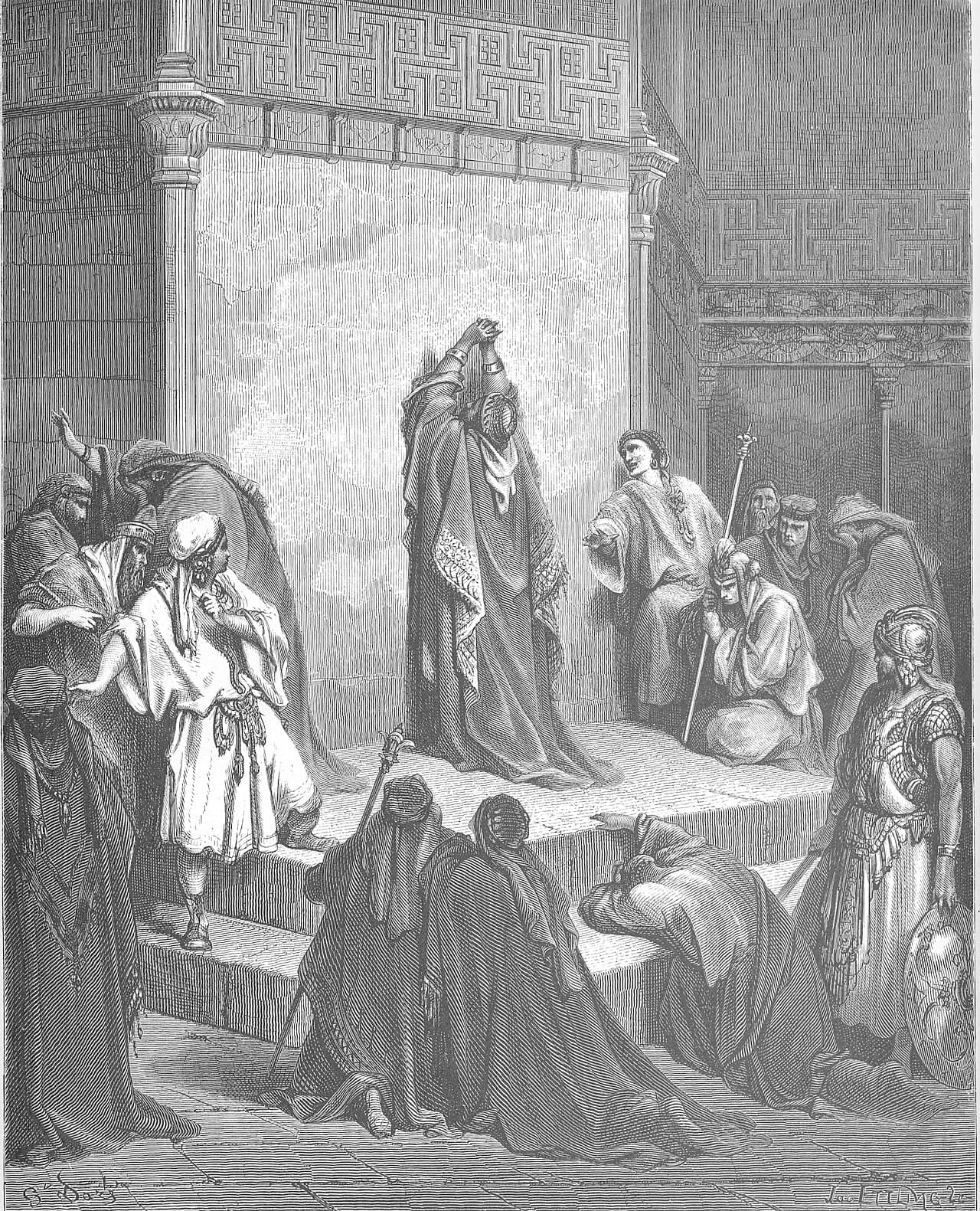
David Mourns the Death of Absalom, Gustave Doré, 1866. Public domain.
Old Testament · Book 10 of 66
2 Samuel
David reigns forty years in three acts: the LORD gives him the throne and promises him a house forever, the sword enters his house after Bathsheba and Uriah, and the book closes with his song, his last words and an altar.
David reigns forty years in three acts: the LORD gives him the throne and promises him a house forever, the sword enters his house after Bathsheba and Uriah, and the book closes with his song, his last words and an altar.
What is 2 Samuel about?
2 Samuel is the story of David's reign of forty years. It opens with David mourning Saul and Jonathan. He is made king over Judah at Hebron and then over all Israel, takes Jerusalem, brings up the ark, and receives the LORD's promise of a house that will last forever. Then he takes Bathsheba and has her husband Uriah killed. He is forgiven, and he watches the sword Nathan named pass through his own sons, Amnon and Absalom. The book ends with David's song, his last words and an altar on a threshing floor.
All 24 chapters
Every chapter of the book, in one grid. Each cell opens that chapter.
- The throne given2 Samuel 1 to 10
- The sword in the house2 Samuel 11 to 20
- The last things2 Samuel 21 to 24
The colour is the act of the book the chapter stands in, and every cell opens that chapter's Study level.
Who wrote it, where, when, for whom, and why?
2 Samuel names no author, and Samuel has died before it opens (1 Samuel 25:1). The book cites a written source, the Book of Jashar, where David's lament for Saul and Jonathan is written (1:18), and it speaks of names that stand to this day, Perez-uzzah (6:8) and Absalom's Monument (18:18). Chronicles says the acts of King David are written in the records of Samuel the seer, Nathan the prophet and Gad the seer (1 Chronicles 29:29). The song of chapter 22 stands again as Psalm 18, the promise of chapter 7 is sung in Psalm 89 (Psalms 89:3), and Peter preaches it at Pentecost (Acts 2:30).
and he ordered that the sons of Judah be taught the Song of the Bow. It is written in the Book of Jashar:
2 Samuel 1:18, Berean Standard Bible.
The book opens at Ziklag, where David hears of Saul's death (1:1). At the LORD's word he goes up to Hebron and is anointed king over Judah (2:1 and 4). After all Israel anoints him there (5:3), he takes the fortress of Zion and makes Jerusalem his city (5:7). The rest of the book is told from Jerusalem, apart from the months David spends in flight across the Jordan at Mahanaim (17:24).
The text counts the reign itself. David was thirty years old when he became king and reigned forty years, seven years and six months in Hebron and thirty-three years in Jerusalem (5:4 and 5; 1 Kings 2:11). The book gives no date of writing. It was written down after the kings of Judah stood as a line, since 1 Samuel 27:6 says that Ziklag belongs to the kings of Judah to this day.
The book is written for Judah and Israel, two peoples who anoint David apart, Judah at Hebron (2:4) and the elders of Israel years later (5:3), and who pull apart again when Sheba cries that Israel has no share in David (20:1 and 2).
It sets down the house the LORD promised David and how that promise held through its king's sin. The LORD says that David's house and kingdom will endure forever (7:16), and David at the end of his life calls it an everlasting covenant, ordered and secured in every part (23:5).
David's kingdom stands among small neighbours. The Philistines come against him from the coast (5:17) and their giants fight at Gath (21:20). He defeats Moab (8:2), Hadadezer king of Zobah (8:3), the Arameans of Damascus (8:5) and Edom (8:14), and besieges the Ammonite city of Rabbah (11:1). Hiram king of Tyre sends cedar and craftsmen to build his palace (5:11). Jerusalem, taken from the Jebusites (5:6), becomes the city of the ark, and at its edge David buys the threshing floor of Araunah (24:24).
Sources. 2 Samuel 1:1, 1:18, 2:1 and 4, 5:3 to 7, 5:11, 5:17, 6:8, 7:16, 8:2 to 14, 11:1, 17:24, 18:18, 20:1 and 2, 21:20, 23:5 and 24:24; 1 Samuel 25:1 and 27:6; 1 Chronicles 29:29; Psalms 18 and 89:3; Acts 2:30. Every verse is read in the Berean Standard Bible.
How is 2 Samuel arranged, and what is it for?
The three acts the book falls into, then what it teaches and what it was written to do.
- The throne given2 Samuel 1 to 10, 237 verses
David mourns Saul, is made king over Judah and then all Israel, takes Jerusalem, brings up the ark and receives the promise of a lasting house.
It turns at 5:3. All the elders of Israel anoint David king at Hebron.
- The sword in the house2 Samuel 11 to 20, 321 verses
David takes Bathsheba and has Uriah killed, is forgiven, and watches the sword Nathan named pass through Amnon, Absalom and Sheba.
It turns at 11:27. The thing David had done was evil in the sight of the LORD.
- The last things2 Samuel 21 to 24, 137 verses
Six pieces close the book: a famine, the giants, David's song, his last words, his mighty men and an altar on a threshing floor.
It turns at 21:1. A famine of three years opens a closing collection of six pieces.
The theme
The LORD gives David the throne and promises him a house that will stand forever, before David commits his worst sin. When David sins, he is forgiven, and the sentence Nathan brings runs through his house to the end of the book. The promise and the sentence both hold, and the book ends with David calling the covenant everlasting.
The purpose
2 Samuel was written so that Israel would know how the house of David came to the throne and on what terms it stands. It shows a king who is answerable to the word the prophet brings, and a promise that outlasts the failures of the king it was made to. It leaves David old, with an altar standing on the ground where the temple will be built, which is where 1 Kings takes up the story of his son.
The three frames, read from the outside in
1The reign, forty years (5:4), opening with the lament for Saul and Jonathan (1:17) and closing with David's song and last words (22:1; 23:1).
2The throne given, chapters 1 to 10: everything David touches succeeds.
2The sword in the house, chapters 11 to 20: the sword never leaves his house.
The rule is the verdict of 11:27, where the thing David had done was evil in the sight of the LORD.
The throne given, 2 Samuel 1 to 10
What the text says in these 10 chapters, 237 verses, and the pages they open on.
The book opens at Ziklag with the news that Saul and Jonathan are dead, and David mourns them in the lament of the bow. The men of Judah anoint him king at Hebron, while Abner sets up Saul's son Ish-bosheth over the rest of Israel, and a long war follows until both Abner and Ish-bosheth are murdered. Then all the tribes come to Hebron and anoint David king over Israel. He takes Zion, brings the ark up to his city with dancing, and hears through Nathan that the LORD will build him a house and establish his son's throne forever. His armies win on every side, and he seats Jonathan's lame son at his own table.
Your house and kingdom will endure forever before Me, and your throne will be established forever.”
- Study
2 Samuel 1the news from Gilboa and the lament of the bowShow the summary and 3 pagesShow summary, 3 pagesHide the summary
An Amalekite comes to Ziklag with torn clothes, claiming he finished Saul himself and bringing the crown and armlet as proof, expecting reward and receiving execution, for how were you not afraid to lift your hand to destroy the LORD’s anointed? Then David composes the lament called the Song of the Bow and orders Judah taught it; it is written in the book of Jashar. It refuses to gloat: 'Tell it not in Gath; proclaim it not in the streets of Ashkelon, lest the daughters of the Philistines rejoice, and the daughters of the uncircumcised exult.' It praises the man who hunted him ('Saul and Jonathan, beloved and delightful in life, were not divided in death') and grieves the friend without restraint: 'your love to me was extraordinary, surpassing the love of women.'
On this chapter (3)
- David and Jonathan
The friendship of the king's son and the shepherd, to the lament.
- Who wrote 2 Samuel, and when?
Answered under Where do readers disagree, lower on this page, with each reading and who holds it.
- 2 Samuel 1:17
The verse on its own page, with the commentators on it by era.
- David and Jonathan
- Study
2 Samuel 2Judah anoints David, and Abner makes Ish-bosheth kingShow the summary and 1 pageShow summary, 1 pageHide the summary
David inquires of Jehovah before he moves, goes up to Hebron, and is anointed king over the house of Judah. His first royal act is a thank-you: a blessing on the men of Jabesh-gilead for burying Saul. But Abner takes Ish-bosheth over to Mahanaim and makes him king over the rest, and the land divides. At the pool of Gibeon twelve champions a side kill each other to a man, so the place is called Helkath-hazzurim, and a very sore battle follows. Asahel, light of foot as a wild roe, chases Abner and will not turn aside; Abner kills him with a backward thrust of the spear. At dusk Abner calls across the hill: 'Shall the sword devour for ever?'
On this chapter (1)
- 2 Samuel 2:4
The verse on its own page, with the commentators on it by era.
- 2 Samuel 2:4
- Study
2 Samuel 3Abner comes over and Joab murders himShow the summary and 1 pageShow summary, 1 pageHide the summary
'David grew stronger and stronger, while the house of Saul grew weaker and weaker' (3:1), the chapter is that sentence worked out. Sons are born in Hebron, Amnon and Absalom and Adonijah among them, all of whom will trouble him. Abner, accused over Saul's concubine, turns kingmaker for the other side; David's price is the return of Michal, and Paltiel follows her weeping to Bahurim. The deal is made and the feast eaten. Then Joab, who was not consulted and has a brother to avenge, calls Abner back to the gate of Hebron and stabs him. David curses Joab's house, walks behind the bier, and fasts: 'Do you not realize that a great prince has fallen today in Israel?'
On this chapter (1)
- 2 Samuel 3:1
The verse on its own page, with the commentators on it by era.
- 2 Samuel 3:1
- Study
2 Samuel 4Ish-bosheth murdered in his bedShow the summary and 1 pageShow summary, 1 pageHide the summary
With Abner gone, Ish-bosheth's hands grow feeble and all Israel is troubled. Here the narrator pauses to introduce a five-year-old: Jonathan's son Mephibosheth, dropped by his nurse in the panic after Gilboa and lame in both feet, a loose thread that will matter in chapter 9. Then two Benjamite captains, Rechab and Baanah, come into the house at noon while the king rests, kill him, and travel all night to Hebron to present his head as a service: Today the LORD has granted vengeance to my lord the king against Saul and his offspring. David answers with the Amalekite precedent, and has these murderers of a righteous man in his own bed executed.
On this chapter (1)
- 2 Samuel 4:4
The verse on its own page, with the commentators on it by era.
- 2 Samuel 4:4
- Study
2 Samuel 5king over all Israel, and Zion takenShow the summary and 2 pagesShow summary, 2 pagesHide the summary
All the tribes come to Hebron on the argument of kinship and record: we are your own flesh and blood, and you were the one who led Israel out and brought them back. He is anointed a third time, thirty years old, and reigns forty years in all. Then the stroke that makes the nation: he takes the Jebusite stronghold Israel had never taken, and Zion becomes the city of David. Hiram of Tyre sends cedar, and David perceives that Jehovah had exalted his kingdom for his people's sake. Twice the Philistines come up; twice he asks first, and the second time is told to circle behind the trees and strike at the sound of marching in their tops.
On this chapter (2)
- Zion and Jerusalem
The city David takes, from the stronghold to the new Jerusalem.
- 2 Samuel 5:4
The verse on its own page, with the commentators on it by era.
- Zion and Jerusalem
- Study
2 Samuel 6Uzzah struck, and the ark brought up with dancingShow the summary and 4 pagesShow summary, 4 pagesHide the summary
The ark comes home in two stages, and the first goes badly. Carried on a new cart rather than on the priests' shoulders, it shakes at the threshing-floor of Nacon; Uzzah puts out his hand to steady it and God smites him there. David is angry, then afraid, and asks how the ark shall come to him; it lodges three months with Obed-edom, whose whole house is blessed. Hearing that, David brings it up with sacrifice every six paces, shouting and the sound of the trumpet, dancing before Jehovah with all his might, girded with a linen ephod. Michal despises him from the window, and his answer is unrepentant: it was before Jehovah, and I will be yet more vile than this.
On this chapter (4)
- The ark of the covenant
The chest of the covenant, how it was carried and where it rested.
- Worship
What Scripture says worship is, David dancing before the ark among it.
- Why was Uzzah struck dead for steadying the ark?
Answered under Where do readers disagree, lower on this page, with each reading and who holds it.
- 2 Samuel 6:14
The verse on its own page, with the commentators on it by era.
- The ark of the covenant
- Study
2 Samuel 7the house promised, and David's prayerShow the summary and 5 pagesShow summary, 5 pagesHide the summary
The hinge of the Old Testament. David, settled in his house of cedar, proposes to build Jehovah a house; Nathan approves, then is sent back that night to reverse it. Instead God will build David a house: 'I will raise up your descendant after you … and I will establish the throne of his kingdom forever. … I will be his Father, and he will be My son' (7:12-14, quoted of Christ in Hebrews 1:5). The church has always read the promise messianically, and rightly, the son of David who reigns without end is Jesus, risen and enthroned. David answers not with planning but wonder: 'Who am I, O Lord GOD, and what is my house, that You have brought me this far?'
On this chapter (5)
- The Davidic covenant
The promise of a house and a throne forever, and how the New Testament reads it.
- The throne
The throne of God and the throne promised to David's son.
- The seed
The promised offspring, from Eden to David to Christ.
- Was the promise of chapter 7 unconditional, when it also names the rod?
Answered under Where do readers disagree, lower on this page, with each reading and who holds it.
- 2 Samuel 7:16
The verse on its own page, with the commentators on it by era.
- The Davidic covenant
- Study
2 Samuel 8the wars on every side, and justice for allShow the summary and 1 pageShow summary, 1 pageHide the summary
The covenant is followed by a summary of the empire it was given to. David subdues the Philistines, measures Moab with a line, defeats Hadadezer of Zobah as far as the River, and cuts down the Syrians of Damascus who came to help; garrisons go into Syria and Edom. Toi of Hamath sends vessels of silver, gold, and brass, and David dedicates them all to Jehovah with the spoil of every nation. Twice the chapter states the reason: Jehovah gave victory to David whithersoever he went. Then the verdict on his rule at its height (he administered justice and righteousness for all his people), followed by a cabinet list.
On this chapter (1)
- 2 Samuel 8:15
The verse on its own page, with the commentators on it by era.
- 2 Samuel 8:15
- Study
2 Samuel 9Mephibosheth at the king's tableShow the summary and 2 pagesShow summary, 2 pagesHide the summary
David asks whether any of Saul's house is left, that he may show him the kindness of God for Jonathan's sake, a search for someone to bless, in a dynasty that usually searched for rivals to kill. Ziba names Jonathan's son, lame of his feet, living in Lo-debar. Mephibosheth comes and falls on his face; David tells him not to fear, restores all the land of Saul, assigns Ziba's household to farm it, and adds the sentence the chapter is remembered for: 'you will always eat at my table.' Mephibosheth keeps the scale straight, What is your servant, that you should show regard for a dead dog like me? He was lame in both his feet.
On this chapter (2)
- Were chapters 9 to 20 written to defend Solomon's claim to the throne?
Answered under Where do readers disagree, lower on this page, with each reading and who holds it.
- 2 Samuel 9:1
The verse on its own page, with the commentators on it by era.
- Were chapters 9 to 20 written to defend Solomon's claim to the throne?
- Study
2 Samuel 10the envoys shamed, and the Ammonite warShow the summary and 1 pageShow summary, 1 pageHide the summary
The same kindness offered abroad is answered with insult. David sends comforters to Hanun on the death of his father Nahash; the princes of Ammon persuade the young king they are spies, so he shaves off half their beards, cuts their garments off at the buttocks, and sends them away, and David meets them at Jericho with orders to stay until the beards are grown. Ammon hires Syrians by the tens of thousands, and Joab, caught between two fronts, splits the army with Abishai and speaks the soldier's creed of the book: 'Be strong and let us fight bravely for our people and for the cities of our God. May the LORD do what is good in His sight' (10:12).
On this chapter (1)
- 2 Samuel 10:12
The verse on its own page, with the commentators on it by era.
- 2 Samuel 10:12
Characters (9)
Who the text follows. A name with a page carries its door.
- David
King over Judah at Hebron, then over all Israel for forty years.
- Saul
The first king, whose death on Gilboa opens the book.
- Jonathan
Saul's son and David's friend, mourned in the lament.
- Abner
Saul's commander, who makes Ish-bosheth king and then comes over to David.
Show the next 5
- Ish-bosheth
Saul's son, king at Mahanaim until his own captains kill him.
- Joab
David's commander, who kills Abner, Absalom and Amasa.
- Michal
Saul's daughter and David's wife, who despises him for dancing.
- Nathan
The prophet who brings the promise in chapter 7 and the sentence in chapter 12.
- Mephibosheth
Jonathan's lame son, given a seat at the king's table.
Places (10)
Where the chapters stand.
- Ziklag
Where David hears the news of Saul's death.
- Hebron
David's first capital, where Judah and then all Israel anoint him.
- Mahanaim
Ish-bosheth's seat east of the Jordan.
- Zion
The stronghold David takes and names the City of David.
Show the next 6
- Jerusalem
Taken from the Jebusites and made David's city.
- Philistia
The coastland of the enemy David defeats in chapters 5 and 8.
- Moab
Defeated and made to pay tribute in chapter 8.
- Damascus
Where David sets garrisons among the Arameans.
- Edom
Garrisoned by David, and all its people subject to him.
- Ammon
The kingdom whose king shames David's envoys.
Themes (6)
What these chapters raise, each on its own page.
- The Davidic covenant
The house and the throne promised forever.
- Zion and Jerusalem
The city David takes, and what it becomes.
- The ark of the covenant
The ark brought up to the City of David.
- Worship
David dancing before the LORD with all his might.
Show the next 2
- David and Jonathan
The friendship mourned in the lament of the bow.
- The throne
The throne promised to David's son.
Where the New Testament uses these chapters (7)each marked as a quotation or an allusion, with the evidence
- Explicit quotationHis Father, My son, 2 Samuel 7:14 at Hebrews 1:5. Hebrews sets the words I will be His Father, and He will be My Son beside Psalm 2:7 to show the Son above the angels. Held by The writer to the Hebrews.
- Probable allusionA Father to you, 2 Samuel 7:14 at 2 Corinthians 6:18. Paul gathers several promises into one and turns the promise to David's son into a promise to all God's sons and daughters. Held by Paul.
- Probable allusionThe throne of His father David, 2 Samuel 7:12 to 16 at Luke 1:32 and 33. Gabriel's words to Mary take up the throne, the house and the kingdom that never ends from Nathan's oracle. Held by Luke.
- Probable allusionOne of his descendants on his throne, 2 Samuel 7:12 and 16 at Acts 2:30. Peter says God promised David on oath to place one of his descendants on his throne; the oath is sung in Psalm 132:11 and rests on 2 Samuel 7. Held by Peter, as Luke records him.
- Probable allusionThe sure blessings promised to David, 2 Samuel 7:15 and 23:5 at Acts 13:34. Paul quotes Isaiah 55:3, which names the everlasting covenant with David that 23:5 calls ordered and secured in every part. Held by Paul, as Luke records him.
- Probable allusionThe son of David, 2 Samuel 7:12 at Matthew 1:1. The New Testament opens by naming Jesus the son of David, the descendant the promise of 7:12 looked for. Held by Matthew.
- Probable allusionThe Root and the Offspring of David, 2 Samuel 7:12 at Revelation 22:16. Jesus names himself the Root and the Offspring of David at the close of the Bible. Held by John, recording the words of Jesus.
The sword in the house, 2 Samuel 11 to 20
What the text says in these 10 chapters, 321 verses, and the pages they open on.
In the spring David stays in Jerusalem, takes Bathsheba, and has her husband Uriah killed at Rabbah. Nathan brings him a story of a stolen lamb and then the sentence: the sword will never leave his house. David confesses and is forgiven, and the child dies. Then the sentence runs through his sons. Amnon rapes Tamar, Absalom kills Amnon, flees, is brought home, and takes the kingdom, and David goes up the Mount of Olives weeping. Absalom dies in an oak, David mourns him, and the king returns only for Sheba to lead Israel away, until a wise woman ends the revolt at Abel Beth-maacah.
Now, therefore, the sword will never depart from your house, because you have despised Me and have taken the wife of Uriah the Hittite to be your own.’
- Study
2 Samuel 11Bathsheba, and Uriah sent to the frontShow the summary and 3 pagesShow summary, 3 pagesHide the summary
'At the return of the year, at the time when kings go out to battle,' David sends Joab to besiege Rabbah, 'but David tarried at Jerusalem.' From the roof at evening he sees a woman bathing, asks who she is, is told plainly that she is another man's wife, and sends and takes her anyway. The message comes back: I am with child. Then the cover-up, step by escalating step. Uriah recalled and urged to go down to his house; Uriah sleeping at the door because the ark and Israel and Judah are in tents; Uriah made drunk and still refusing; and at last Uriah carrying his own death warrant to Joab. 'But the thing that David had done displeased Jehovah.'
On this chapter (3)
- David and Bathsheba
The sin, the parable, the confession and what followed.
- Lust and adultery of the heart
Jesus on the look that begins the sin.
- 2 Samuel 11:27
The verse on its own page, with the commentators on it by era.
- David and Bathsheba
- Study
2 Samuel 12the ewe lamb, the confession, the child's deathShow the summary and 6 pagesShow summary, 6 pagesHide the summary
Nathan comes with a lawsuit disguised as a story: a rich man with many flocks who took the poor man's one ewe lamb, that slept in his arms and was like a daughter to him. David's anger is kindled and he passes sentence, and Nathan turns it: 'You are that man!' The judgment stands: the sword will never depart from your house. David's confession is four words, 'I have sinned against the LORD', and the pardon is immediate (The LORD has taken away your sin) but the child dies. Psalm 51 belongs to this hour. 'I will go to him, but he will not return to me.' Then Solomon is born, and Jehovah names him Jedidiah.
On this chapter (6)
- David and Bathsheba
The sin, the parable, the confession and what followed.
- Repentance
Turning back to God, David's confession among the examples.
- Forgiveness
God's forgiveness and ours.
- The penitential psalms
The seven psalms of confession, Psalm 51 among them.
- Why did David live when the law required death for adultery and murder?
Answered under Where do readers disagree, lower on this page, with each reading and who holds it.
- 2 Samuel 12:13
The verse on its own page, with the commentators on it by era.
- David and Bathsheba
- Study
2 Samuel 13Amnon and Tamar, and Absalom's revengeShow the summary and 1 pageShow summary, 1 pageHide the summary
The sword arrives on schedule. Amnon, David's firstborn, is sick with desire for his half-sister Tamar; his cousin Jonadab, a very subtle man, coaches him into feigning illness and asking that she come make cakes in his sight. She pleads with him not to do this folly in Israel (whither shall I carry my shame?) and he forces her, then hates her with a hatred greater than the love, and bolts the door behind her. Tamar puts ashes on her head, rends her garment of many colors, and remains desolate in Absalom's house. David is very wroth and does nothing. Two years later Absalom has Amnon struck down at a sheepshearing feast, and flees to Geshur for three years.
On this chapter (1)
- 2 Samuel 13:28
The verse on its own page, with the commentators on it by era.
- 2 Samuel 13:28
- Study
2 Samuel 14the woman of Tekoa, and Absalom brought homeShow the summary and 1 pageShow summary, 1 pageHide the summary
Joab, seeing the king's heart is toward Absalom, sends a wise woman of Tekoa in mourning dress with a case that mirrors David's own: one of her two sons killed the other, and the avengers demand the survivor, which would quench her coal that is left. David grants her protection; she springs the trap (why has the king not brought back his own banished son?) and grounds it in God's own character: 'we will die and be like water poured out on the ground … God does not take away a life; but He devises ways that the banished one may not be cast out from Him' (14:14). David sends for Absalom but bars him from the royal presence two years, until the prince burns Joab's barley field.
On this chapter (1)
- 2 Samuel 14:14
The verse on its own page, with the commentators on it by era.
- 2 Samuel 14:14
- Study
2 Samuel 15Absalom proclaimed king, and David's flightShow the summary and 2 pagesShow summary, 2 pagesHide the summary
Absalom mounts a campaign in daylight: chariots and horses and fifty runners, standing beside the way of the gate, telling every litigant that his case is good but there is no man deputed of the king to hear him, and kissing whoever bows: 'In this way he stole the hearts of the men of Israel' (15:6). The revolt is proclaimed at Hebron, David's own counselor Ahithophel among the conspirators. David abandons Jerusalem to spare it, and the road out is a procession of loyalties: Ittai the Gittite refusing to leave; the priests turned back with the ark, because if I find favor he will bring me again; David weeping up Olivet barefoot; and one prayer sent ahead, turn the counsel of Ahithophel into foolishness.
On this chapter (2)
- David as a type of Christ
Where the life of David is read as a pattern of the Son of David.
- 2 Samuel 15:30
The verse on its own page, with the commentators on it by era.
- David as a type of Christ
- Study
2 Samuel 16Ziba, Shimei's curses, and the roofShow the summary and 1 pageShow summary, 1 pageHide the summary
Two men meet the fleeing king. Ziba comes with loaded asses, bread, summer fruit, and wine, and a slander about Mephibosheth hoping for the crown; David, in no position to investigate, gives him everything. Then Shimei of Saul's house walks along the hillside cursing and throwing stones, calling him a man of blood; Abishai offers to take off his head, and David refuses on the deepest ground in the chapter: 'let him curse me, for the LORD has told him so', my own son seeketh my life, how much more this Benjamite. Meanwhile Ahithophel counsels the public taking of the concubines on the housetop: Nathan's word fulfilled to the letter.
On this chapter (1)
- 2 Samuel 16:22
The verse on its own page, with the commentators on it by era.
- 2 Samuel 16:22
- Study
2 Samuel 17Ahithophel and Hushai, and the crossing of the JordanShow the summary and 1 pageShow summary, 1 pageHide the summary
Ahithophel's plan is militarily perfect: give me twelve thousand men, pursue tonight while he is weary and weak-handed, strike the king only, and bring all the people back. Hushai's counter-plan is theater and buys the night, your father and his men are mighty men, as fierce as a wild bear robbed of her cubs; gather all Israel from Dan to Beersheba and go in person. Absalom prefers it, and the narrator says why: 'the LORD had purposed to thwart the good counsel of Ahithophel in order to bring disaster on Absalom.' The warning goes by Jonathan and Ahimaaz, hidden in a well at Bahurim. Ahithophel sets his house in order and hangs himself.
On this chapter (1)
- 2 Samuel 17:14
The verse on its own page, with the commentators on it by era.
- 2 Samuel 17:14
- Study
2 Samuel 18the battle in the forest, and Absalom's deathShow the summary and 1 pageShow summary, 1 pageHide the summary
David would march with his people, but they refuse to risk him, you are worth ten thousand of us. His last order before the battle is heard by all the troops: 'Treat the young man Absalom gently for my sake.' The fight spreads through the forest of Ephraim, and the forest devoured more people that day than the sword devoured. Absalom, riding his mule under a great oak, is caught by the head and left hanging between heaven and earth; a soldier who will not touch him reports it, and Joab thrusts three darts through his heart. Then the runners, the watchman, and the king's stair: 'O my son Absalom! My son, my son Absalom! If only I had died instead of you, O Absalom, my son, my son!'
On this chapter (1)
- 2 Samuel 18:33
The verse on its own page, with the commentators on it by era.
- 2 Samuel 18:33
- Study
2 Samuel 19the king's return, and Judah and Israel quarrelShow the summary and 1 pageShow summary, 1 pageHide the summary
The victory is turned into mourning until Joab confronts the king brutally. You love those who hate you and hate those who love you; speak comfort to your servants or not a man will stay the night. David sits in the gate and the army files past. The return is a negotiation: Judah is coaxed back first, with Amasa promised Joab's command; Shimei runs down with a thousand Benjamites and is spared under oath; Mephibosheth, who had neither dressed his feet nor trimmed his beard since the king left, answers Ziba's slander. Barzillai, eighty years old, declines the court because he can no longer taste or hear the singing. At the Jordan the tribes fall to arguing over who owns the king.
On this chapter (1)
- 2 Samuel 19:23
The verse on its own page, with the commentators on it by era.
- 2 Samuel 19:23
- Study
2 Samuel 20Sheba's revolt, and the head over the wallShow the summary and 1 pageShow summary, 1 pageHide the summary
The quarrel breaks open at once. Sheba the son of Bichri blows the trumpet with the slogan that will split the kingdom for good in Rehoboam's day: 'We have no share in David, no inheritance in Jesse’s son. Every man to his tent, O Israel!' Home in Jerusalem, David shuts up the ten concubines Absalom defiled, living in widowhood to the day of their death. Amasa is slow to muster, so Joab overtakes him at the great stone in Gibeon, takes him by the beard as if to kiss him, and kills him. The chase ends at Abel of Beth-maacah, where a wise woman calls over the siege mound, would you destroy a city that is a mother in Israel?
On this chapter (1)
- 2 Samuel 20:1
The verse on its own page, with the commentators on it by era.
- 2 Samuel 20:1
The sentence and its fulfilment
12 Samuel 12:10 to 12. Nathan brings the sentence.
“the sword will never depart from your house” (12:10)
22 Samuel 12:18. The child born to Bathsheba dies on the seventh day.
“the son born to you will surely die” (12:14)
32 Samuel 13:28 and 29. Absalom's young men kill Amnon at the sheep-shearing.
“I will raise up adversity against you from your own house” (12:11)
42 Samuel 13:37 to 14:33. Absalom flees to Geshur and is brought back.
“I will raise up adversity against you from your own house” (12:11)
52 Samuel 16:22. A tent is pitched for Absalom on the roof.
“I will do this thing in broad daylight before all Israel” (12:12)
62 Samuel 18:9 to 15. Absalom hangs in the oak and Joab kills him.
“the sword will never depart from your house” (12:10)
72 Samuel 20:1 to 22. Sheba leads Israel away, until his head is thrown over the wall.
“I will raise up adversity against you” (12:11)
Characters (12)
Who the text follows. A name with a page carries its door.
- David
King over Judah at Hebron, then over all Israel for forty years.
- Bathsheba
Uriah's wife, whom David takes, and the mother of Solomon.
- Uriah the Hittite
Her husband, who will not go home while the army is in tents.
- Nathan
The prophet who brings the promise in chapter 7 and the sentence in chapter 12.
Show the next 8
- Amnon
David's firstborn, who rapes Tamar and is killed by Absalom.
- Tamar
David's daughter, who lives desolate in Absalom's house.
- Absalom
David's son, who kills Amnon, takes the kingdom and dies in the oak.
- Ahithophel
David's counsellor who joins Absalom and hangs himself.
- Hushai
David's friend, sent back to defeat Ahithophel's counsel.
- Shimei
A man of Saul's house who curses the fleeing king.
- Joab
David's commander, who kills Abner, Absalom and Amasa.
- Solomon
Born to Bathsheba after the child's death, and loved by the LORD.
Places (7)
Where the chapters stand.
- Jerusalem
Taken from the Jebusites and made David's city.
- Rabbah
The Ammonite city where Uriah is killed and which Joab takes.
- Tekoa
The town of the wise woman Joab sends to the king.
- Mount of Olives
The hill David climbs weeping as he flees Absalom.
Show the next 3
- The Jordan
The river David crosses in flight and on his return.
- Mahanaim
David's refuge east of the Jordan.
- Abel Beth-maacah
The city where Sheba's revolt ends.
Themes (5)
What these chapters raise, each on its own page.
- David and Bathsheba
The sin, the parable and the sentence.
- Repentance
David's confession and what it did and did not undo.
- Forgiveness
The LORD takes away David's sin.
- The penitential psalms
The psalms of confession, Psalm 51 among them.
Show the next 1
- David as a type of Christ
The king rejected and going up the Mount of Olives.
The last things, 2 Samuel 21 to 24
What the text says in these 4 chapters, 137 verses, and the pages they open on.
The book closes with six pieces set beside one another rather than in the order of the reign. A famine is traced to Saul's killing of the Gibeonites, seven of his descendants are handed over, and Rizpah keeps watch over their bodies. Four giants of Gath fall to David's men. David sings his song of deliverance, the same song that stands as Psalm 18, and speaks his last words about an everlasting covenant. His mighty men are named, and the list ends with Uriah the Hittite. Last, David counts the people, a plague falls, and he buys a threshing floor and builds an altar where the plague stops.
Is not my house right with God? For He has established with me an everlasting covenant, ordered and secured in every part. Will He not bring about my full salvation and my every desire?
- Study
2 Samuel 21the Gibeonites and Rizpah (1 to 14), and the giants of Gath (15 to 22)Show the summary and 5 pagesShow summary, 5 pagesHide the summary
Two appendices of famine and giants. A three-year famine is traced to Saul's slaughter of the Gibeonites, who ask not silver but seven of Saul's sons; David spares Mephibosheth for Jonathan's oath and gives up the rest. Then Rizpah, mother of two of them, spreads sackcloth on the rock and keeps the birds off by day and the beasts by night, from harvest until water dropped out of heaven, a vigil that shames the king into burying the bones of Saul and Jonathan in Zela. Four more battles follow against the sons of the giant, one of them a man with six fingers and six toes on each limb; after David nearly falls, his men swear he shall go out no more, so that the lamp of Israel may not be extinguished.
On this chapter (5)
- Rizpah
The mother who kept watch over her sons from harvest to rain.
- David and Goliath
The battle in the Valley of Elah and the giants of Gath.
- Was David right to hand seven of Saul's sons to the Gibeonites?
Answered under Where do readers disagree, lower on this page, with each reading and who holds it.
- Who killed Goliath, David or Elhanan?
Answered under Where do readers disagree, lower on this page, with each reading and who holds it.
- 2 Samuel 21:14
The verse on its own page, with the commentators on it by era.
- Rizpah
- Study
2 Samuel 22David's song of deliverance, the same as Psalm 18Show the summary and 2 pagesShow summary, 2 pagesHide the summary
David's great song of deliverance, preserved again as Psalm 18. It opens by piling up titles ('The LORD is my rock, my fortress, and my deliverer', my shield, the horn of my salvation, my high tower), then turns the answered prayer into a storm theophany: the earth shakes: 'He parted the heavens and came down', he rides upon a cherub and flies, and he reaches from on high and draws his servant out of many waters. The close is all gift: 'As for God, His way is perfect'; he maketh my feet like hinds' feet; 'Your gentleness exalts me.' The last verses give thanks among the nations: Paul quotes them for the Gentile mission (Romans 15:9).
On this chapter (2)
- David's life in the psalms
The psalms read against the events of David's life.
- 2 Samuel 22:2
The verse on its own page, with the commentators on it by era.
- David's life in the psalms
- Study
2 Samuel 23the last words (1 to 7), and the mighty men (8 to 39)Show the summary and 2 pagesShow summary, 2 pagesHide the summary
'These are the last words of David', introduced as the anointed of the God of Jacob and the sweet psalmist of Israel: 'The Spirit of the LORD spoke through me; His word was on my tongue.' The oracle describes the ruler Israel actually needs (one that ruleth over men righteously, in the fear of God, as the light of the morning when the sun riseth), then rests not on his own house but on the promise of chapter 7: an everlasting covenant, ordered in all things, and sure. The rest honors his mighty men: Eleazar smiting till his hand stuck to his sword; Shammah alone in a plot of lentils; the three who broke through for water from the well of Bethlehem, which David poured out to Jehovah; and, last of all, Uriah the Hittite.
On this chapter (2)
- The Davidic covenant
The promise of a house and a throne forever, and how the New Testament reads it.
- 2 Samuel 23:5
The verse on its own page, with the commentators on it by era.
- The Davidic covenant
- Study
2 Samuel 24the census, the plague and the altarShow the summary and 2 pagesShow summary, 2 pagesHide the summary
David orders a census of the fighting men; even Joab objects, but the king's word prevails, and the count comes in at eight hundred thousand in Israel and five hundred thousand in Judah. Then David's heart smites him. Gad offers three chastisements, and David chooses the one held directly in God's hand: 'let me fall now into the hand of Jehovah; for his mercies are great: and let me not fall into the hand of man.' Seventy thousand die, and the destroying angel stands over Jerusalem till Jehovah stays it at the threshing-floor of Araunah. David pleads as a shepherd ('these sheep, what have they done?') and buys the floor rather than take it free, refusing to offer that which cost him nothing.
On this chapter (2)
- Did the LORD or Satan move David to count the people?
Answered under Where do readers disagree, lower on this page, with each reading and who holds it.
- 2 Samuel 24:24
The verse on its own page, with the commentators on it by era.
- Did the LORD or Satan move David to count the people?
Characters (7)
Who the text follows. A name with a page carries its door.
- David
King over Judah at Hebron, then over all Israel for forty years.
- Rizpah
Saul's concubine, who guards her sons' bodies from harvest until the rain.
- Elhanan
One of David's men, who kills the brother of Goliath the Gittite at Gob (21:19).
- Goliath
The giant of Gath, named again in the wars of chapter 21.
Show the next 3
- Gad
The prophet who brings David the three choices after the census.
- Araunah
The Jebusite who sells David his threshing floor.
- Joab
David's commander, who kills Abner, Absalom and Amasa.
Places (4)
Where the chapters stand.
- Gibeon
The town of the Gibeonites, whom Saul had killed.
- Gath
The Philistine city of the four giants.
- Bethlehem
The town whose well the three mighty men break through to reach.
- The threshing floor of Araunah
Where the plague stops and David builds the altar.
Themes (4)
What these chapters raise, each on its own page.
- Rizpah
The vigil on the rock.
- David and Goliath
The giants of Gath, and the question of 21:19.
- David's life in the psalms
The song of chapter 22 and the psalms of his life.
- The Davidic covenant
The everlasting covenant of David's last words.
Where the New Testament uses these chapters (1)each marked as a quotation or an allusion, with the evidence
- Explicit quotationI will praise You among the nations, 2 Samuel 22:50 at Romans 15:9. Paul quotes the song, as it is written, to show the Gentiles glorifying God; the same line stands at Psalm 18:49. Held by Paul.
- Author
- Traditional: compilation by Nathan and Gad from Samuel's earlier records (1 Chr 29:29)
- Date
- Events c. 1010–970 BC; compilation during Solomon's early reign
- Audience
- The Davidic dynasty and its subjects weighing covenant faithfulness against covenant promise
Where do readers disagree?
One list: the readings with their holders, and what the evidence does not settle.
Who wrote 2 Samuel, and when?
- Prophetic records, set down close to the events. Held by the Talmud (Bava Batra 14b to 15a) and by C. F. Keil and Franz Delitzsch, Biblical Commentary on the Books of Samuel (1864).
- Older sources edited into a longer history. Held by Martin Noth, Überlieferungsgeschichtliche Studien (1943), and Frank Moore Cross, Canaanite Myth and Hebrew Epic (1973).
What the evidence does not settle: When the material reached its present form. Both readings take the material to be early; they differ on the date of the final edition.
The argument in full
Prophetic records, set down close to the events. Chronicles names the records of Samuel, Nathan and Gad, and Nathan and Gad both speak inside the book. The notices that names stand to this day (6:8; 18:18) fit readers who could still see the places.
Older sources edited into a longer history. Court sources, among them the History of David's Rise and chapters 9 to 20, were shaped by a later editor into one history running from the conquest to the exile.
The witnesses to the text, 4
The Masoretic Text (c. AD 1008 (Leningrad Codex)). The standard Hebrew text behind English translations. Samuel is the book where the Masoretic tradition shows more copying damage than most: short gaps, dropped words, and hard readings such as 21:19 and 23:8 cluster here in a way they do not in the Torah. 4QSamuel-a (Qumran Cave 4) (c. 50-25 BC). The fullest Samuel scroll from Qumran, and the most useful single witness to the book. It repeatedly agrees with the Greek against the Masoretic Text, which showed that many Septuagint readings in Samuel translate a genuine Hebrew text rather than a translator's liberty. At the census account it preserves a longer text around 24:16-17, describing the angel and David's sight of him in terms close to the parallel at 1 Chronicles 21:16, where the Masoretic Samuel is shorter. Published by Frank Moore Cross and colleagues in Discoveries in the Judaean Desert XVII (2005). The Septuagint (LXX), 2 Kingdoms (Old Greek c. 3rd-2nd century BC; kaige revision c. 1st century BC to 1st century AD). The Greek Samuel is not one translation throughout. Dominique Barthélemy (Les Devanciers d'Aquila, 1963) identified a section running from 2 Samuel 11:2 to 1 Kings 2:11 that had been revised toward a proto-Masoretic Hebrew, the kaige recension, while the Lucianic manuscripts often preserve the older Old Greek underneath it. Reading the two layers apart is standard practice in Samuel textual criticism. The Old Latin (Vetus Latina) Samuel fragments (translated c. 2nd-3rd century AD, surviving in later copies and patristic citations). Translated from Greek before Jerome's Vulgate, and often carrying Lucianic-type readings that agree with 4QSamuel-a against the Masoretic Text. A secondary witness that turned out to matter once the Qumran scroll was read.
The finds, 4
The Tel Dan Stele (9th century BC; excavated 1993-1994). An Aramaic victory inscription found at Tel Dan by Avraham Biran's excavation and published with Joseph Naveh (Israel Exploration Journal, 1993 and 1995). It names the king of Israel and, on the standard reading, BYTDWD, the house of David, as the dynastic name of the southern kingdom. Philip Davies argued the letters could be a place name rather than a dynasty; André Lemaire and most epigraphers hold the dynastic reading, which is now the majority position. On that reading it is the earliest extrabiblical reference to David, written by a hostile neighbor within about a century and a half of his reign. The Mesha Stele (the Moabite Stone), line 31 (c. 840 BC; found at Dhiban 1868). A damaged line that André Lemaire read as bt[d]wd, house of David, in 1994 (Biblical Archaeology Review). The reading is contested. Israel Finkelstein, Nadav Na'aman, and Thomas Römer argued in 2019 for a Moabite royal name instead; Michael Langlois, working the same year from Reflectance Transformation Imaging of the stone and the nineteenth-century squeeze, argued the house of David reading stands. The line is genuinely broken, and both readings are live. The Stepped Stone Structure and the Large Stone Structure, City of David (excavated 1920s onward; the Large Stone Structure excavated 2005). Eilat Mazar identified the massive walls she uncovered above the Stepped Stone Structure as David's palace, the house of cedar of 2 Samuel 5:11, and dated them to the tenth century BC. Israel Finkelstein, Ze'ev Herzog, Lily Singer-Avitz, and David Ussishkin replied in Tel Aviv (2007) that the walls belong to several periods, that the pottery does not secure a tenth-century date, and that the identification runs ahead of the evidence. Both sides are named here because the dating of monumental building in tenth-century Jerusalem is the live question, and it has not been settled. Khirbet Qeiyafa (excavated 2007-2013; radiocarbon dates c. 1020-980 BC). A fortified town in the Elah Valley with two gates, casemate walls, and no pig bones. Yosef Garfinkel reads it as a Judahite border fortress from exactly the era 1 and 2 Samuel describe, evidence of a state capable of building. Israel Finkelstein and Alexander Fantalkin argued it may be Canaanite or north-Israelite rather than Judahite. The radiocarbon dating is not much disputed; what the site's ethnic and political attribution proves is.
Did the LORD or Satan move David to count the people?
- Both are true: the LORD permits and Satan tempts. Held by Matthew Henry, Exposition of the Old and New Testaments (1706 to 1714), and John Gill, Exposition of the Old Testament (1763).
- Chronicles names a human adversary. Held by Sara Japhet, I and II Chronicles.
- The LORD did not move David; Satan and David's own ambition did. Held by Adam Clarke in his Commentary on the Bible, who reads 24:1 through 1 Chronicles 21:1.
What the evidence does not settle: Which agent Chronicles means, and whether the two accounts describe one cause at two levels. Every party in the story treats the census as sin (24:10).
The argument in full
Both are true: the LORD permits and Satan tempts. 2 Samuel 24:1 names the anger of the LORD and 1 Chronicles 21:1 names Satan, and Job 1 and 2 and 1 Kings 22:19 to 23 show the LORD's permission and a hostile agent's act as one event seen from two heights.
Chronicles names a human adversary. The Hebrew noun at 1 Chronicles 21:1 stands without the definite article, which elsewhere usually marks the ordinary sense of an adversary rather than the proper name.
The LORD did not move David; Satan and David's own ambition did. God could not be angry with David for a census he had moved him to take, so the mover is the one Chronicles names, working on a king who wanted to know his strength for wars he had not been told to fight.
Who killed Goliath, David or Elhanan?
- Samuel lost words a copyist's eye skipped. Held by C. F. Keil and Franz Delitzsch, Biblical Commentary on the Books of Samuel (1864).
- Elhanan is David under another name. Held by Jonathan ben Uzziel in Targum Jonathan to the Prophets, the Aramaic rendering the Talmud ascribes to him (Megillah 3a), which renders 21:19 of David himself.
What the evidence does not settle: What the Hebrew of 21:19 first read. 1 Samuel 17:50 has David kill the Philistine, and the damaged verse of 2 Samuel is read in its light or against it.
The argument in full
Samuel lost words a copyist's eye skipped. 1 Chronicles 20:5 reads that Elhanan killed Lahmi the brother of Goliath, and the Hebrew letters behind the two readings are close. The Berean Standard Bible reads the brother of Goliath at 21:19.
Elhanan is David under another name. The verse is read as a second name for the king rather than a second giant killer.
Why was Uzzah struck dead for steadying the ark?
- The LORD taught Israel to fear his law. Held by Robert Jamieson, A. R. Fausset and David Brown in their Commentary Critical and Explanatory on the Whole Bible, who read the death as meant to teach awe of God's majesty and submission to his law.
- Uzzah's own heart was the fault. Held by Pacian of Barcelona in On Penitents (391), who writes that Uzzah touched the ark without having examined his conscience.
What the evidence does not settle: How the method and the man weigh against each other. 2 Samuel names Uzzah's irreverence and Chronicles names the failure to seek the LORD about the proper order, and neither text sets one against the other.
The argument in full
The LORD taught Israel to fear his law. The law gave the ark to the Kohathites to carry on poles and forbade them to touch the holy things. The new cart copied the Philistines (1 Samuel 6:7), and the second attempt, carried by the Levites, costs no life.
Uzzah's own heart was the fault. The text gives the cause as his irreverence (6:7), which names the man's act and not only the method.
Was David right to hand seven of Saul's sons to the Gibeonites?
- A broken national oath, outside the ordinary court. Held by Keil and Delitzsch in their Biblical Commentary on the Books of Samuel.
- The text leaves the guilt of the seven unproved. Held by Adam Clarke in his Commentary on the Bible, who notes that no other passage records Saul's killing of the Gibeonites and asks where the proof is that the seven took part.
What the evidence does not settle: Whether the famine's end answers the deaths or the burial. 21:14 places the answer after the burial and says nothing of the handing over.
The argument in full
A broken national oath, outside the ordinary court. Deuteronomy 24:16 governs the ordinary court, and the Gibeonite claim answers the oath Israel swore in the LORD's name (Joshua 9:19), which Saul broke.
The text leaves the guilt of the seven unproved. The text records no word from the LORD to hand over the seven, and God answers prayer for the land only after Rizpah's vigil and the burial of the bones (21:14).
Why did David live when the law required death for adultery and murder?
- The LORD spared his life by his own word. Held by John Wesley, Explanatory Notes upon the Old Testament (1765), who reads the pardon of 12:13 as sparing David the death his own sentence of 12:5 deserved.
- The death the law required passed to the child. Held by Adam Clarke in his Commentary on the Bible, who reads 12:13 as lifting only the death the law of adultery required.
What the evidence does not settle: What the pardon rests on. The text says only that David confessed and the LORD took away his sin (12:13).
The argument in full
The LORD spared his life by his own word. The pardon is the LORD's act, spoken by his prophet, and it stands above the sentence the law would pass.
The death the law required passed to the child. Nathan's next words are that the child will die (12:14), and the sword stays in the house (12:10), so the consequences run on after the pardon.
Was the promise of chapter 7 unconditional, when it also names the rod?
- A royal grant, secured by God's oath. Held by Moshe Weinfeld, The Covenant of Grant in the Old Testament and in the Ancient Near East (JAOS 90, 1970).
- Real grants carried conditions too. Held by Gary Knoppers, Ancient Near Eastern Royal Grants and the Davidic Covenant (JAOS 116, 1996).
- The son is disciplined, and the throne stands. Held by Matthew Henry in his Exposition of the Old and New Testaments, who reads the correction of 7:14 as an article of the covenant that flows from God's fatherly love.
What the evidence does not settle: How 7:14 and 7:16 hold together. Psalm 89 reads the promise as unbreakable and Psalm 132 attaches a condition, and both stand in the same book.
The argument in full
A royal grant, secured by God's oath. The promise takes the form of a king's grant for past faithfulness, and 7:15 says the LORD's loving devotion will never be removed from David's son as it was from Saul.
Real grants carried conditions too. The grant form does not by itself settle permanence, and 7:14 names the rod for a son who does wrong.
The son is disciplined, and the throne stands. The rod falls on the son who does wrong and the throne of 7:16 still stands, while Psalm 132:12 ties each generation's seat on it to keeping the covenant.
The neighbours' own texts, 3
Hittite and Neo-Assyrian royal land grants, Hittite and Assyrian, c. 14th-7th century BC. A sovereign rewards a loyal servant with a perpetual, heritable grant of land or office. The grant is a gift for past faithfulness rather than a contract of future obligations, and its language of an everlasting possession to the servant and his seed after him matches the form of 2 Samuel 7 closely. Moshe Weinfeld set out the comparison in 'The Covenant of Grant in the Old Testament and in the Ancient Near East' (Journal of the American Oriental Society 90, 1970), arguing that the Davidic and Abrahamic covenants take the grant form while Sinai takes the suzerain-vassal treaty form. Gary Knoppers challenged the sharp division in the same journal ('Ancient Near Eastern Royal Grants and the Davidic Covenant: A Parallel?', JAOS 116, 1996), showing that real grants carried conditions too. The form is genuinely shared; what the form settles about permanence is argued. The Apology of Hattusili III, Hittite, 13th century BC. A king who came to the throne outside the ordinary line sets out an account of his rise: the goddess chose him, he never sought the crown, he spared his predecessor when he had the chance, and the deaths that cleared his path were not his doing. The sequence in 1 and 2 Samuel makes the same kind of case for David, twice recording that he refused to strike Saul and executing the men who claimed credit for the deaths of Saul, Abner, and Ish-bosheth. P. Kyle McCarter Jr. laid out the comparison in 'The Apology of David' (Journal of Biblical Literature 99, 1980). The genre parallel is real and illuminating about why the narrative keeps insisting on David's distance from each convenient death. It does not decide whether the account is true, and the same narrative that clears David of Saul's blood convicts him at length over Uriah's, which no royal apology would do. Mesopotamian and Northwest Semitic temple-building accounts, Sumerian, Akkadian, and Northwest Semitic, c. 22nd-6th century BC. A standard sequence: the king wins rest from his enemies, receives divine permission through a dream or oracle, gathers materials, builds the temple, dedicates it, and receives a blessing on his dynasty. 2 Samuel 7 opens on the first two steps precisely, with rest from enemies round about (7:1) and an oracle delivered by night (7:4-17). Victor Avigdor Hurowitz documented the pattern in I Have Built You an Exalted House (1992). Israel's version turns on the same hinge and then breaks it: the oracle refuses the king permission to build and gives him a dynasty instead, inverting the expected order so that the house God builds comes first and the house the king builds comes second, through his son.
Were chapters 9 to 20 written to defend Solomon's claim to the throne?
- A succession narrative written for Solomon. Held by Leonhard Rost, Die Überlieferung von der Thronnachfolge Davids (1926), and by Martin Noth (1943) as part of the edited history.
- A court record by men who were there. Held by Keil and Delitzsch, reading the prophets' records Chronicles names.
What the evidence does not settle: Whether the chapters defend anyone. They convict David at length over Uriah, which a royal defence would not be expected to do, and both readings take them as early.
The argument in full
A succession narrative written for Solomon. Chapters 9 to 20 with 1 Kings 1 and 2 form one story that ends with Solomon on the throne, written to show how he came to it.
A court record by men who were there. The records of Nathan and Gad account for the close detail of the Absalom and Bathsheba chapters.
The pages 2 Samuel opens on
Studies69
- The Davidic Covenant
- David and Bathsheba
- David and Jonathan
- David and Goliath
- David as a Type of Christ
- David's Life in the Psalms
Show the next 6 titles
Show the next 6 titles
Show the next 6 titles
- David and Mephibosheth
- The Tabernacle
- The Seed Promise
- The Covenants
- Son of David
- The Genealogies of Christ
Show the next 6 titles
- The Kings of Israel & Judah
- Messianic Psalms
- Hard Questions in the Old Testament
- Saul
- The Qinah, the Rhythm of the Hebrew Lament
- Hebron
Show the next 6 titles
- Jabesh-gilead
- The Land of Judah
- Jebusite Jerusalem before David
- Jerusalem
- The nations left in the land
- The Philistines
Show the next 6 titles
- The Ruler from Bethlehem
- The Shepherd
- Nadab and Abihu: the unauthorized fire
- The Threshing Floor
- What the Chronicler Leaves Out, and Why
- God Dwelling with His People, from Eden to the New Jerusalem
Show the next 6 titles
- Shiloh and the Scepter: Genesis 49:10
- Shiphrah and Puah, the Hebrew Midwives
- Solomon
- The House
- Unequally Yoked
- Balaam
Show the next 6 titles
- The Words Mishpat and Tsedaqah
- Moab and Ammon
- Chesed, the Loyalty No Law Compels
- Abimelech and Jotham's Fable
- Ammon
- Prayers, Merits, and the Dead
Show the next 6 titles
Places7
Show the next 1 title
Books beside it4
Sources for this page
The painting in the band is David Mourns the Death of Absalom, Gustave Doré, 1866. Public domain. The acts, the chapter entries, the figures and the Context are read off the text of 2 Samuel. The works behind the readings under Where do readers disagree are the Babylonian Talmud, Bava Batra 14b to 15a; C. F. Keil and Franz Delitzsch, Biblical Commentary on the Books of Samuel (1864); Martin Noth, Überlieferungsgeschichtliche Studien (1943); Frank Moore Cross, Canaanite Myth and Hebrew Epic (1973); Matthew Henry, Exposition of the Old and New Testaments (1706 to 1714); John Gill, Exposition of the Old Testament (1763); Sara Japhet, I and II Chronicles (1993); Targum Jonathan to the Prophets; Moshe Weinfeld, JAOS 90 (1970); Gary Knoppers, JAOS 116 (1996); Leonhard Rost, Die Überlieferung von der Thronnachfolge Davids (1926); John Wesley, Explanatory Notes upon the Old Testament (1765); Adam Clarke, Commentary on the Bible (1832); Robert Jamieson, A. R. Fausset and David Brown, Commentary Critical and Explanatory on the Whole Bible (1871); and Pacian of Barcelona, On Penitents (391). The works behind the witnesses and the finds are Frank Moore Cross and others, Discoveries in the Judaean Desert XVII (2005); Dominique Barthélemy, Les Devanciers d'Aquila (1963); P. Kyle McCarter Jr., The Apology of David, JBL 99 (1980); and Victor Avigdor Hurowitz, I Have Built You an Exalted House (1992). Every verse quoted on this page is the Berean Standard Bible, read from the store.