
2 Timothy 4:20 · Debate · Illness and Pain
Does God Always Heal?
Christians who pray for the sick divide over whether God has promised to heal every believer who asks in faith.
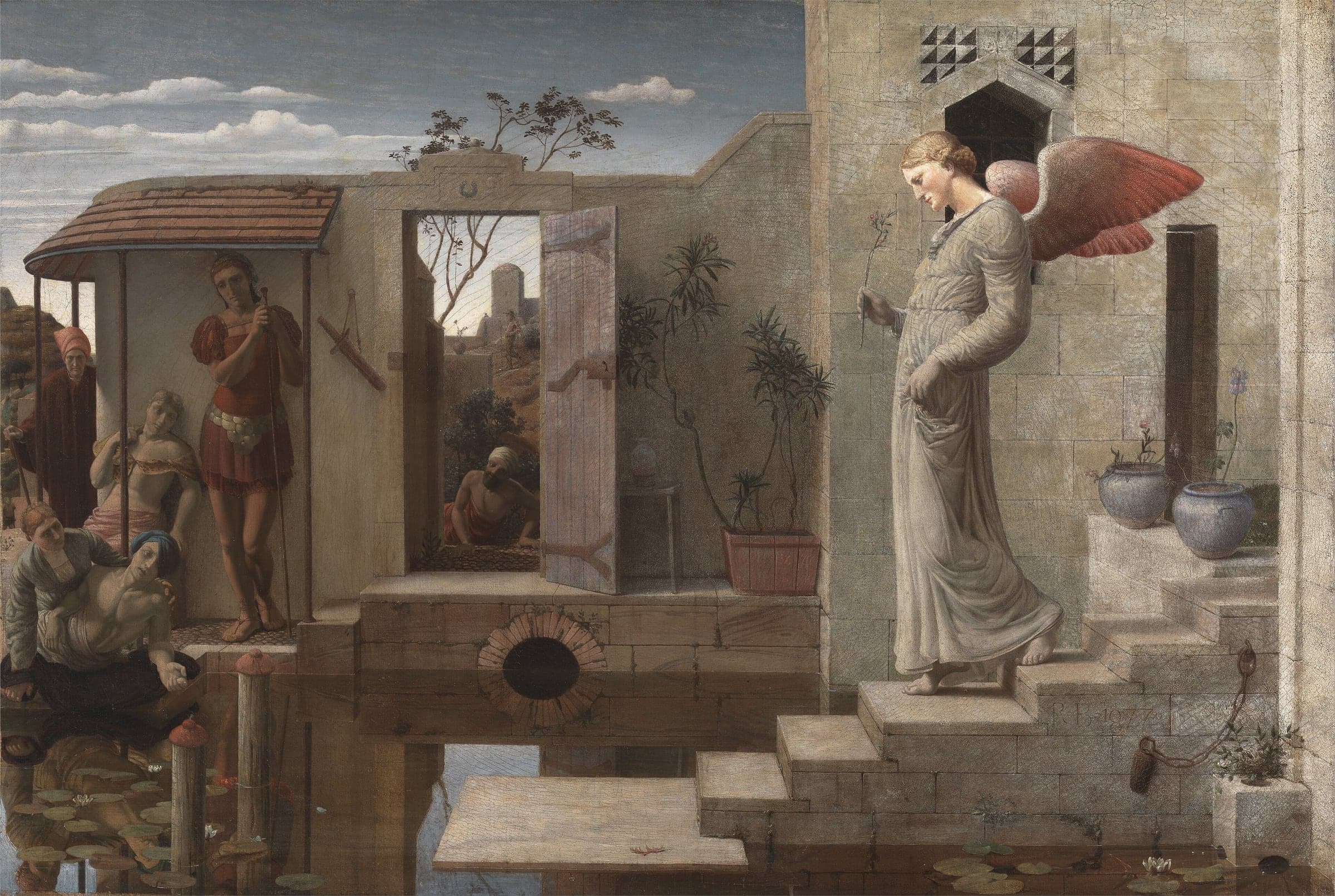
On Malta, Paul prayed over the father of Publius, laid his hands on him, and the man rose from fever and dysentery.
Erastus has remained at Corinth, and Trophimus I left sick in Miletus.
- The question
- Does God always heal the sick who pray in faith?
- The texts
- Isaiah 53:4, Matthew 8:17, James 5:15, 2 Timothy 4:20
Summary
Every side confesses that God heals, and every side has prayed for believers who were not healed. The healing reading holds that the cross bought the body's healing, so that faith may claim it now. The other reading holds that the cross provides for the body but that the body's full healing comes at the resurrection, and that God heals before then as He wills. Each reading has its holders and its works, and medical care stands beside prayer in both.
- A. B. Simpson, who founded the Christian and Missionary Alliance, set out the reading that healing is promised now in The Gospel of Healing, revised in 1915.
- Benjamin B. Warfield answered the healing movement in Counterfeit Miracles, his lectures published in 1918.
- Paul's letters name three companions who fell ill, Trophimus, Epaphroditus and Timothy.
The Texts Every Side Reads
Five passages, from Isaiah to James, carry the weight of the question.
Does God Always Heal? weighs the promises of healing in Scripture against the believers Scripture records as left unhealed. It belongs to the trial of illness and pain because every sick believer who prays meets the question. The answer shapes how the sick are prayed for and how they bear what is not taken away.
The question it answers is what Scripture allows a sick believer to expect from prayer. It gives the texts both readings use, their answers set side by side, and three questions taken one at a time: the atonement, the gifts, and the sick whom Paul did not heal. It then gives the ground both readings share, the strongest objections, and the books in which their holders make their case.
Surely He took on our infirmities and carried our sorrows; yet we considered Him stricken by God, struck down and afflicted.The healing reading finds the body's healing in the servant's suffering here, and the other reading answers it from the same verse.
When evening came, many who were demon-possessed were brought to Jesus, and He drove out the spirits with a word and healed all the sick. This was to fulfill what was spoken through the prophet Isaiah: “He took on our infirmities and carried our diseases.”Matthew applies Isaiah 53:4 to the healings of one evening, and the readings divide over whether the fulfilment reaches every believer.
He Himself bore our sins in His body on the tree, so that we might die to sin and live to righteousness. “By His stripes you are healed.”Peter joins the wounds of Christ to the cross and to sin, and each reading asks what kind of healing his words name.
And in the church God has appointed first of all apostles, second prophets, third teachers, then workers of miracles, and those with gifts of healing, helping, administration, and various tongues. Are all apostles? Are all prophets? Are all teachers? Do all work miracles? Do all have gifts of healing? Do all speak in tongues? Do all interpret?Paul places gifts of healing among the gifts God appointed in the church, and the question of whether they continue begins from this list.
And the prayer offered in faith will restore the one who is sick. The Lord will raise him up. If he has sinned, he will be forgiven.James's promise is the text both readings must account for when a believer is prayed for and stays ill.
The doctrine of healing as a whole, from the LORD who heals to the elders of James 5, has its own study.
1 Peter 2:24, 1 Corinthians 12:28 to 30, James 5:15
Two Readings, Three Questions
A. B. Simpson and Benjamin B. Warfield stand for the two readings in each row.
Simpson and Warfield agree in part on the atonement and part company on the gifts and on Trophimus.
| The question | Healing promised now (Simpson) | Healing at God's will (Warfield) |
|---|---|---|
| Is healing provided in the atonement? | Yes, and it is open to faith today. | Yes, but the body is made whole only when it is raised. |
| Do the gifts of healing continue? | Yes. They belong to the church in every age. | No. They ended with the first generation of the church. |
| Why did Paul leave Trophimus sick? | His recovery may only have been slow. | Paul did not heal by his own power, and he sent Timothy to a remedy. |
Each Reading Stated
Simpson, Warfield and the teachers beside them state their readings of the atonement and the gifts in their own words.
Healing in the atonementA. B. Simpson, Derek Prince, Matthew Henry
Simpson grounded healing in the cross and in the Fall. "If sickness be the result of the Fall," he wrote, "it must be included in the atonement of Christ."
Derek Prince, a British charismatic Bible teacher who died in 2003, pressed Isaiah 53:4 through Matthew's use of it.
“Notice that Matthew has no doubt who is the person referred to in Isaiah 53, for he applies it to Jesus. Notice also that Matthew, who was a Jew and understood Hebrew, had no doubt that the application of those verses in Isaiah 53 is physical.”
Derek Prince · Jesus Carried Away Your Diseases (devotional, Claiming Your Inheritance series) · on Matthew 8:17Pentecostal-Charismatic
Matthew Henry, writing in 1710, joined the miracles of Christ's life to the cross.
“Christ bore away sin by the merit of his death, and bore away sickness by the miracles of his life; nay, though those miracles are ceased, we may say, that he bore our sicknesses then, when he bore our sins in his own body upon the tree; for sin is both the cause and the sting of sickness.”
Matthew Henry · Commentary on the Whole Bible · on Matthew 8:17Puritan
Matthew 8:17 read of Christ's own curesBenjamin B. Warfield, Adam Clarke
Warfield wrote that Matthew 8:17 "speaks only of Christ's own miraculous cures, and does not in the remotest way suggest that His followers were to work similar ones."
He granted that the atonement reaches the body: "For the removal of these physical evils, too, provision is made in the atonement. But the benefit here too is not received all at once." He held that believers remain weak, liable to disease and certain to die until the work of redemption is completed in them.
Adam Clarke, in his Commentary on the Bible, read Isaiah's words as referring properly to the taking away of sin and Matthew's use of them as referring to bodily affliction. He held that Matthew saw the healing of the body as an emblem of the soul's salvation.
Do the gifts of healing continue?Simpson, Warfield
Simpson answered from the church's history: "It remained in the Church for centuries, and only disappeared gradually in the growing worldliness, corruption, formalism and unbelief."
Warfield held the opposite in the first lecture of his book. The miraculous gifts "were part of the credentials of the Apostles as the authoritative agents of God in founding the church", he wrote, and "they necessarily passed away" with the apostolic church.
The site's tradition is Wesleyan-Pentecostal. John Wesley, from whom its Wesleyan stream comes, wrote in his Explanatory Notes upon the New Testament (1755) that Christ fulfilled Isaiah's words in the highest sense by bearing our sins on the tree. He added that Christ fulfilled them in a lower sense by healing the diseases that were the fruit of sin. Scripture leaves the question open to more than one reading, and the site gives no verdict between them.
Paul and His Sick Companions
The two readings account for each of these illnesses in their own way.
Trophimus left at Miletus2 Timothy 4:20
Trophimus, from the province of Asia, was among the men who accompanied Paul (Acts 20:4). John Chrysostom, in his tenth homily on 2 Timothy, asked why Paul did not heal him. He answered, "The Apostles could not do everything, or they did not dispense miraculous gifts upon all occasions, lest more should be ascribed to them than was right."
Simpson answered that "Trophimus may also have been healed although delayed", since healing by faith is not always instantaneous. Warfield wrote that we are all left here like Trophimus, sick, and that one who insists on relief can expect only the answer given to Paul, that God's grace is sufficient.
Epaphroditus near deathPhilippians 2:25 to 27
He was sick indeed, nearly unto death. But God had mercy on him, and not only on him but also on me, to spare me sorrow upon sorrow.Paul credits the recovery of Epaphroditus to God's mercy, and the readings differ over whether it came by a gift of healing.
Jamieson, Fausset and Brown held that the sickness of Epaphroditus shows that the apostles had not ordinarily the permanent gift of miracles. Adam Clarke, on Philippians 2:26, quoted William Paley's judgment that the power of performing cures "only visited the apostles occasionally, and did not at all depend upon their own will". Simpson wrote that Epaphroditus was healed through God's mercy.
Timothy's stomach1 Timothy 5:23
Stop drinking only water and use a little wine instead, because of your stomach and your frequent ailments.Paul prescribes a remedy for a fellow worker's frequent ailments, and both readings must place this counsel beside the prayer of faith.
Clement of Alexandria read the counsel as medicine fitted to a weak body.
“‘Use a little wine,’ says the apostle to Timothy, who drank water, ‘for thy stomach's sake;’ most properly applying its aid as a strengthening tonic suitable to a sickly body enfeebled with watery humours; and specifying ‘a little,’ lest the remedy should, on account of its quantity, unobserved, create the necessity of other treatment.”
Clement of Alexandria · The Instructor Book 2 · on 1 Timothy 5:23Patristic
Warfield set this verse beside Trophimus and concluded: "It seems quite clear that Paul did not share the views of our modern Faith-Healers."
Paul's thorn2 Corinthians 12:7 to 10
A. B. Simpson held that it is not at all certain Paul's thorn in the flesh was a disease, and he guessed at some humiliation, perhaps stammering.
What Both Readings Hold
Both readings confess four teachings about God, the body and the end of sickness.
THE LORD HEALS
Both readings confess the name God gave Himself at Marah, the LORD who heals His people.
THE BODY WAITS
Both readings hold that believers still groan as they wait for the redemption of their bodies.
DEATH IS LAST
Both readings hold that death is the last enemy Christ destroys.
PAIN ENDS
Both readings look for the day when God takes away death, mourning, crying and pain.
Death is last, Pain ends
Simpson, who urged the sick to trust God for healing, still wrote: "We do not imply by this that the medical profession is sinful, or the use of means always wrong."
The Readings Weighed
On the atonement and on the gifts, each reading faces one objection that its rival presses hardest.
The objection to healing nowBenjamin B. Warfield
Warfield pressed the fact that believers still fall ill and die. If Christ's redemption took away disease as it took away condemnation, he argued, then none who are sick could be in Christ, and the decay and death of every Christian would mark him as lost.
The objection to healing at the resurrectionA. B. Simpson
Simpson pressed the wording of Isaiah 53:4 itself. He read its verb "bear" as the very word used for the atonement of sin, and so counted the bearing of sickness a part of the atonement.
Chrysostom's witness to the cessationJohn Chrysostom
In his twenty-ninth homily on 1 Corinthians, John Chrysostom told his hearers that the chapter was obscure to them. The cause, he said, was "their cessation, being such as then used to occur but now no longer take place".
The objection to the cessation of the giftsA. B. Simpson
Simpson answered from the Acts that in the apostolic age "these manifestations of healing power were by no means confined to the Apostles. Philip and Stephen were as gloriously used as Peter and John."
Books to Read Next
These four works state the readings in the words of their own holders, from Chrysostom to Warfield.
The Gospel of Healing
A. B. Simpson · 1915 (revised edition)
Its chapters give the scriptural foundation of divine healing, its principles, the popular objections, practical directions and the author's own testimony.
READ IT FREE →Counterfeit Miracles
Benjamin B. Warfield · 1918
Warfield gave its six lectures as the Thomas Smyth Lectures at Columbia Theological Seminary, and the fifth, on faith-healing, answers the healing movement's proof texts one by one.
READ IT FREE →Homilies on First Corinthians
John Chrysostom · before 407
Chrysostom explains in this homily the spiritual gifts that Paul lists in 1 Corinthians 12.
READ IT FREE →Commentary on the Whole Bible
Matthew Henry · 1710
His notes on Matthew 8 and Philippians 2 weigh the healings of Christ and the sickness of Paul's companions.
Mercy for the Sick
The readings disagree on the means of healing and agree on the care of the sick.
Whichever reading a believer holds, the sick are to be prayed for, and the hour and manner of the answer belong to God.
He who forgives all your iniquities and heals all your diseases,This verse joins the forgiveness both readings agree is given now to the healing they dispute, so it stands at the end of the question.
Sources
Scripture is the Berean Standard Bible.
- A. B. Simpson, The Gospel of Healing, revised edition (Harrisburg: Christian Publications; copyright 1915), chapters 1 to 3.
- Benjamin B. Warfield, Counterfeit Miracles (New York: Charles Scribner's Sons, 1918), lectures 1 and 5 with the notes.
- John Chrysostom, Homilies on First Corinthians, Homily 29, Nicene and Post-Nicene Fathers, first series, volume 12.
- John Chrysostom, Homily 10 on 2 Timothy, on 2 Timothy 4:20.
- Matthew Henry, Commentary on the Whole Bible (1710), on Matthew 8:17.
- Adam Clarke, Commentary on the Bible (1832), on Matthew 8:17.
- Adam Clarke, Commentary on the Bible (1832), on 2 Timothy 4:20.
- Adam Clarke, Commentary on the Bible (1832), on Philippians 2:26, quoting William Paley.
- Jamieson, Fausset and Brown, Commentary Critical and Explanatory on the Whole Bible (1871), on Philippians 2:27.
- John Wesley, Explanatory Notes upon the New Testament (1755), on Matthew 8:17.
- Derek Prince, Jesus Carried Away Your Diseases (devotional, Claiming Your Inheritance series), on Matthew 8:17.
- Derek Prince (1915 to 2003), British Bible teacher, biographical note.
- Clement of Alexandria, The Instructor, book 2, on 1 Timothy 5:23.
Keep Studying
People and groups10
In this trial5
Values1
Trials of life1