
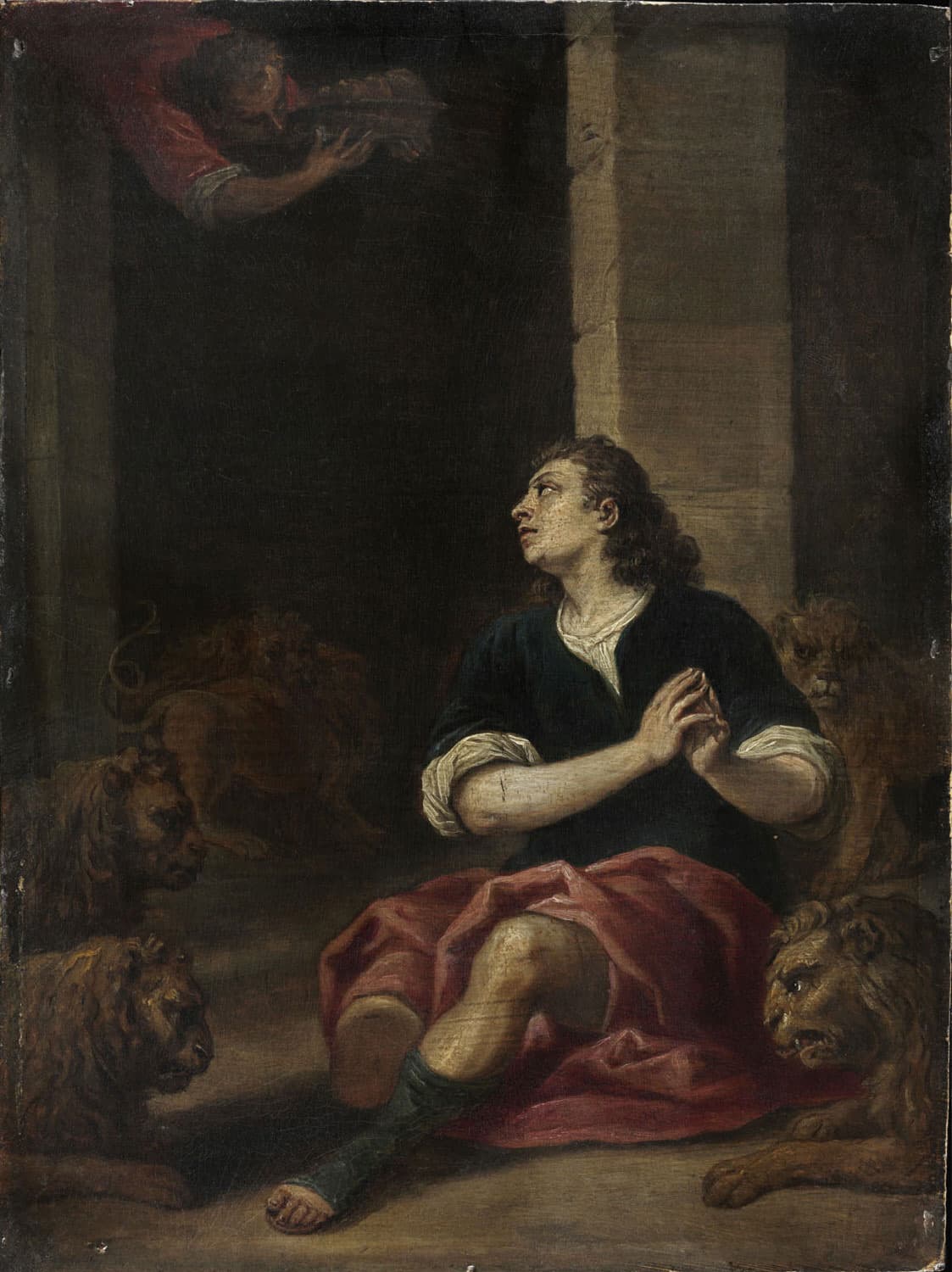
Daniel 6 · Story · Prayer
Daniel Prays Three Times a Day
Daniel 6 records a thirty-day ban on prayer under Darius the Mede and the night Daniel spent in a den of lions.
Daniel's rivals knew when and where he prayed, and they wrote a law to catch him at it.
Now when Daniel learned that the document had been signed, he went into his house, where the windows of his upper room opened toward Jerusalem, and three times a day he got down on his knees, prayed, and gave thanks to his God, just as he had done before.
- Where
- Babylon
- Who
- Daniel
- When
- The reign of Darius the Mede, after the fall of Babylon (Daniel 5:30 to 31)
Summary
Darius the Mede planned to set Daniel over his whole kingdom, and the other officials searched his work for a charge and found none. They persuaded the king to sign a decree against any petition to a god or a man except the king, and Daniel went home to his upper room and prayed. He was thrown to the lions and the stone was sealed, and at dawn he answered the king from the den unhurt.
- Daniel knelt, prayed and gave thanks three times a day at windows that faced Jerusalem, as he had done before the decree (Daniel 6:10).
- A decree of the Medes and Persians could not be changed, and the king who signed it could not save Daniel from it (Daniel 6:15).
- Daniel 6:23 gives the reason he came out unhurt, that he had trusted in his God.
The Old Man at the Window
Daniel had served the kings of Babylon for a lifetime when the decree against prayer was signed.
This study reads Daniel 6 for what it teaches about prayer. A law written to stop prayer met a habit already formed, and the whole chapter turns on the hours Daniel kept at his window.
The question this study answers is why a law against prayer found Daniel at his window, and what the chapter teaches about fixed prayer under threat. It gives the chapter in order, its Aramaic words, the law that could not be changed, the teachers' readings and the dispute over the king's identity.
Nebuchadnezzar first came against Jerusalem "In the third year of the reign of Jehoiakim king of Judah" (Daniel 1:1). The den came after "Darius the Mede received the kingdom at the age of sixty-two" (Daniel 5:31).
The usual date of that first campaign is 605 BC, and Albert Barnes reports 607 BC on Jahn's reckoning and 606 BC on Ussher's. The Nabonidus Chronicle dates the fall of Babylon to October 539 BC. A youth taken from Jerusalem in his middle teens was therefore about eighty at the den, though the text gives no age.
Thus the administrators and satraps sought a charge against Daniel concerning the kingdom, but they could find no charge or corruption, because he was trustworthy, and no negligence or corruption was found in him. Finally these men said, “We will never find any charge against this Daniel, unless we find something against him concerning the law of his God.”The only charge his rivals could hope for shows what his life was known for before a word of the decree was written.
The Chapter in Twelve Steps
Daniel 6 moves from the king's plan for Daniel to the king's letter to every nation.
Daniel's prayer stands between the signing of the decree and the night in the den.
- Darius sets three administrators over 120 satrapsDariusDaniel 6:1 to 2
- The king plans to set Daniel over the whole kingdomDariusDaniel 6:3
- The rivals search his work and find no faultthe administrators and satrapsDaniel 6:4
- The king signs the decree of thirty daysDariusDaniel 6:9
- Daniel prays at his open windowsDanielDaniel 6:10
- The rivals find him praying and accuse himthe administrators and satrapsDaniel 6:11 to 13
- The king labours until sundown to save himDariusDaniel 6:14
- Daniel is thrown in and the stone is sealedDarius and his noblesDaniel 6:16 to 17
- The king spends the night fastingDariusDaniel 6:18
- At dawn Daniel answers from the denDanielDaniel 6:19 to 22
- Daniel is lifted out and the accusers are thrown inDariusDaniel 6:23 to 24
- Darius writes to every nationDariusDaniel 6:25 to 27
A timeline of twelve steps in Daniel 6, each with the one who acts and its verse.
The king labours until sundown to save him, Daniel is thrown in and the stone is sealed, The king spends the night fasting, At dawn Daniel answers from the den, Daniel is lifted out and the accusers are thrown in, Darius writes to every nation
The Decree and the Window
The officials framed a decree that Daniel's daily prayer would break, and he went home to pray.
So the administrators and satraps went together to the king and said, “O King Darius, may you live forever! All the royal administrators, prefects, satraps, advisers, and governors have agreed that the king should establish an ordinance and enforce a decree that for thirty days anyone who petitions any god or man except you, O king, will be thrown into the den of lions. Therefore, O king, establish the decree and sign the document so that it cannot be changed—in accordance with the law of the Medes and Persians, which cannot be repealed.” Therefore King Darius signed the written decree.The officials named every rank of the kingdom as agreed, so the king signed a law whose only target was Daniel.
The Aramaic of the verse of the window names three acts, kneeling (berak), praying (tsela) and giving thanks (yeda). The verb tsela stands only twice in Scripture, here and in Ezra 6:10, and yeda only here and in Daniel 2:23.
The accusers told the king, "He still makes his petition three times a day" (Daniel 6:13).
Morning, noon, and night, I cry out in distress, and He hears my voice.Jamieson, Fausset and Brown set this verse beside Daniel 6:10 as the warrant for his three times of prayer.
and when they return to You with all their heart and soul in the land of the enemies who took them captive, and when they pray to You in the direction of the land that You gave to their fathers, the city You have chosen, and the house I have built for Your Name, then may You hear from heaven, Your dwelling place, their prayer and petition, and may You uphold their cause.Solomon asked at the dedication of the temple that God hear captives who prayed toward the land and the city, the direction Daniel's windows faced.
The Didache, an early Christian manual of teaching, gives the Lord's Prayer and then the rule "Thrice in the day thus pray" (Didache 8, in M. B. Riddle's translation of 1886).
“When blessed Daniel in Babylon prayed, he opened the windows facing Jerusalem, not under the impression that God was confined there but from his knowledge that the divine manifestation occurred there.”
Theodoret of Cyrus · Commentary on Psalm 28:2 · on Daniel 6:10Patristic
1 Kings 8:48 to 49, Theodoret of Cyrus
The Night and the Dawn
The king spent the night without food or sleep and ran to the den at first light.
So the king gave the order, and they brought Daniel and threw him into the den of lions. The king said to Daniel, “May your God, whom you serve continually, deliver you!” A stone was brought and placed over the mouth of the den, and the king sealed it with his own signet ring and with the rings of his nobles, so that nothing concerning Daniel could be changed.The king's words at the mouth of the den show that he hoped Daniel's God would do what his own law could not.
At the first light of dawn, the king got up and hurried to the den of lions. When he reached the den, he cried out in a voice of anguish, “O Daniel, servant of the living God, has your God, whom you serve continually, been able to deliver you from the lions?” Then Daniel replied, “O king, may you live forever! My God sent His angel and shut the mouths of the lions. They have not hurt me, for I was found innocent in His sight, and I have done no wrong against you, O king.”The king's question and Daniel's answer are the turn of the chapter, from the night of fear to the morning of vindication.
The Aramaic word for angel in Daniel 6:22 stands only twice in Scripture. The other place is the furnace, where Nebuchadnezzar blessed the God "who has sent His angel and delivered His servants who trusted in Him" (Daniel 3:28).
The verb rendered "he had trusted" in Daniel 6:23 is the verb of "he was trustworthy" in Daniel 6:4. It stands three times in Scripture, and the third use is in Daniel 2:45.
who through faith conquered kingdoms, administered justice, and gained what was promised; who shut the mouths of lions,Hebrews counts the shutting of lions' mouths among the deeds of faith in Israel's past.
A Law That Could Not Be Changed
Daniel and Esther both describe Persian decrees that stood once they were signed and sealed.
So if it pleases the king, let him issue a royal decree, and let it be recorded in the laws of Persia and Media so that it cannot be repealed, that Vashti shall never again enter the presence of King Xerxes, and that her royal position shall be given to a woman better than she.The advisers of Xerxes asked for a decree that could not be repealed, the same request the officials made of Darius.
Now you may write in the king’s name as you please regarding the Jews, and seal it with the royal signet ring. For a decree that is written in the name of the king and sealed with the royal signet ring cannot be revoked.”The book of Esther gives the rule from the mouth of the king himself, outside the book of Daniel.
The Aramaic word for the den, gov, means a pit for wild animals, and all ten of its uses in Scripture stand in this chapter.
A Second Prayer Under Darius
A prayer of confession in Daniel 9 is dated to the first year of the same king.
Daniel 9:1 names the king as "Darius son of Xerxes, a Mede by descent", the ruler of chapter 6.
in the first year of his reign, I, Daniel, understood from the sacred books, according to the word of the LORD to Jeremiah the prophet, that the desolation of Jerusalem would last seventy years. So I turned my attention to the Lord God to seek Him by prayer and petition, with fasting, sackcloth, and ashes.Daniel's prayer of confession was for Jerusalem, the ruined city his windows faced.
While he was still praying, Gabriel came to him "about the time of the evening sacrifice" (Daniel 9:21), the hour of the temple's evening offering.
What the Chapter Leaves Unsaid
Daniel 6 is silent on how the rivals knew his hours, and the book is silent on his death.
The chapter does not say how the rivals knew when Daniel prayed, only that they "went as a group" and found him at it (Daniel 6:11).
But as for you, go on your way until the end. You will rest, and will arise to your inheritance at the end of the days.”The last word the book speaks to Daniel looks to the end of the days, and no verse after it tells of his death.
The Lion's Mouth in the New Testament
Paul and Peter take up the picture of the lion, and a teacher of the fourth century set the den beside the tomb.
But the Lord stood by me and strengthened me, so that through me the message would be fully proclaimed, and all the Gentiles would hear it. So I was delivered from the mouth of the lion.Paul borrows the lion's mouth for his own trial, so Daniel's rescue became a way to speak of the Lord's help.
Be sober-minded and alert. Your adversary the devil prowls around like a roaring lion, seeking someone to devour.Peter names the adversary who still prowls, so the reader of Daniel 6 learns where the danger now lies.
Aphrahat the Persian Sage, in his Demonstrations (fourth century), set Daniel's sealed and guarded pit beside the guarded grave of Jesus, a comparison Daniel 6 itself does not draw.
Faith Under Fire sets the furnace of Daniel 3 and the den of Daniel 6 side by side.
Who Was Darius the Mede?
Daniel names the king and his age at his accession, and readers hold three identifications of him.
Albert Barnes, in his Notes on Daniel 6:28, calls the king "Darius or Cyaxares". Each view meets the same difficulty, that no text outside Daniel names a ruler called Darius the Mede.
The Decree of Darius
The chapter ends with the accusers in the den and a royal letter to every nation.
At the command of the king, the men who had falsely accused Daniel were brought and thrown into the den of lions—they and their children and wives. And before they had reached the bottom of the den, the lions overpowered them and crushed all their bones.The chapter records the king's sentence on the accusers and their households without comment, and the lions' violence shows they were hungry.
I hereby decree that in every part of my kingdom, men are to tremble in fear before the God of Daniel: For He is the living God, and He endures forever; His kingdom will never be destroyed, and His dominion will never end. He delivers and rescues; He performs signs and wonders in the heavens and on the earth, for He has rescued Daniel from the power of the lions.”The king who had forbidden prayer to any god for thirty days now commands every part of his kingdom to fear the God of Daniel.
The account closes, "So Daniel prospered during the reign of Darius and the reign of Cyrus the Persian" (Daniel 6:28).
Sources
Scripture is the Berean Standard Bible.
- STEP Bible, Translators Amalgamated Hebrew Old Testament, the tagged Hebrew and Aramaic text (Tyndale House, Cambridge), CC BY 4.0.
- STEP Bible lexicon of Extended Strongs for Hebrew and Aramaic (Tyndale House, Cambridge), CC BY 4.0.
- The Didache, tr. M. B. Riddle, in Ante-Nicene Fathers, vol. 7, ed. Alexander Roberts, James Donaldson and A. Cleveland Coxe (Buffalo: Christian Literature Publishing, 1886)
- The Nabonidus Chronicle, on the fall of Babylon in October 539 BC, with Nebuchadnezzar's first campaign against Jerusalem in 605 BC.
- John C. Whitcomb, Darius the Mede (Grand Rapids: Eerdmans, 1959)
- Donald J. Wiseman, Some Historical Problems in the Book of Daniel, in Notes on Some Problems in the Book of Daniel (Tyndale Press, 1965)
- Albert Barnes, Notes, Explanatory and Practical, on the Old and New Testaments (1832 to 1869), on Daniel 1:1 and 6:28.
- Theodoret of Cyrus, Commentary on Psalm 28:2 (fifth century)
- Aphrahat the Persian Sage, Demonstrations 21:18 (fourth century)
- Robert Jamieson, A. R. Fausset and David Brown, Commentary Critical and Explanatory on the Whole Bible (1871), on Daniel 6:10.
Keep Studying
Read it1
In this value4
People and groups7
Show the next 1 title
Symbols2
Doctrines2