

King
Solomon
King of United Israel — Wisest Man · United Monarchy · 970-930 BC
The Judgment of Solomon, Nicolas Poussin
Summary
The wisest and wealthiest king, who built the Temple but whose heart was turned away by foreign wives in his old age.
- Solomon was David's son by Bathsheba, and Nathan the prophet brought him a second name from God, Jedidiah, which means beloved of the LORD.
- At Gibeon he was told to ask for anything, and he asked for a heart that could hear a case; the first thing he does with the gift is judge two women nobody else at court would have heard.
- He built the temple in seven years and his own palace in thirteen, and the book sets the two numbers side by side without comment.
- Deuteronomy 17 forbids a king many horses, many wives, and much silver and gold, and 1 Kings records Solomon in excess of all three.
- Scripture records his sin, the sentence, and the mercy written into the sentence, and it records neither repentance nor a rejection of him, so this page names the positions on where he ended and gives no verdict.
On this page
Start here
Therefore give Your servant an understanding heart to judge Your people and to discern between good and evil. For who is able to govern this great people of Yours?”
1 Kings 3:9→- 4 key events in order
- 287 verses name Solomon, across 14 books
In Scripture
- Verses
- 287
- Books
- 14
Solomon
- Role
- King of United Israel — Wisest Man
- Era
- United Monarchy
- Dates
- 970-930 BC
- Tribe
- Judah
- Father
- David
- Spouse
- Pharaoh's daughter, many others
- Children
- Rehoboam
The life in order
in the order the canon tells it
- He is born to David and Bathsheba, and the LORD loves the child2 Samuel 12:24Then David comforted his wife Bathsheba, and he went to her and lay with her. So she gave birth to a son, and they named him Solomon. Now the LORD loved the child
- Nathan brings him a second name, Jedidiah2 Samuel 12:25and sent word through Nathan the prophet to name him Jedidiah because the LORD loved him.
- David is told the son will be a man of rest, named for peace1 Chronicles 22:9But a son will be born to you who will be a man of rest. I will give him rest from all his enemies on every side; for his name will be Solomon, and I will grant to Israel peace and quiet during his reign.
- David charges him to know the God of his father1 Chronicles 28:9As for you, Solomon my son, know the God of your father and serve Him wholeheartedly and with a willing mind, for the LORD searches every heart and understands the intent of every thought. If you seek Him, He will be found by you; but if you forsake Him, He will reject you forever.
- David keeps the oath he swore to Bathsheba1 Kings 1:30I will carry out this very day exactly what I swore to you by the LORD, the God of Israel: Surely your son Solomon will reign after me, and he will sit on my throne in my place.”
- Zadok anoints him at Gihon1 Kings 1:39Zadok the priest took the horn of oil from the tabernacle and anointed Solomon. Then they blew the ram’s horn, and all the people proclaimed, “Long live King Solomon!”
- He marries Pharaoh's daughter before the temple exists1 Kings 3:1Later, Solomon formed an alliance with Pharaoh king of Egypt by marrying his daughter. Solomon brought her to the City of David until he had finished building his palace and the house of the LORD, as well as the wall around Jerusalem.
- He loves the LORD, except that he sacrifices on the high places1 Kings 3:3And Solomon loved the LORD and walked in the statutes of his father David, except that he sacrificed and burned incense on the high places.
- At Gibeon he asks for a heart that can judge the people1 Kings 3:9Therefore give Your servant an understanding heart to judge Your people and to discern between good and evil. For who is able to govern this great people of Yours?”
- The country sees the wisdom of God in him1 Kings 3:28When all Israel heard of the judgment the king had given, they stood in awe of him, for they saw that the wisdom of God was in him to administer justice.
- Every man under his own vine and his own fig tree1 Kings 4:25Throughout the days of Solomon, Judah and Israel dwelt securely from Dan to Beersheba, each man under his own vine and his own fig tree.
- Three thousand proverbs and a thousand and five songs1 Kings 4:32Solomon composed three thousand proverbs, and his songs numbered a thousand and five.
- The temple is finished in seven years1 Kings 6:38In his eleventh year and eighth month, the month of Bul, the temple was finished in every detail and according to every specification. So he built the temple in seven years.
- His own palace takes thirteen1 Kings 7:1Solomon, however, took thirteen years to complete the construction of his entire palace.
- He says at the dedication that heaven cannot contain God1 Kings 8:27But will God indeed dwell upon the earth? Even heaven, the highest heaven, cannot contain You, much less this temple I have built.
- The LORD appears to him a second time1 Kings 9:2the LORD appeared to him a second time, as He had appeared to him at Gibeon.
- The queen of Sheba says the half was not told her1 Kings 10:7But I did not believe these things until I came and saw with my own eyes. Indeed, not even half was told to me. Your wisdom and prosperity have far exceeded the report I heard.
- In his old age his wives turn his heart1 Kings 11:4For when Solomon grew old, his wives turned his heart after other gods, and he was not wholeheartedly devoted to the LORD his God, as his father David had been.
- God tells him the kingdom will be torn away1 Kings 11:11Then the LORD said to Solomon, “Because you have done this and have not kept My covenant and My statutes, which I have commanded you, I will tear the kingdom away from you and give it to your servant.
- He is buried in the city of David, and Rehoboam reigns1 Kings 11:43And Solomon rested with his fathers and was buried in the city of his father David. And his son Rehoboam reigned in his place.
Why Solomon matters
Solomon was the son of David and Bathsheba, born after the marriage that began in David's worst sin. Nathan the prophet carried him a second name from God, Jedidiah, which means beloved of the LORD. He was not the oldest son and he had no automatic claim on the throne. He became king because David had sworn an oath to his mother and kept it, on the day an older brother was already holding a coronation feast a short walk from the palace. Early in the reign he went out to the high place at Gibeon to sacrifice, and God told him in a dream to ask for anything he wanted. He asked for a heart that could hear a case and judge the people. God gave him that and added the wealth he had not asked for. The first thing the account shows him doing with the gift is settling a dispute between two women with no standing at court and no witnesses to call. He built the house his father was not allowed to build. Seven years on the temple and thirteen on his own palace, and the narrator prints both numbers and says nothing else about them. At the dedication the cloud filled the building so thickly that the priests could not stand to minister, and he prayed the longest prayer any king prays in Scripture. Much of it asks mercy for a nation not yet in exile and for foreigners who had not yet arrived. The splendor was paid for and the text prints the invoice. Thirty thousand men of Israel were conscripted in shifts, seventy thousand carried loads and eighty thousand cut stone in the hills. The peoples left in the land were put to forced labor. Those counts sit in the same chapters that praise the wisdom. Kings sent envoys to hear him, and a queen came from the ends of the earth. What drew her was his fame concerning the name of the LORD, and she went home blessing that name. Jesus later set her against His own hearers as a witness, and said that One greater than Solomon was standing in front of them. Then the account turns. He had seven hundred wives of royal birth and three hundred concubines, and when he grew old they turned his heart. He built shrines for their gods on the ridge east of the city he had filled with the glory of God. God told him the kingdom would be torn from his son's hand, and it was. The seams were laid early. He married Pharaoh's daughter before the temple existed. He sacrificed on the high places in the same verse that says he loved the LORD. He gathered horses out of Egypt and gold past weighing. Deuteronomy 17 had named those three things by name, and 1 Kings 11 is where the account names the turn rather than where the turn begins.
Biography
Solomon received David's kingdom and asked God for wisdom rather than wealth. God granted both. His wisdom drew the Queen of Sheba. He built the magnificent Temple in Jerusalem. His reign was Israel's golden age. However, he accumulated 700 wives and 300 concubines who turned his heart to other gods. He built high places for their idols. God told Solomon the kingdom would be torn from his son. His heavy taxation sowed seeds of rebellion. He authored Proverbs, Ecclesiastes, and Song of Solomon.
Therefore give Your servant an understanding heart to judge Your people and to discern between good and evil. For who is able to govern this great people of Yours?”
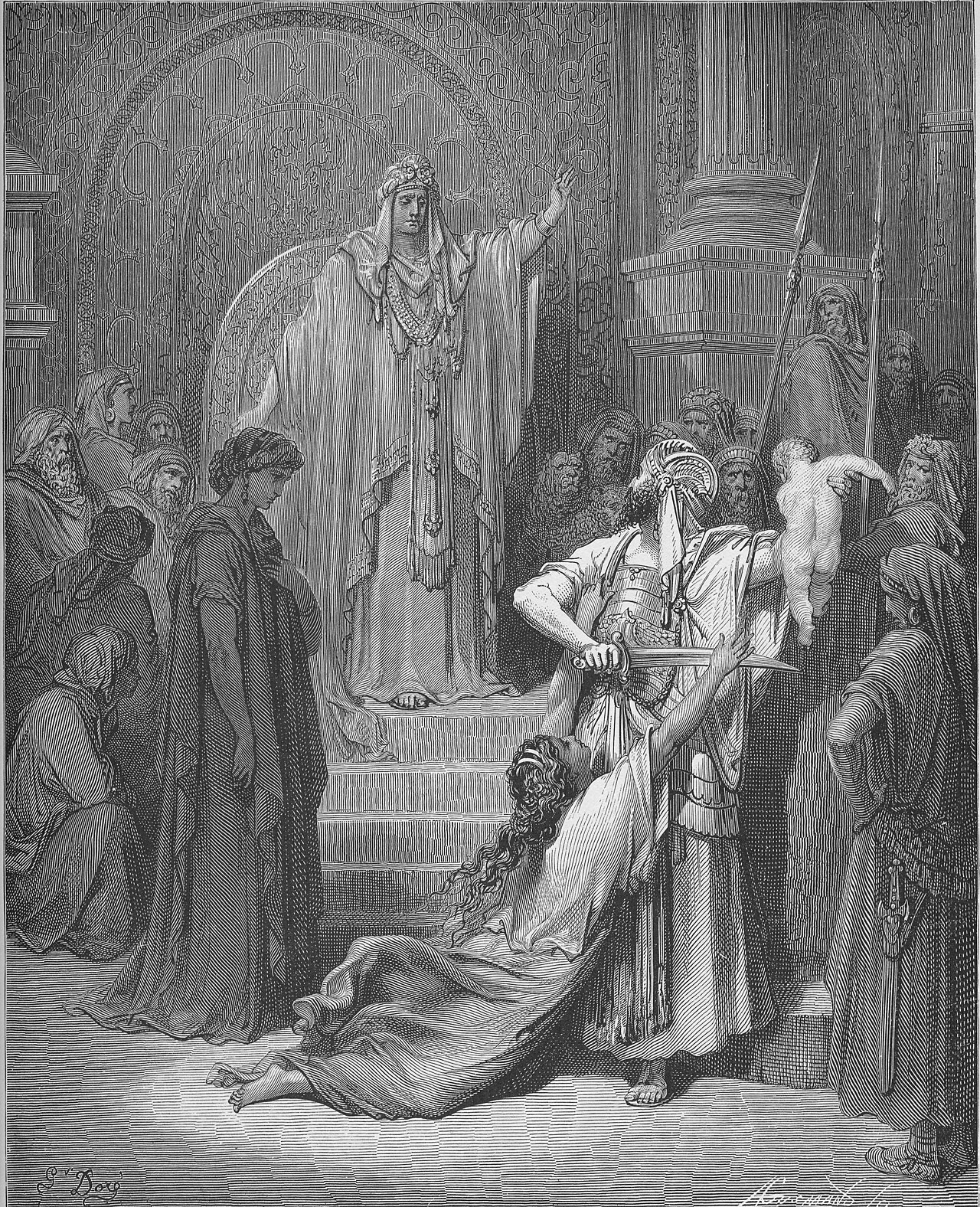
The two mothers and the sword
1 Kings 3:16-28, in the order it happens
- Two women with no standing come before the king1 Kings 3:16At that time two prostitutes came to the king and stood before him.
- They were alone in the house, so there are no witnesses1 Kings 3:18On the third day after I gave birth, this woman also had a baby. We were alone, with no one in the house but the two of us.
- One of the children dies in the night1 Kings 3:19During the night this woman’s son died because she rolled over on him.
- The living child is taken and the dead one laid in his place1 Kings 3:20So she got up in the middle of the night and took my son from my side while I was asleep. She laid him in her bosom and put her dead son at my bosom.
- Two claims, and nothing to weigh them with1 Kings 3:22“No,” said the other woman, “the living one is my son and the dead one is your son.” But the first woman insisted, “No, the dead one is yours and the living one is mine.” So they argued before the king.
- The king calls for a sword1 Kings 3:24The king continued, “Bring me a sword.” So they brought him a sword,
- Cut the child in two and give half to each1 Kings 3:25and the king declared, “Cut the living child in two and give half to one and half to the other.”
- One woman gives up her claim to keep him alive1 Kings 3:26Then the woman whose son was alive spoke to the king because she yearned with compassion for her son. “Please, my lord,” she said, “give her the living baby. Do not kill him!” But the other woman said, “He will be neither mine nor yours. Cut him in two!”
- The ruling names her by what she was willing to lose1 Kings 3:27Then the king gave his ruling: “Give the living baby to the first woman. By no means should you kill him; she is his mother.”
- All Israel stands in awe of the king1 Kings 3:28When all Israel heard of the judgment the king had given, they stood in awe of him, for they saw that the wisdom of God was in him to administer justice.
These two women had no standing and no man to bring the case for them, and the king of Israel heard them himself. There was no evidence of any kind, because 3:18 says they were alone in the house with no one else in it. The sword is a test of love rather than a search for a fact, and the woman who gives up her claim is named the mother because of what she was willing to lose.
Solomon and the two mothers: the full studyKey events
- 1Asked for wisdom1 Kings 3:5-14→
God granted wisdom and riches
Read the verse here
1 Kings 3:5-14One night at Gibeon the LORD appeared to Solomon in a dream, and God said, “Ask, and I will give it to you!”
- 2Built the Temple1 Kings 6-8→
Seven years of construction
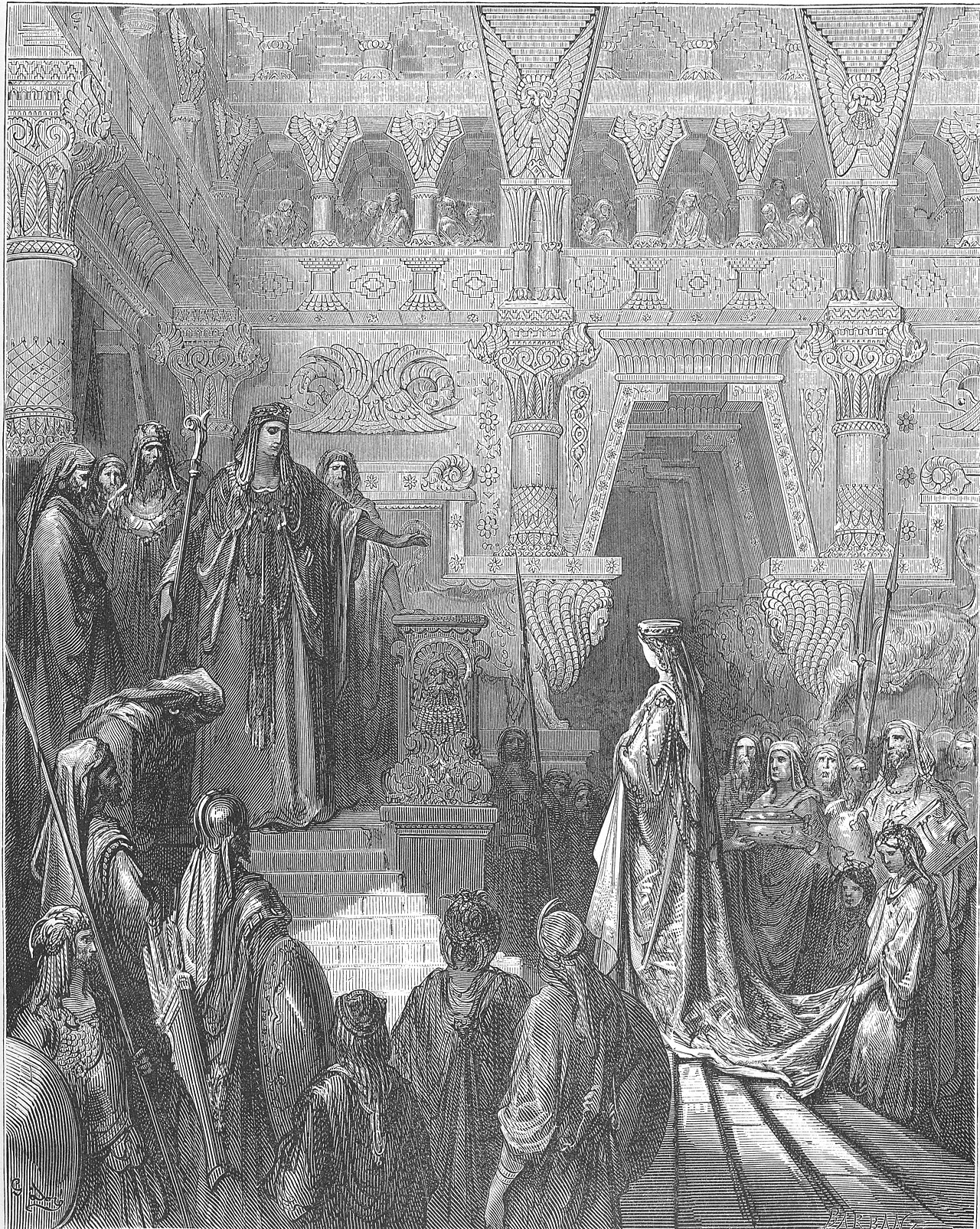
- 3Queen of Sheba's visit1 Kings 10:1-13→
Tested his wisdom
Read the verse here
1 Kings 10:1-13Now when the queen of Sheba heard about the fame of Solomon concerning the name of the LORD, she came to test him with difficult questions.
- 4Heart turned away1 Kings 11:1-13→
Foreign wives led to idolatry
Read the verse here
1 Kings 11:1-13King Solomon, however, loved many foreign women along with the daughter of Pharaoh—women of Moab, Ammon, Edom, and Sidon, as well as Hittite women.
More key verses
Text: Berean Standard Bible.
“When all has been heard, the conclusion of the matter is this: Fear God and keep His commandments, because this is the whole duty of man.”
What they got right, and what they got wrong
Strengths
Wisest man ever, great builder and administrator, peaceful reign
Weaknesses
Too many wives, allowed idolatry, heavy taxation
Lessons
Guard your heart in old age as in youth. Compromise leads to apostasy.
Spiritual significance
Solomon shows that wisdom without obedience leads to ruin. Finishing well requires lifelong vigilance.
How Solomon points to Jesus
The promise at 2 Samuel 7 has a near reference and a far one, and the book of Kings knows it. 7:13 says the son will build a house for the Name and that God will establish the throne of his kingdom forever. Solomon fills the near half. He is the son from David's own body who builds the house, and he says so himself at the dedication. The far half outruns him inside his own book, because the throne was promised forever and 1 Kings 11:11 tears the kingdom out of his hand. Augustine put the gap plainly in his second exposition of Psalm 88, which the site's reader numbers Psalm 89: “Solomon fell and so made room for people to stretch their hope toward Christ.” The name itself carries the reading. Chronicles gives its meaning before the child is born, at 1 Chronicles 22:9, where the son is called a man of rest and Israel is promised peace and quiet in his days. Reading that name as a pointer to Christ the peacemaker is old and crosses traditions. Hippolytus of Rome, in the first half of the third century, calls the proverbs those of Solomon, “that is to say, the ‘peacemaker,’ who, in truth, is Christ the Savior.” Origen says the same in the middle of the third century, Theodoret of Cyrus repeats the etymology in the fifth, and Adam Clarke gives the Hebrew roots behind it in 1832. It is presented here as a reading, with the men who held it named and dated. The reign's own picture of peace is the one the prophets take up. 1 Kings 4:25 says that through all Solomon's days Judah and Israel dwelt securely from Dan to Beersheba, each man under his own vine and his own fig tree. Micah 4:4 and Zechariah 3:10 both use that sentence of an age still ahead. The language written about forty years of settled government became the language of the hope, and the site's page on the millennial kingdom carries where that leads. The house could not hold the One it was built for, and the builder said so on the day he opened it. At 1 Kings 8:27 he asks whether God will indeed dwell upon the earth, since heaven itself cannot contain Him. Clement of Alexandria, writing around AD 200, read that verse of the temple of Christ's flesh and of the church that would rise through the union of faith. Cyril of Jerusalem set it beside Psalm 72 in his twelfth catechetical lecture about AD 350. Stephen then quoted Solomon's own sentence back at the men who charged him with speaking against the temple, at Acts 7:47 to 7:49, which Adam Clarke pointed out in 1832. Zechariah 6:12 and 6:13 name a man called the Branch who will build the temple of the LORD and be a priest on his throne, and John 2:19 to 2:21 has Jesus speak of the temple of His body. Each of these is a reading, offered with its holder, and none of them is the plain sense of 1 Kings 6. The clearest thing the New Testament does with Solomon is measure him and find someone larger. At Matthew 12:42 and Luke 11:31 the Queen of the South comes from the ends of the earth to hear the wisdom of Solomon, and One greater than Solomon is standing in the room. At Matthew 6:29 not even Solomon in all his glory was dressed like one of the wildflowers. The wisest king is outmatched in wisdom and the richest king is outdressed by a weed. John Chrysostom, preaching at Antioch about AD 390, spends his comment praising the queen for crossing the world to hear wise words, and leaves it there. The lamp stays lit, and that is the text's own frame. 1 Kings 11:36 keeps one tribe for the son so that David will always have a lamp before God in Jerusalem, and 11:39 sets an end to the humbling in the same sentence that pronounces it. Nothing on this page turns the two women of 1 Kings 3, the queen of Sheba, or the divided kingdom into a story about the church taking Israel's place. Some early readings of these chapters do go there, and this site does not carry them. Where a figure of Christ is read out of Solomon's reign, it is given as a reading with its holder named, and the promises God made to Israel remain Israel's.
Solomon building the Temple points to Christ, the true Temple. His reign of peace foreshadows Christ's millennial reign.
The voices
each quoted from the work named
OUR FIRST thought is that no mere man would have said this concerning himself unless he had been altogether eaten up with vanity; for Solomon was among the Jews the very ideal of greatness and wisdom. It would be an instance of the utmost self-conceit if any mere man were to say of himself’’A greater than Solomon is here.’ Any person who was really greater and wiser than Solomon would be the last man to claim such preeminence. A wise man would never think of it; a prudent man would never say it.
Give - an understanding heart to judge thy people - He did not ask wisdom in general, but the true science of government. This wisdom he sought, and this wisdom he obtained.
"Let me see it hers, rather than not see it at all." By this tenderness towards the child it appeared that she was not the careless mother that had overlaid the dead child, but was the true mother of the living one, that could not endure to see its death, having compassion on the son of her womb.
4 more teachers on these versesAlbert Barnes · Hippolytus of Rome · Augustine of Hippo
A levy out of all Israel - This was, apparently, the first time that the Israelites had been called upon to perform forced labor, though it had been prophesied 1Sa 8:16. David had bound to forced service “the strangers” 1Ch 22:2; but hitherto the Israelites had escaped. Solomon now, in connection with his proposed work of building the temple, with the honor of God as an excuse, laid this burden upon them.
In noticing successively Solomon’s excessive accumulation of silver and gold 1Ki 10:14-25, his multiplication of horses 1Ki 10:26-29, and his multiplication of wives, the writer has in mind the warning of Moses against these three forms of princely ostentation, all alike forbidden to an Israelite monarch (marginal reference).
Proverbs are words of exhortation that serve the whole path of life. They serve as guides and signs for those who are seeking their way to God by reviving them when they become tired by the length of the road. These, moreover, are the proverbs of "Solomon," that is to say, the "peacemaker," who, in truth, is Christ the Savior.
[God] promised that something everlasting would spring from David's seed. Then Solomon was born, and he became a man of such profound wisdom that everyone supposed God's promise concerning David's offspring had been fulfilled in him. But no, Solomon fell and so made room for people to stretch their hope toward Christ. God can neither be deceived nor deceive us, so we can be certain that he did not ground his promise in Solomon, for he knew Solomon would fall.
Solomon in Scripture
Open a book to read its mentions here. Text: Berean Standard Bible. Names repeat in Scripture, so some of these verses may speak of another person called Solomon. The two marks are drawn from the chapters this page's own references stand in.
Old TestamentNew Testamentsegment width = share of mentions
Old Testament10 books · 277 mentions
2 Samuel2 mentions
1 Kings153 mentions
- 1 Kings 1:10But he did not invite Nathan the prophet, Benaiah, the mighty men, or his brother Solomon.
- 1 Kings 1:11Then Nathan said to Bathsheba the mother of Solomon, “Have you not heard that Adonijah son of Haggith has become king, and our lord David does not know it?
- 1 Kings 1:12Now please, come and let me advise you. Save your own life and the life of your son Solomon.
- 1 Kings 1:13Go at once to King David and say, ‘My lord the king, did you not swear to your maidservant, “Surely your son Solomon will reign after me, and he will sit on my throne”? Why then has Adonijah become king?’
- 1 Kings 1:17“My lord,” she replied, “you yourself swore to your maidservant by the LORD your God: ‘Surely your son Solomon will reign after me, and he will sit on my throne.’
148 further mentions in 1 Kings, read them in the book.
2 Kings4 mentions
- 2 Kings 21:7Manasseh even took the carved Asherah pole he had made and set it up in the temple, of which the LORD had said to David and his son Solomon, “In this temple and in Jerusalem, which I have chosen out of all the tribes of Israel, I will establish My Name forever.
- 2 Kings 23:13The king also desecrated the high places east of Jerusalem, to the south of the Mount of Corruption, which King Solomon of Israel had built for Ashtoreth the abomination of the Sidonians, for Chemosh the abomination of the Moabites, and for Milcom the abomination of the Ammonites.
- 2 Kings 24:13As the LORD had declared, Nebuchadnezzar also carried off all the treasures from the house of the LORD and the royal palace, and he cut into pieces all the gold articles that Solomon king of Israel had made in the temple of the LORD.
- 2 Kings 25:16As for the two pillars, the Sea, and the movable stands that Solomon had made for the house of the LORD, the weight of the bronze from all these articles was beyond measure.
1 Chronicles24 mentions
- 1 Chronicles 3:5and these sons were born to him in Jerusalem: Shimea, Shobab, Nathan, and Solomon. These four were born to him by Bathsheba daughter of Ammiel.
- 1 Chronicles 3:10Solomon’s son was Rehoboam:
- 1 Chronicles 6:10Johanan was the father of Azariah, who served as priest in the temple that Solomon built in Jerusalem,
- 1 Chronicles 6:32They ministered with song before the tabernacle, the Tent of Meeting, until Solomon built the house of the LORD in Jerusalem. And they performed their duties according to the regulations given them.
- 1 Chronicles 14:4These are the names of the children born to him in Jerusalem: Shammua, Shobab, Nathan, Solomon,
19 further mentions in 1 Chronicles, read them in the book.
2 Chronicles76 mentions
- 2 Chronicles 1:1Now Solomon son of David established himself securely over his kingdom, and the LORD his God was with him and highly exalted him.
- 2 Chronicles 1:2Then Solomon spoke to all Israel, to the commanders of thousands and of hundreds, to the judges, and to every leader in all Israel—the heads of the families.
- 2 Chronicles 1:3And Solomon and the whole assembly went to the high place at Gibeon because it was the location of God’s Tent of Meeting, which Moses the servant of the LORD had made in the wilderness.
- 2 Chronicles 1:5But the bronze altar made by Bezalel son of Uri, the son of Hur, was in Gibeon before the tabernacle of the LORD. So Solomon and the assembly inquired of Him there.
- 2 Chronicles 1:6Solomon offered sacrifices there before the LORD on the bronze altar in the Tent of Meeting, where he offered a thousand burnt offerings.
71 further mentions in 2 Chronicles, read them in the book.
Ezra2 mentions
Nehemiah5 mentions
- Nehemiah 7:57The descendants of the servants of Solomon: the descendants of Sotai, the descendants of Sophereth, the descendants of Perida,
- Nehemiah 7:60The temple servants and descendants of the servants of Solomon numbered 392 in all.
- Nehemiah 11:3These are the heads of the provinces who settled in Jerusalem. (In the villages of Judah, however, each lived on his own property in their towns—the Israelites, priests, Levites, temple servants, and descendants of Solomon’s servants—
- Nehemiah 12:45They performed the service of their God and the service of purification, along with the singers and gatekeepers, as David and his son Solomon had prescribed.
- Nehemiah 13:26Did not King Solomon of Israel sin in matters like this? There was not a king like him among many nations, and he was loved by his God, who made him king over all Israel—yet foreign women drew him into sin.
Proverbs3 mentions
Song of Solomon7 mentions
- Song of Solomon 1:1This is Solomon’s Song of Songs.
- Song of Solomon 1:5I am dark, yet lovely, O daughters of Jerusalem, like the tents of Kedar, like the curtains of Solomon.
- Song of Solomon 3:7Behold, it is Solomon’s carriage, escorted by sixty of the mightiest men of Israel.
- Song of Solomon 3:9King Solomon has made his carriage out of the timber of Lebanon.
- Song of Solomon 3:11Come out, O daughters of Zion, and gaze at King Solomon, wearing the crown his mother bestowed on the day of his wedding— the day of his heart’s rejoicing.
2 further mentions in Song of Solomon, read them in the book.
New Testament4 books · 10 mentions
Matthew4 mentions
- Matthew 1:6and Jesse the father of David the king. Next: David was the father of Solomon by Uriah’s wife,
- Matthew 1:7Solomon the father of Rehoboam, Rehoboam the father of Abijah, and Abijah the father of Asa.
- Matthew 6:29Yet I tell you that not even Solomon in all his glory was adorned like one of these.
- Matthew 12:42The Queen of the South will rise at the judgment with this generation and condemn it; for she came from the ends of the earth to hear the wisdom of Solomon, and now One greater than Solomon is here.
Luke2 mentions
- Luke 11:31The Queen of the South will rise at the judgment with the men of this generation and condemn them; for she came from the ends of the earth to hear the wisdom of Solomon, and now One greater than Solomon is here.
- Luke 12:27Consider how the lilies grow: They do not labor or spin. Yet I tell you, not even Solomon in all his glory was adorned like one of these.
John1 mention
Acts3 mentions
- Acts 3:11While the man clung to Peter and John, all the people were astonished and ran to them in the walkway called Solomon’s Colonnade.
- Acts 5:12The apostles performed many signs and wonders among the people, and with one accord the believers gathered together in Solomon’s Colonnade.
- Acts 7:47But it was Solomon who built the house for Him.
Common questions
Was Solomon saved?
Readers differ; the positions are named
Scripture does not say. 1 Kings 11 records the sin, the anger of God and the sentence, and it records no repentance and no restoration. It also records no rejection of him personally, and the sentence is twice softened for David's sake, at 11:12 and 11:13. Three passages pull in different directions and all three belong here. Nehemiah 13:26 holds him up as a warning to a later generation and still calls him a man loved by his God. 2 Samuel 7:14 and 7:15 promised David that when this son did wrong God would discipline him with the rod of men, and that His loving devotion would never be removed from him as it had been removed from Saul. 1 Kings 11:9 to 11:11 is the sentence itself.
The positions, with the men who hold them. Matthew Henry, in 1710, reads 2 Samuel 7 straight onto 1 Kings 11:13 and writes that though Solomon fell he was not utterly cast down, and that God will not suffer those whom He loves to lie still in sin. Albert Barnes, writing in the middle of the nineteenth century, argues from 1 Kings 9:25 that Solomon never openly or wholly apostatized and kept up the temple worship to the end. Adam Clarke, in 1832, puts three questions to 1 Kings 11:11 and answers none of them: whether this was another warning, whether Solomon might yet have recovered himself, and whether there was mercy in the message that he could have sought and found. Augustine states in one exposition of the Psalms that Solomon was rejected by God. That position is named with its holder and is not adopted here.
Ancient Judaism argued the same question and left it where this page leaves it. The Babylonian Talmud, the Bavli, reached its received form in Babylonia between roughly AD 500 and 600, and its tractate Sanhedrin, chapter ten, takes up who has a share in the World to Come. The passage at Sanhedrin 104b opens, in the Sefaria English text, “Rav Yehuda says that Rav says: They sought to enumerate one more, King Solomon, in the list of kings with no share in the World-to-Come.” What follows records that the attempt was stopped, and that a heavenly voice cited Job 34:33 to say the decision belongs to God and not to men. That is aggadah, the narrative material rather than the legal material, and it is carried here as reception history rather than as a reading of the biblical text.
Did Solomon write Proverbs, Ecclesiastes and the Song of Songs?
Readers differ; the positions are named
Proverbs names him in its own text three times, at 1:1, 10:1 and 25:1, and 25:1 records that the men of Hezekiah copied a further collection about two and a half centuries after his death. The book also names Agur at 30:1 and Lemuel at 31:1, so it presents itself as a collection headed by Solomon rather than as a single-author volume.
Ecclesiastes never says his name. The speaker is the Teacher, the son of David, king in Jerusalem, at 1:1, and king over Israel in Jerusalem at 1:12, which fits him and fits no one else in that line as neatly. The traditional attribution is ancient and leads here. The argument against it is linguistic: the Hebrew of the book carries later forms and vocabulary that many Hebraists date well after the tenth century, and that argument is named rather than dismissed. The question was live long before modern criticism, since Albert Barnes was already writing “Ecclesiastes, if it is Solomon’s” in the 1830s. The Song of Songs carries his name at 1:1 in a Hebrew phrase that can be read as by Solomon, for Solomon or about Solomon, and the site's page on the reading traditions carries that question at length.
Why did the case of the two mothers need a sword?
Because there was no evidence of any kind. 3:18 says the two women were alone in the house with no one else in it, so there was nothing to weigh but two claims. The king made a test instead of a judgment. Adam Clarke put it plainly in 1832: the real mother would rather give up her claim than see the child cut in pieces, while the pretender would watch that with indifference. The verdict at 3:27 names her by what she did, and 3:26 has already given the reason, that she yearned with compassion for her son.
Were the two women prostitutes?
The Berean Standard Bible renders the Hebrew word at 3:16 as two prostitutes, which is the usual sense and the reading behind nearly every English Bible. A minority reading exists and this page names it. Adam Clarke argued in 1832 that the Aramaic Targum renders the word as tavern-keepers, and that women of that trade would not have dared appear before the king. John Wesley noted in 1765 that the Hebrew word carries both senses, and thought the two were unmarried because no husband appears to contest the case. Either way the placement of the scene stands: the king of Israel heard two women who had no standing and no man to speak for them.
Where was Sheba, and who was the queen?
Readers differ; the positions are named
Scripture says she came from the ends of the earth, that she came because of the fame of Solomon concerning the name of the LORD, and that she went home blessing that name. It does not give her name or her country, and two identifications are on the table.
The Arabian identification places her in the Sabaean kingdom of south Arabia. Albert Barnes argued for it on the ground that Arabian Sheba was the spice country of the ancient world while Ethiopia produced no spices, and that Arabian Sheba was a kingdom while Ethiopian Sheba was a town. The Ethiopian tradition claims her as its own and is set out in the Kebra Nagast, the national epic written in Ge’ez and generally dated to the fourteenth century AD, which makes her the mother of Menelik by Solomon. Adam Clarke reported that tradition in 1832 and treated it as a tradition. Charles Spurgeon named both identifications from the pulpit and settled neither, and neither does this page.
Did archaeology find Solomon?
Readers differ; the positions are named
1 Kings 9:15 says Solomon fortified Hazor, Megiddo and Gezer, and that verse is what the argument turns on. In the late 1950s Yigael Yadin found that the six-chambered gates at all three sites matched one plan and read the verse as the explanation. The three structures have been called the Solomonic gates ever since. The Tel Gezer Excavation Project, directed by Steven Ortiz and Samuel Wolff from 2006 to 2017, published radiocarbon and ceramic dates placing Gezer's gate stratum early in the tenth century BC, at 998 to 957 BC, and dated the destruction of that fortification system to the third quarter of the same century, which they tie to the campaign of Shoshenq I, the Shishak of 1 Kings 14:25.
Israel Finkelstein has argued since the 1990s for a low chronology that moves this architecture down by roughly a century, to the Omride dynasty of the ninth, and a large part of the field has followed some version of that dating; Finkelstein and Matthew Adams restated the case for Megiddo in Tel Aviv 48 in 2021. Separately, Erez Ben-Yosef's radiocarbon work at the smelting camp at Timna dated a large organized copper industry in the Arabah to the tenth century BC, which is the century Kings assigns to Solomon's fleet, though Ben-Yosef himself attributes the mines to an Edomite polity rather than to Israel. This page reports the evidence and the dispute and gives no verdict either way. It does not say archaeology has proved Solomon and it does not say archaeology has disproved him.
Why did God let Solomon build the temple when David could not?
The text gives the reason twice, and it is about blood rather than about worth. At 1 Chronicles 22:8 God tells David he had shed much blood and waged great wars, and that he was not to build a house for the Name on that account. 22:9 names the son as a man of rest whose own name would mean peace, and says God would give Israel quiet during his reign. Nothing in the passage says David was less loved or Solomon more deserving. The house was to be built by a king whose reign had rest in it, and the site's page on the temple carries the building itself at length.
What does 2 Chronicles 7:14 promise, and to whom?
It was spoken to Solomon at night, after the dedication of the temple, about that temple and that nation. The conditions are the ones the verse gives, that God's people who are called by His name humble themselves and pray and seek His face and turn from their wicked ways. The promise attached to them is that God will hear from heaven, forgive their sin and heal their land. This page says who the sentence was spoken to and what it says. It does not stretch it into a claim about any present-day country, and the wider question of what God's promises to Israel mean now is handled on the site's covenant pages.
How old was Solomon when he became king?
Scripture does not say, and this page does not supply a figure. He calls himself only a little child at 1 Kings 3:7, which is a statement about being unequal to the office rather than a number. He reigned forty years, at 1 Kings 11:42. Albert Barnes reckoned from that and from Rehoboam's age at accession that Solomon was probably around twenty at the start and around sixty at his death. Jerome, in Letter 74 of AD 398, calls him a boy of twelve. Both figures are inferences drawn from the text rather than statements of it, and the question stays open.
Notable art
4 verified pieces depicting Solomon
Sources cited
- Berean Standard BibleEvery verse quoted on this page, taken byte for byte from the site's verses table. Public domain since 2023.
- Nicolas Poussin, The Judgment of Solomon (1649), Musée du Louvre, INV 7277 and MR 2316The painting at the head of this page, carried through the site's license-verified portrait table. Public domain.
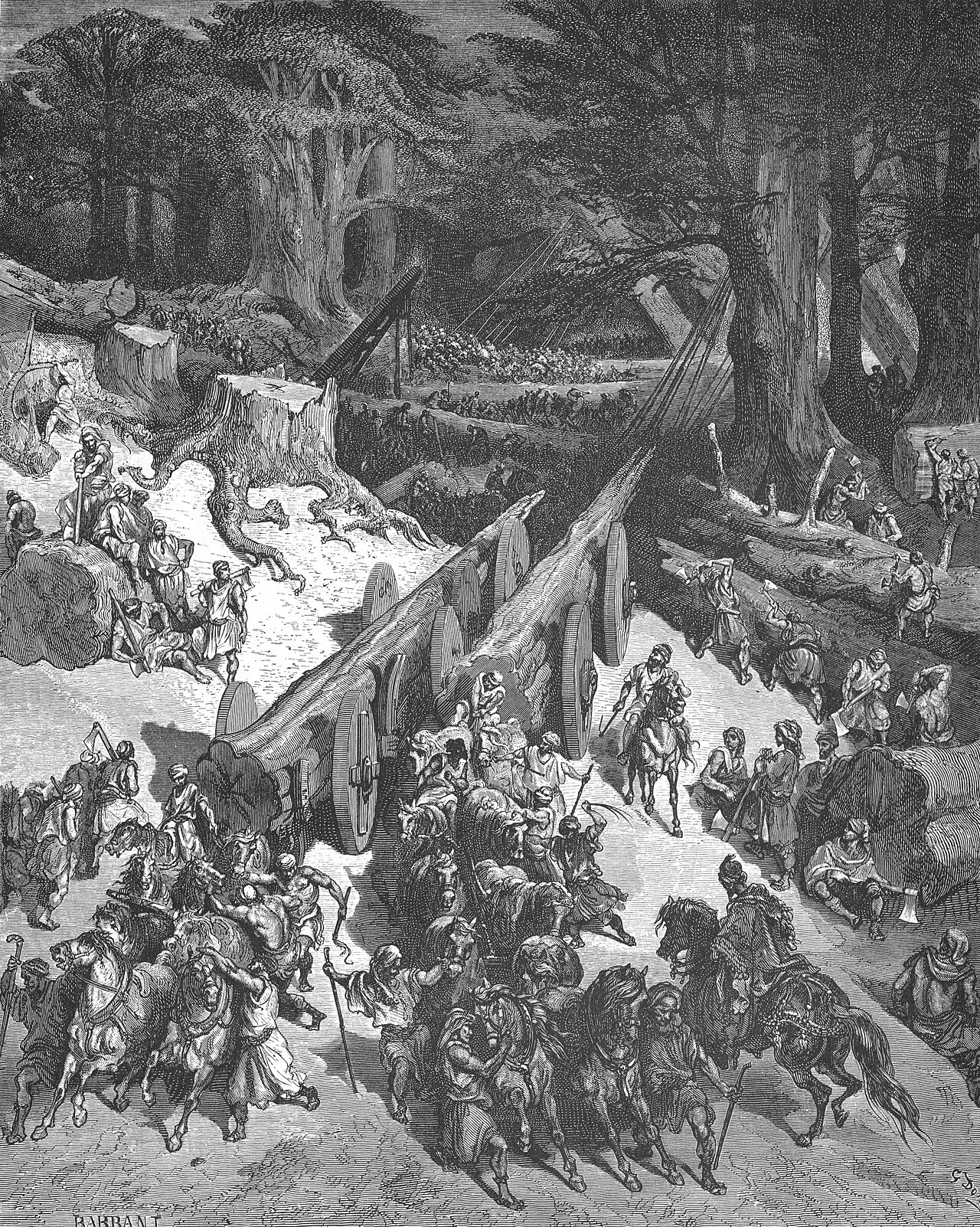
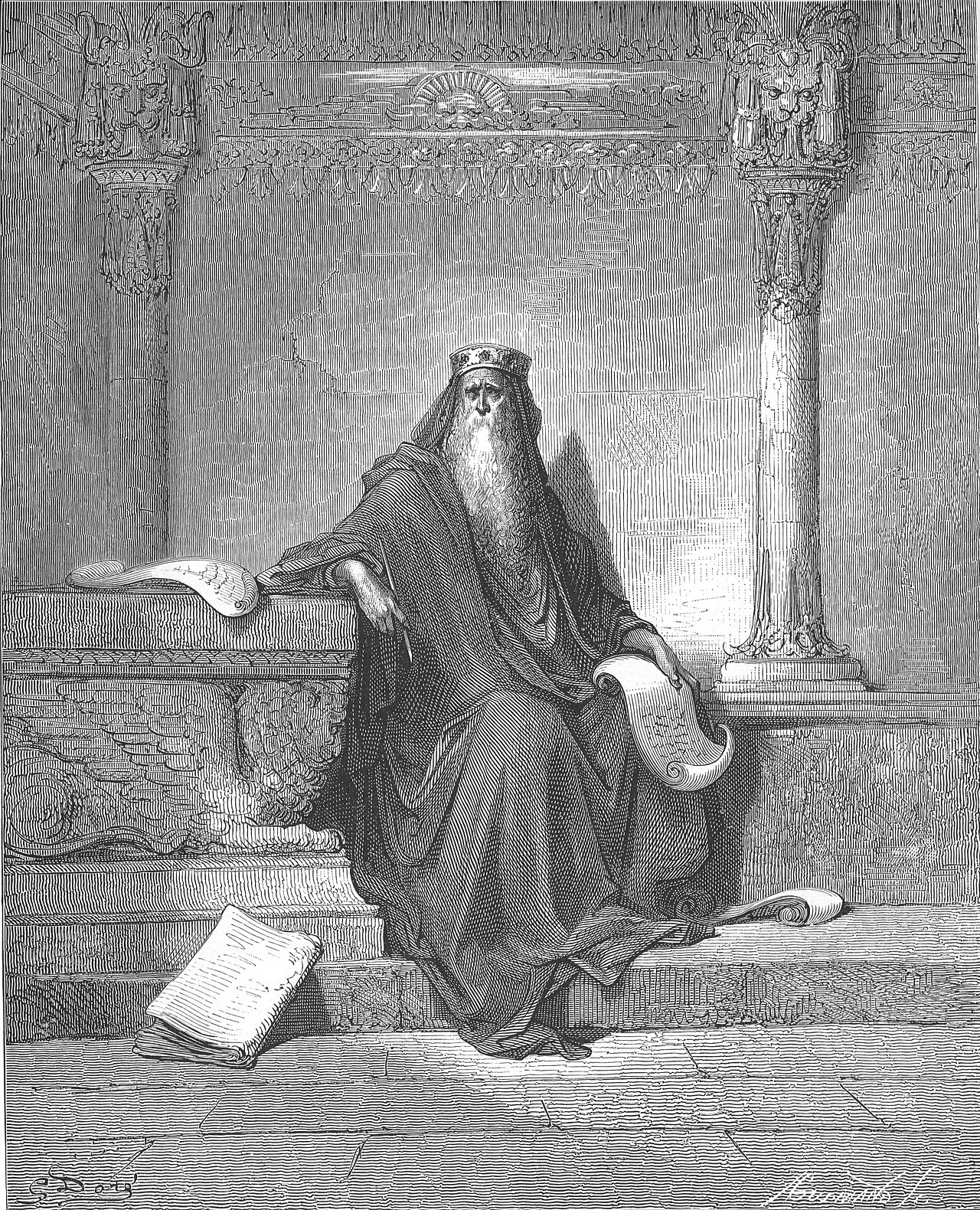
- Gustave Doré, The Holy Bible with Illustrations by Gustave Doré (1866)Plates 084, 085, 086 and 087 on this page, in that order. Public domain.
- Adam Clarke, Commentary on the Bible (1832)Quoted on 1 Kings 3:9, and reported on 1 Kings 3:16, 3:25, 10:13 and 11:11 and on Acts 7:48. Public domain.
- Matthew Henry, Commentary on the Whole Bible (1710)Quoted on 1 Kings 3:26, and reported on 1 Kings 11:13 and Nehemiah 13:26. Public domain.
- Albert Barnes, Notes, Explanatory and Practical, on the Old and New Testaments (1832-1869)Quoted on 1 Kings 5:13 and 11:1, and reported on 1 Kings 4:32, 10:1 and 11:4. The store carries no year on these rows, so the work's date range is printed instead. Public domain.
- John Wesley, Explanatory Notes upon the Old Testament (1765)Reported on 1 Kings 3:9, 3:16, 6:12 and 11:4. Public domain.
- Charles H. Spurgeon, The Metropolitan Tabernacle PulpitSermon no. 1600, “A Greater Than Solomon”, quoted on Luke 11:31, and sermon no. 3166 of the same title reported on the two identifications of Sheba. The year is the volume's publication date. Public domain, CCEL edition.
- The early Christian writers cited on this pageHippolytus of Rome, Clement of Alexandria, Origen, Cyril of Jerusalem, John Chrysostom, Theodoret of Cyrus and Augustine of Hippo. Where the work's own date is established it is given; where it is not, the century is given and no year is printed, because the store carries the author's death year rather than the date of the work. Public domain translations.
- Jerome, Letter 74 (AD 398)The source of the reckoning that Solomon was a boy of twelve at his accession, reported on this page as an inference rather than as a figure the text gives. Public domain translation.
- Sefaria, Babylonian Talmud, Sanhedrin 104bThe opening clause of the passage on Solomon's share in the World to Come, quoted in the question on where he ended. Aggadah, redacted in Babylonia between roughly AD 500 and 600, carried as reception history.
- Steven Ortiz and Samuel Wolff, New Evidence for the 10th Century BCE at Tel GezerThe radiocarbon and ceramic dates for Gezer's gate stratum, 998 to 957 BC, and the destruction tied to Shoshenq I.
- Israel Finkelstein and Matthew Adams, The Megiddo Gates: Outdated Views versus New Data, Tel Aviv 48 (2021) 208-212The low-chronology position on the six-chambered gates, named on this page as the other side of a live dispute.
- Erez Ben-Yosef, the Timna smelting camp and its Oxford radiocarbon datesThe tenth-century BC dating of a large copper industry in the Arabah, with the excavator's own attribution of the mines to an Edomite polity rather than to Israel.
- The Kebra Nagast, fourteenth century, E. A. Wallis Budge translationThe Ethiopian tradition of Menelik, named on this page as a tradition with its date. No better freely available record of the work's dating was found for this page.
- The temple, on this siteThe building itself, its story slot and its later history. This page carries the reign and sends the reader there for the house.
Keep studying
On this page
Studies6
Every page that names them1
Books13
Doorway1
Keep this page