
Jeremiah 25 · Subject · Featured Study
The Seventy Years
How Daniel, Zechariah and the Chronicler count the seventy years of Babylon, and why 2 Chronicles 36 joins them to the Sabbath years of Leviticus 26.
Jeremiah gave a number, and the books after him counted it from different starting points.
- Books
- Jeremiah, Leviticus, 2 Chronicles, Daniel, Zechariah
- Hold in memory
- Jeremiah 29:10, 2 Chronicles 36:21
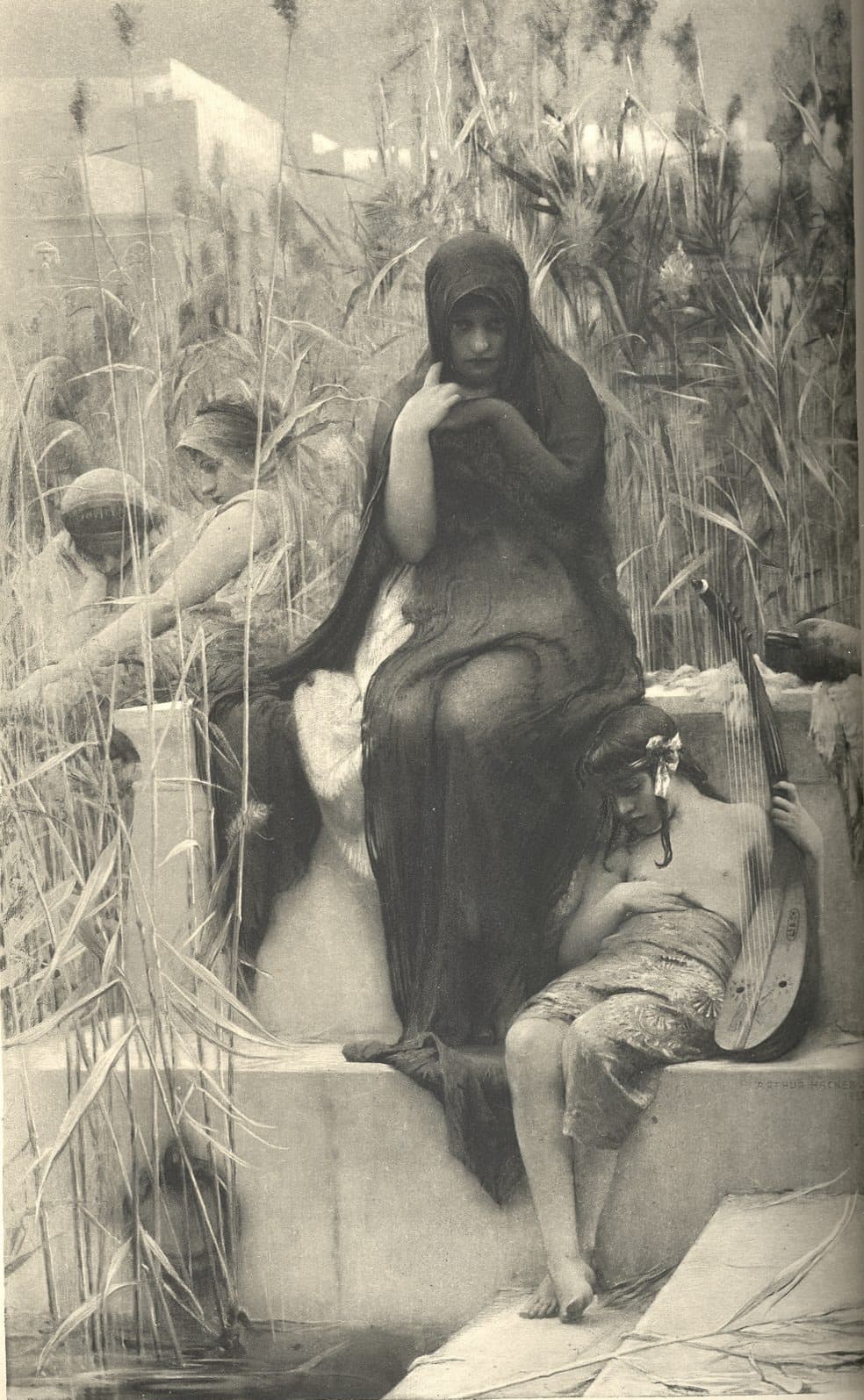
Arthur Hacker, By the Waters of Babylon (1888), oil on canvas, Rochdale Arts and Heritage Service. Public domain (made before 1930), Wikimedia Commons file Arthur Hacker - By the Waters of Babylon (1888).jpg.
THE ARTWORKHacker painted Israelite exiles beside the waters of Babylon, as Psalm 137 tells, with the harp silent in the hands of the youth at the mourner's side.
Summary
The seventy years are the span Jeremiah gave for Judah and the nations to serve Babylon before God brought the exiles home.
- Jeremiah named the span in his word of Jeremiah 25 and in his letter to the exiles in Jeremiah 29.
- Daniel and Zechariah counted the years as the desolation of Jerusalem and of its temple.
- The Chronicler read them as the Sabbath years the land had not kept, as Leviticus 26 had warned.
- The Babylonian Chronicle fixes three of the dates, and the burning of the temple is reckoned from Scripture.
The Word in Jehoiakim's Fourth Year
Jeremiah gave the term once to Jerusalem and once to the exiles in Babylon.
This is the word that came to Jeremiah concerning all the people of Judah in the fourth year of Jehoiakim son of Josiah king of Judah, which was the first year of Nebuchadnezzar king of Babylon.The verse dates the prophecy by two kings at once, so the term begins in a year both Judah and Babylon could name.
And this whole land will become a desolate wasteland, and these nations will serve the king of Babylon for seventy years. But when seventy years are complete, I will punish the king of Babylon and that nation, the land of the Chaldeans, for their guilt, declares the LORD, and I will make it an everlasting desolation.The verses tie the end of the term to the punishment of Babylon, so every counting must end near Babylon's fall.
For this is what the LORD says: “When Babylon’s seventy years are complete, I will attend to you and confirm My promise to restore you to this place.Writing to the exiles taken with Jehoiachin, Jeremiah calls the term Babylon's seventy years and ties the return to its end.
Five Spans on One Scale
The five spans differ in their first year by as much as twenty years.
Seven dated events run from the battle of Carchemish to the completed temple.
To scale: 7 of 7 stops dated; a ring is approximate; a mark that would lie on another stands in a lane under the axis.
- Carchemish, the first year of Nebuchadnezzar605 BCWiseman
- Jehoiachin taken to Babylon597 BCWiseman2 Kings 24:12
- The temple burnedabout 586 BC2 Kings 25:8
- Babylon falls to Cyrus539 BCRogers
- The proclamation of Ezra 1about 538 BCEzra 1:1
- The foundation laid againabout 520 BCreckoned from Darius's second yearHaggai 2:18
- The temple completed, as Anderson dates itabout 515 BCEzra 6:15
Five of the seven stops carry their verse, and the other two carry the scholar who dates them.
The five spans run from 66 to 70 years, and only the count from 606 BC, which Keil and Anderson share, reaches the full seventy.
The five counts as a table
| Counted by | Years | Years BC, text and scholars | Verse |
|---|---|---|---|
| The tablets' dates | 66 | 605 to 539 BC, Jeremiah 29:10, with the dates Wiseman and Rogers give | Jeremiah 29:10 |
| Barnes | 69 | 605 to 536 BC, 2 Chronicles 36:21, counted by Barnes | 2 Chronicles 36:21 |
| Keil and Anderson | 70 | 606 to 536 BC, Jeremiah 25:1 and 11, counted by Keil and Anderson | Jeremiah 25:11 |
| Anderson, the desolations | 69 | 589 to 520 BC, Daniel 9:2, counted by Anderson | Daniel 9:2 |
| After Clarke | 66 | 586 to 520 BC, Zechariah 1:12, counted after Clarke | Zechariah 1:12 |
Each bar is one span and its length in years; the table gives its years BC, the text it rests on and the scholars behind its dates.
How Each Text Counts the Years
Daniel, Zechariah and the Chronicler each name the seventy years in a setting of their own.
Daniel in the first year of DariusDaniel 9:1 to 2
in the first year of his reign, I, Daniel, understood from the sacred books, according to the word of the LORD to Jeremiah the prophet, that the desolation of Jerusalem would last seventy years.Daniel reads the number in Jeremiah's books in the first year Babylon was ruled by the Medes, and the reading moves him to pray.
Gabriel came to Daniel while he was still praying (Daniel 9:21), and his answer at Daniel 9:24 opens the prophecy of the seventy weeks.
Zechariah in the second and fourth years of DariusZechariah 1:7 to 12 and 7:1 to 5
Then the angel of the LORD said, “How long, O LORD of Hosts, will You withhold mercy from Jerusalem and the cities of Judah, with which You have been angry these seventy years?”Zechariah counts the seventy years as anger on Jerusalem and the cities of Judah, and he hears the count in the second year of Darius.
“Ask all the people of the land and the priests, ‘When you fasted and mourned in the fifth and seventh months for these seventy years, was it really for Me that you fasted?Two years later the LORD measures the fasts of the fifth and seventh months by the same seventy years.
Adam Clarke, on Zechariah 1:12, held that the years could not mean the captivity, which had ended nearly twenty years before, and counted them from the destruction of the temple.
The Chronicler and the first year of Cyrus2 Chronicles 36:20 to 23 and Ezra 1:1
In the first year of Cyrus king of Persia, to fulfill the word of the LORD spoken through Jeremiah, the LORD stirred the spirit of Cyrus king of Persia to send a proclamation throughout his kingdom and to put it in writing as follows:Ezra opens with the proclamation that closes Chronicles, and both name it the fulfilment of the word through Jeremiah.
Josephus wrote in his Antiquities, book 11, chapter 1, that the first year of Cyrus was "the seventieth from the day that our people were removed out of their own land into Babylon". In Against Apion, book 1, chapter 21, he gave the temple fifty years in ruins, from Nebuchadnezzar's eighteenth year to the foundation laid in the second year of Cyrus.
A Term Set Before the Temple Fell
Jeremiah and Daniel date the word and the first siege before Jerusalem was burned.
Albert Barnes, on Jeremiah 25:1, read Daniel's third year and Jeremiah's fourth as one year counted in two ways. Adam Clarke, on 2 Chronicles 36:6, reported that Ussher counted the seventy years from the three years Jehoiakim served Babylon. D. J. Wiseman judged Daniel 1:1 the only possible evidence for a siege of Jerusalem in the year of Carchemish and its exegesis uncertain.
In the third year of the reign of Jehoiakim king of Judah, Nebuchadnezzar king of Babylon came to Jerusalem and besieged it.Daniel dates the first siege to Jehoiakim's third year, the start Barnes and Gill give the servitude.
The Dates and How Sure They Are
Wiseman and Rogers give the years the tablets fix, and the reigns in Scripture give the rest.
Wiseman's edition of the Babylonian Chronicle, published by the British Museum in 1956, calls the year of the battle of Carchemish certain, 605 BC. The same tablets date the capture of Jerusalem and of its king to the second day of Adar, 15 or 16 March 597 BC.
The Chronicle breaks off after 594 BC and resumes in the reign of Neriglissar, so the year of the fire is reckoned from the nineteenth year of Nebuchadnezzar in 2 Kings 25:8.
R. W. Rogers, in Cuneiform Parallels to the Old Testament of 1912, gives from the Chronicle the taking of Sippar without battle and the entry of Cyrus's army into Babylon two days later, in 539 BC. Rogers dates Cyrus as king of Babylonia from 538 BC, while Barnes, Keil and Anderson, on the older tables, give 536 BC for his first year.
From the foundation to the completed templeHaggai 2:18; Ezra 6:15
Haggai dates the laying of the foundation to the twenty-fourth day of the ninth month of Darius's second year. Anderson set that day at 17 December 520 BC.
And this temple was completed on the third day of the month of Adar, in the sixth year of the reign of King Darius.The completion of the house is the last date any counting of the temple's seventy years can reach.
The Words of the Desolation
Two Hebrew words from Brown, Driver and Briggs join Daniel 9 and 2 Chronicles 36 to Leviticus 26.
RATSAH
Brown, Driver and Briggs give the sense make acceptable or satisfy, as a debt is paid off, for the land paying off its Sabbaths in Leviticus 26 and in 2 Chronicles 36.
CHORBAH
Brown, Driver and Briggs give waste, desolation or ruin, list the ruins of Jerusalem at Daniel 9:2, and list the cities laid waste in Leviticus 26:31 and 33.
What the Text Leaves Unsaid
Three matters on which the texts that name the seventy years are silent.
No text that names the seventy years gives the day they began or the day they ended.
2 Chronicles 36 does not say that seventy Sabbath years were left unkept.
Jeremiah does not say whether the number is a count of years or a measure of a reign.
The Land's Sabbaths Repaid
The Chronicler read the exile through the law of the Sabbath year.
But in the seventh year there shall be a Sabbath of complete rest for the land—a Sabbath to the LORD. You are not to sow your field or prune your vineyard.This verse sets the rule of one fallow year in seven, which the Chronicler counts the exile as making good.
Then the land shall enjoy its Sabbaths all the days it lies desolate, while you are in the land of your enemies. At that time the land will rest and enjoy its Sabbaths. As long as it lies desolate, the land will have the rest it did not receive during the Sabbaths when you lived in it.The warning stands among the covenant curses, and the Chronicler borrows its words to tell of the exile.
So the land enjoyed its Sabbath rest all the days of the desolation, until seventy years were completed, in fulfillment of the word of the LORD through Jeremiah.The Chronicler joins Jeremiah's number to that rest, so the exile becomes the land's Sabbaths repaid.
Keil, on Jeremiah 25:11, read the number also as seven times ten, the number of God's works set against the number of earthly completeness.
Voices on the Seventy Years
Matthew Henry on the purpose of the term, and Jamieson, Fausset and Brown on the Sabbath years.
Matthew Henry, 1710Commentary on the Whole Bible, on Jeremiah 25:9 to 11
“The fixing of time during which the captivity should last would be of great use, not only for the confirmation of the prophecy, when the event (which in this particular could by no human sagacity be foreseen) should exactly answer the prediction, but for the comfort of the people of God in their calamity and the encouragement of faith and prayer.”
Matthew Henry · Commentary on the Whole Bible · on Jeremiah 25:9 to 11Puritan
Jamieson, Fausset and Brown, 1871Commentary Critical and Explanatory, on Leviticus 26:34
“The number of those sabbatic years seems to have been seventy, as determined by the duration of the captivity. This early prediction is very remarkable, considering that the usual policy of the Assyrian conquerors was to send colonies to cultivate and inhabit their newly acquired provinces.”
Jamieson, Fausset & Brown · Commentary Critical and Explanatory on the Whole Bible · on Leviticus 26:34Reformed
How Are the Seventy Years Counted?
Five readings of the span, each with its holders, its case and the strongest objection.
The servitude under Babylon, ended by CyrusKeil, The Prophecies of Jeremiah; Barnes, Notes on 2 Chronicles; Gill, Exposition; Josephus, Antiquities · Lutheran, Presbyterian and Baptist commentary, and Jewish history
The objection is Daniel 9:2, which measures the seventy years by the desolation of Jerusalem, and the city stood in ruins from the fire of about 586 BC.
The desolation of the temple, from 586 BC to its rebuildingJerome, Commentary on Daniel; Adam Clarke, Commentary on the Bible · Latin patristic and Methodist commentary
Jerome, in his Commentary on Daniel, took the years Daniel names as the desolation of the temple, which would end when the people returned and built the temple and the city.
The objection is Jeremiah 25:1, which gives the term before the temple fell, and Jeremiah 29:10, which ends it with Babylon.
Three judgments: the servitude, the captivity and the desolationsSir Robert Anderson, The Coming Prince · British evangelical prophetic chronology
Anderson set out the distinction in the preface to The Coming Prince. "The failure to distinguish between the several judgments of the Servitude, the Captivity and the Desolations, is a fruitful source of error in the study of Daniel and the historical books of Scripture."
He dated the servitude from 606 BC, the captivity of Jehoiachin from 598 BC, and the desolations from the tenth day of the tenth month of Zedekiah's ninth year, 589 BC. He counted the desolations as 25,200 days of years of 360 days, ending on the day the foundation was laid in 520 BC.
The objection is Keil's count, which reaches seventy years by the regnal years of the kings of Babylon and needs no year of 360 days.
The span of a kingdomAlbert Barnes after Robert Lowth, Notes on Isaiah; Keil, The Prophecies of Jeremiah · Anglican, Presbyterian and Lutheran commentary
Barnes, after Lowth, read the span of a king's life in Isaiah 23:15 as one kingdom and held that the Babylonian monarchy lasted seventy years. Keil called the years the time of Babylon's sovereignty and rejected the view that the number is "a so-called round number".
The length of our days is seventy years— or eighty if we are strong— yet their pride is but labor and sorrow, for they quickly pass, and we fly away.The psalm sets the length of a life at seventy years, the measure Isaiah 23:15 gives a reign.
The objection is the arithmetic of the Chronicle's own dates, which give Babylon's empire fewer than seventy years, and Barnes himself wrote on Jeremiah 25:11 that the empire lasted a little short of seventy years.
Sabbath years owed to the landJamieson, Fausset and Brown, Commentary Critical and Explanatory; Adam Clarke after Houbigant, Commentary on the Bible · Scottish and Methodist commentary
This reading takes the Chronicler at his word and counts the exile as the rest the land was owed. Adam Clarke, on Leviticus 26:34, reported Houbigant's reckoning of about 490 years from Saul to the exile, which hold seventy Sabbath years.
The objection is that Leviticus 26:34 gives no number of Sabbath years, so the count of 490 years rests on a chronology the text does not give.
Books on the Seventy Years
Four works on the seventy years and their dates, all four free to read.
The Prophecies of Jeremiah, volume 1
C. F. Keil, translated by David Patrick · 1874
Keil counts the seventy years by the kings of Babylon and answers Hitzig, Ewald and Graf, who held the verses added later.
Read at the Internet ArchiveThe Coming Prince, eleventh edition
Sir Robert Anderson · after 1902
Anderson works out the seventy weeks of Daniel 9 and the seventy years on which, by his reading, they rest.
Read at the Internet ArchiveCuneiform Parallels to the Old Testament
Robert William Rogers · 1912
Rogers translates the Babylonian records of Nabonidus and Cyrus and tells the fall of Babylon from them.
Read at the Internet ArchiveThe Antiquities of the Jews
Flavius Josephus, translated by William Whiston · 1737
Josephus tells in books 10 and 11 of the fall of Jerusalem, of the land lying a desert seventy years and of the decree of Cyrus.
Read at Project GutenbergThe Promise Kept
Jeremiah 29:10 promised a return to this place when Babylon's seventy years were complete.
God set a term on Babylon, gave the land its rest and brought the exiles home in the first year of Cyrus.
So the text asks the reader to trust God's appointed times and, as Daniel did, to pray on His promises, which are Yes in Christ.
So I turned my attention to the Lord God to seek Him by prayer and petition, with fasting, sackcloth, and ashes.The verse shows how Daniel met a promise near its end, by seeking God.
For all the promises of God are “Yes” in Christ. And so through Him, our “Amen” is spoken to the glory of God.Paul names the One in whom every promise of God, this term among them, is kept.
Keep studying
Studies11