

James Fairman, Jerusalem, before 1904. Public domain.
Genesis 14 and 22 · Place · Featured Study
Jerusalem
Jerusalem stands on a ridge of the Judaean hills about 60 kilometres east of the Mediterranean, at about 760 metres.
A Jebusite hill fort became the city where God chose to put His name.
Then Melchizedek king of Salem brought out bread and wine—since he was priest of God Most High—
- Today
- Jerusalem, the Old City and the City of David ridge
- Region
- the hill country of Judah
- Site
- 31.768, 35.214
- First named
- Joshua 10:1 “Now Adoni-zedek king of Jerusalem heard that…”
- Last named
- Revelation 21:2 “…the holy city, the new Jerusalem, coming down…”
A Jebusite hill fort became the city where God chose to put His name.
Summary
Jerusalem is the city David made his capital, where Solomon built the house of the LORD.
- Its one spring, the Gihon, made a city possible on a ridge with no river.
- The Babylonians and later the Romans each left the city and its temple in ruins.
- Scripture closes with a new Jerusalem coming down out of heaven from God.
Salem and Moriah
The name Jerusalem first appears in Joshua 10:1, and the story of its ridge reaches back to Abram's day.
Strong's dictionary counts 643 uses of the name in the Hebrew Bible.
Then Melchizedek king of Salem brought out bread and wine—since he was priest of God Most High—The king of Salem served as a priest long before any priest of Israel.
Then Solomon began to build the house of the LORD in Jerusalem on Mount Moriah, where the LORD had appeared to his father David. This was the place that David had prepared on the threshing floor of Ornan the Jebusite.This is the one verse that names the temple hill Mount Moriah.
Strong's dictionary counts 643 uses of the name in the Hebrew Bible.
Then Solomon began to build the house of the LORD in Jerusalem on Mount Moriah, where the LORD had appeared to his father David. This was the place that David had prepared on the threshing floor of Ornan the Jebusite.This is the one verse that names the temple hill Mount Moriah.
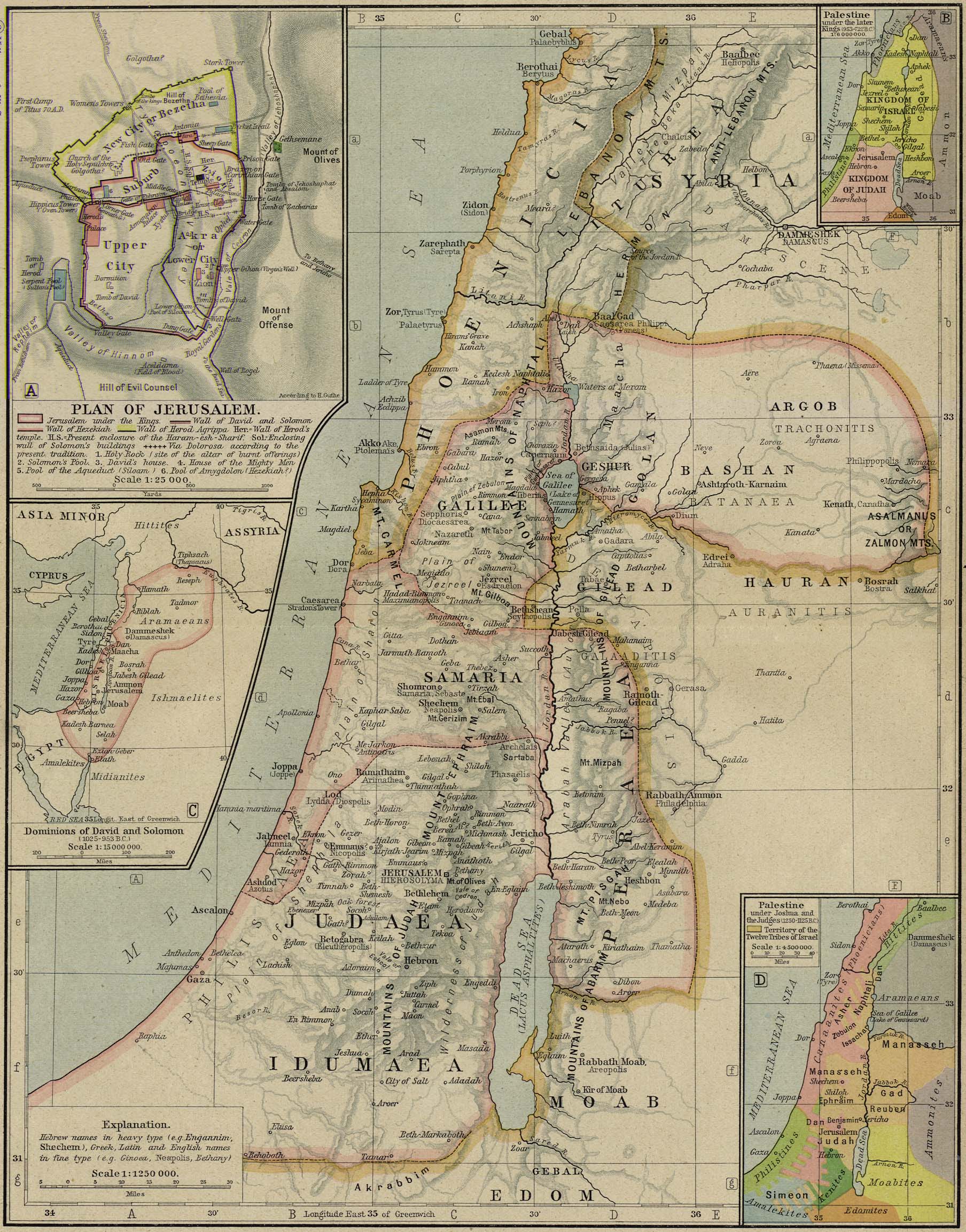
The Road to the City on the Map
The Rand McNally plate of 1926 shows Hebron, Bethlehem and Kiriath-jearim around the city in the hills.
Hebron lies about 28 kilometres south of Jerusalem in a straight line.
- Located: the site is known
- The route, in the order the text gives
- 1Hebron, David reigned over Judah here for seven years and six months 2 Samuel 5:5
- 2Jerusalem, David took up residence in the fortress and built the city up around it 2 Samuel 5:9
- 3Bethlehem, The town of David's father, a short walk south of the city 1 Samuel 16:1
- 4Kiriath-jearim, The ark of God was brought up from here 1 Chronicles 13:6
Base map: Reference map of ancient Palestine, Rand McNally reference map (1926), public domain. Places with a place page stand at its coordinates and the others at the point cited for each, set on the plate by Jerusalem and Damascus, as the plate prints them.
Four places; the line joins Hebron to Jerusalem. The point of Kiriath-jearim is OpenBible's identification.
Jerusalem Through Time
The city's record runs from a settlement by the Gihon to the fall of the second temple.
People lived beside the Gihon for some two thousand years before David took the city.
- About 3000 BCA first settlement grows up near the Gihon Spring
- The 1330s BCAbdi-Heba writes to Egypt from Urusalim in the Amarna letters
- The days of AbramMelchizedek, king of Salem, blesses AbramGenesis 14:18 to 20
- The days of JoshuaJudah cannot drive out the Jebusites living in JerusalemJoshua 15:63
- About 1000 BCDavid captures the fortress of Zion2 Samuel 5:7
- The reign of SolomonSolomon builds the house of the LORD on Mount Moriah2 Chronicles 3:1
- The reign of HezekiahHezekiah stops up the springs outside the city against Sennacherib2 Chronicles 32:2 to 4
- 586 BCBabylon burns the temple and breaks down the walls2 Kings 25:9 to 10
- 539 BCCyrus of Persia lets the exiles go up to rebuild the house of the LORDEzra 1:2 to 3
- The days of NehemiahThe wall is finished in fifty-two daysNehemiah 6:15
- AD 70Rome besieges the city and destroys it with the second temple
Eleven events in order; the rows from Scripture carry their references.
The reign of Hezekiah, 586 BC, 539 BC, The days of Nehemiah, AD 70
The Ridge and Its Valleys
The ridge runs south from a plateau, with deep valleys on three sides.
The Mount of Olives rises across the Kidron to the east, and the steep Valley of Hinnom runs along the south. The Tyropoeon valley once ran through the middle of the walled city and divided the temple hill from the western hill.
As the mountains surround Jerusalem, so the LORD surrounds His people, both now and forevermore.The verse shows how the shape of the land entered Israel's worship.
The Tunnel and the Inscriptions
The city's one spring was carried under the ridge, and its name appears on stone and papyrus from the days of Judah's kings.
The Siloam tunnel runs through the rock from the Gihon Spring to the Pool of Siloam. The Siloam inscription found in it tells how two teams of cutters started at opposite ends and met in the middle.
It was Hezekiah who blocked the upper outlet of the Spring of Gihon and channeled it down to the west side of the City of David. And Hezekiah prospered in all that he did.This is the verse the Siloam tunnel has long been read against.
The date of the tunnelAmos Frumkin and Aryeh Shimron (2006); Ronny Reich and Eli Shukron (2011)
Amos Frumkin and Aryeh Shimron, in the Journal of Archaeological Science (2006), report dates from organic matter in the original plaster and from the mineral growths in the tunnel that support Hezekiah's reign. Ronny Reich and Eli Shukron, in The Date of the Siloam Tunnel Reconsidered (2011), argued from new excavations for an earlier start in the late ninth or early eighth century BC.
An early Hebrew inscription of the nameKhirbet Beit Lei, found in 1961
A cave inscription found in 1961 at Khirbet Beit Lei, near Beit Guvrin, is one of the earliest Hebrew writings of the name Jerusalem outside the Bible. It is dated to the sixth or seventh century BC, and a papyrus naming the city is dated to the seventh.
Where It Points
In the New Testament Jesus weeps over the earthly city, and the apostles look for the city that comes from God.
As Jesus approached Jerusalem and saw the city, He wept over it and said, “If only you had known on this day what would bring you peace! But now it is hidden from your eyes. For the days will come upon you when your enemies will barricade you and surround you and hem you in on every side. They will level you to the ground—you and the children within your walls. They will not leave one stone on another, because you did not recognize the time of your visitation from God.”Jesus foretold the siege forty years before the Roman armies came.
Instead, you have come to Mount Zion, to the city of the living God, the heavenly Jerusalem. You have come to myriads of angelsHebrews turns the reader from the earthly mountain to the heavenly one.
I saw the holy city, the new Jerusalem, coming down out of heaven from God, prepared as a bride adorned for her husband.The last vision of Scripture gives the bride of the Lamb the name of this city.
The Voices
Three teachers on the joy of Zion, the name Salem and Christ's tears over the city, from Ambrose to Matthew Henry.
died 397 · Ambrose of Milan
Commentaries on the Twelve Davidic Psalms, On Psalm 48
Zion's joy spreads over the earth
The quotation1 quotation
“Truly the Lord is called great. For consider, he has poured exaltation and joy over all the orb of this earth where previously the land produced the most dreadful growth of sin; he has made joyful the earth that once abounded in sorrow, tears and groans. Now our conscience is set free from sin and can rejoice. Before this it was unhappy, it was drowned in the whirlpool of its own sin; but now, through the goodness and kindness of Christ, it is absolved from all error.”
Ambrose of Milan · Commentaries on the Twelve Davidic Psalms, On Psalm 48 · on Psalm 48:2Patristic
died 420 · Jerome
Homily 9, on Psalm 75
Salem, then Jebus, then Jerusalem
The quotation1 quotation
“And his place was made in peace: which in Hebrew is said ‘in Salem.’ So it seems, according to the letter, to speak of Jerusalem, that is, Salem, which formerly was called Salem, and afterward Jebus, and then was called Jerusalem. This is that Salem in which Melchizedek was king. We read, ‘Thou art a priest for ever after the order of Melchizedek.’ He did not say, after the order of Aaron, but of Melchizedek. What did he mean to say, Thou art a priest for ever after the order of Melchizedek?”
Jerome · Homily 9, on Psalm 75 · on Psalm 76:2Patristic
1662 to 1714 · Matthew Henry
Commentary on the Whole Bible
Christ wept as He saw the city
The quotation1 quotation
“Probably, it was when he was coming down the descent of the hill from the mount of Olives, where he had a full view of the city, the large extent of it, and the many stately structures in it, and his eye affected his heart, and his heart his eye again. What a tender spirit Christ was of; we never read that he laughed, but we often find him in tears.”
Matthew Henry · Commentary on the Whole Bible · on Luke 19:41Puritan
Was Salem Jerusalem?
Two readings of the city of Melchizedek in Genesis 14:18, each with its holders.
Salem is the early name of JerusalemFlavius Josephus
Josephus, in his Antiquities of the Jews, writes that Melchisedec was king of the city Salem and that they afterward called Salem Jerusalem.
The objection: Egyptian texts of about 1800 BC and the Amarna letters call the city by longer names, Rusalimum and Urusalim.
Salem was a northern town near ShechemRobert R. Cargill
Cargill, in Melchizedek, King of Sodom (Oxford University Press, 2019), argues from those longer names that Jerusalem was never called Salem in antiquity. He reads Salem and Zion in Psalm 76:2 as two places and points to the Shalem near Shechem in Genesis 33:18.
The objection: Psalm 76:2 sets Salem in parallel with Zion, and the tradition from Josephus onward reads the two as one city.
Books to Read Next
One of these two works can be read free online.
The Wars of the Jews, Book 6
Flavius Josephus, translated by William Whiston · the first century AD
Josephus, who was with the Romans at the siege, gives the eyewitness account of the fall of the city and the burning of the temple.
Read at Project GutenbergMelchizedek, King of Sodom: How Scribes Invented the Biblical Priest-King
Robert R. Cargill · 2019
Cargill traces how ancient scribes wrote and rewrote the figure of Melchizedek.
In print: find it wherever books are sold.
The City of the Great King
The long history of the city shows both God's judgment on sin and His faithfulness to the house of David.
The reader is called to seek the city that is to come, for here we have no permanent city.
Sources
Scripture is the Berean Standard Bible.
- Strong's Hebrew dictionary, h3389 and h8004.
- OpenBible.info, Bible Geocoding Data, ancient.jsonl, CC BY.
- Flavius Josephus, Antiquities of the Jews 1.10.2 and The Wars of the Jews, Book 6, translated by William Whiston, public domain.
- Robert R. Cargill, Melchizedek, King of Sodom: How Scribes Invented the Biblical Priest-King (New York: Oxford University Press, 2019)
- Ambrose of Milan, Commentaries on the Twelve Davidic Psalms, 397, on Psalm 48:2.
- Amos Frumkin and Aryeh Shimron, Tunnel Engineering in the Iron Age: Geoarchaeology of the Siloam Tunnel, Jerusalem, Journal of Archaeological Science 33, 2 (2006), pages 227 to 237.
- Ronny Reich and Eli Shukron, The Date of the Siloam Tunnel Reconsidered, Tel Aviv 38, 2 (2011), pages 147 to 157.
- Jerome, Homily 9, on Psalm 76:2.
- Matthew Henry, Commentary on the Whole Bible, 1710, on Luke 19:41.
- Rand McNally atlas reference map, 1926, public domain.
Keep Studying
Read it4
People and groups4
Places9
Symbols1