
Judges 2 to 10 · Subject · Featured Study
Baal and the religion of Canaan
Judges 2, 6, 8 and 10, with Baal of Peor in Numbers 25, Mount Carmel in 1 Kings 18, Jehu, Josiah, Hosea and Jeremiah.
How long will you waver between two opinions? If the LORD is God, follow Him. But if Baal is God, follow him.
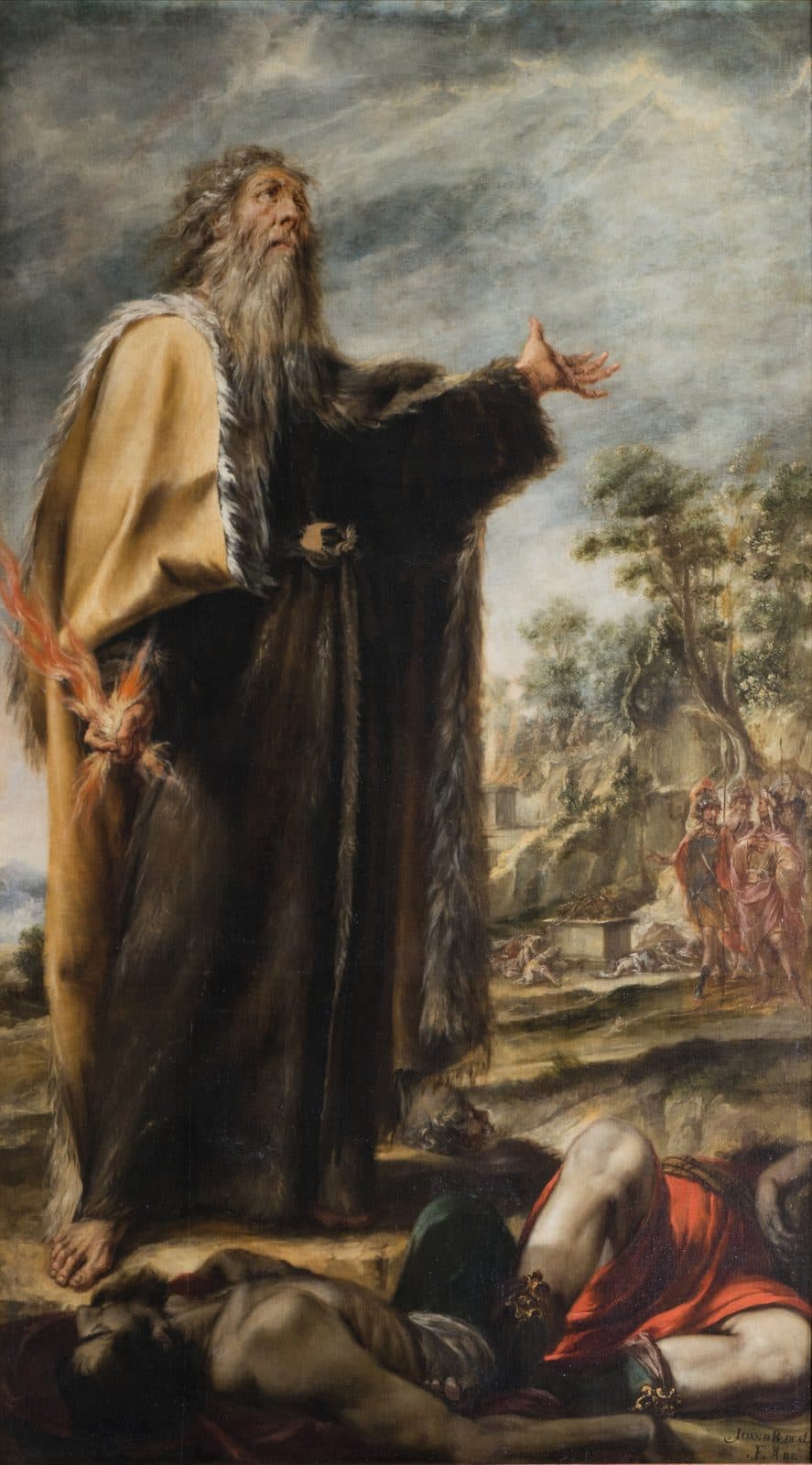
Juan de Valdés Leal, Elijah and the Prophets of Baal, 1658, oil on canvas. Public domain (published before 1930), via Wikimedia Commons, File:Valdes_leal-elias_y_los_profetas_de_baal.jpg.
THE ARTWORKValdés Leal painted Elijah after the contest of 1 Kings 18, the prophets of Baal slain at his feet as verse 40 records, and behind him the altar where the fire of the LORD fell.
Summary
Baal was the chief god of Canaan, and Scripture records Israel's worship of him from the plains of Moab to the last years of Judah.
- Judges names the service of the Baals and the Ashtoreths as the sin of the generation after Joshua (Judges 2:13).
- Ahab's marriage to Jezebel of Sidon brought the worship of Baal into the royal house of Israel.
- On Mount Carmel the prophets of Baal called on him till evening and none answered, and the LORD answered Elijah by fire.
- Jehu and Josiah, kings of Israel and of Judah, each destroyed the worship of Baal in his own kingdom.
- Tablets and a stele from Ras Shamra, older than the kingdom of Israel, show how Baal's own worshippers named and pictured him.
Baal in the Book of Judges
Judges 2, 6 and 10 show the Baals early, midway and late in the years of the judges.
And the Israelites did evil in the sight of the LORD and served the Baals. Thus they forsook the LORD, the God of their fathers, who had brought them out of the land of Egypt, and they followed after various gods of the peoples around them. They bowed down to them and provoked the LORD to anger, for they forsook Him and served Baal and the Ashtoreths.The narrator sets the Baals against the God who brought Israel out of Egypt, so the sin is forsaking a known Lord.
C. F. Keil, on Judges 2:11 to 13, took the plural Baalim for all false gods, the gods of the peoples around Israel in verse 12. He explained the plural by Baal's place as the chief male god of the Canaanites, worshipped by each nation under its own title.
The gods of five nationsJudges 10:6
And again the Israelites did evil in the sight of the LORD. They served the Baals, the Ashtoreths, the gods of Aram, Sidon, and Moab, and the gods of the Ammonites and Philistines. Thus they forsook the LORD and did not serve Him.The list adds the gods of the neighbours on every side, which shows how far the service of the Baals had spread by the days of Jephthah.
Gideon pulls down his father's altarJudges 6:25 to 32
On that very night the LORD said to Gideon, “Take your father’s young bull and a second bull seven years old, tear down your father’s altar to Baal, and cut down the Asherah pole beside it. Then build a proper altar to the LORD your God on the top of this stronghold. And with the wood of the Asherah pole you cut down, take the second bull and offer it as a burnt offering.”On the night of his call the LORD orders Gideon to tear down his father's altar to Baal, before any battle with Midian.
But Joash said to all who stood against him, “Are you contending for Baal? Are you trying to save him? Whoever pleads his case will be put to death by morning! If Baal is a god, let him contend for himself with the one who has torn down his altar.” So on that day Gideon was called Jerubbaal, that is to say, “Let Baal contend with him,” because he had torn down Baal’s altar.Joash turns the town's anger back on Baal, and the new name Jerubbaal records the challenge.
Albert Barnes suggests who the men of the city were who demanded Gideon's death.
“The mention of the ‘men of the city’ by the side of Gideon’s ‘father’s household’ suggests the probability of their being a remnant of the Canaanite population, and the special patrons of Baal-worship.”
Albert Barnes · Notes, Explanatory and Practical, on the Old and New Testaments (1832-1869) · on Judges 6:27Evangelical
Adam Clarke, on Judges 6:32, notes that 2 Samuel 11:21 calls Gideon Jerubbesheth, putting the word for shame in place of the name Baal.
Baal on the Stele and in the Story of Israel
The stele of Baal from Ras Shamra with its parts numbered, and a timeline of Baal worship from Numbers 25 to Jeremiah 7.
The stele shows Baal striding with a raised club and a branching spear.
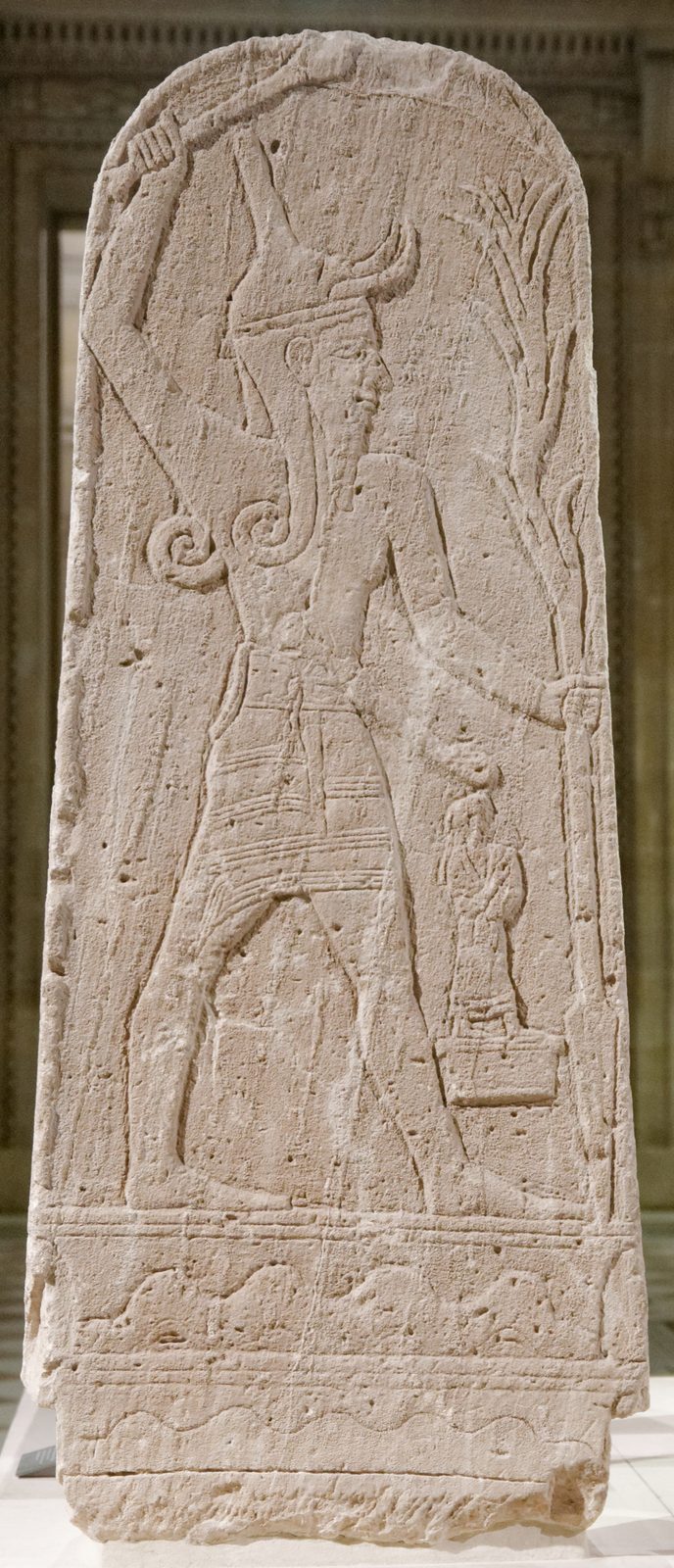
- The raised clubHis right arm is lifted over his head with a club, the pose of a god who strikes.Judges 6:31
- The horned crownHe wears a tall crown in the Egyptian style with horns at its base.Judges 2:13
- The spear that branchesHis left hand holds a spear whose top branches upward, which the Louvre reads as the thunderbolt and the branch.1 Kings 17:1
- The kingA small robed figure on a pedestal before the god is named in the Louvre's record as a king.1 Kings 16:32
- The mountain and the seaTwo carved bands at the foot are read in the Louvre's record as the mountain and the sea.Psalm 29:3
Stele of Baal with the thunderbolt, limestone, Ras Shamra (Ugarit), 2000 to 1150 BC, Musée du Louvre AO 15775. Photograph by Jastrow, 2006, public domain, via Wikimedia Commons, File:Baal_thunderbolt_Louvre_AO15775.jpg.
The limestone stele whole, with five numbered parts named in the Louvre's record.
Baal was worshipped in Israel from Shittim to the days of Jeremiah, and Gideon, Elijah, Jehu and Josiah each struck at his worship.
To scale: 7 of 11 stops dated; a ring is approximate; a bar is a span.
- Baal of Peor at Shittimabout 1406 BC, Israel eats the sacrifices of Moab's gods and joins in worshiping Baal of Peor.Numbers 25:1 to 3
- The generation after Joshua1406 to 1050 BC, the days of the judges, The LORD sells Israel into the hands of plunderers and enemies all around.Judges 2:14
- Gideon's night workThe text gives no year, Gideon and ten servants tear down the altar of Baal by night.Judges 6:27 to 28
- Baal-berithThe text gives no year, As soon as Gideon is dead, Israel sets up Baal-berith as its god.Judges 8:33
- The cry under the AmmonitesThe text gives no year, Israel confesses that it has forsaken its God and served the Baals.Judges 10:10
- Ahab's temple in Samaria874 to 853 BC, Ahab's reign, Ahab sets up an altar for Baal in the temple he built in Samaria.1 Kings 16:32
- The fire on CarmelIn Ahab's reign; the text gives no year, The people fall facedown and cry that the LORD is God.1 Kings 18:39
- Jehu's sacrificeabout 841 BC, Jehu's guards kill the servants of Baal and the temple is made a latrine.2 Kings 10:25 to 27
- Hosea's chargeabout 755 to 715 BC, Hosea's ministry, The LORD will punish Israel for the days of the Baals.Hosea 2:13
- Josiah's reform622 BC, Josiah does away with the priests who burned incense to Baal, the sun and the moon.2 Kings 23:5
- Jeremiah at the temple627 to 586 BC, Jeremiah's ministry, Jeremiah asks whether those who burn incense to Baal can then stand in the LORD's house.Jeremiah 7:9 to 10
Eleven stops, each with its verse and its date where one can be given.
The Louvre's record gives the stele's findspot as the acropolis of Ras Shamra, west of the temple of Baal, where Claude Schaeffer's mission found it on 28 May 1932. The museum dates the stone between 2000 and 1150 BC, the Middle or Late Bronze Age, before Samuel anointed Saul king (1 Samuel 10:1).
The dates of the judges are counted from the 480 years of 1 Kings 6:1, and the dates of the kings follow the reckoning of Edwin Thiele.
Ahab, Jezebel and Mount Carmel
1 Kings 16 to 18 tells how Baal came to Samaria and how the contest on Carmel ended.
And as if it were not enough for him to walk in the sins of Jeroboam son of Nebat, he even married Jezebel the daughter of Ethbaal king of the Sidonians, and he then proceeded to serve and worship Baal. First, Ahab set up an altar for Baal in the temple of Baal that he had built in Samaria. Then he set up an Asherah pole. Thus Ahab did more to provoke the LORD, the God of Israel, to anger than all the kings of Israel before him.The writer ranks Ahab above every king before him in provoking the LORD, and counts the sins of Jeroboam as the lesser part of his guilt.
Then you may call on the name of your god, and I will call on the name of the LORD. The God who answers by fire, He is God.” And all the people answered, “What you say is good.”Elijah sets the test on fire from heaven, and the people agree to the terms before either side begins.
The contest followed the drought Elijah announced to Ahab in 1 Kings 17:1, and closed with rain after Elijah bowed down on Carmel's summit (1 Kings 18:41 to 45). Arvid Kapelrud, in Baal in the Ras Shamra Texts (1952), read 1 Kings 18 as showing a rain and storm god, expected to bring rain and fertility when asked.
The prophets of Baal call on him1 Kings 18:26 to 29
And they took the bull that was given them, prepared it, and called on the name of Baal from morning until noon, shouting, “O Baal, answer us!” But there was no sound, and no one answered as they leaped around the altar they had made. At noon Elijah began to taunt them, saying, “Shout louder, for he is a god! Perhaps he is deep in thought, or occupied, or on a journey. Perhaps he is sleeping and must be awakened!” So they shouted louder and cut themselves with knives and lances, as was their custom, until the blood gushed over them. Midday passed, and they kept on raving until the time of the evening sacrifice. But there was no response; no one answered, no one paid attention.The writer says twice that no one answered, and that silence is the evidence Elijah asked the people to weigh.
Albert Barnes gives two reasons for Elijah's taunt at noon.
“The object of Elijah’s irony was two-fold; (1) to stimulate the priests to greater exertions, and so to make their failure more complete, and (2) to suggest to the people that such failure would prove absolutely that Baal was no God.”
Albert Barnes · Notes, Explanatory and Practical, on the Old and New Testaments (1832-1869) · on 1 Kings 18:27Evangelical
Matthew Henry sets the cutting with knives beside the law of Deuteronomy 14:1.
“God never required his worshippers thus to honour him; but the service of the devil, though in some instances it pleases and pampers the body, yet in other things it is really cruel to it, as in envy and drunkenness. It seems, this was the manner of the worshippers of Baal. God expressly forbade his worshippers to cut themselves, Deut. xiv.”
Matthew Henry · Commentary on the Whole Bible · on 1 Kings 18:28Puritan
The fire and the end of the prophets1 Kings 18:38 to 40
Then the fire of the LORD fell and consumed the sacrifice, the wood, the stones, and the dust, and it licked up the water in the trench. When all the people saw this, they fell facedown and said, “The LORD, He is God! The LORD, He is God!” Then Elijah ordered them, “Seize the prophets of Baal! Do not let a single one escape.” So they seized them, and Elijah brought them down to the Kishon Valley and slaughtered them there.The confession answers the question Elijah put to the people in verse 21, which they had met with silence.
Jehu and Josiah Tear Down the Altars
Jehu destroyed the servants of Baal by a feigned sacrifice, and Josiah cleared the articles of Baal out of the temple in Jerusalem.
Jehu's deception2 Kings 10:18 to 28
Then Jehu brought all the people together and said, “Ahab served Baal a little, but Jehu will serve him a lot. Now, therefore, summon to me all the prophets of Baal, all his servants, and all his priests. See that no one is missing, for I have a great sacrifice for Baal. Whoever is missing will not live.” But Jehu was acting deceptively in order to destroy the servants of Baal.Jehu calls a great sacrifice for Baal, and the writer tells the reader at once that it is a deception.
Jamieson, Fausset and Brown judge Jehu's summons by the law of Moses.
“Jehu's appointment of a solemn sacrifice in honor of Baal, and a summons to all his worshippers to join in its celebration, was a deep-laid plot, which he had resolved upon for their extinction, a measure in perfect harmony with the Mosaic law, and worthy of a constitutional king of Israel.”
Jamieson, Fausset & Brown · Commentary Critical and Explanatory on the Whole Bible · on 2 Kings 10:19Reformed
Thus Jehu eradicated Baal from Israel, but he did not turn away from the sins that Jeroboam son of Nebat had caused Israel to commit—the worship of the golden calves at Bethel and Dan.The writer credits Jehu with removing Baal from Israel and in the next breath faults him for keeping the golden calves at Bethel and Dan.
The goddesses Josiah removed2 Kings 23:6, 7 and 13
He brought the Asherah pole from the house of the LORD to the Kidron Valley outside Jerusalem, and there he burned it, ground it to powder, and threw its dust on the graves of the common people.Josiah takes the Asherah pole out of the LORD's own house, which shows how far the worship had reached in Judah.
He also tore down the quarters of the male shrine prostitutes that were in the house of the LORD, where the women had woven tapestries for Asherah.Women had woven hangings for Asherah inside the house of the LORD, and Josiah tore down the rooms where they worked.
The king also desecrated the high places east of Jerusalem, to the south of the Mount of Corruption, which King Solomon of Israel had built for Ashtoreth the abomination of the Sidonians, for Chemosh the abomination of the Moabites, and for Milcom the abomination of the Ammonites.Josiah's reform reached back to the worship Solomon himself had begun, so it judged a king of David's own line.
Baal in the Texts of Ugarit
The tablets of Ugarit give Baal's names and deeds as his own worshippers told them.
Arvid Kapelrud dates the finding of the first Ras Shamra texts to 1929 and places them in the middle of the second millennium BC. In them Baal acts beside El, Anat, Asherah and Mot, and Kapelrud counts about twenty places naming him Hadad, the old Semitic storm god. He reads the singular Baal of Judges 6:25 and 1 Kings 18 as one god, and notes a Ras Shamra list naming a Baal of several places.
Sing to God! Sing praises to His name. Exalt Him who rides on the clouds— His name is the LORD— and rejoice before Him.The psalm calls the LORD the One who rides on the clouds, a title the Ras Shamra texts give to Baal.
The voice of the LORD is over the waters; the God of glory thunders; the LORD is heard over many waters.The psalm gives the thunder over the waters to the LORD, the power the Canaanites gave to the storm god.
The Rider of the CloudsKapelrud, 1952, on Psalm 68:4
Kapelrud counted the title Rider of the Clouds fourteen times in the texts he read, and he wrote that it was probably better rendered “Driver of the Clouds”. He set Psalm 68:4 beside it as the parallel most often cited.
The Words for Baal and the Goddesses
Four Hebrew words name Baal and the goddesses worshipped beside him.
BAAL (H1168)
The proper name of the god, which the lexicon defines as a Phoenician deity.
BAAL (H1167)
The common noun for a master, an owner or a husband, the word from which the god took his name.
ASHTAROTH (H6252)
The Ashtoreths, the name of a Sidonian goddess and of a place east of the Jordan.
ASHERAH (H842)
A goddess of the Phoenicians and also the wooden image of her, rendered Asherah pole in the Berean text.
The local Baals and the goddessesJudges, Numbers, Deuteronomy and 1 Kings
| Name | What the text says | Verse |
|---|---|---|
| The Baals | The plural form, Baalim. | Judges 2:11 |
| Baal of Peor | The Baal Israel joined in worshiping at Shittim in Moab. | Numbers 25:3 |
| Bamoth-baal | The heights of Baal from which Balak showed Balaam the camp of Israel. | Numbers 22:41 |
| Baal-berith | The god whose temple gave Abimelech seventy shekels of silver to hire men. | Judges 9:4 |
| Ashtoreth of the Sidonians | The goddess of the Sidonians whom Solomon followed. | 1 Kings 11:5 |
| Asherah | The goddess whose four hundred prophets ate at Jezebel's table. | 1 Kings 18:19 |
| The Asherah pole | A wooden pole the law forbade beside the altar of the LORD. | Deuteronomy 16:21 |
Ashtoreth and the Asherim in KeilKeil on Judges 2:13
Keil read Ashtoreth as the leading female deity of the Canaanite tribes, a moon goddess. He held that the name Asherah passed to the goddess from her idols, which were mostly wooden columns, the Asherim of Exodus 34:13.
What the Text Leaves Unsaid
Judges and Kings leave four matters about Baal unsaid.
Judges and Kings name Baal's altars and the sacred pillar of his temple (2 Kings 10:26 to 27) and do not describe his image. They tell no story of Baal's deeds and nothing of his worshippers' beliefs.
The text does not say whether Jezebel's Baal was the Baal of Peor or Baal-berith. 1 Kings 16:31 names her father, Ethbaal king of the Sidonians, and calls the god only Baal.
My Husband, and No Longer My Master
Hosea charges Israel with giving to Baal what the LORD had given.
For she does not acknowledge that it was I who gave her grain, new wine, and oil, who lavished on her silver and gold—which they crafted for Baal.The LORD names the gifts Baal was worshipped for and claims them as His own.
In that day,” declares the LORD, “you will call Me ‘my Husband,’ and no longer call Me ‘my Master.’ For I will remove from her lips the names of the Baals; no longer will their names be invoked.The LORD will take the word baal off Israel's lips, even as a title for Himself.
Adam Clarke, on Hosea 2:16, gave the Hebrew for my Master as Baali and for my Husband as Ishi. He explained that the first title, good in itself, could no longer be used of the LORD because it had been given to false gods.
The end of the names of the BaalsMatthew Henry on Hosea 2:16 to 17
Matthew Henry reads the promise as God's parting of Israel from its besetting sin.
“Note, The surest pledge and token of God's favour to any people is his effectual parting between them and their beloved sins. The worship of Baal was the sin that did most easily beset the people of Israel; it was their own iniquity, the sin that had dominion over them; but now that idolatry shall be quite abolished, and there shall not be the least remains of it among them.”
Matthew Henry · Commentary on the Whole Bible · on Hosea 2:16 to 17Puritan
Baal of Peor rememberedPsalm 106:28 to 29
They yoked themselves to Baal of Peor and ate sacrifices offered to lifeless gods. So they provoked the LORD to anger with their deeds, and a plague broke out among them.The psalmist calls the gods of Peor lifeless and names the plague that followed, so the first fall to Baal is remembered in Israel's worship.
Jamieson, Fausset and Brown, on Numbers 25:3, took the real name of the idol of Peor to be Chemosh. Albert Barnes, on the same verse, wrote that this identification is now given up.
Voices on Baal
Albert Barnes on the people at Carmel, and Matthew Henry on Jehu's reform.
The silent peopleAlbert Barnes on 1 Kings 18:21
Albert Barnes explains why the people gave Elijah no answer.
“The people were mute. They could not but feel the logical force of Elijah’s argument; but they were not prepared at once to act upon it. They wished to unite the worship of Yahweh with that of Baal - to avoid breaking with the past and completely rejecting the old national worship, yet at the same time to have the enjoyment of the new rites, which were certainly sensuous, and probably impure.”
Albert Barnes · Notes, Explanatory and Practical, on the Old and New Testaments (1832-1869) · on 1 Kings 18:21Evangelical
Jehu's reform weighedMatthew Henry on 2 Kings 10:30
Matthew Henry weighs Jehu's reform against the sin of Jeroboam.
“He departed from the sins of Ahab, but not from the sins of Jeroboam--discarded Baal, but adhered to the calves. The worship of Baal was indeed the greater evil, and more heinous in the sight of God, but the worship of the calves was a great evil, and true conversion is not only from gross sin, but from all sin--not only from false gods, but from false worships.”
Matthew Henry · Commentary on the Whole Bible · on 2 Kings 10:30Puritan
What Baal Was, and What Israel's Poets Took
Four readings in two pairs, each with its holders and the objection to it
Baal was the sunAdam Clarke, John Wesley and C. F. Keil
Adam Clarke, in his Commentary on the Bible on Judges 2:13, took Baal and Ashtaroth to mean in a general way the sun and the moon. On 1 Kings 18:24 he called the Baal of Carmel the sun and so the god of fire. John Wesley, in his Explanatory Notes upon the Old Testament on Judges 2:13, read Baal and Ashtaroth as the sun and moon. Keil, in his commentary of 1872 on Judges 2:13, called Baal a sun god.
The objection rests on the stele and the tablets of Ras Shamra, where Baal holds a club and a thunderbolt and is called Hadad. It rests also on 1 Kings 17:1 and 1 Kings 18:41 to 45, where the contest turns on rain.
Baal was the storm and rain godArvid Kapelrud
This reading takes the figure on the stele and the god of the tablets as the god whose prophets Elijah faced.
The objection rests on the distance in time and place. The tablets come from a city on the Syrian coast in the second millennium BC. Scripture speaks of local Baals such as Baal of Peor and Baal-berith (Numbers 25:3 and Judges 8:33).
Israel's poets borrowed the storm god's picturesArvid Kapelrud
Kapelrud held that Psalm 68 describes the LORD in pictures taken from the world of the West Semitic storm god. He also held that in Israel a long struggle ended in victory for the LORD, and the features taken over from Baal were expelled.
The objection rests on Hosea 2:8 and 1 Kings 18:39, which claim for the LORD alone the gifts and the answer that Baal's worshippers looked for from Baal.
The prophets set the LORD against Baal on Baal's own groundAdam Clarke
Adam Clarke, on Hosea 2:8, read the verse as showing how often the gifts of God are credited to any cause but the right one.
The objection rests on Psalm 68:4, where a title known from the Ras Shamra texts is given to the LORD with no word of contest beside it.
Books on Baal
Four works on Baal in Judges, Kings and the Ugarit texts, two free on archive.org.
Biblical Commentary on the Old Testament: Joshua, Judges, Ruth
C. F. Keil and F. Delitzsch, translated by James Martin · 1872
Keil comments on the Hebrew of Judges verse by verse and sets out the older view of Baal and Ashtoreth.
Read on archive.orgBaal in the Ras Shamra Texts
Arvid S. Kapelrud · 1952
Kapelrud gathers Baal's names and deeds from the tablets of Ugarit and compares them with the Old Testament.
Read on archive.orgNotes, Explanatory and Practical, on the Old and New Testaments
Albert Barnes · 1832 to 1869
Barnes reads the contest on Carmel and Jehu's reform with attention to the people who watched.
Commentary on the Whole Bible
Matthew Henry · 1710
Henry reads each passage for its use in the reader's own life.
The LORD, He Is God
Romans 11 and 1 Corinthians 10 apply the story of Baal to the church.
Israel tried to keep the LORD and Baal together, and Elijah asked the people to choose. The passages ask the reader to give the LORD the credit for every gift and to serve Him alone.
And what was the divine reply to him? “I have reserved for Myself seven thousand men who have not bowed the knee to Baal.” In the same way, at the present time there is a remnant chosen by grace.Paul answers the question whether God has rejected His people with the answer God gave to Elijah.
You cannot drink the cup of the Lord and the cup of demons too; you cannot partake in the table of the Lord and the table of demons too.The choice of Carmel returns at the Lord's table, where no one can share the table of demons too.
Keep studying
Studies9
People9
Places2
Doctrines5
Peoples and groups1