
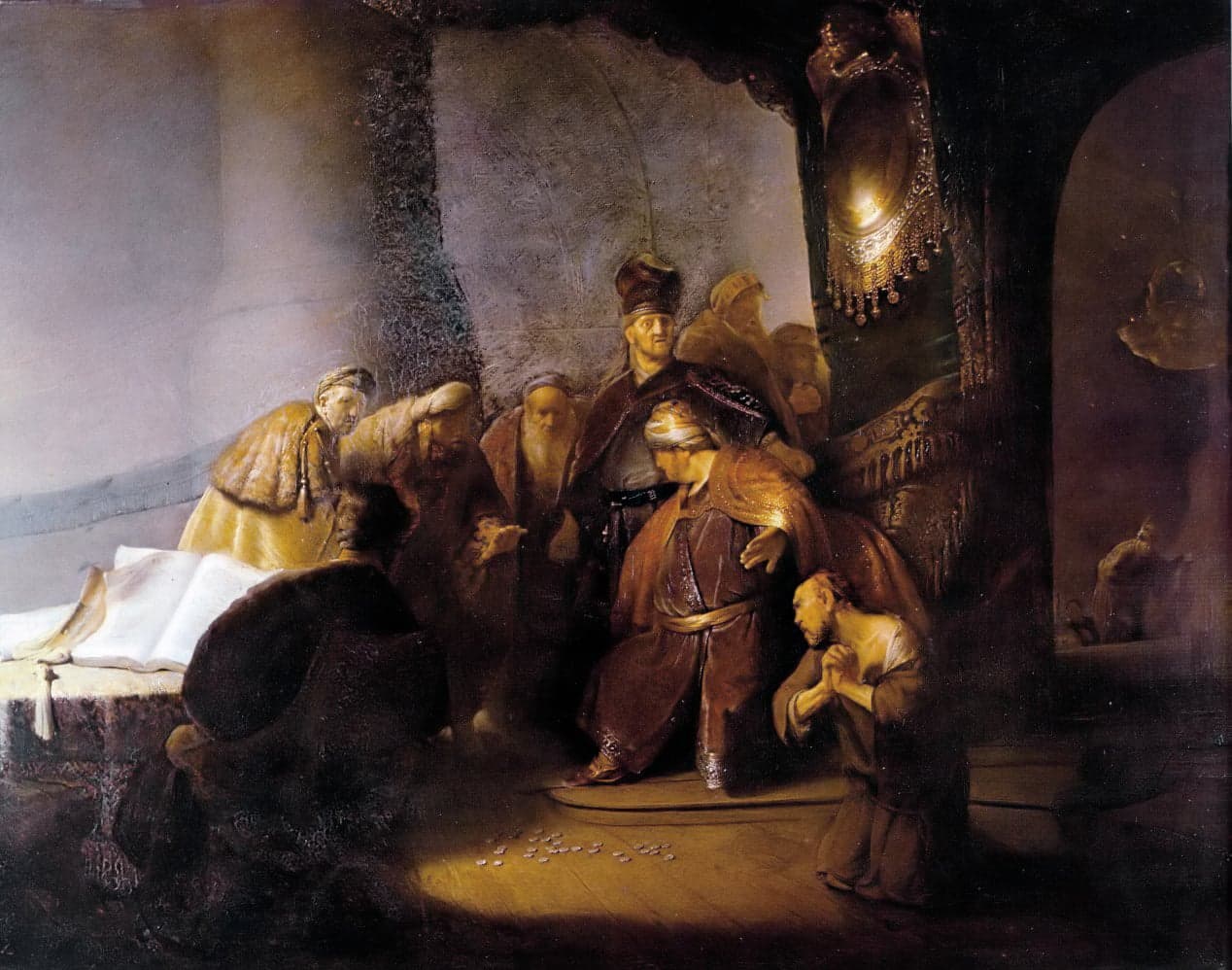
2 Corinthians 7:10 · Passage · Repentance
Godly Sorrow and Worldly Sorrow
Second Corinthians 7:8 to 11 sets two kinds of grief over sin side by side and names the end that each one reaches.
Matthew uses one Greek verb for the remorse of Judas, and Paul uses the same verb for his own regret over a letter he sent to Corinth.
Godly sorrow brings repentance that leads to salvation without regret, but worldly sorrow brings death.
- Books
- 2 Corinthians, Matthew
- Hold in memory
- 2 Corinthians 7:10
Summary
Paul looks back on a severe letter that had grieved the church at Corinth. He had once regretted sending it, but the news Titus brought changed his mind, because the grief had turned the church back to what was right. Paul calls that turn repentance, and he lists seven marks of it that he saw in the church.
- Grief over sin can lead to repentance, and Paul calls the grief that does so godly sorrow.
- Worldly sorrow mourns the loss and the shame and goes no further, and its end is death.
- Godly sorrow shows itself in deeds, such as earnestness, zeal and an eagerness to set the wrong right.
- The repentance godly sorrow produces leads to a salvation no one ever regrets.
A Letter Written Through Tears
Paul wrote a severe letter in place of a painful visit and then waited for Titus to bring word of how it was received.
When does grief over sin turn a person back to God, and when does it only crush him? This study of 2 Corinthians 7:8 to 11 answers from Paul's own account of a letter that grieved a church. The passage belongs to repentance, the turn of the whole person from sin to God, and it shows the sorrow that leads to that turn and the sorrow that does not.
The study sets the passage in its story, draws the two sorrows side by side, reads Paul's words for grief, regret and repentance, and lists the seven marks he saw at Corinth. It then compares the grief of Peter with the grief of Judas and of Esau.
Paul had decided not to make “another painful visit” to Corinth (2 Corinthians 2:1), and he wrote to the church instead.
For through many tears I wrote you out of great distress and anguish of heart, not to grieve you but to let you know how much I love you.Paul explains that the letter was written in love and at great cost to himself.
He went on to Macedonia, where he found no rest and was “pressed from every direction” (2 Corinthians 7:5).
But God, who comforts the downcast, comforted us by the arrival of Titus, and not only by his arrival, but also by the comfort he had received from you. He told us about your longing, your mourning, and your zeal for me, so that I rejoiced all the more.Titus brought the news that the letter had moved the church to longing, mourning and zeal.
The Two Sorrows Side by Side
Godly sorrow and worldly sorrow both grieve, and they part at what the grief does next.
Peter and Judas both grieved over their sin during the trial of Jesus, and one grief ended in restoration while the other ended in death.
| What is compared | Godly sorrow | Worldly sorrow |
|---|---|---|
| The Greek of 2 Corinthians 7:10 | he kata theon lype, grief according to God | he tou kosmou lype, the grief of the world |
| The one who grieved | Peter: “And he went outside and wept bitterly.” | Judas: “he was filled with remorse and returned the thirty pieces of silver to the chief priests and elders.” |
| What he did next | He answered the risen Lord, “Lord, You know all things. You know I love You.” | “So Judas threw the silver into the temple and left.” |
| Where it ended | Jesus said to him, “Feed My sheep.” | “Then he went away and hanged himself.” |
Verses 8 to 10, Grief, Regret and Repentance
Paul uses one word for grief, another for his own regret and a third for repentance.
The verb for grieving in these verses is lypeo (G3076), to distress, and the noun of 2 Corinthians 7:10 is lype (G3077), sadness or grief. Paul uses the verb metamelomai (G3338), to care afterwards, twice in 2 Corinthians 7:8, once to say that he does not regret the letter and once to say that he did regret it.
And now I rejoice, not because you were made sorrowful, but because your sorrow led you to repentance. For you felt the sorrow that God had intended, and so were not harmed in any way by us.Paul names the end that made the grief worth causing, and he calls it repentance.
The noun for repentance in 2 Corinthians 7:9 is metanoia (G3341). In 2 Corinthians 7:10 the salvation it leads to is ametameletos (G278), a word the Tyndale House brief lexicon glosses irrevocable and the Berean text renders “without regret”.
Verse 11, the Seven Marks of Godly Sorrow
Paul names seven things that godly sorrow produced in the church at Corinth.
- 1EarnestnessThe noun spoude (G4710) means eagerness and earnestness, and Paul begins the list with it: “what earnestness”.2 Corinthians 7:11
- 2Eagerness to clear yourselvesThe noun apologia (G627) is a plea or defence, which the Berean text renders “what eagerness to clear yourselves”.2 Corinthians 7:11
- 3IndignationThe noun aganaktesis (G24) means indignation, and this is its one use in the New Testament.2 Corinthians 7:11
- 4AlarmThe noun phobos (G5401) means alarm or fright, the fear that took hold of the church.2 Corinthians 7:11
- 5LongingThe noun epipothesis (G1972) means a longing for, and Titus had already reported “your longing” (2 Corinthians 7:7).2 Corinthians 7:11
- 6ZealThe noun zelos (G2205) is heat or ardour, here zeal in a good sense.2 Corinthians 7:11
- 7VindicationThe noun ekdikesis (G1557) means vindication or retribution, the wrong dealt with and justice done.2 Corinthians 7:11
Eagerness to clear yourselves, Indignation, Alarm, Longing, Zeal, Vindication
Paul ends the verse with his verdict, “In every way you have proved yourselves to be innocent in this matter” (2 Corinthians 7:11). He adds that he wrote so that “your earnestness on our behalf would be made clear to you in the sight of God” (2 Corinthians 7:12).
Peter's Tears and Judas's Remorse
Luke and Matthew record what each disciple did with his grief, and Hebrews adds the tears of Esau.
Peter denied Jesus three times in the courtyard of the high priest, the third time with curses and oaths, and then the rooster crowed (Matthew 26:69 to 74). Luke records what happened next.
And the Lord turned and looked at Peter. Then Peter remembered the word that the Lord had spoken to him: “Before the rooster crows today, you will deny Me three times.”This is the moment the grief began, when Jesus saw the disciple who had just disowned Him.
Judas came to the chief priests and elders and said, “I have sinned by betraying innocent blood,” and they turned him away with the words “You bear the responsibility” (Matthew 27:4). His grief was real, and it carried him to those who had paid him and away from the one he had betrayed.
Hebrews gives a third case of grief that found no way back. Esau sold his birthright for a single meal (Hebrews 12:16).
For you know that afterward, when he wanted to inherit the blessing, he was rejected. He could find no ground for repentance, though he sought the blessing with tears.The letter sets Esau's tears beside its warning against becoming godless like him.
Teachers on the Two Sorrows
Ambrose, John Chrysostom and Augustine each wrote on the grief that leads to repentance.
died 397 · Ambrose of Milan
On Paradise 15.76
Sadness according to God is useful, and the Old Testament shows the same pattern.
The quotation1 quotation
“He also persuades us that this sadness is useful, which is according to God, not according to the world. 'It is necessary,' he says, 'for you to be saddened unto repentance according to God; for according to God, sadness produces salvation, but sadness according to the world produces death. But also consider from the Old Testament that those who were saddened by bodily works found favor, but those who delighted in the works of this world remained in punishment.' Finally, the Hebrews who groaned in the labors of Egypt obtained the grace of the righteous.”
Ambrose of Milan · On Paradise 15.76 · on 2 Corinthians 7:9Patristic
died 407 · John Chrysostom
Homily 15 on 2 Corinthians
Godly grief made the church more careful, and each mark Paul names is a token of that care.
The quotation1 quotation
“‘For behold,’ he saith, ‘this self-same thing, that ye were made sorry after a godly sort, what earnest care it wrought in you.’ 'For not only,' he saith, 'did your sorrow not cast you into that condemning of yourselves, as having acted idly in so doing; but it made you even more careful.' Then he speaks of the certain tokens of that carefulness; ‘Yea,’ what ‘clearing of yourselves,’ towards me. ‘Yea, what indignation’ against him that had sinned. ‘Yea, what fear.’ For so great carefulness and very speedy reformation was the part of men who feared exceedingly. And that he might not seem to be exalting himself, see how quickly he softened it by saying, ‘Yea, what longing,’ that towards me. ‘Yea, what zeal,’ that on God's behalf. ‘Yea, what avenging:’ for ye also avenged the laws of God that had been outraged. ‘In every thing ye approved yourselves to be pure in the matter.’ Not only by not having perpetrated, for this was evident before, but also by not consenting unto it. For since he said in the former Epistle, ‘and ye are puffed up;’ he also says here, 'ye have cleared yourselves of this suspicion also; not only by not praising, but also by rebuking and being indignant.'”
John Chrysostom · Homily 15 on 2 Corinthians · on 2 Corinthians 7:11Patristic
died 430 · Augustine of Hippo
City of God 14.8
Christian writings use sorrow in a good sense, though the Stoics denied it any place in the soul of a wise man.
The quotation1 quotation
“Moreover, even sorrow, the emotion for which, the Stoics claim, there can be found in the soul of a wise man no corresponding ‘attitude,’ is a word used in a good sense, especially in Christian writings. The apostle, for example, praises the Corinthians because they were sorrowful according to God. Of course, someone may object that the apostle congratulated the Corinthians because their sorrow led them to repentance and that such sorrow can be experienced only by those who have sinned. What he says is this: ‘Seeing that the same letter did for a while make you sorry, now I am glad; not because you were made sorry but because your sorrow led you to repentance. For you were made sorry according to God, that you might suffer no loss at our hands. For the sorrow that is according to God produces repentance that surely tends to salvation, whereas the sorrow that is according to the world produces death. For behold this very fact that you were made sorry according to God, what earnestness it has wrought in you.’”
Augustine of Hippo · City of God 14.8 · on 2 Corinthians 7:8Patristic
The Sorrow That Turns to God
Godly sorrow brings the grieving sinner to God, and the psalms promise that He receives him.
Worldly sorrow looks at the loss, the shame and the people who saw it, while godly sorrow looks to the God who was wronged.
The LORD is near to the brokenhearted; He saves the contrite in spirit.The psalm gives the reason a broken heart can bring its grief to God.
Sources
Scripture is the Berean Standard Bible.
- STEP Bible, Translators Brief lexicon of Extended Strongs for Greek (Tyndale House, Cambridge), CC BY 4.0, based on Abbott-Smith (1922)
- Ambrose of Milan, On Paradise, chapter 15, section 76.
- John Chrysostom, Homilies on 2 Corinthians, homily 15.
- Augustine of Hippo, The City of God, book 14, chapter 8.
Keep Studying
In this value4
People and groups8