
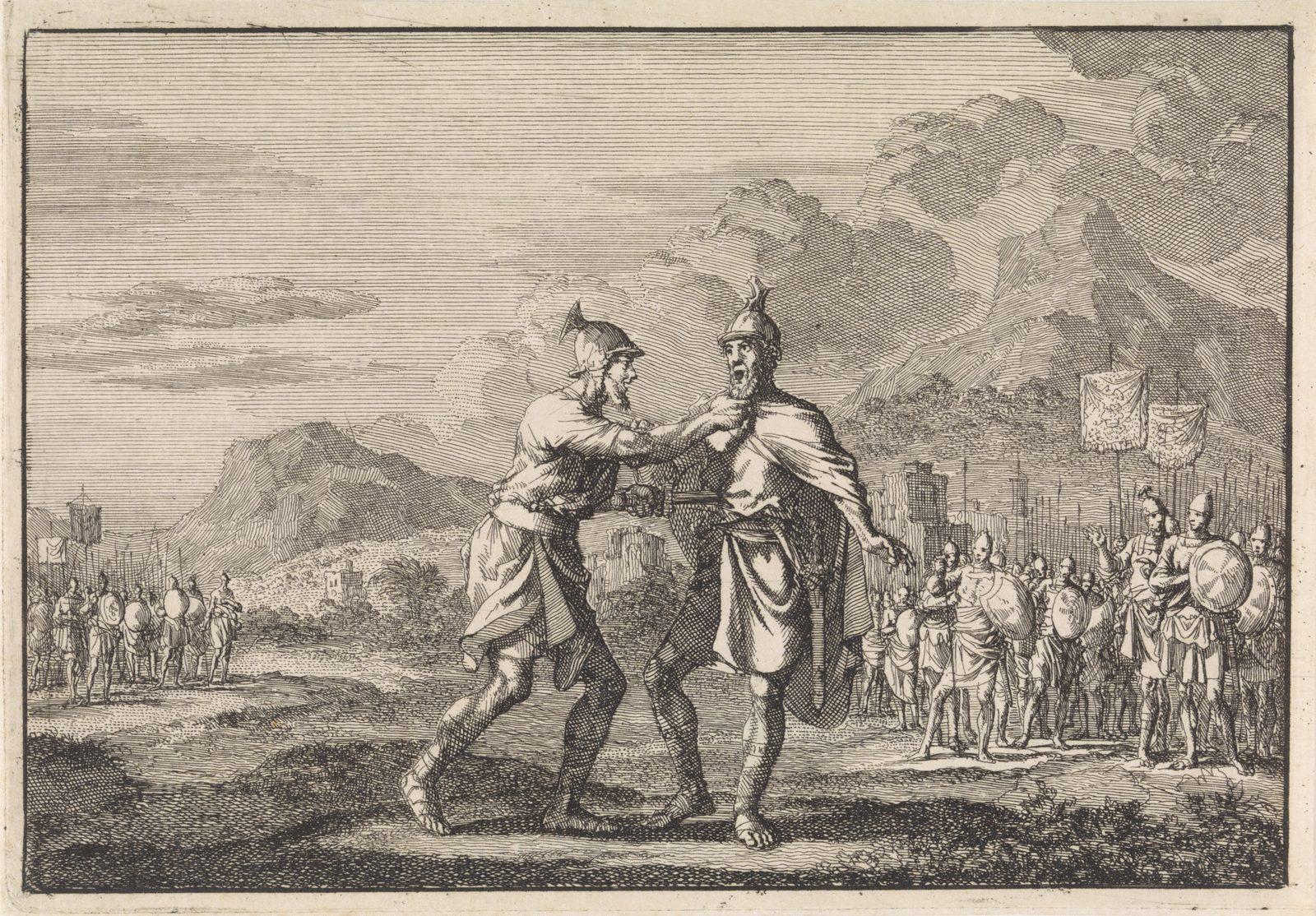
Jan Luyken, Joab Kills Amasa, 1704. Public domain.
2 Samuel 2 to 1 Kings 2 · Person · Featured Study
Joab son of Zeruiah
He led David's army against Ammon, Aram and Edom.
Now David had said, “Whoever is the first to strike down a Jebusite will become chief commander.” And Joab son of Zeruiah went up first, and he became the chief.
- Died
- at the tent of the LORD, early in the reign of Solomon
- Family
- mother: Zeruiah, David's sister; brother: Abishai; brother: Asahel; uncle: David
- Places
- Bethlehem, Jerusalem, Tekoa
- First named
- 1 Samuel 26:6 “…and Abishai son of Zeruiah, Joab’s brother, “Who…”
- Last named
- 1 Kings 11:16 “Joab and all…”
When Benaiah ordered him out of the tent of the LORD, the old commander answered, “No, I will die here.”
Summary
Joab was the son of David's sister Zeruiah and the commander of David's army. He won Jerusalem's first assault and carried out the king's letter against Uriah. He killed Abner and Amasa, the commanders of the armies of Israel and Judah. When he sided with Adonijah, Solomon had him killed at the altar.
- He stayed six months in Edom and struck down every male he could find.
- He told the man who saw Absalom in the oak that he would have paid him ten shekels and a belt to strike him down.
- The census he carried out took nine months and twenty days.
- Chronicles says the number he counted was never entered in the chronicles of King David.
Where Joab Stands in Scripture
The text names him in the books of Samuel, Kings and Chronicles.
He was still in the army's command when Solomon came to the throne.
Joab son of Zeruiah was over the army; Jehoshaphat son of Ahilud was the recorder;The list closes the account of David's wars against the nations around him.
His Life, Turn by Turn
His life runs from the pool of Gibeon to the tent of the LORD.
Joab won David's wars and killed the men who stood in his way.
- Meets Abner's men in battleGibeon2 Samuel 2:13
- Kills Abner in the gatewayHebron2 Samuel 3:27
- Goes up first against the Jebusites and is made chiefJerusalem1 Chronicles 11:6
- Fights the Arameans while Abishai faces Ammonoutside the Ammonite city2 Samuel 10:9 to 10
- Sets Uriah where the fighting is fiercestRabbah2 Samuel 11:16
- Sends the wise woman of Tekoa to the kingJerusalem2 Samuel 14:2 to 3
- Kills Absalom in the oakthe forest of Ephraim2 Samuel 18:14
- Kills Amasa at the great stoneGibeon2 Samuel 20:8 to 10
- Ends Sheba's revolt by a wise woman's counselin the north2 Samuel 20:22
- Counts the fighting men against his own counselfrom Dan to Beersheba2 Samuel 24:4
- Sides with AdonijahJerusalem1 Kings 1:7
- Put to death on Solomon's orderat the altar1 Kings 2:34
Two of the twelve turns are killings in time of peace.
Kills Absalom in the oak, Kills Amasa at the great stone, Ends Sheba's revolt by a wise woman's counsel, Counts the fighting men against his own counsel, Sides with Adonijah, Put to death on Solomon's order
The Commander of David's Army
His story runs from 1 Chronicles 11 to 1 Kings 2.
Joab's story runs beside David's reign, and he acts at nearly every crisis of it.
First up against Jerusalem1 Chronicles 11:4 to 8; Albert Barnes
Albert Barnes notes that Joab's part in taking the city, and in rebuilding it, is known only from Chronicles.
The wars against Ammon2 Samuel 10 to 12; Adam Clarke
Be strong and let us fight bravely for our people and for the cities of our God. May the LORD do what is good in His sight.”Joab spoke these words to Abishai with the enemy before him and behind him.
Adam Clarke calls it a very fine military address, equal to any of ancient or modern times. In the same war David sent him the letter about Uriah.
Now, therefore, assemble the rest of the troops, lay siege to the city, and capture it. Otherwise I will capture the city, and it will be named after me.”Jamieson, Fausset and Brown explain that kings of the time took the honour of a city's fall for themselves.
Absalom brought home and Absalom killed2 Samuel 14 and 18
Now Joab son of Zeruiah perceived that the king’s heart longed for Absalom. So Joab sent to Tekoa to bring a wise woman from there. He told her, “Please pretend to be a mourner; put on clothes for mourning and do not anoint yourself with oil. Act like a woman who has mourned for the dead a long time.John Wesley reads the king's longing as a wish for a pretext, which Joab supplied.
The king let Absalom come home but would not see him. After two years Absalom set Joab's barley field on fire to make him come, and Joab then brought him before the king.
In the battle in the forest Joab killed Absalom against the king's order, and afterward he rebuked the king for his grief.
Amasa at the great stone2 Samuel 19:13 and 2 Samuel 20:4 to 13
And say to Amasa, ‘Aren’t you my flesh and blood? May God punish me, and ever so severely, if from this time you are not the commander of my army in place of Joab!’”David's promise to Amasa took Joab's command from him.
Amasa was slow to gather the men of Judah, and Joab's men went out after the rebel Sheba. At Gibeon Amasa came to meet them.
Amasa was not on guard against the dagger in Joab’s hand, and Joab stabbed him in the stomach and spilled out his intestines on the ground. And Joab did not need to strike him again, for Amasa was dead. Then Joab and his brother Abishai pursued Sheba son of Bichri.Amasa had commanded Absalom's army before David's pardon.
The wise woman of Abel2 Samuel 20:15 to 22
“Far be it!” Joab declared. “Far be it from me to swallow up or destroy! That is not the case. But a man named Sheba son of Bichri, from the hill country of Ephraim, has lifted up his hand against the king, against David. Deliver him alone, and I will depart from the city.” “Look,” the woman replied, “his head will be thrown to you over the wall.”Joab answers her charge that he would destroy a mother in Israel.
The people of the town threw Sheba's head over the wall, and Joab returned to the king in Jerusalem.
The census2 Samuel 24:1 to 9; 1 Chronicles 21:3 to 6
But Joab replied to the king, “May the LORD your God multiply the troops a hundred times over, and may the eyes of my lord the king see it. But why does my lord the king want to do such a thing?”The man who had obeyed the letter about Uriah objected to this order.
But Joab did not include Levi and Benjamin in the count, because the king’s command was detestable to him.Chronicles adds what Joab left out of the count.
Adonijah and the altar1 Kings 1 and 2
Moreover, you know what Joab son of Zeruiah did to me—what he did to Abner son of Ner and Amasa son of Jether, the two commanders of the armies of Israel. He killed them in peacetime to avenge the blood of war. He stained with the blood of war the belt around his waist and the sandals on his feet. So act according to your wisdom, and do not let his gray head go down to Sheol in peace.David gave this charge to Solomon as his death drew near.
When the news of Adonijah's death reached him, Joab fled to the tent of the LORD and took hold of the horns of the altar. Solomon sent Benaiah son of Jehoiada against him, and Benaiah took his place over the army.
The Sons of Zeruiah
David named the sons of Zeruiah as a group three times.
Albert Barnes, in his Notes on 1 Chronicles 2:16, judges that Abishai was the eldest of the three, though Joab stood first among them. Each time David spoke of the sons of Zeruiah, he set himself apart from them.
And I am weak this day, though anointed as king, and these men, the sons of Zeruiah, are too fierce for me. May the LORD repay the evildoer according to his evil!”David said this on the day he buried Abner.
He named them again when Abishai offered to kill Shimei, both when Shimei cursed him and when Shimei came to ask his pardon (2 Samuel 16:10 and 2 Samuel 19:22).
The Family of Joab
His family runs from his mother Zeruiah to his cousin Amasa.
Amasa, whom he killed, was his cousin through David's other sister.
Generation 1
Generation 2
Albert Barnes reads Zeruiah and Abigail as half-sisters of David, daughters of a man named Nahash.
The Places of His Campaigns
Six places mark his life, from Bethlehem in the south to Abel in the north.
His campaigns took him east of the Jordan and to Israel's northern border.
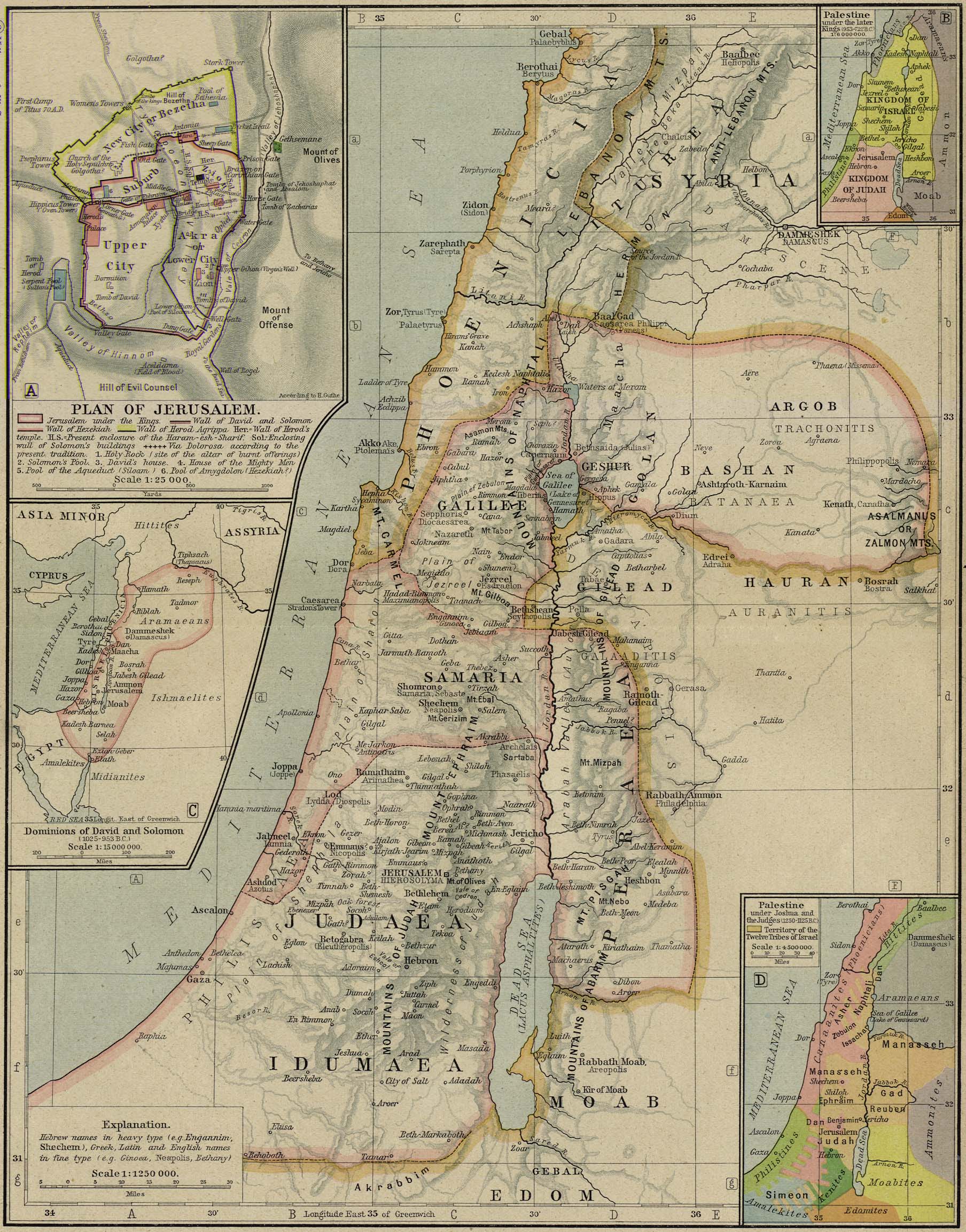
- 1Bethlehem, His father's tomb, where Asahel was buried. 2 Samuel 2:32
- 2Gibeon, Solomon offered burnt offerings at its great high place. 1 Kings 3:4
- 3Jerusalem, He went up first and restored the rest of the city. 1 Chronicles 11:8
- 4Rabbah, He took the royal city's water supply. 2 Samuel 12:27
- 5Tekoa, He brought a wise woman from there. 2 Samuel 14:2
- 6Abel-beth-maacah, He laid siege to it to take Sheba. 2 Samuel 20:15
Not placed: Gibeon (2), Rabbah (4), Abel-beth-maacah (6).
Base map: Reference map of ancient Palestine, Rand McNally reference map (1926), public domain. Each place stands at its place page's coordinates, set on the plate by Jerusalem and Damascus, as the plate prints them.
Albert Barnes places the tent where Joab died at Gibeon, the town of his first battle.
Questions His Life Raises
Three questions answered from the text and its readers
Why did Joab kill Abner and Amasa?2 Samuel 3:27 and 2 Samuel 20:10; C. F. Keil; Rashi; John Chrysostom
C. F. Keil holds that the killing of Abner could not be defended even as blood revenge. He traces both killings to jealousy, the fear that a reconciled rival would lessen Joab's influence with the king.
Rashi reads the gateway of Hebron as the seat of judges, where Joab took Abner to be judged for Asahel's blood.
John Chrysostom, in his Homilies on the Gospel of Matthew, names David's captain as a man who avenged himself even justly and brought endless sorrows on himself.
Why did Joab leave Levi and Benjamin out of the count?1 Chronicles 21:6; Albert Barnes; Adam Clarke
Albert Barnes explains the omission of Levi by the precedent of Numbers 1:47 to 49, and the omission of Benjamin by Joab's wish to spoil the king's plan and turn away God's wrath. Adam Clarke gives the reason of the rabbis: Benjamin had already been punished enough after the outrage at Gibeah.
Why could the altar not save him?Exodus 21:14; 1 Kings 2:31; Albert Barnes
But if a man schemes and acts willfully against his neighbor to kill him, you must take him away from My altar to be put to death.Albert Barnes notes that the law refused the altar's protection to a murderer only, and that this is why Solomon speaks of innocent blood.
And the king replied, “Do just as he says. Strike him down and bury him, and so remove from me and from the house of my father the innocent blood that Joab shed.Solomon gave this order when Joab would not leave the altar.
What the Text Leaves Unsaid
Three things the text does not tell about him
The text never names Joab's father, and it names no wife or son of his. It gives no age for him at his death.
How Scripture Reads Him
Matthew Henry reads the charge of 1 Kings 2:5 as the duty of a king.
Joab served David's throne in war after war, and David's charge to Solomon named the blood he shed. Henry gives the reason a king could not leave it unpunished.
“Magistrates are the avengers of the blood of those they have the charge of. It aggravated Joab's crime that he was neither ashamed of the sin nor afraid of the punishment, but daringly wore the girdle and shoes that were stained with innocent blood, in defiance of the justice both of God and the king.”
Matthew Henry · Commentary on the Whole Bible · on 1 Kings 2:5Puritan
Voices on Joab
Gregory the Dialogist preached on Joab's kiss at Gibeon.
Gregory the Dialogist (died 604)
Morals on the Book of Job, Book 15.11
Gregory the Dialogist turns from Job to the scene at the great stone of Gibeon.
“So with the wicked severally, because they have evil not upon the tongue, but under the tongue, in the words of their mouth they hold out sweet things, and in the thoughts of their heart are plotting mischiefs. For it is hence that Joab held the beard of Amasa with his right hand, whilst secretly putting his left hand to his sword, he shed out his bowels. For to hold the chin with the right hand is to caress as if in kindness. But he puts his left hand to his sword, who in secret strikes in malice.”
on 2 Samuel 20:9 to 10Patristic
How Readers Judge Joab
Commentators divide over whether his service to the throne outweighs the blood he shed.
Their blood will come back upon the heads of Joab and his descendants forever; but for David, his descendants, his house, and his throne, there shall be peace from the LORD forever.”This sentence answers David's charge to Solomon in 1 Kings 2:5 to 6.
A ruthless servant of the throneJamieson, Fausset and Brown, and Albert Barnes
Jamieson, Fausset and Brown call him a ruthless veteran who was a patriot at heart, and they hold that he killed Absalom out of a sincere regard for David's interests. Albert Barnes describes him as politic, bold and unscrupulous, but never needlessly cruel.
The objection is that Solomon's sentence calls the blood of Abner and Amasa innocent blood.
A murderer his service could not coverAdam Clarke and John Wesley
Adam Clarke calls Joab a very bad man, and on his death he grants that Joab had served the state well but holds that a murderer could not be left to live. John Wesley judges that David's sparing him after Abner's death was cruel pity.
The objection is that the text credits Joab with sound counsel against the census and with sparing the town of Abel.
Books to Read Next
Both works are in the public domain, and each has a free copy to read.
Biblical Commentary on the Books of Samuel
C. F. Keil and F. Delitzsch · 1880
Keil weighs Joab's reasons for the killing in the gate in his note on 2 Samuel 3:27 to 30.
Read at the Internet ArchiveA Critical and Exegetical Commentary on the Books of Samuel
Henry Preserved Smith · 1899
Smith comments on 1 and 2 Samuel verse by verse, Joab's chapters among them.
Read at the Internet ArchiveBlood That Speaks
Joab's victories kept David on his throne, and the altar he held could not cover him. Hebrews points to the blood of Jesus.
to Jesus the mediator of a new covenant, and to the sprinkled blood that speaks a better word than the blood of Abel.Hebrews sets the new covenant beside the blood of the first man killed by his brother.
Sources
Scripture is the Berean Standard Bible.
- C. F. Keil and F. Delitzsch, Biblical Commentary on the Books of Samuel, T. and T. Clark, 1880, pp. 305 to 306.
- Henry Preserved Smith, A Critical and Exegetical Commentary on the Books of Samuel, T. and T. Clark, 1899.
- Rashi (1040 to 1105), on 2 Samuel 3:27, The Metsudah Tanach series, Lakewood, N.J. (CC-BY)
- Albert Barnes, Notes, Explanatory and Practical, on the Old and New Testaments, 1832 to 1869, on 1 Chronicles 2:16, 1 Chronicles 11:6, 1 Chronicles 21:6, 2 Samuel 20:20, 1 Kings 2:28, 1 Kings 2:31 and 1 Kings 11:16.
- Adam Clarke, Commentary on the Bible, 1832, on 2 Samuel 10:12, 2 Samuel 24:3, 1 Chronicles 21:6, 1 Kings 2:28 and 1 Kings 2:34.
- Jamieson, Fausset and Brown, Commentary Critical and Explanatory on the Whole Bible, 1871, on 2 Samuel 12:28, 2 Samuel 18:14 and 2 Samuel 20:18 to 20.
- John Wesley, Explanatory Notes upon the Old Testament, 1765, on 2 Samuel 3:39 and 2 Samuel 14:1.
- Matthew Henry, Commentary on the Whole Bible, 1710, on 1 Kings 2:5.
- John Chrysostom, Homilies on the Gospel of Matthew 42.2, 407.
- Gregory the Dialogist (Gregory the Great, died 604), Morals on the Book of Job 15.11.
Keep Studying
Read it4
Studies7
People and groups8
Places8