
Luke 14:11 · Subject · Honour
Honour and Shame in the Biblical World
A volume of 1965 named honour and shame the values of Mediterranean society, and New Testament scholars have applied the model and disputed it since.
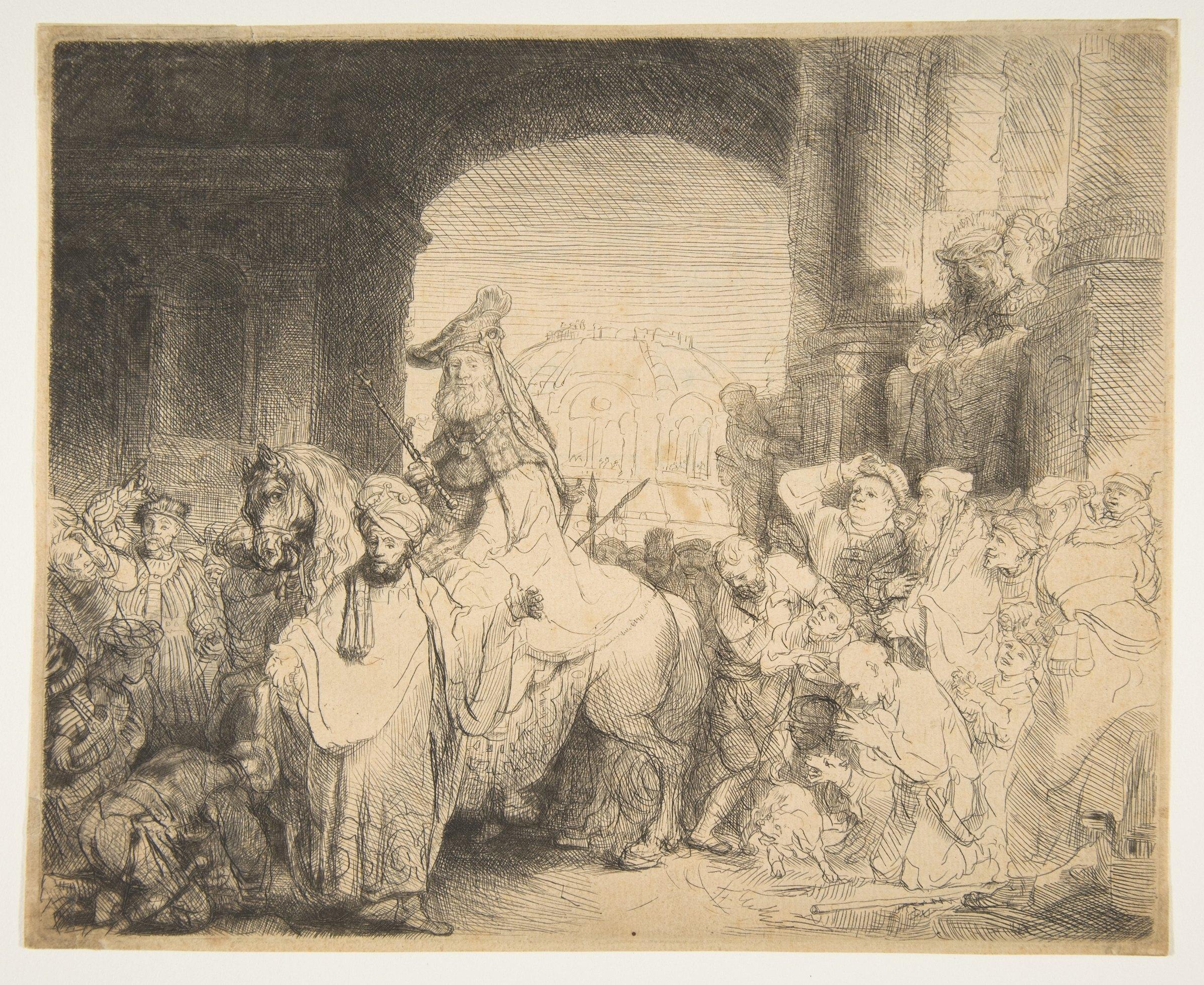
Asked how the king should honour a man, Haman described a royal robe and the king's own horse, sure that the man was himself.
For everyone who exalts himself will be humbled, and the one who humbles himself will be exalted.”
- Books
- Luke, Esther, 2 Samuel, John, Matthew, Hebrews
- Hold in memory
- Luke 14:11
Summary
In the world of the Bible honour was given and taken in front of others: at a feast, in a city square, at a king's court. Jesus told the proud that God would bring them low and the humble that He would raise them. Modern study of that world has turned on one pair of words, and its critics ask how far the pair reaches.
- Jesus named the love of praise from one another as a bar to faith in John 5:44.
- Aristotle and Ben Sira wrote lists of honour's marks and of shame's proper objects.
- Jerome Neyrey and David deSilva read the New Testament through honour and shame.
- Michael Herzfeld and Zeba Crook question the reach and the age of the model.
Honour Given in Public
Jesus watched guests pick their seats at a meal and answered with a parable of a wedding feast.
The question here is how honour was won and lost among the Bible's peoples, and how far the scholars' account of it holds.
But when you are invited, go and sit in the last place, so that your host will come and tell you, ‘Friend, move up to a better place.’ Then you will be honored in front of everyone at the table with you.The rule rests on the host's judgment, which no guest can seize for himself.
So many we must give place toMatthew Henry
“Note, It ought to check our high thoughts of ourselves to think how many there are that are more honourable than we, not only in respect of worldly dignities, but of personal merits and accomplishments. Instead of being proud that so many give place to us, it should be humbling to us that there are so many that we must give place to.”
Matthew Henry · Commentary on the Whole Bible · on Luke 14:8 to 9Puritan
The Model and Its Critics in Their Dates
Nine works built the model and tested it.
Anthropologists set out the model and questioned it within fifteen years, and biblical scholars applied it and tested it in the works dated here.
To scale: 9 of 9 stops dated; a mark that would lie on another stands in a lane under the axis.
- J. G. Peristiany, editor, Honour and Shame: The Values of Mediterranean Society1965 ADThe archive.org catalogue record of the London edition
- Michael Herzfeld, Honour and Shame: Problems in the Comparative Analysis of Moral Systems1980 ADMan, new series, volume 15
- Unni Wikan, Shame and Honour: A Contestable Pair1984 ADMan, new series, volume 19
- Jerome H. Neyrey, Honor and Shame in the Gospel of Matthew1998 ADThe publisher's record, Westminster John Knox
- F. Gerald Downing, Honor among Exegetes1999 ADThe Catholic Biblical Quarterly, volume 61
- David A. deSilva, Honor, Patronage, Kinship and Purity2000 ADThe Open Library record, InterVarsity Press
- Bruce J. Malina, The New Testament World, third edition2001 ADThe publisher's record, Westminster John Knox
- Louise J. Lawrence, An Ethnography of the Gospel of Matthew2003 ADThe publisher's record, Mohr Siebeck
- Zeba A. Crook, Honor, Shame, and Social Status Revisited2009 ADThe Journal of Biblical Literature, volume 128
A timeline of nine works, each row naming the record that fixes its date.
Bruce J. Malina, The New Testament World, third edition, Louise J. Lawrence, An Ethnography of the Gospel of Matthew, Zeba A. Crook, Honor, Shame, and Social Status Revisited
Honour Taken and Given in the Stories
Esther 6 and 2 Samuel 10 tell of honour and shame done to a man's body and dress.
So Haman took the robe and the horse, arrayed Mordecai, and paraded him through the city square, crying out before him, “This is what is done for the man whom the king is delighted to honor!” Then Mordecai returned to the king’s gate. But Haman rushed home, with his head covered in grief.Each man's place after the ride shows who had gained and who had lost.
So Hanun took David’s servants, shaved off half of each man’s beard, cut off their garments at the hips, and sent them away. When this was reported to David, he sent messengers to meet the men, since they had been thoroughly humiliated. The king told them, “Stay in Jericho until your beards have grown back, and then return.”The shame lay in being seen, so the cure David chose was time spent out of sight.
The man whom the king delights to honourMatthew Henry
“But how is he thunderstruck when the king bids him not to order all this to be done, but to do it himself to Mordecai the Jew, the very man he hated above all men and whose ruin he was now designing! Now, it is to no purpose to think of moving any thing to the king against Mordecai when he is the man whom the king delights to honour.”
Matthew Henry · Commentary on the Whole Bible · on Esther 6:10Puritan
The beard in the EastJamieson, Fausset and Brown
“Besides, a knowledge of the extraordinary respect and value which has always been attached, and the gross insult that is implied in any indignity offered, to the beard in the East, will account for the shame which the deputies felt, and the determined spirit of revenge which burst out in all Israel on learning the outrage.”
Jamieson, Fausset & Brown · Commentary Critical and Explanatory on the Whole Bible · on 2 Samuel 10:4Reformed
Glory From One Another or From God
Jesus set the praise of people against the glory that comes from God, in John and in Matthew.
How can you believe if you accept glory from one another, yet do not seek the glory that comes from the only God?Jesus makes the question of honour a question of faith.
Nevertheless, many of the leaders believed in Him; but because of the Pharisees they did not confess Him, for fear that they would be put out of the synagogue. For they loved praise from men more than praise from God.John records rulers who believed and kept silent for fear of the synagogue.
So when you give to the needy, do not sound a trumpet before you, as the hypocrites do in the synagogues and on the streets, to be honored by men. Truly I tell you, they already have their full reward.Jesus warns that giving done to be honoured by men has its full reward already.
Honours from menCyril of Alexandria
“He accuses the Pharisees of love of rule and of prizing honours from men, covertly hinting that they do exceeding ill, in unadvisedly putting the diseases of their own soul upon God Who can by no means know disease. Next He says that they, fast held by vain glory, thereby lose the fairest prize, meaning faith in Him: whereof Paul too speaketh clearly to us: for if (says he) I were yet pleasing men, I should not be Christ's servant.”
Cyril of Alexandria · Commentary on the Gospel of John, Book 3 · on John 5:44Patristic
Aristotle and Ben Sira on Honour and Shame
A Greek philosopher and the book of Sirach set down what honour consisted of and what to be ashamed of.
Aristotle writes in the Rhetoric that "Honour is the token of a man's being famous for doing good". He lists its parts, among them sacrifices, privileges, grants of land, front seats at civic celebrations and statues (Rhetoric 1.5, Roberts's translation).
Ben Sira, whose book stands in the Apocrypha of the King James Version, gives a list of things to be ashamed of. It opens, "Be ashamed of whoredom before father and mother: and of a lie before a prince and a mighty man" (Sirach 41:17). His next list names things not to be ashamed of, with the law of the Most High first (Sirach 42:1 to 2).
How Far the Model Reaches
Scholars have used the model as a key, called its words too broad, or kept it and asked for tests text by text.
Honour and shame as values of the Mediterranean worldJ. G. Peristiany, Julian Pitt-Rivers, Jerome H. Neyrey and David A. deSilva
Peristiany's volume carried Julian Pitt-Rivers's essay Honour and Social Status. Cross and Uskul quote his definition of honour from page 21. It is "the value of a person in his own eyes, but also in the eyes of his society".
Neyrey's study of Matthew, in its publisher's words, "clarifies what praise, honor, and glory meant to Matthew and his audience". DeSilva's book, its catalogue says, reads the personhood of early Christians as "connected with group values".
The objection: Lawrence's publisher says she finds that New Testament worlds need not "submit to a unitary Mediterranean social script".
The two words are too broad for many systemsMichael Herzfeld and Unni Wikan
Herzfeld argued in 1980 that "'honour' and 'shame' are inefficient glosses on a wide variety of indigenous terminological systems". Unni Wikan's article of 1984 questions the pairing in its title, Shame and Honour: A Contestable Pair.
The objection: Luke 14:10 and 2 Samuel 10:5 speak of honour and humiliation in their own words, so the pair answers to the texts.
Keep the model and test it text by textF. Gerald Downing and Zeba A. Crook
Downing's abstract treats honour and shame as one conclusion among several, dominant only where a text shows it. Crook wrote that the model "is starting to show signs of its age". He asks for changes "that would increase its heuristic power and longevity".
The objection: Neyrey reads a whole Gospel through praise, honour and glory, so the values frame the book from its first chapter to its last.
The Shame He Scorned
Hebrews and Philippians close the subject at the cross, where the deepest humbling came before the highest name.
And being found in appearance as a man, He humbled Himself and became obedient to death—even death on a cross. Therefore God exalted Him to the highest place and gave Him the name above all names,Paul sets a death on a cross beside the name above all names, the rule of Luke 14:11 kept in Christ.
Let us fix our eyes on Jesus, the author and perfecter of our faith, who for the joy set before Him endured the cross, scorning its shame, and sat down at the right hand of the throne of God.Hebrews calls the reader to look to the One who bore that shame and now sits at God's right hand.
Sources
Scripture is the Berean Standard Bible.
- The King James Version, Apocrypha, Sirach 41:17 and 42:1 to 2.
- Aristotle, Rhetoric, book 1, chapter 5, translated by W. Rhys Roberts.
- J. G. Peristiany, editor, Honour and Shame: The Values of Mediterranean Society (London: Weidenfeld and Nicolson, 1965), with Julian Pitt-Rivers, Honour and Social Status, pages 19 to 78.
- Cross and Uskul, a chapter of 2022 on cultures of honor, quoting Pitt-Rivers (1965), page 21; quoted at fifty words or fewer.
- Bruce J. Malina, The New Testament World: Insights from Cultural Anthropology, third edition, revised and expanded (Louisville: Westminster John Knox, 2001)
- Jerome H. Neyrey, Honor and Shame in the Gospel of Matthew (Louisville: Westminster John Knox, 1998); the publisher's description quoted at fifty words or fewer.
- David A. deSilva, Honor, Patronage, Kinship and Purity (InterVarsity Press, 2000); the catalogue description quoted at fifty words or fewer.
- Michael Herzfeld, Honour and Shame: Problems in the Comparative Analysis of Moral Systems, Man, new series, 15 (1980): 339 to 351, doi 10.2307/2801675; the abstract quoted at fifty words or fewer.
- Unni Wikan, Shame and Honour: A Contestable Pair, Man, new series, 19 (1984), from page 635, doi 10.2307/2802330; cited by its title.
- F. Gerald Downing, Honor among Exegetes, The Catholic Biblical Quarterly 61 (1999): 53 to 73; its published abstract.
- Zeba A. Crook, Honor, Shame, and Social Status Revisited, Journal of Biblical Literature 128 (2009): 591 to 611, doi 10.2307/25610205; quoted at fifty words or fewer.
- Louise J. Lawrence, An Ethnography of the Gospel of Matthew: A Critical Assessment of the Use of the Honour and Shame Model in New Testament Studies (Tübingen: Mohr Siebeck, 2003); the publisher's summary quoted at fifty words or fewer.
- Matthew Henry on Luke 14:8 to 9 and Esther 6:10; Jamieson, Fausset and Brown on 2 Samuel 10:4; Cyril of Alexandria on John 5:44.
Keep Studying
In this value5
Go further2
Trials of life1