
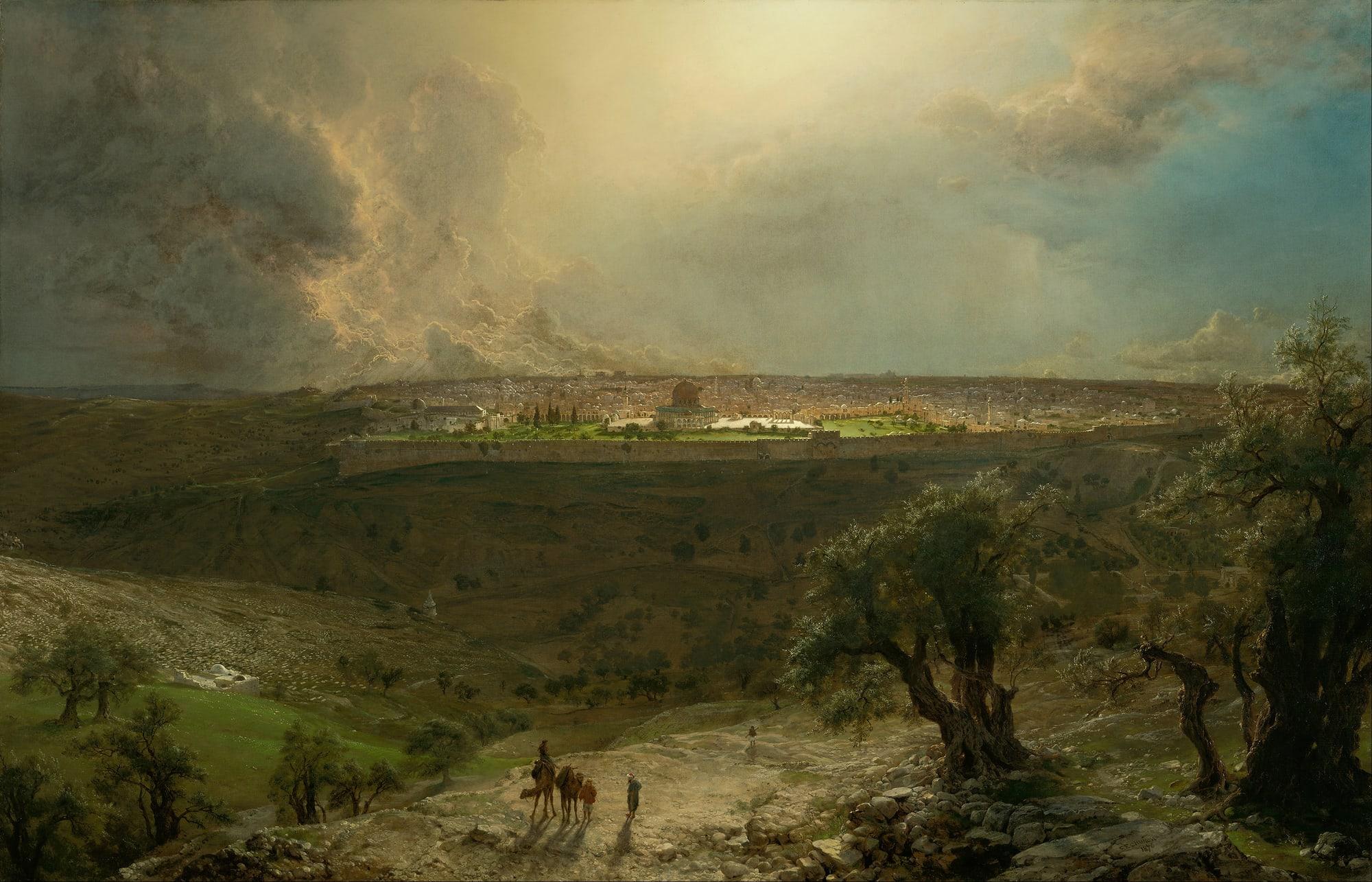
Frederic Edwin Church, Jerusalem from the Mount of Olives, 1870. Public domain.
2 Samuel 15:30 · Place · Featured Study
Mount of Olives
The Mount of Olives is the ridge east of Jerusalem where Jesus taught, prayed and ascended.
But David continued up the Mount of Olives, weeping as he went up. His head was covered, and he was walking barefoot. And all the people with him covered their heads and went up, weeping as they went.
- Today
- Jebel et-Tur
- Region
- East of Jerusalem, across the Kidron Valley
- First named
- 2 Samuel 15:30 “But David continued up the Mount of Olives,…”
- Last named
- Acts 1:12 “…returned to Jerusalem from the Mount of Olives,…”
At the summit, where he used to worship God, David met his friend Hushai with his robe torn and dust on his head.
Summary
The Kidron Valley lies between the ridge and the city. The road to Bethany runs over it.
- Ziba met David just past the top with donkeys, bread, raisins and wine (2 Samuel 16:1).
- Bethphage and Bethany stood at the mount, on the road Jesus took into the city (Mark 11:1).
- The Berean text names the Mount of Olives in 14 verses, 2 of them in the Old Testament.
David on the Ascent
Absalom's revolt sent David out of the city over this ridge, and Scripture first names the mount on that road.
This study asks where the Mount of Olives stands, what Scripture records on it and how far it lay from the city. It sets the mount on an atlas plate, follows it from Solomon to the apostles and weighs where the ascension took place.
Adam Clarke, the Methodist commentator, notes that a covered head marked a mourner. It also marked a condemned man, whose face was covered when sentence was passed.
Strong's dictionary glosses the Greek word behind Olivet as an olive orchard, and the Mount of Olives in particular. The word stands 11 times in the Greek New Testament.
The study of David tells the king who fled, and the study of Ittai the Gittite tells of the foreigner who went with him.
The Mount on the Plate
A map of the country round Jerusalem prints the mount and its villages.
The mount stands east of the walled city, with Bethany beyond it and the Mount of Offence to the south.
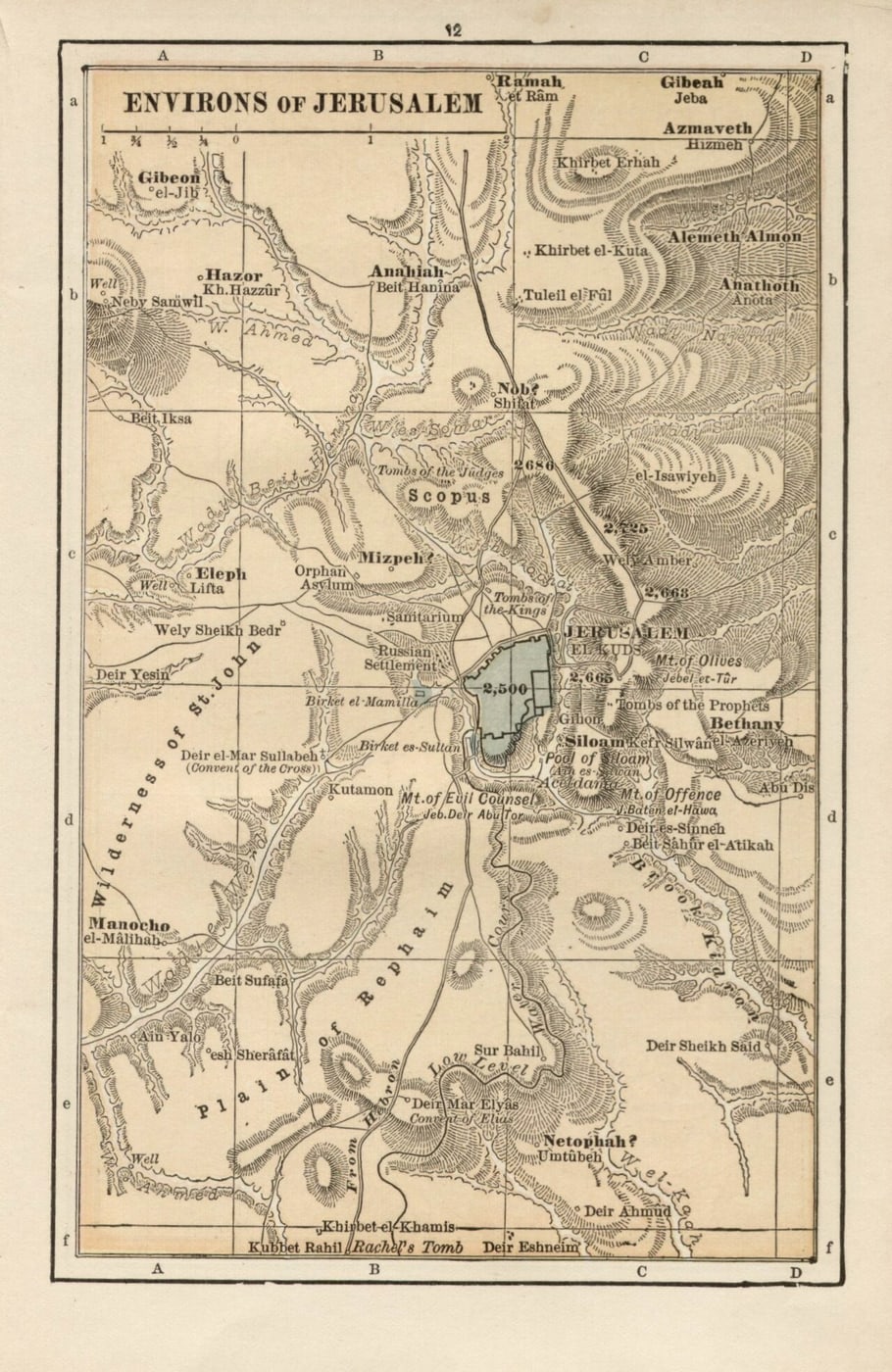
- JerusalemThe whole city was stirred when Jesus entered it from the mount. The plate shades the walled city and prints Jerusalem, El Kuds.Matthew 21:10
- Mount of OlivesThe crowd of disciples began to praise God at the descent from the mount. The plate prints Mt. of Olives, Jebel et-Tur, east of the city.Luke 19:37
- BethanyLuke closes his Gospel with the disciples led out as far as Bethany. The plate prints Bethany, el-Azeriyeh, on the far side of the mount, the easternmost point.Luke 24:50
- Mount of OffenceEaston names one summit the Mount of Corruption for Solomon's high places. The Latin Bible calls it the Mount of Offence, and the plate prints that name south of the Mount of Olives.2 Kings 23:13
John Fulton, Environs of Jerusalem. Public domain; File:John Fulton, Environs of Jerusalem (FL45610940 3950270).jpg.
Four numbered points, each where the plate prints the place, with north at the top. The plate prints a scale in miles and names none of the four with a query.
The study of Gethsemane teaches the garden across the Kidron, and the study of Zion teaches the city on the hills opposite.
The Mount in Scripture, in Order
The ridge appears in Kings and then in every Gospel and in Acts.
Six of the seven moments fall in the Gospels and Acts.
- Solomon's old ageSolomon builds high places for Chemosh and Molech on a hill east of Jerusalem1 Kings 11:7
- The approach to JerusalemJesus sends two disciples ahead from Bethphage on the Mount of OlivesMatthew 21:1
- The last weekJesus sits on the mount opposite the temple, and four disciples come to Him privatelyMark 13:3
- The evenings of that weekJesus teaches at the temple by day and lodges on the mount by nightLuke 21:37
- The night of His arrestThe disciples follow Jesus out to the mount, as was His customLuke 22:39
- The Feast of TabernaclesJesus goes out to the Mount of Olives after teaching at the feastJohn 8:1
- After the ascensionThe apostles return to Jerusalem from the mount, a Sabbath day's journey awayActs 1:12
Seven moments from 1 Kings to Acts in the order of the canon, each with its verse.
The questions of Mark 13:3 to 4 open the Olivet Discourse, the teaching Jesus gave on the mount about the end of the age.
Two studies tell two of these moments whole: the entry into Jerusalem, and the ascension.
How Far from the City
Josephus gives the mount's distance from the city, and Easton its height above it.
In his Antiquities 20.8.6 Josephus sets the mount over against the city at five furlongs. In The Wars of the Jews 5.2.3 the tenth legion camps on the mount six furlongs from Jerusalem. A deep valley he calls Cedron lies between.
M. G. Easton's Bible Dictionary (1897) gives the mount's modern name as Jebel et-Tur, the Mount of the Summit. He puts it about 200 feet above the level of the city.
Now Bethany was near Jerusalem, a little less than two miles away,The village stood farther out than the summit of the mount.
What the Text Leaves Unsaid
The Gospels give Gethsemane a name and a side of the valley, and no more.
Matthew 26:30 and 36 take Jesus out to the Mount of Olives and then to a place called Gethsemane. John 18:1 calls it a garden across the Kidron. None of the four Gospels says where on the slope it lay.
He Wept Over the City
The glory of the LORD paused over this mountain as it left the city, and Jesus wept over the city from the same ridge.
And the glory of the LORD rose up from within the city and stood over the mountain east of the city.Barnes takes this mountain for the Mount of Olives.
As Jesus approached Jerusalem and saw the city, He wept over it and said, “If only you had known on this day what would bring you peace! But now it is hidden from your eyes.Luke sets this lament on the road down from the mount.
Voices on the Mount
Cyril of Jerusalem read David's flight and Zechariah's sign on this mount as pointing to Christ.
Cyril of Jerusalem (died 386)
“Again, after Absalom's rebellion, when David was in flight, with many possible routes before him, he chose to make his escape by the Mount of Olives, as good as invoking in his own mind the Deliverer who should from there ascend into the heavens. And when Shimei cursed him bitterly he said, ‘Let him be.’”
Cyril of Jerusalem · Catechetical Lecture 2:12, 20 · on 2 Samuel 15:30Patristic
“But it might happen that he should sit upon a foal; give us rather a sign where the king who enters will stand. Give us a sign not far from the city, that it may not be unknown to us; give us a sign nearby and clearly visible, that being in the city we may behold the place. Again the prophet answers, saying, ‘That day his feet shall rest upon the Mount of Olives, which is opposite Jerusalem to the east.’ Is it possible for anyone standing within the city not to behold the place?”
Cyril of Jerusalem · Catechetical Lecture 12:11 · on Zechariah 14:4Patristic
Where Did the Ascension Take Place?
Luke names Bethany in his Gospel and the Mount of Olives in Acts. Readers differ on how near the village the event stood.
While He was blessing them, He left them and was carried up into heaven.Luke's Gospel gives the ascension here, and Acts adds the mount.
On the mount, about a mile outJohn Gill and Adam Clarke
John Gill, the Baptist commentator, holds on Luke 24:50 that Luke's Bethany is not the town, which stood fifteen furlongs out. For Gill the ascension took place a Sabbath day's distance from the city, about a mile. Clarke, on Acts 1:12, takes Bethany and Bethphage as names for tracts of the mount as well as for its villages.
The objection: Luke 24:50 says Jesus led them out as far as Bethany, and John 11:18 gives that name to the village.
Nearer the village of BethanyM. G. Easton, Illustrated Bible Dictionary
Easton lists a summit called the Mount of Ascension as the supposed site. From Luke 24:51 to 52 he holds that the event probably took place nearer Bethany.
The objection: Acts 1:12 names the Mount of Olives as the place the apostles walked back from.
In the Same Way
David left the city by this mount and came back as king. Luke sets the ascension on the same ridge. Zechariah names it as the place where the LORD's feet will stand.
“Men of Galilee,” they said, “why do you stand here looking into the sky? This same Jesus, who has been taken from you into heaven, will come back in the same way you have seen Him go into heaven.”The promise was given on the mount itself.
On that day His feet will stand on the Mount of Olives, east of Jerusalem, and the Mount of Olives will be split in two from east to west, forming a great valley, with half the mountain moving to the north and half to the south.Jamieson, Fausset and Brown read this verse with the ascension as His return in person to the same mount.
Zechariah 14 sets this verse within the day of the LORD, when He becomes King over all the earth (Zechariah 14:9).
Sources
Scripture is the Berean Standard Bible.
- American Standard Version (1901)
- James Strong, Exhaustive Concordance of the Bible (1890), Greek dictionary, entry 1638, with the occurrence count of the site's lexicon.
- Adam Clarke, Commentary on the Bible (1832), on 2 Samuel 15:30.
- Adam Clarke, Commentary on the Bible (1832), on Acts 1:12.
- John Gill, Exposition of the New Testament (1746 to 1748), on Luke 24:50.
- Jamieson, Fausset and Brown, Commentary Critical and Explanatory on the Whole Bible (1871), on Ezekiel 11:23.
- Flavius Josephus, Antiquities of the Jews, trans. William Whiston, 20.8.6.
- Flavius Josephus, The Wars of the Jews, trans. William Whiston, 5.2.3.
- M. G. Easton, Illustrated Bible Dictionary (1897), entry Olive, Mount of.
- Albert Barnes, Notes, Explanatory and Practical, on the Old and New Testaments (1832 to 1869), on Ezekiel 11:23.
- Cyril of Jerusalem, Catechetical Lecture 2, on 2 Samuel 15:30.
- Cyril of Jerusalem, Catechetical Lecture 12, on Zechariah 14:4.
Keep Studying
Read it5
Studies7
Doctrines1