
Nob
Summary
The town of the priests near Jerusalem where David ate the showbread, the precedent Jesus cited, and which Saul put to the sword.
- David fled to Nob and asked the priest Ahimelech for bread, receiving the consecrated Bread of the Presence (1 Samuel 21:1-6).
- At Nob, David also took the sword of Goliath, kept there wrapped behind the ephod (1 Samuel 21:9).
- Doeg the Edomite reported David's visit to Saul, who had the priests of Nob killed and the whole town put to the sword (1 Samuel 22:9-19).
- Jesus later cited David's meal at Nob to answer an accusation that His disciples had broken the Sabbath (Matthew 12:3-4; Mark 2:25-26).
On this page
In Scripture
- Verses
- 6
- Books
- 3
Near Nob
- Moriah2.5 km · 1.5 mi S
- Gibeah2.7 km · 1.7 mi N
- Mount of Olives2.7 km · 1.7 mi SE
- Zion2.9 km · 1.8 mi S
- Jerusalem3.9 km · 2.4 mi SW
- Bethany4.2 km · 2.6 mi SE
Straight-line distances, computed from the gazetteer coordinates.
Where it is
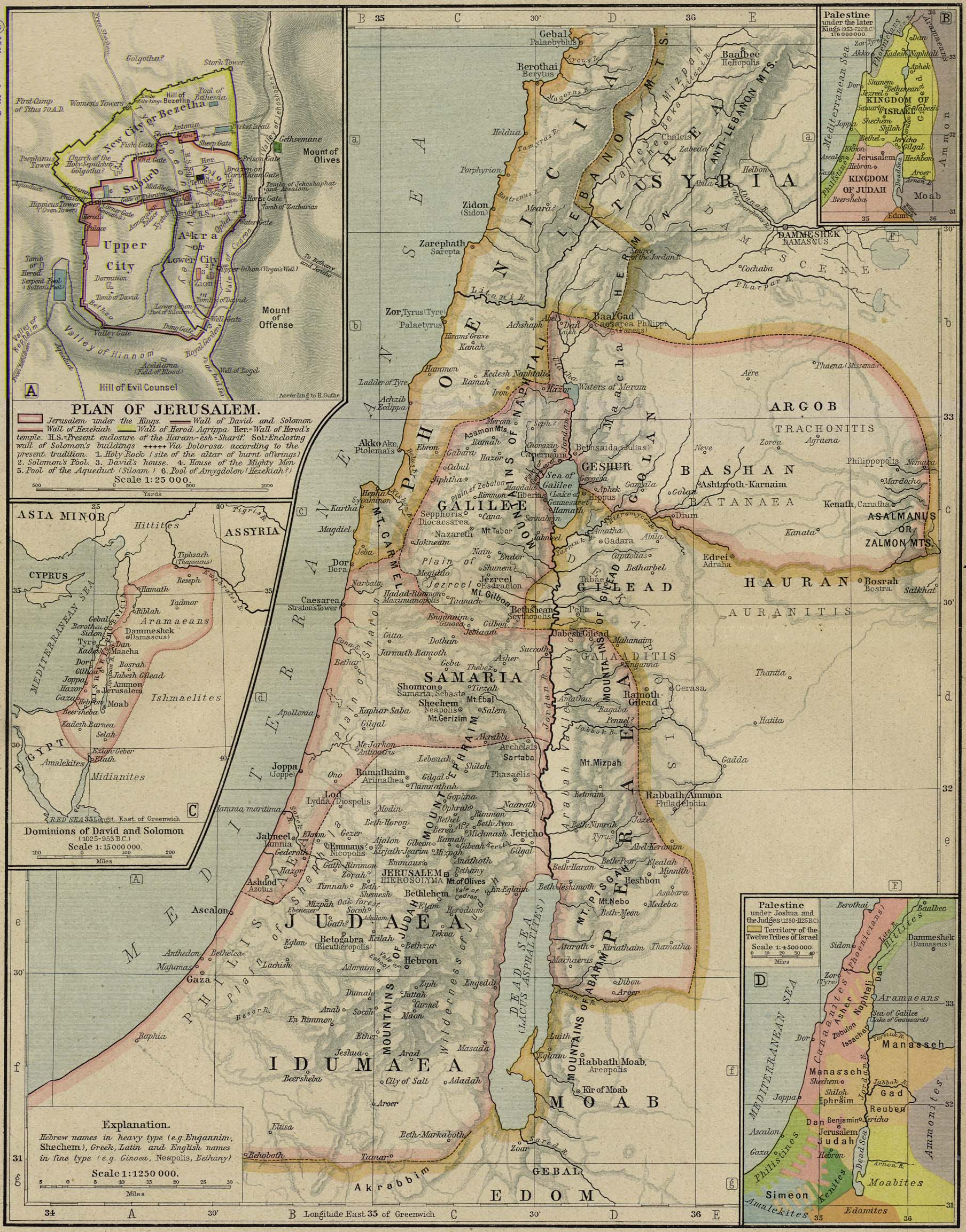
the country around it
- Coordinates
- 31.7996° N, 35.2330° Efind it on the Atlas →
- Region
- Benjamin
- Kind of place
- Town
1 place the record names with Nob, the farthest 2.9 km away
- Located: the gazetteer fixes one site
- ? Proposed: one candidate among several
- A dashed line ends at a place the gazetteer does not fix
Not located: Assyria. The gazetteer records no location for it, so it is not marked.
Why Nob matters
What has been found
the evidence, and where it is disputed
David at Nob, outlined
1 Samuel 21:1-9, in the order it happens
Read 1 Samuel 21:1-9, in the order it happens
- David comes alone to Ahimelech1 Samuel 21:1Then David came to Nob, to Ahimelech the priest. And when Ahimelech met David, he trembled and asked him, “Why are you alone? Why is no one with you?”
- David asks for bread1 Samuel 21:3Now then, what do you have on hand? Give me five loaves of bread, or whatever can be found.”
- Only the consecrated bread is on hand1 Samuel 21:4“There is no common bread on hand,” the priest replied, “but there is some consecrated bread—provided that the young men have kept themselves from women.”
- The Bread of the Presence given1 Samuel 21:6So the priest gave him the consecrated bread, since there was no bread there but the Bread of the Presence, which had been removed from before the LORD and replaced with hot bread on the day it was taken away.
- Doeg the Edomite is present1 Samuel 21:7Now one of Saul’s servants was there that day, detained before the LORD. And his name was Doeg the Edomite, the chief shepherd for Saul.
- The sword of Goliath given1 Samuel 21:9The priest replied, “The sword of Goliath the Philistine, whom you killed in the Valley of Elah, is here; it is wrapped in a cloth behind the ephod. If you want, you may take it. For there is no other but this one.” And David said, “There is none like it; give it to me.”
Doeg's report and the slaughter of the priests, 1 Samuel 22:6-23, are told next, in the timeline below.
The Showbread: the full studyWhat happened here, in order
in the order the canon tells it
- Doeg reports what he saw at Nob1 Samuel 22:9But Doeg the Edomite, who had stationed himself with Saul’s servants, answered: “I saw the son of Jesse come to Ahimelech son of Ahitub at Nob.
- Saul's own guards refuse to strike the priests1 Samuel 22:17Then the king ordered the guards at his side, “Turn and kill the priests of the LORD, because they too sided with David. For they knew he was fleeing, but they did not tell me.” But the king’s servants would not lift a hand to strike the priests of the LORD.
- Doeg kills the priests himself1 Samuel 22:18So the king ordered Doeg, “You turn and strike down the priests!” And Doeg the Edomite turned and struck down the priests himself. On that day he killed eighty-five men who wore the linen ephod.
- Nob, the city of the priests, put to the sword1 Samuel 22:19He also put to the sword Nob, the city of the priests, with its men and women, children and infants, oxen, donkeys, and sheep.
- Abiathar escapes to David1 Samuel 22:20But one of the sons of Ahimelech son of Ahitub escaped. His name was Abiathar, and he fled to David.
- Assyria's march halts at NobIsaiah 10:32Yet today they will halt at Nob, shaking a fist at the mount of Daughter Zion, at the hill of Jerusalem.
- Jesus cites David's meal at NobMatthew 12:3Jesus replied, “Have you not read what David did when he and his companions were hungry?
- Mark's account names "the days of Abiathar"Mark 2:26During the high priesthood of Abiathar, he entered the house of God and ate the consecrated bread, which was lawful only for the priests. And he gave some to his companions as well.”
- Nob resettled after the exileNehemiah 11:32in Anathoth, Nob, Ananiah,
Nob in Scripture
6 verses name it, in 3 books
Open a book to read its mentions here. Text: Berean Standard Bible.
Old TestamentNew Testamentsegment width = share of mentions
Old Testament3 books · 6 mentions
1 Samuel4 mentions
- 1 Samuel 21:1Then David came to Nob, to Ahimelech the priest. And when Ahimelech met David, he trembled and asked him, “Why are you alone? Why is no one with you?”
- 1 Samuel 22:9But Doeg the Edomite, who had stationed himself with Saul’s servants, answered: “I saw the son of Jesse come to Ahimelech son of Ahitub at Nob.
- 1 Samuel 22:11Then the king sent messengers to summon Ahimelech the priest, the son of Ahitub, and his father’s whole family, who were priests at Nob. And all of them came to the king.
- 1 Samuel 22:19He also put to the sword Nob, the city of the priests, with its men and women, children and infants, oxen, donkeys, and sheep.
Nehemiah1 mention
Common questions
Why did David take consecrated bread meant only for priests?
David told Ahimelech he was on an urgent mission for the king and had nothing to eat. Ahimelech had no ordinary bread on hand, only the Bread of the Presence that had just been removed from before the LORD, and gave it to David on the condition that his men had kept themselves ritually clean. Jesus later cited this same act as a precedent for mercy taking priority over a rigid rule.
Who was Doeg the Edomite, and why did he inform on David?
Doeg was an Edomite serving as Saul's chief shepherd, present at Nob the day David came for bread and a weapon, the sword of Goliath, the Philistine David had killed at the Valley of Elah. He later reported what he saw to Saul, who was actively hunting David, and his report led directly to Saul's order against Ahimelech's household.
Why did Saul order the priests killed, and why did his own guards refuse?
Saul was sitting at Gibeah when Doeg's report reached him, and he accused Ahimelech's household of conspiring with David because they had given him food and a weapon. Saul's own guards would not strike the priests of the LORD, so Saul turned to Doeg, who carried out the order himself, killing eighty-five priests and then the rest of the town.
Why does Mark say "the days of Abiathar the high priest" when 1 Samuel 21 names Ahimelech?
Readers differ; the positions are named
1 Samuel 21 names Ahimelech, Abiathar's father, as the priest who met David at Nob. Mark's Gospel places the event in the days of Abiathar the high priest. Readers have proposed that Mark's phrase names an era associated with Abiathar's later fame as high priest under David, rather than claiming Abiathar personally held that office on that exact day, since Abiathar was present at Nob as Ahimelech's son and later became high priest himself. Others read it as a variation in the wording. Neither reading is settled, and this page names the question rather than choosing between them.
What does Jesus's citation of this story mean for the Sabbath question?
Jesus used David's meal at Nob to answer the accusation that His disciples broke the Sabbath by picking grain. He argued that if David could eat consecrated bread in a case of need, and priests can labor in the temple on the Sabbath without guilt, then something greater than the temple was present, and mercy takes priority over a rigid reading of the law. Jesus called Himself Lord of the Sabbath in the same breath.
Sources cited
- OpenBible.info Bible Geocoding: Nobread 2026-08-20The coordinates on this page. Used under CC-BY with attribution to OpenBible.info.
- OT in Context, NobStates that Nob's exact modern identification is uncertain but generally associated with the Mount Scopus area or the village of Shuafat, used for the re-verification pass (2026-09-02, session 7); cited alongside the traditional Ras el-Mesharif/Isawiya identification found in standard Bible geography references.
Keep studying
On this page
Lives that run through it1
Doorway2
Keep this page