
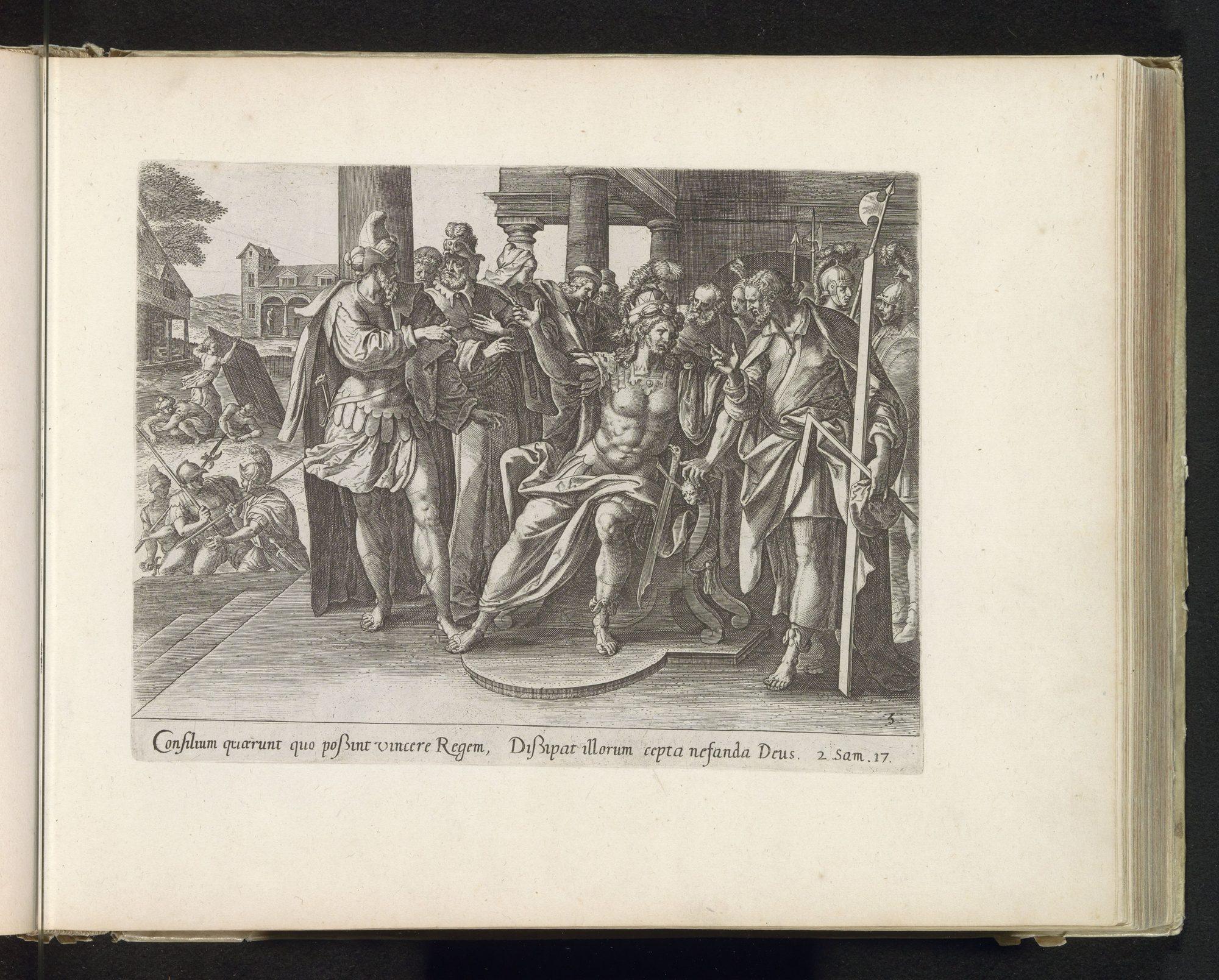
Wierix after Maerten de Vos, Ahithophel and Hushai with Absalom, 1585. Public domain.
2 Samuel 16:15 to 17:23 · Story · Featured Study
Ahithophel and Hushai: The Counsel Duel
Absalom heard two plans for ending David's reign and chose the one that gave David time.
Then Absalom and all the men of Israel said, “The advice of Hushai the Archite is better than that of Ahithophel.” For the LORD had purposed to thwart the good counsel of Ahithophel in order to bring disaster on Absalom.
- Where
- Jerusalem, En Rogel, Bahurim, Giloh
- Who
- Ahithophel, Hushai, Absalom, David
- When
- one night of Absalom's revolt, with David across the Jordan by daybreak
Hushai answered the best adviser in Israel by promising Absalom an army like the sand on the seashore.
Summary
Ahithophel and Hushai had both served David. When Absalom rose against his father, each man gave him a plan for the war, and the two plans did not agree. Absalom took Hushai's plan. Two young men ran with the news to David, and Ahithophel went home to Giloh.
- Two priests' sons hid in a well at Bahurim while Absalom's men searched for them.
- Hushai said David was as fierce as a bear that has lost her cubs.
- One scholar finds a family reason for Ahithophel to turn on David.
Two Advisers Before Absalom
Absalom asked two of his father's advisers how to finish the revolt, and they disagreed.
The Chronicler's roll of David's officials names both advisers in one verse.
Ahithophel was the king’s counselor. Hushai the Archite was the king’s friend.The verse gives each man his title at David's court.
Ahithophel offered to choose the men and lead them himself. The plan pleased Absalom and all the elders of Israel, and still Absalom sent for Hushai to hear what he too would say.
Hushai answered that this time Ahithophel's advice was not sound, and he gave a plan of his own. Hushai then sent the plans of both men to Zadok and Abiathar the priests.
The study of Ittai the Gittite tells the flight from Jerusalem and weighs the ruse David gave Hushai.
The study of Absalom teaches the son who led the revolt.
The Two Plans, and the Night After
The two speeches differ on every point, and messengers carried the result to David.
Ahithophel wanted speed and one death, and Hushai offered size and glory.
| Point | Ahithophel's plan | Hushai's plan |
|---|---|---|
| When | Tonight | After all Israel is gathered |
| The force | Twelve thousand chosen men | All Israel will gather from Dan to Beersheba |
| Who leads | Ahithophel himself | Absalom in person |
| The target | The king alone | No man with David will be left |
| David's state | Weak and weary | A man of war, fierce as a bear robbed of her cubs |
| The picture | The people will come back like a bride to her husband | Israel will fall on him like dew and drag his city into the valley |
The word went from Hushai through the priests and a servant girl to Jonathan and Ahimaaz, and on to David.
- Hushai tells Zadok and Abiathar both plansJerusalem2 Samuel 17:15
- The priests send word not to wait at the fordsJerusalem2 Samuel 17:16
- A servant girl carries the message to Jonathan and AhimaazEn-rogel2 Samuel 17:17
- A young man sees them and tells AbsalomEn-rogel2 Samuel 17:18
- The two climb down into a well, and a woman covers it with grainBahurim2 Samuel 17:19
- She tells the searchers the two have crossed the brookBahurim2 Samuel 17:20
- David and all his people cross before daybreakthe Jordan2 Samuel 17:22
Seven steps of the night in order, each with its place and its verse.
How Hushai Won the Room
Commentators from Josephus to H. P. Smith have explained why the slower plan carried the day.
Albert Barnes reads “this time” as a contrast with the counsel Ahithophel had given before, which Hushai let stand. He holds that the concession gave Hushai an appearance of candour and weight to his dissent.
Jamieson, Fausset and Brown find Hushai's skill chiefly in the general levy he urged with Absalom in command, a proposal that flattered the pride and ambition of the usurper. H. P. Smith adds that the picture of the king marching in the midst of such an army was meant to impress Absalom's imagination. In Smith's reading the speech also hinted that an expedition under Ahithophel could not do as well as one under Absalom.
Josephus, in his Antiquities of the Jews, puts Ahithophel's number at ten thousand, where the Berean text has twelve. He writes that it was God who made Hushai's counsel appear best to Absalom's mind.
Ahithophel's House
H. P. Smith finds in Ahithophel's family a reason for his part in the revolt.
H. P. Smith, in his International Critical Commentary on Samuel, calls Ahithophel the grandfather of Bathsheba and judges that he had a special reason to seek David's destruction. Smith also concludes from the later narrative that Ahithophel was the soul of the rebellion. He suspects that the original text of 2 Samuel 15:12 told how Ahithophel stirred up the conspiracy from Giloh while Absalom held the feast at Hebron.
The study of David's mighty men sets out the roll that names Ahithophel's son, and the study of David and Bathsheba tells the wrong done to her house.
What the Text Leaves Unsaid
The narrator records no word Ahithophel spoke at home, and Hushai drops out of the story.
Second Samuel 17:23 says that Ahithophel put his affairs in order, and it gives no words of his. Josephus has him tell his family what advice he had given and why he would die, a speech 2 Samuel does not contain.
After 2 Samuel 17:15 the narrative does not name Hushai again. First Kings 4:16 names a Baana son of Hushai, in Asher and in Aloth, and the text does not say whether he was this Hushai's son.
The Counsel of the LORD Stands
A proverb and a psalm set the night of the two counsels under the LORD's rule.
There is no wisdom, no understanding, no counsel that can prevail against the LORD.The book of Proverbs names counsel among what fails against the LORD.
The LORD frustrates the plans of the nations; He thwarts the devices of the peoples.The psalm widens the rule from one court to the nations.
Augustine of Hippo, in On Grace and Free Will, held that the counsel was called good because it served Absalom's purpose for the time. He taught that God worked in Absalom's heart to choose another plan, one not to his advantage.
Voices on the Counsel Duel
Matthew Henry compared Ahithophel's plan with two sayings of the Gospels.
Matthew Henry (1662 to 1714)
Commentary on the Whole Bible
Matthew Henry, in his Commentary on the Whole Bible, set Ahithophel's plan to strike the king alone beside the plotters of the Gospels.
“Let that one man die for the people, John xi. Kill the heir, and the inheritance shall be ours, Matt. xxi. But the counsel of them both was turned into foolishness.”
on 2 Samuel 17:1 to 3Puritan
Why Did Ahithophel Hang Himself?
The verse gives one cause, and the commentators read it three ways.
When Ahithophel saw that his advice had not been followed, he saddled his donkey and set out for his house in his hometown. He put his affairs in order and hanged himself. So he died and was buried in his father’s tomb.The narrator gives only what Ahithophel saw and what he did.
He foresaw Absalom's defeat and David's justiceJosephus, Keil and Delitzsch, Adam Clarke and H. P. Smith
Keil and Delitzsch hold that he could foresee Absalom losing his cause for want of his advice. Adam Clarke notes that every step was deliberate, and H. P. Smith that he was convinced the outcome would be failure. Josephus gives the same reason in the speech he sets on Ahithophel's lips.
The objection: the verse names only that his advice had not been followed, and the battle had not yet been fought.
His pride could not bear the slightAlbert Barnes, and Jamieson, Fausset and Brown
Albert Barnes holds that Ahithophel was probably moved by deep mortification at the slight of his rejected counsel. Jamieson, Fausset and Brown name wounded vanity and mortified pride at the loss of his ascendancy.
The objection: Jamieson, Fausset and Brown themselves add a painful conviction that the delay had lost Absalom's cause, so pride is not the whole account.
The justice of God on the plotterMatthew Henry
Matthew Henry reads the death as honour done to the justice of God, the wicked snared in the work of their own hands.
The objection: H. P. Smith notes that Ahithophel was not refused burial in his father's tomb, and finds no sign that the biblical writers treated his death as especially abhorrent.
Books to Read Next
All three works are in the public domain, and each has a free copy to read.
A Critical and Exegetical Commentary on the Books of Samuel
Henry Preserved Smith · 1899
Smith reads Hushai's speech line by line and weighs Ahithophel's part in the revolt.
Read at the Internet ArchiveAntiquities of the Jews, Book 7
Flavius Josephus, translated by William Whiston · about 93
Josephus retells both speeches and Ahithophel's last words to his family in chapter 9.
Read at Project GutenbergBiblical Commentary on the Books of Samuel
C. F. Keil and F. Delitzsch · 1880
Keil explains why Ahithophel could foresee the end once his plan was set aside.
Read at the Internet ArchiveA Sound Plan Set Aside
Ahithophel's plan was sound, and Absalom set it aside for a speech that pleased him.
The counsel of the LORD stands forever, the purposes of His heart to all generations.The psalm sets one counsel above every plan of the night.
Sources
Scripture is the Berean Standard Bible.
- Henry Preserved Smith, A Critical and Exegetical Commentary on the Books of Samuel, International Critical Commentary (New York: Charles Scribner's Sons, 1899), on 2 Samuel 15:12, 15:31, 17:11 to 14 and 17:23.
- Flavius Josephus, Antiquities of the Jews 7.9.6 and 7.9.8, translated by William Whiston.
- C. F. Keil and F. Delitzsch, Biblical Commentary on the Books of Samuel (Edinburgh: T. and T. Clark, 1880), on 2 Samuel 17:23.
- Albert Barnes, Notes, Explanatory and Practical, on the Old and New Testaments (1832 to 1869), on 2 Samuel 17:7.
- Albert Barnes, Notes, Explanatory and Practical, on the Old and New Testaments (1832 to 1869), on 2 Samuel 17:23.
- Jamieson, Fausset and Brown, Commentary Critical and Explanatory on the Whole Bible (1871), on 2 Samuel 17:1 to 11.
- Jamieson, Fausset and Brown, Commentary Critical and Explanatory on the Whole Bible (1871), on 2 Samuel 17:23.
- Adam Clarke, Commentary on the Bible (1832), on 2 Samuel 17:23.
- Matthew Henry, Commentary on the Whole Bible (1710), on 2 Samuel 17:1 to 3.
- Matthew Henry, Commentary on the Whole Bible (1710), on 2 Samuel 17:23.
- Augustine of Hippo, On Grace and Free Will 20.41, dated 430 in its quotation row.
Keep Studying
Studies7
People and groups5
Doctrines1