
1 Samuel 24:6
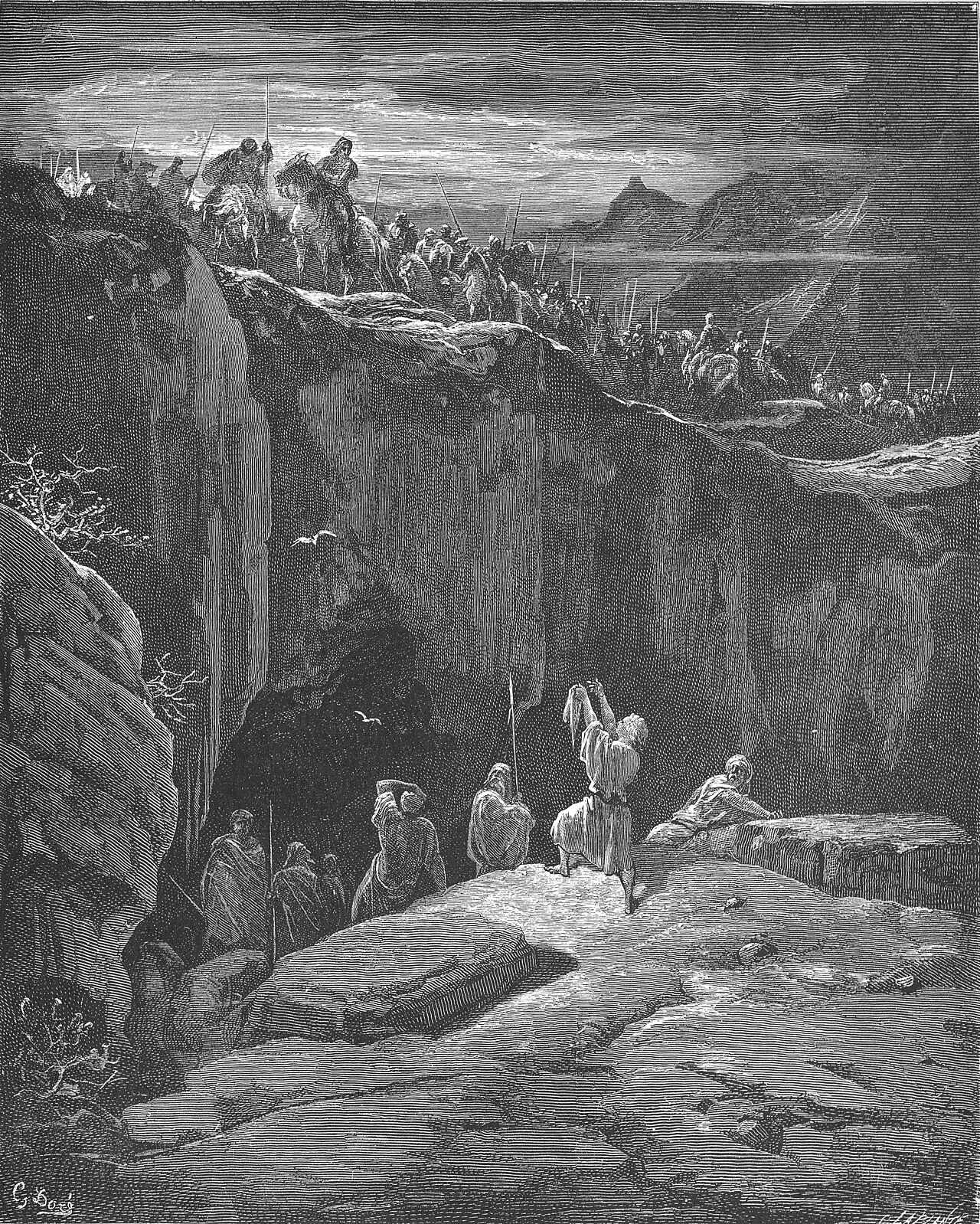
in 1 Samuel 24So he said to his men, “The LORD forbid that I should do such a thing to my master, the LORD’s anointed. May I never lift my hand against him, since he is the LORD’s anointed.”
BSB
The same verse in ASV and KJV ▾
ASV
And he said unto his men, Jehovah forbid that I should do this thing unto my lord, Jehovah’s anointed, to put forth my hand against him, seeing he is Jehovah’s anointed.
KJV
And he said unto his men, The Lord forbid that I should do this thing unto my master, the Lord’s anointed, to stretch forth mine hand against him, seeing he is the anointed of the Lord.
⋯
This verse in 1 Samuel 24
Commentary
9 notes on this verseWhat a virtuous action that was, when David wished rather to spare the king his enemy, though he could have injured him! How useful, too, it was, for it helped him when he succeeded to the throne. For all learned to be faithful to their king and not to seize the kingdom but to fear and reverence him. Thus what is virtuous was preferred to what was useful, and then usefulness followed on what was virtuous.
This site's exposition
to stretch forth mine hand against him
on 1 Samuel 24:6-7
David states the anointed argument at full length for the first time in the book, the Lord forbid that I should do this thing unto my master, the Lord's anointed, seeing he is the anointed of the Lord. The title had entered Scripture as an office at 2:10 and had been fixed on David himself at 16:6, and here he refuses to let his own anointing become grounds for touching Saul's. He does not merely hold his own hand but stays his servants with these words, and Henry calls the restraint a type of Christ, who saved his persecutors rather than striking them down.
The record, by era
The Church Fathers2 voices
It was not without God's influence, you see, that he [David] succeeded in prevailing over those frenzied men [his soldiers who wished to kill Saul]: the grace of God was found on the inspired man's lips, adding a sort of inducement to those words. It was, however, no slight contribution that David also made: since he had formed them in the past, consequently in the critical moment he found them ready and willing. It was not as leader of troops, you see, but as priest he commanded them, and that cave was a church on that occasion: like someone appointed as bishop, he delivered a homily to them, and after this homily he offered a kind of remarkable and unusual sacrifice, not sacrificing a calf, not slaying a lamb, but—what was of greater value than these—he offered to God gentleness and clemency, sacrificing irrational resentment, slaying anger and mortifying the limbs that are on the earth. He acted as victim, priest and altar: everything came from him—the thought that offered gentleness and clemency, the clemency and gentleness and the heart in which they were offered.
As a Christian judge, you must play the part of a loving father, you must show anger for wrongdoing but remember to make allowance for human weakness; do not indulge your inclination to seek vengeance for the vile acts of sinners, but direct your effort to the cure of the sinners' wounds.… There is also that well-known example of forbearance on the part of holy David, when his enemy was delivered into his hands and he spared him, an example which shines with greater luster from the fact that he had power to act otherwise. Do not, then, let your power of punishment make you harsh, when the necessity of inquiry did not shake your spirit of mildness.
The Medieval Church1 voice
And he said to his men, "May the Lord be merciful to me," etc. David is shown to have refrained from killing Saul, despite Saul's most hostile pursuit of him, for two main reasons: first, he remembered him as his lord and as having been …
The Puritans and the Awakening2 voices
): The Lord forbid that I should do this thing. Note, Sin is a thing which it becomes us to startle at, and to resist the temptations to, not only with resolution, but with a holy indignation.
quarantine:debris (2026-07-29) — leading-punctuation+unbalanced-parens
And he said unto his men,....
2 more voices on this verse
The Nineteenth Century2 voices
The Lord’s anointed - However unworthily Saul was now acting, he had been appointed to his high office by God himself, and he could only be removed by the authority which placed him on the throne. Even David, who knew he was appointed to reign in his stead, and whose life Saul had often sought to destroy, did not conceive that he had any right to take away his life; and he grounds the reasons of his forbearance on this - He is my master, I am his subject.
A commentator
Jamieson, Fausset & Brown1802–1910
Commentary Critical and Explanatory on the Whole Bible (1871)
proposed
Behold the day of which the Lord said unto thee, Behold, I will deliver thine enemy into thine hand--God had never made any promise of delivering Saul into David's hand; but, from the general and repeated promises of the kingdom to him, they concluded that the king's death was to be effected by taking advantage of some such opportunity as the present.
The words behind it
20 Hebrew wordsEvery Hebrew word of this verse in the order it stands, with what it means and the door to its own study. The last column counts the times a word stands in the whole Bible: the rarer the word, the more the places it appears belong together.
| Hebrew | Sound | Meaning | Word study | In the Bible |
|---|---|---|---|---|
| וַיֹּ֨אמֶר | vaiyomer | and he said | H559 → | 5305 times |
| לַאֲנָשָׁ֜יו | laanashav | to men his | H582 → | 566 times |
| חָלִ֧ילָה | chalilah | far be it | H2486 → | 21 times |
| לִּ֣י | li | to <the> me | ||
| מֵֽיהוָ֗ה | meyahweh | from Yahweh | H3068 → | 6520 times |
| אִם־ | ʾim- | if | H518 → | 1069 times |
| אֶעֱשֶׂה֩ | ʾeeseh | I will do | H6213 → | 2628 times |
| אֶת־ | ʾet- | <obj.> | H853 → | 10935 times |
| הַדָּבָ֨ר | hadavar | the thing | H1697 → | 1440 times |
| הַזֶּ֤ה | hazeh | <the> this | H2088 → | 1180 times |
| לַֽאדֹנִי֙ | ladoni | to lord my | H113 → | 333 times |
| לִמְשִׁ֣יחַ | limshiach | to [the] [one] anointed of | H4899 → | 39 times |
| יְהוָ֔ה | yahweh | Yahweh | H3068 → | 6520 times |
| לִשְׁלֹ֥חַ | lishloach | by stretching out | H7971 → | 845 times |
| יָדִ֖י | yadi | hand my | H3027 → | 1618 times |
| בּ֑וֹ | bo | on <the> him | ||
| כִּֽי־ | ki- | for | H3588 → | 4482 times |
| מְשִׁ֥יחַ | meshiach | [is] [the] [one] anointed of | H4899 → | 39 times |
| יְהוָ֖ה | yahweh | Yahweh | H3068 → | 6520 times |
| הֽוּא׃ | hu' | he | H1931 → | 1879 times |
וַיֹּ֨אמֶרand he said
vaiyomerH559 →5305 times
לַאֲנָשָׁ֜יוto men his
laanashavH582 →566 times
חָלִ֧ילָהfar be it
chalilahH2486 →21 times
לִּ֣יto <the> me
li
מֵֽיהוָ֗הfrom Yahweh
meyahwehH3068 →6520 times
אִם־if
ʾim-H518 →1069 times
אֶעֱשֶׂה֩I will do
ʾeesehH6213 →2628 times
אֶת־<obj.>
ʾet-H853 →10935 times
הַדָּבָ֨רthe thing
hadavarH1697 →1440 times
הַזֶּ֤ה<the> this
hazehH2088 →1180 times
לַֽאדֹנִי֙to lord my
ladoniH113 →333 times
לִמְשִׁ֣יחַto [the] [one] anointed of
limshiachH4899 →39 times
יְהוָ֔הYahweh
yahwehH3068 →6520 times
לִשְׁלֹ֥חַby stretching out
lishloachH7971 →845 times
יָדִ֖יhand my
yadiH3027 →1618 times
בּ֑וֹon <the> him
bo
כִּֽי־for
ki-H3588 →4482 times
מְשִׁ֥יחַ[is] [the] [one] anointed of
meshiachH4899 →39 times
יְהוָ֖הYahweh
yahwehH3068 →6520 times
הֽוּא׃he
hu'H1931 →1879 times
A shaded row is a word that stands 400 times or fewer in the Bible.
The walk
8 stopsEach card is a verse this one points to, and under it the verses that one points to in turn. Where several paths arrive at the same place, that place is listed first: the text keeps returning to it.
Through
Matthew 5:44But I tell you, love your enemies and pray for those who persecute you,
it leads to
- 1 Peter 3:9
Do not repay evil with evil or insult with insult, but with blessing, because to this you were called so that you may inherit a blessing.
Reached by 2 separate paths from here.
- Romans 12:14
Bless those who persecute you. Bless and do not curse.
- Luke 6:27–28
But to those of you who will listen, I say: Love your enemies, do good to those who hate you,
- Romans 12:20–21
On the contrary, “If your enemy is hungry, feed him; if he is thirsty, give him a drink. For in so doing, you will heap burning coals on his head.”
- Proverbs 25:21–22
If your enemy is hungry, give him food to eat, and if he is thirsty, give him water to drink.
- 1 Peter 3:9
Through
Romans 12:14Bless those who persecute you. Bless and do not curse.
it leads to
- Matthew 5:44
But I tell you, love your enemies and pray for those who persecute you,
- 1 Thessalonians 5:15
Make sure that no one repays evil for evil. Always pursue what is good for one another and for all people.
- Romans 12:21
Do not be overcome by evil, but overcome evil with good.
- Matthew 5:44
About 1 Samuel
This page draws on Adam Clarke, Commentary on the Bible; Ambrose of Milan, On the Duties of the Clergy 3.9.60; Augustine of Hippo, LETTER 133; Bede, Commentary on Samuel; Jamieson, Fausset & Brown, Commentary Critical and Explanatory on the Whole Bible; John Chrysostom, HOMILIES ON DAVID AND SAUL 2; John Gill, Exposition of the Old Testament (1748-1763) and Matthew Henry, Commentary on the Whole Bible.