
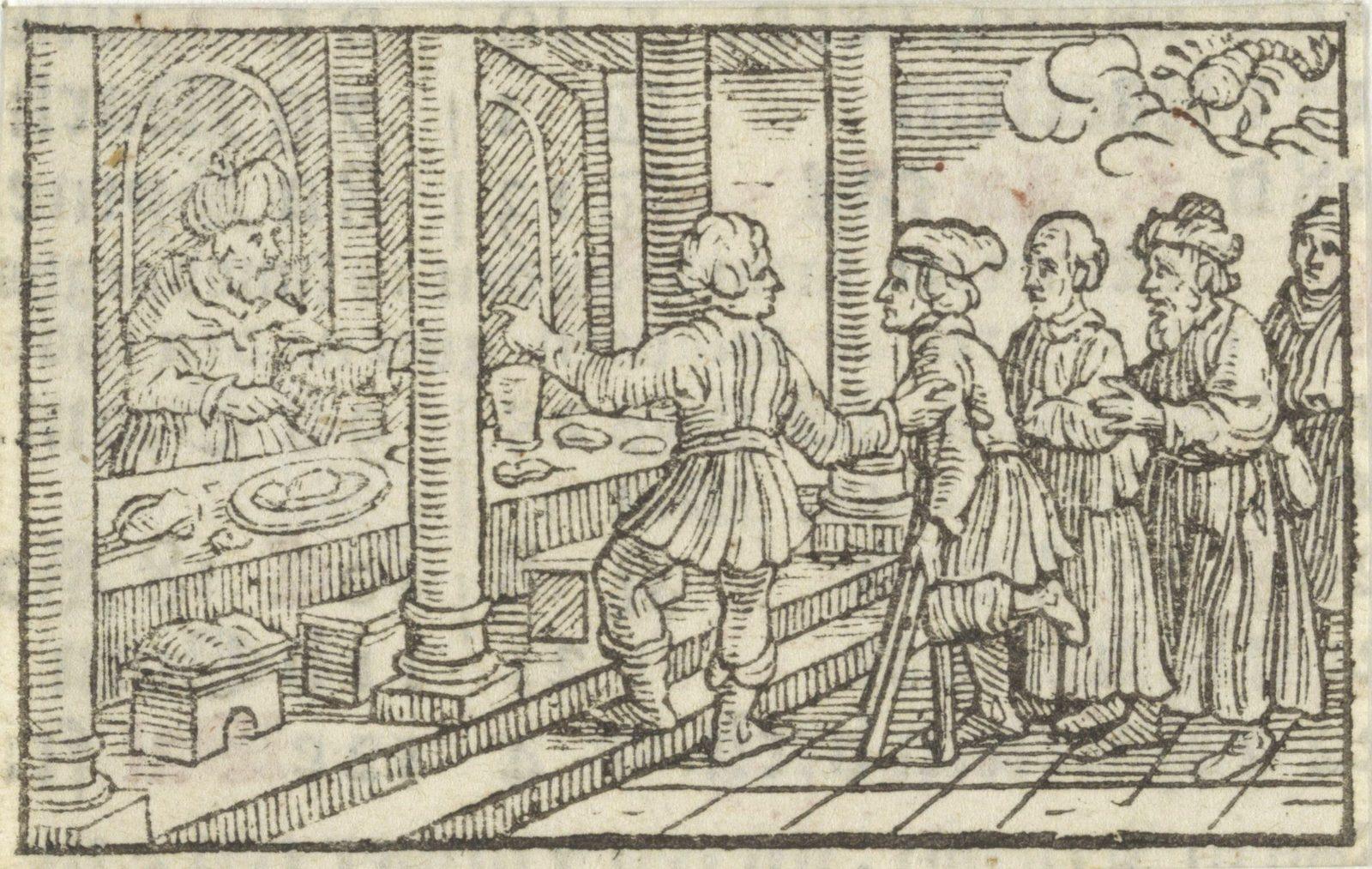
Anonymous Dutch woodcut, David and the Son of Jonathan, 1600 to 1699. Public domain.
2 Samuel 4 to 2 Samuel 21 · Person · Featured Study
Mephibosheth
His son Mica carried the line of Saul and Jonathan into the genealogies of Chronicles.
And Mephibosheth said to the king, “Instead, since my lord the king has safely come to his own house, let Ziba take it all!”
- Family
- father: Jonathan son of Saul; grandfather: Saul; uncle: Ish-bosheth; son: Mica
- Places
- Jezreel, Jerusalem
- First named
- 2 Samuel 4:4 “…became lame. His name was Mephibosheth.”
- Last named
- 1 Chronicles 9:40 “The son of Jonathan: Merib-baal, who was the…”
From the day David fled Jerusalem until the day he came home, Jonathan's son did not wash his clothes.
Summary
Mephibosheth was the son of Jonathan and the grandson of King Saul. He was lamed at the age of five and grew up in the house of Machir at Lo-debar. David brought him to Jerusalem for Jonathan's sake. His servant Ziba accused him during Absalom's revolt, and the king's ruling at the Jordan left the two men to share his land.
- His son is Mica in 2 Samuel and Micah in Chronicles.
- Ziba's household worked Saul's land for him while he lived in Jerusalem.
- The Greek version gives his answer at the Jordan in other words, as H. P. Smith notes.
Where Mephibosheth Stands in Scripture
Second Samuel gives him one name and Chronicles another.
The name Mephibosheth stands in thirteen verses, all in 2 Samuel, and it belongs to two men: Jonathan's son and a son of Saul by Rizpah.
Rashi, in his commentary on 2 Samuel 4:4, reads the notice of his lameness as one more step in the loss of the kingdom by Saul's house.
And Jonathan son of Saul had a son who was lame in his feet. He was five years old when the report about Saul and Jonathan came from Jezreel. His nurse picked him up and fled, but as she was hurrying to escape, he fell and became lame. His name was Mephibosheth.The verse stands between Abner's death and Ish-bosheth's, when Saul's house had lost its defenders.
His Life, Turn by Turn
His life runs from Lo-debar to the famine of 2 Samuel 21.
His life moved between Lo-debar, the king's table and the road of Absalom's revolt.
- Brought to the kingfrom Lo-debar2 Samuel 9:5
- Given all the land of SaulJerusalem2 Samuel 9:7
- Eats at the king's table, with his young son MicaJerusalem2 Samuel 9:12
- Accused by Ziba of waiting for the kingdombeyond the summit2 Samuel 16:3
- Loses all he owns to Ziba by the king's wordbeyond the summit2 Samuel 16:4
- Goes down to meet the king on his returnfrom Jerusalem2 Samuel 19:24 to 25
- Told to divide the land with Zibaat the king's return2 Samuel 19:29
- Spared when seven of Saul's descendants are handed overJerusalem2 Samuel 21:7
Four of the eight turns fall in 2 Samuel 16 and 19, in Absalom's revolt and the king's return.
Told to divide the land with Ziba, Spared when seven of Saul's descendants are handed over
The Heir of a Fallen House
His story runs from 2 Samuel 4 to 2 Samuel 21.
After his nurse's flight, each turn of Mephibosheth's story came from a stronger man: a king, a servant, or the men who demanded Saul's descendants.
The flight from Saul's house2 Samuel 4:4; C. F. Keil
Sent for from Lo-debar2 Samuel 9
David asked for anyone left of Saul's house to whom he could show kindness for Jonathan's sake, and Ziba named Jonathan's son.
Ziba's word in the revolt2 Samuel 16:1 to 4; Matthew Henry
“Where is your master’s grandson?” asked the king. And Ziba answered, “Indeed, he is staying in Jerusalem, for he has said, ‘Today, the house of Israel will restore to me the kingdom of my grandfather.’”Ziba spoke these words to David on the day he fled from Absalom.
Matthew Henry, in his Commentary on the Whole Bible, writes that Ziba was not content to manage his master's estate and wanted to own it. David gave it to him on the spot.
At the king's return2 Samuel 19:24 to 30; Albert Barnes
“My lord the king,” he replied, “because I am lame, I said, ‘I will have my donkey saddled so that I may ride on it and go with the king.’ But my servant Ziba deceived me, and he has slandered your servant to my lord the king. Yet my lord the king is like the angel of God, so do what is good in your eyes.This is the only account he gives of why he stayed behind.
Albert Barnes answers from the donkeys Ziba brought to the king in 2 Samuel 16:1.
“What appears to have happened is, that when Mephibosheth ordered Ziba to saddle the donkeys and ride with him to join David, Ziba left him under pretence of obeying, but instead laded the donkeys with provisions, and went off alone with them, thus making it impossible for Mephibosheth to follow.”
Albert Barnes · Notes, Explanatory and Practical, on the Old and New Testaments (1832-1869) · on 2 Samuel 19:26Evangelical
Spared for the oath2 Samuel 21:1 to 9; Rashi
Now the king spared Mephibosheth son of Jonathan, the son of Saul, because of the oath before the LORD between David and Jonathan son of Saul.Saul had broken Israel's oath to the Gibeonites, and the famine of 2 Samuel 21:1 came from it.
Rashi, drawing on the Talmud's tractate Yevamot, explains that the king prayed for mercy on Mephibosheth so that the ark would not hold him back when Saul's descendants passed before it.
A Lame Son of a Royal House
Commentators read his lameness as a bar to the throne.
Jamieson, Fausset and Brown, in their Commentary Critical and Explanatory, read the notice of his lameness as the reason he was held unfit to reign. Adam Clarke wrote on 2 Samuel 9:13 that he was fit for no public office, and that the king treated him with the utmost respect.
John Wesley, in his Explanatory Notes, judged that his friends may have kept him hidden for fear David would cut him off, as princes commonly did.
The Family of Mephibosheth
His family runs from his grandfather Saul to his grandsons.
Saul's son by Rizpah bore the same name as Jonathan's son.
Generation 1
- SaulHis grandfather, the first king of Israel
Generation 2
- JonathanHis father, who fell with Saul
- Ish-boshethHis uncle, king of Israel after Saul
- Mephibosheth son of RizpahSaul's son who bore the same name
Generation 3
- MephiboshethJonathan's son, called Merib-baal in Chronicles
Generation 4
- MicaHis young son when he came to David
Generation 5
- Pithon, Melech, Tarea and AhazThe sons of Mica
Chronicles names the four sons of Mica in 1 Chronicles 8:35.
The Places of His Life
Three places mark his life, from Jezreel to Jerusalem.
He grew up away from the court and lived the rest of his life in the king's city.
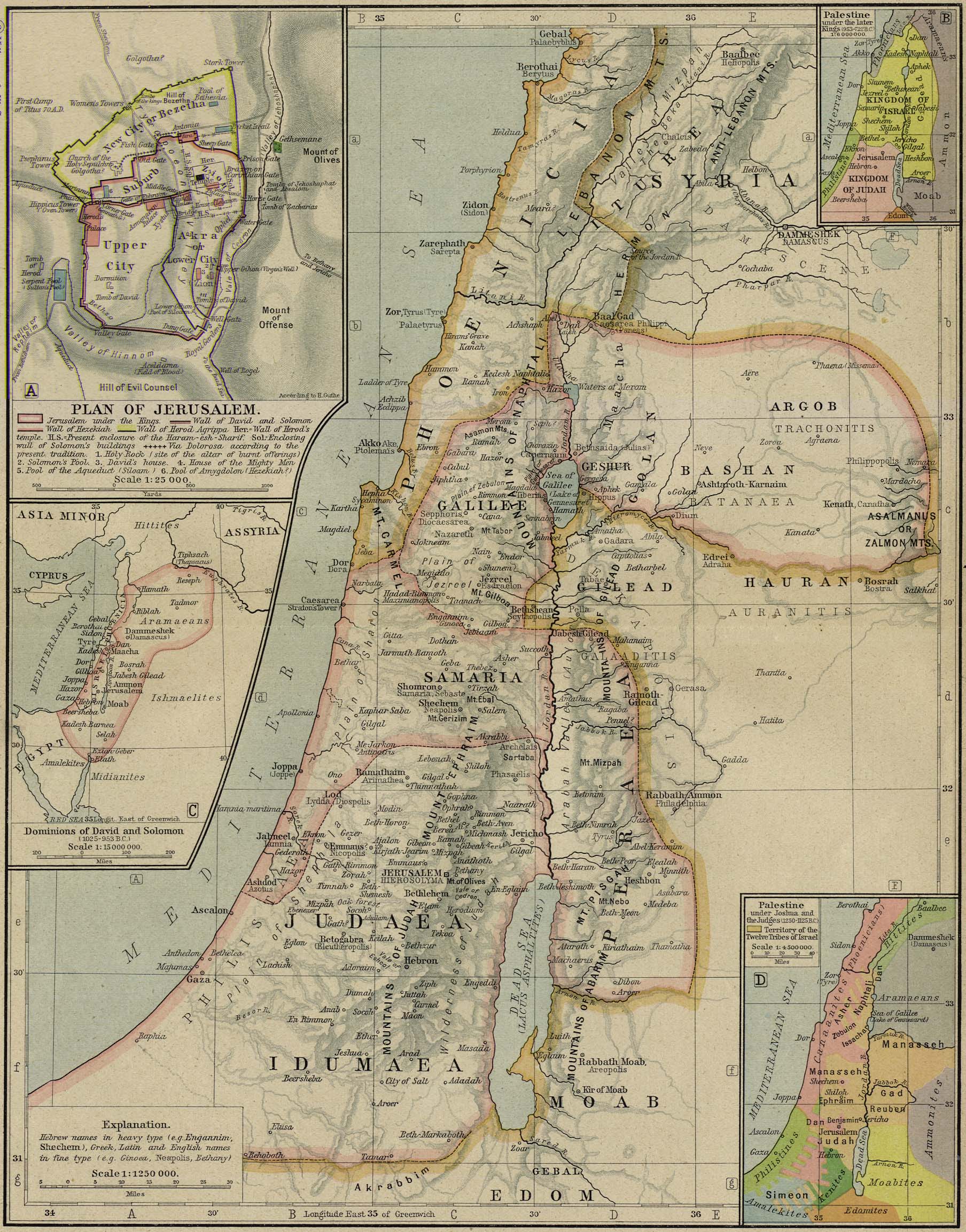
- 1Jezreel, Saul's army camped by its spring before the battle in which he fell. 1 Samuel 29:1
- 2Lo-debar, He lived there until David sent for him. 2 Samuel 9:5
- 3Jerusalem, He stayed in the city when David fled from Absalom. 2 Samuel 16:3
Not placed: Lo-debar (2).
Base map: Reference map of ancient Palestine, Rand McNally reference map (1926), public domain. Each place stands at its place page's coordinates, set on the plate by Jerusalem and Damascus, as the plate prints them.
Machir son of Ammiel, who had sheltered him, later fed David's men at Mahanaim.
Questions His Life Raises
Three questions answered from the text and its readers
Why does Chronicles call him Merib-baal?1 Chronicles 9:40; H. P. Smith; Adam Clarke
The son of Jonathan: Merib-baal, who was the father of Micah.H. P. Smith, in his Critical and Exegetical Commentary on the Books of Samuel, holds that Merib-baal is the true form and that the text of Samuel changed it on purpose. Adam Clarke explains the change: Israel came to detest the name Baal and put bosheth, shame, in its place.
Which Mephibosheth was handed to the Gibeonites?2 Samuel 21:7 to 9; John Wesley
But the king took Armoni and Mephibosheth, the two sons whom Rizpah daughter of Aiah had borne to Saul, as well as the five sons whom Merab daughter of Saul had borne to Adriel son of Barzillai the Meholathite.Did he hope to be given his grandfather's kingdom?2 Samuel 16:3 and 2 Samuel 19:24; Jamieson, Fausset and Brown; Albert Barnes
Jamieson, Fausset and Brown grant that such a hope could have arisen while David's house was at war with itself, and they find Ziba's story plausible. Albert Barnes writes that no one can say whether Mephibosheth was wholly guiltless.
Adam Clarke answers that his mourning for the absent king refuted the charge.
What the Text Leaves Unsaid
Four things the text does not tell about him
The text names no wife of Mephibosheth and no mother of Mica. It gives no age for him when David sent for him, and it records no death or burial.
How Scripture Reads Him
Matthew Henry gives a reason why Chronicles names the descendants of Jonathan.
The list in 1 Chronicles 8 runs from Saul through Jonathan and Merib-baal to the grandsons of Ulam. A second list, in 1 Chronicles 9, ends where the account of Saul's death begins.
Ulam was his firstborn, Jeush second, and Eliphelet third. The sons of Ulam were mighty men of valor, archers, and they had many sons and grandsons—150 in all. All these were the descendants of Benjamin.These archers stand at the far end of the line that began with Mephibosheth's son.
Albert Barnes counts Ulam's grandsons in the thirteenth generation from Jonathan and places the list near the time of Hezekiah. Henry sets this line beside the other sons of Saul.
“It is common in all languages to put sons for grandsons and other descendents, much more in the scanty language of the Hebrews. After Saul, divers of his sons are named, but the posterity of none of them, save Jonathan only, who was blessed with numerous issue and those honoured with a place in the sacred genealogies for the sake of his sincere kindness to David.”
Matthew Henry · Commentary on the Whole Bible · on 1 Chronicles 8:33Puritan
David's Ruling at the Jordan
Readers differ on what the king's order about the land did.
The king replied, “Why say any more? I hereby declare that you and Ziba are to divide the land.”In 2 Samuel 16:4 the king had given Ziba everything that belonged to Mephibosheth.
A compromise between two accountsAlbert Barnes
Albert Barnes holds that David, unable to get to the bottom of the story and perhaps unwilling to make an enemy of Ziba, split the land and so took back part of his hasty gift.
The objection is that the verse gives no reason for the order, and Barnes supplies one the text does not state.
The first grant restoredMatthew Henry and Adam Clarke
Matthew Henry reads the order as the first grant of 2 Samuel 9:10 restored: the land was Mephibosheth's, and Ziba was to farm it. Adam Clarke agrees that the order put things back as they had stood and cancelled the gift to Ziba.
The objection is that the king's word is divide, and Clarke himself grants that Ziba kept too much for what he had done.
A reward for Ziba's zealH. P. Smith
H. P. Smith holds that Ziba's zeal in serving the king was the reason for the order, and that David may have suspected Mephibosheth had been slow to follow him.
The objection is that the narrator reports his mourning in 2 Samuel 19:24 before either man speaks, and Barnes reads that report in his favour.
Books to Read Next
Both works are in the public domain, and each has a free copy to read.
Biblical Commentary on the Books of Samuel
C. F. Keil and F. Delitzsch · 1880
Keil explains both forms of his name in his note on 2 Samuel 4:4.
Read at the Internet ArchiveA Critical and Exegetical Commentary on the Books of Samuel
Henry Preserved Smith · 1899
Smith reads him as Merib-baal and comments on his chapters verse by verse.
Read at the Internet ArchiveA Place at the King's Table
Mephibosheth called himself a dead dog and was kept at the king's table for the sake of a covenant he had not made. Jesus told of a feast to which the lame are brought in.
The servant returned and reported all this to his master. Then the owner of the house became angry and said to his servant, ‘Go out quickly into the streets and alleys of the city, and bring in the poor, the crippled, the blind, and the lame.’Jesus told this parable at a meal in the house of a leading Pharisee.
Sources
Scripture is the Berean Standard Bible.
- James Strong, Exhaustive Concordance of the Bible, 1890, entries H4648 and H4807.
- C. F. Keil and F. Delitzsch, Biblical Commentary on the Books of Samuel, T. and T. Clark, 1880, p. 308.
- Henry Preserved Smith, A Critical and Exegetical Commentary on the Books of Samuel, T. and T. Clark, 1899, pp. 284 and 365.
- Rashi (1040 to 1105), on 2 Samuel 4:4 and 2 Samuel 21:7, The Metsudah Tanach series, Lakewood, N.J. (CC-BY)
- Matthew Henry, Commentary on the Whole Bible, 1710, on 2 Samuel 16:4, 2 Samuel 19:29 and 1 Chronicles 8:33.
- Albert Barnes, Notes, Explanatory and Practical, on the Old and New Testaments, 1832 to 1869, on 2 Samuel 16:3, 2 Samuel 19:24, 2 Samuel 19:26, 2 Samuel 19:29 and 1 Chronicles 8:40.
- Adam Clarke, Commentary on the Bible, 1832, on 2 Samuel 9:13, 2 Samuel 19:24, 2 Samuel 19:29 and 1 Chronicles 8:34.
- Jamieson, Fausset and Brown, Commentary Critical and Explanatory on the Whole Bible, 1871, on 2 Samuel 4:4 and 2 Samuel 16:3.
- John Wesley, Explanatory Notes upon the Old Testament, 1765, on 2 Samuel 9:1 and 2 Samuel 21:7.
Keep Studying
Read it4
Studies4
People and groups7
Show the next 1 title
Subjects1