
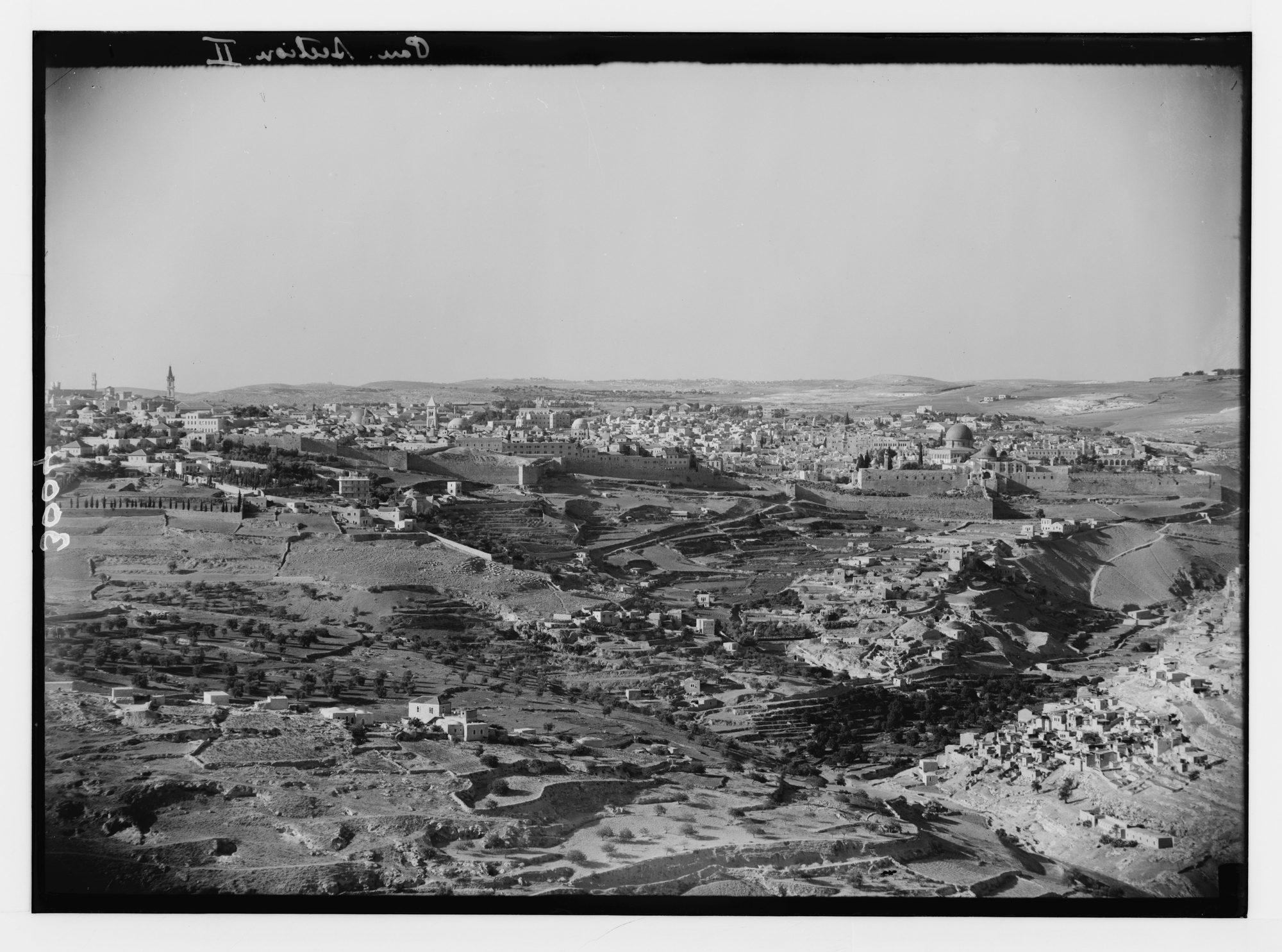
The Old City from Government House, Library of Congress, matpc.02561. Public domain.
2 Samuel 5:9 · Place · Featured Study
The City of David, the Stronghold of Zion
Samuel and Chronicles tell the capture two ways, and the stones on the ridge are still in dispute.
So David took up residence in the fortress and called it the City of David. He built it up all the way around, from the supporting terraces inward.
- Today
- Jerusalem
- Region
- The ridge of Ophel, south of the walled Old City
- First named
- 2 Samuel 5:7 “…of Zion (that is, the City of David).”
- Last named
- Isaiah 22:9 “…in the walls of the City of David.…”
The Jebusites said the blind and the lame could hold the fortress against David.
Summary
Two books of the Bible tell how David's men took the Jebusite stronghold of Zion. Both name a water shaft and the supporting terraces, and neither says what they were. For a hundred years diggers have searched the ridge for both, and they still disagree about what they found.
- The Berean text names the City of David in 39 verses, from 2 Samuel 5:7 to Isaiah 22:9.
- Luke uses the same phrase twice for Bethlehem.
- King Hezekiah made the terraces stronger in his own day.
- Diggers and their critics date the great stone slope wall from about 1000 BC to later.
The Stronghold David Took
The capture stands in two books, and the ridge it happened on has been dug for a century.
This study weighs the stronghold and the city built on it. It sets the two accounts of the capture side by side, weighs the readings of two Hebrew words, and asks what the excavated ridge settles.
The Spring, the Tunnel and Siloam
A plan of 1888 for the Palestine Exploration Fund draws the waters at the foot of the ridge.
The tunnel winds from the spring to the Pool of Siloam.
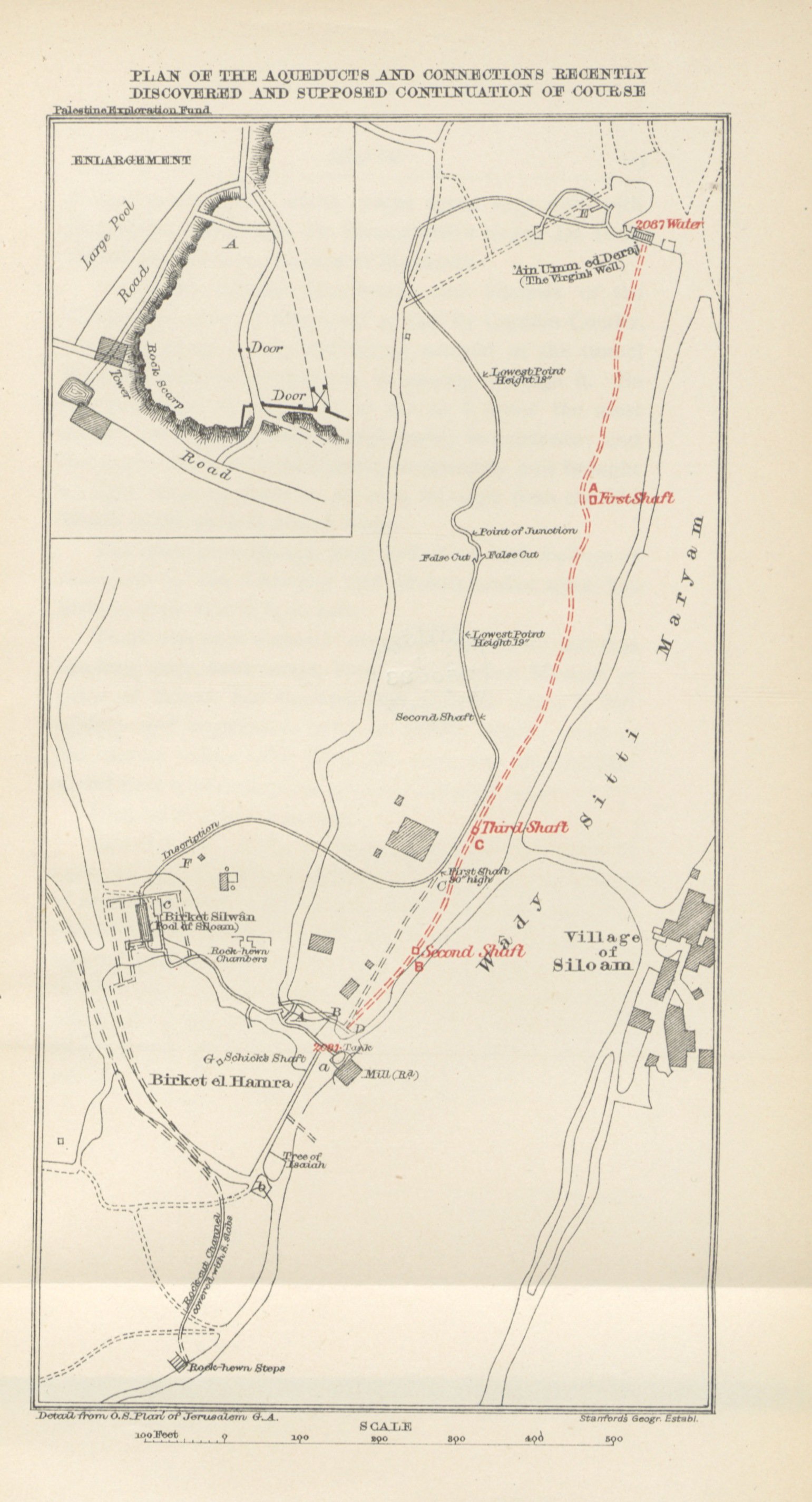
- The Virgin's WellThe plan prints the spring as 'Ain Umm ed-Deraj, the Virgin's Well, at the head of the tunnel, with no query.2 Chronicles 32:30
- The point of junctionThe plan marks a point of junction and two false cuts midway along the tunnel, with no query.2 Kings 20:20
- The inscriptionThe plan prints the word Inscription beside the Pool of Siloam, with no query.2 Kings 20:20
- Birket SilwanIsaiah names the gently flowing waters of Shiloah. The plan prints Birket Silwan, the Pool of Siloam, at the tunnel's end, with no query.Isaiah 8:6
Plan of the Aqueducts and Connections Recently Discovered, Palestine Exploration Fund, from Thomas Hayter Lewis, The Holy Places of Jerusalem (London: John Murray, 1888), page 185, British Library. No known copyright restrictions; File:185 of 'The Holy Places of Jerusalem ... With illustrations, etc' (11195462404).jpg.
Four numbered points, each where the plan prints the place. The plan is a detail from the Ordnance Survey plan of Jerusalem, printed for the Palestine Exploration Fund. Its red lines mark a second aqueduct the plan calls recently discovered, with its supposed continuation.
The study of Hezekiah and Sennacherib teaches the king the books credit with bringing the water into the city.
The Capture in Two Accounts
Samuel gives the water shaft, and Chronicles gives the prize for the first man up.
Only Samuel names the water shaft, and only Chronicles names the man who won the prize.
| Point | 2 Samuel 5:6 to 10 | 1 Chronicles 11:4 to 9 |
|---|---|---|
| Who marched | The king and his men | David and all the Israelites |
| The city's name | Jerusalem | Jerusalem, that is, Jebus |
| The taunt | You will never get in here. Even the blind and lame can repel you | You will never get in here |
| David's charge | Whoever attacks must use the water shaft | Whoever first strikes down a Jebusite will be chief commander |
| Who went up first | Not named | Joab son of Zeruiah |
| The building | From the supporting terraces inward | From the supporting terraces to the surrounding wall, and Joab restored the rest |
The Supporting Terraces
The Hebrew word millo names a work that stands in the building of David, Solomon and Hezekiah.
Strong's dictionary glosses millo a rampart, as filled in, and counts six uses in the Hebrew text. The Berean text renders it the supporting terraces.
and this is the account of his rebellion against the king. Solomon had built the supporting terraces and repaired the gap in the wall of the city of his father David.The verse shows the work going on after David's death.
Then Hezekiah worked resolutely to rebuild all the broken sections of the wall and to raise up towers on it. He also built an outer wall and reinforced the supporting terraces of the City of David, and he produced an abundance of weapons and shields.The verse sets the terraces among a king's defences in wartime.
Keil and Delitzsch take the Millo as a large tower or castle at one corner of the wall, probably built by the Jebusites. They hold that the name, the filling, came from its filling up or completing the fortification. Albert Barnes takes it as part of the original Canaanite defences of Zion, and he compares the house of Millo in the Canaanite city of Shechem.
Then all the leaders of Shechem and Beth-millo gathered beside the oak at the pillar in Shechem and proceeded to make Abimelech their king.Barnes points to this verse for his comparison.
The Ground Under the City
Excavators since the 1920s have dug the ridge, and each find settles some questions and leaves others open.
The stepped stone structureEilat Mazar, 2006; Finkelstein, Koch and Lipschits, 2011
Eilat Mazar, who dug the summit from 2005, judged that the stepped stone structure on the slope is part of one building complex with the large stone structure above it. She dated that building to the very end of Iron Age I or the beginning of Iron Age IIa, slightly before or after 1000 BC. She also found that walls Macalister and Duncan had read as a Jebusite wall destroyed by King David belonged to the same large stone structure.
What it settles: a great stone mantle covers terraces built to hold the steep slope. What it leaves open: Finkelstein, Koch and Lipschits, reading the excavators' results, call its dating circumstantial, late Iron IIA or Iron IIB. They hold that its link with the walls on the ridge cannot be verified today.
The shaft named for WarrenRonny Reich and Eli Shukron, 1995 to 2010
Reich and Shukron found that the first tunnel from the spring was cut in soft rock in the Middle Bronze Age II and reached a point above the water. A later deepening of that tunnel into hard rock stopped before it was finished, and fragments of three oil lamps of the eighth century BC lay in its quarrying waste. Reich now dates the rock-cut pool at the spring to Iron Age II, as part of a water system never completed.
What it settles: in the first phase, Reich writes, the vertical shaft was not visible and was not part of the system. What it leaves open: a radiocarbon study of 2017 offers dates for the spring's fortifications as late as the end of the ninth century BC. Reich's summary does not take up the word of 2 Samuel 5:8.
The inscription in the channelA. H. Sayce, 1881; Frumkin, Shimron and Rosenbaum, 2003
In June 1880 a pupil of Mr. Schick noticed letters on the rock wall of the channel at the Pool of Siloam. A. H. Sayce's translation of 1881 has the excavators work toward each other, pick to pick, and the waters flow from the outlet for a thousand cubits.
What it settles: in 2003 Frumkin, Shimron and Rosenbaum published radiocarbon and uranium-thorium dates that place the tunnel in Iron Age II. What it leaves open: Sayce wrote that the inscription records only the cutting of the conduit, and it names no king and gives no date.
The Siloam Pool of John 9Ronny Reich and Eli Shukron
Reich reports the eastern edge of a large pool surrounded by steps and plastered in its first phase, which he and Shukron identified as the Siloam Pool of John 9.
What it settles: where that pool lay in the late Second Temple period. What it leaves open: David's stronghold, centuries earlier, is not part of the find.
What the Text Leaves Unsaid
Scripture names the water shaft and the terraces, and it describes neither.
Neither account says how Joab went up or what the water shaft was. No verse says where on the ridge the supporting terraces stood.
Voices on the City of David
Tertullian answered Marcion on the blind of 2 Samuel 5, and Matthew Henry wrote on the builders Hiram sent.
Tertullian (died 220)
Tertullian answered Marcion, who set David's order against the blind beside Christ's healing of a blind man.
“For (here is one of Marcion's antitheses): whereas David long ago, in the capture of Zion, was offended by the blind who opposed his admission (into the stronghold). In this respect (I should rather say) that they were a type of people equally blind, who in later times would not admit Christ to be the son of David. So, on the contrary, Christ helped the blind man to show, by this act, that he was not David's son and how different in disposition he was, by being kind to the blind while David ordered them to be slain.”
Tertullian · Against Marcion 4.36 · on 2 Samuel 5:8Patristic
Matthew Henry (1662 to 1714)
Matthew Henry wrote on the cedar and the craftsmen Hiram sent for David's house.
“Many have excelled in arts and sciences who were strangers to the covenants of promise. Yet David's house was never the worse, nor the less fit to be dedicated to God, for being built by the sons of the stranger. It is prophesied of the gospel church, The sons of the strangers shall build up thy walls, and their kings shall minister unto thee, Isa. lx.”
Matthew Henry · Commentary on the Whole Bible · on 2 Samuel 5:11Puritan
The Water Shaft: Four Readings of One Word
Translators and commentators have read the Hebrew tsinnor four ways.
On that day he said, “Whoever attacks the Jebusites must use the water shaft to reach the lame and blind who are despised by David.” That is why it is said, “The blind and the lame will never enter the palace.”The Berean text renders tsinnor the water shaft.
Deep calls to deep in the roar of Your waterfalls; all Your breakers and waves have rolled over me.In the psalm the word belongs to the roar of falling water.
The King James Version renders the word the gutter in 2 Samuel 5:8 and waterspouts in Psalm 42:7.
A channel climbed from the springAlbert Barnes, and Macalister
Barnes reads the order as a charge to reach the defenders by the water-course, which he took to be the only access to the citadel. He notes that some understand a subterranean channel, and in his reading Joab took the hint and climbed up first. Macalister wrote in 1924 that he still held the identification of the gutter with Warren's Shaft the most likely theory. On his reading Joab drew off the defenders by climbing the water shaft and appearing in the middle of the city. The study of Jebusite Jerusalem weighs W. F. Birch's earlier form of that reading.
The objection: the same volume of the Quarterly Statement reports that Professor Albright combated the view.
The gutter at the top of the fortJerome, Martin Luther and the King James Version
Keil and Delitzsch report that Jerome's Latin has the attacker touch the water-pipes of the roofs. Luther's German and the King James Version follow with the gutter.
The objection, which Keil and Delitzsch draw from Psalm 42: there the word signifies a waterfall, a sense a roof gutter does not carry.
A waterfall down the precipiceC. F. Keil and F. Delitzsch
Keil and Delitzsch render the order, let him hurl into the waterfall, down the precipice, both the lame and blind. They suppose a waterfall at the foot of Zion, probably connected with the water of Siloah.
The objection, which they grant themselves: nothing can be fixed with certainty about it, since the situation of the Jebusite fortress was unknown to them.
With the daggerThe Septuagint, in Brenton's English
The Septuagint, as Brenton translated it, reads: let him attack with the dagger both the lame and the blind.
The objection: Keil and Delitzsch hold that the earliest translators had only resorted to guesses at the word.
The LORD Was with Him
Both accounts of the capture end on one verse about the LORD's presence with David.
And David became greater and greater, for the LORD God of Hosts was with him.Chronicles gives the verse again with the LORD of Hosts.
Sources
Scripture is the Berean Standard Bible.
- King James Version, 2 Samuel 5:8 and Psalm 42:7.
- Strong's dictionary in the site's lexicon, entries h6794 and h4407, with their counts of the Hebrew text.
- Albert Barnes, Notes, Explanatory and Practical, on the Old and New Testaments (1832 to 1869), on 2 Samuel 5:8.
- Albert Barnes, Notes, Explanatory and Practical, on the Old and New Testaments (1832 to 1869), on 2 Samuel 5:9.
- C. F. Keil and F. Delitzsch, Biblical Commentary on the Books of Samuel, on 2 Samuel 5:8 and 5:9.
- Brenton's English translation of the Septuagint, Kings II (2 Samuel) 5:8.
- Macalister, the address to the Annual Meeting, Palestine Exploration Fund Quarterly Statement 1924, pages 115 to 117; Reviews and Notices of Publications, page 46.
- Eilat Mazar, Did I Find King David's Palace?, Biblical Archaeology Review 32:1 (2006), as reprinted by the Biblical Archaeology Society.
- Finkelstein, Koch and Lipschits, The Mound on the Mount, Journal of Hebrew Scriptures 11 (2011), article 12.
- Ronny Reich, The Reich-Shukron Excavations in the City of David (1995 to 2010): A Summary, City of David Studies 22 (2021)
- Johanna Regev, Joe Uziel, Nahshon Szanton and Elisabetta Boaretto, Absolute Dating of the Gihon Spring Fortifications, Jerusalem, Radiocarbon 59:4 (2017), abstract.
- A. H. Sayce, The Ancient Hebrew Inscription Discovered at the Pool of Siloam in Jerusalem, Palestine Exploration Fund Quarterly Statement, July 1881.
- Amos Frumkin, Aryeh Shimron and Jeff Rosenbaum, Radiometric Dating of the Siloam Tunnel, Jerusalem, Nature 425 (2003), pages 169 to 171, abstract.
- Tertullian, Against Marcion 4.36.
- Matthew Henry, Commentary on the Whole Bible (1710), on 2 Samuel 5:11.
Keep Studying
Studies5
People and groups4
Symbols1