
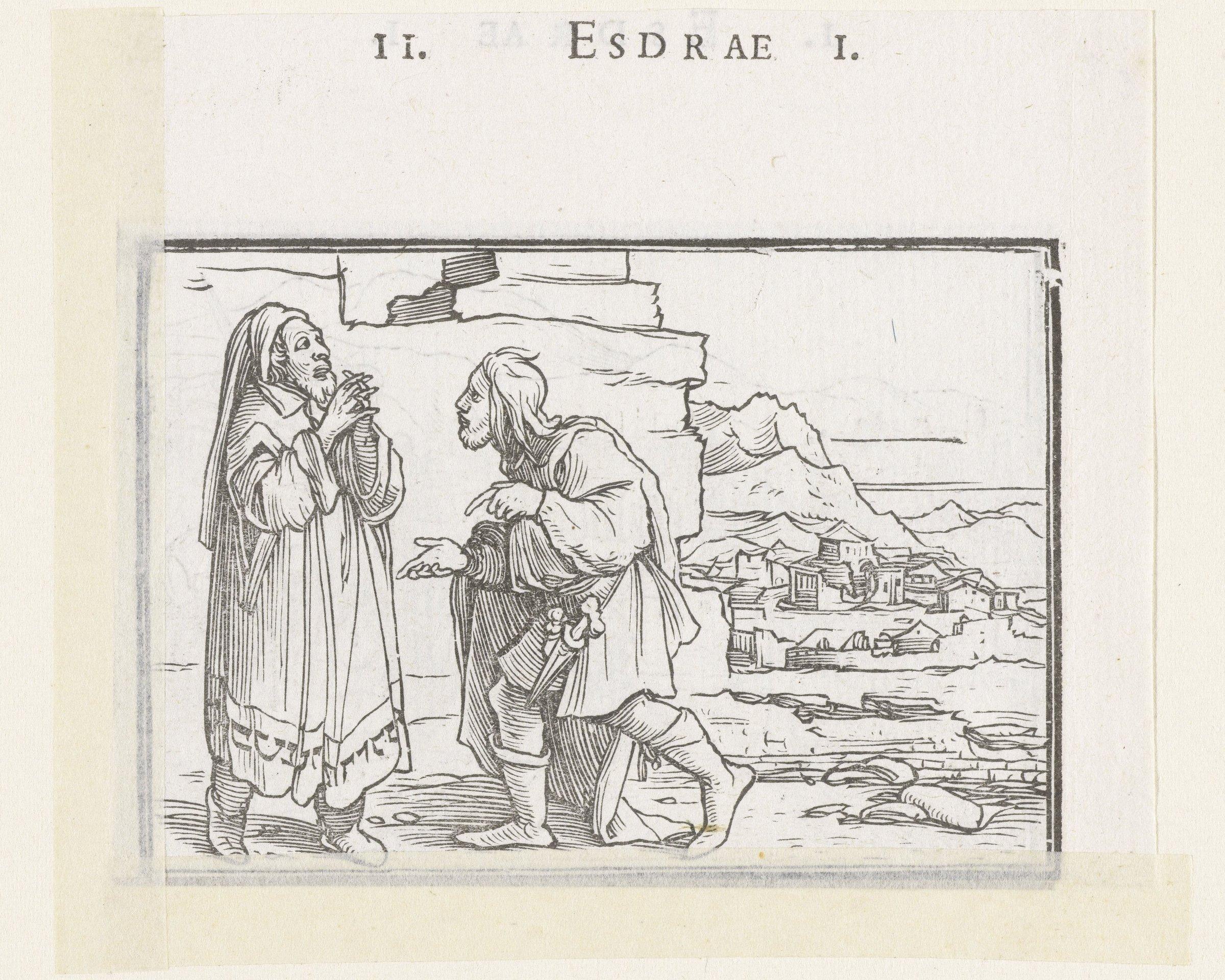
Hans Holbein the Younger, Nehemiah Hears of the Distress of Jerusalem, 1538. Public domain.
Nehemiah 1 to 13 · Subject · Featured Study
Nehemiah's Prayers and Remember Me
Nehemiah wrote eleven of his prayers into his memoir, from a long confession to prayers of one line.
Remember me favorably, O my God, for all that I have done for this people.
- Book
- Nehemiah
- Hold in memory
- Nehemiah 13:22
Nehemiah asked God four times to remember him, and twice to remember the men who had done harm.
Summary
Nehemiah set his prayers into the story he told, from days of mourning in Susa to the book's last line.
- The prayers run from a long confession to a prayer before the king whose words are not given.
- The word remember stands in seven of the eleven.
- The plea remember me stands in eight books of the Bible, from Joseph in prison to the criminal on the cross.
- Readers differ on whether Nehemiah asked for mercy or for his deeds to be counted to him.
How Nehemiah Prayed
The first prayer is the longest, a confession that names the sins of Nehemiah's own family.
This study asks how Nehemiah prayed and what he meant when he asked God to remember him. It lists every prayer of Nehemiah, traces the plea through Scripture and weighs whether he asked for mercy or for credit.
When I heard these words, I sat down and wept. I mourned for days, fasting and praying before the God of heaven.It shows that the prayer of chapter 1 came after days of grief, before any plan.
O Lord, may Your ear be attentive to my prayer and to the prayers of Your servants who delight to revere Your name. Give Your servant success this day, I pray, and grant him mercy in the sight of this man.” (At that time I was the cupbearer to the king.)It shows the long prayer ending on the one request Nehemiah needed answered at court.
The study of the wall tells the prayers of the building as scenes of the story.
Remember Me Across Scripture
Men and women of eight books ask to be remembered in the same two words.
Who asks to be remembered, book by book.
- GenesisJoseph asks Pharaoh's cupbearer to remember him in prison (Genesis 40:14).
- JudgesSamson asks the LORD to remember him and strengthen him once more (Judges 16:28).
- 1 SamuelHannah vows and asks the LORD to remember His maidservant (1 Samuel 1:11).
- NehemiahNehemiah asks it four times (Nehemiah 5:19; Nehemiah 13:14, 22 and 31).
- JobJob asks God to hide him in Sheol and then remember him (Job 14:13).
- PsalmsDavid asks to be remembered by God's loving devotion (Psalm 25:7).
- JeremiahJeremiah asks the LORD to remember him under his persecutors (Jeremiah 15:15).
- LukeA man crucified beside Jesus asks to be remembered in His kingdom (Luke 23:42).
Every verse of the Berean text in which a person asks to be remembered in these words, by book in the order of the canon.
Every Prayer of Nehemiah, in Order
The book records eleven prayers of Nehemiah, from the court of Susa to the last line.
Nehemiah's eleven prayers, from Susa to the last line.
| Where | Kind | What Nehemiah asks |
|---|---|---|
| Nehemiah 1:5 to 11 | Confession | That God remember His word to Moses and give success before the king |
| Nehemiah 2:4 | Before the king | No words are given; he prays before he answers the king |
| Nehemiah 4:4 to 5 | Against the mockers | That their scorn turn back on them |
| Nehemiah 4:9 | With the people | No words are given; they pray and post a guard |
| Nehemiah 5:19 | Remember me | That God remember all he has done for the people |
| Nehemiah 6:9, while his enemies tried to frighten him | For strength | That God strengthen his hands |
| Nehemiah 6:14 | Remember them | That God remember Tobiah, Sanballat and the prophets who frightened him |
| Nehemiah 13:14 | Remember me | That his deeds for the house of God not be blotted out |
| Nehemiah 13:22 | Remember me | That God show him mercy by His abundant loving devotion |
| Nehemiah 13:29 | Remember them | That God remember the men who defiled the priesthood |
| Nehemiah 13:31 | Remember me | That God remember him with favour |
Nehemiah 6:14, Nehemiah 13:14, Nehemiah 13:22, Nehemiah 13:29, Nehemiah 13:31
The Word Remember
One Hebrew verb carries every remember of Nehemiah's prayers.
zakar (Hebrew, H2142)
230 uses in the canon
Strong's dictionary glosses it as to mark so as to be recognised, that is, to remember.
The lexicon in full1 figure
Zakar stands 51 times in the Psalms, and its 9 in Nehemiah put the book eighth.
The ten counts as a table
| Book | Uses |
|---|---|
| Psalms | 51 |
| Isaiah | 26 |
| Ezekiel | 21 |
| Jeremiah | 16 |
| Deuteronomy | 15 |
| Genesis | 10 |
| Job | 10 |
| Nehemiah | 9 |
| Exodus | 8 |
| Lamentations | 7 |
A bar chart of the verb zakar, to remember, in the ten books where the Hebrew word index counts it most.
What the Text Leaves Unsaid
The book records the prayers and leaves their answers to the reader.
Nehemiah records no answer to his four prayers to be remembered.
Remember Me in Your Kingdom
A psalm and the cross carry Nehemiah's plea further.
Remember me, O LORD, in Your favor to Your people; visit me with Your salvation,It shows a believer asking to be remembered as one of God's people, as Nehemiah asked for himself.
And Jesus said to him, “Truly I tell you, today you will be with Me in Paradise.”Jesus answers the man's plea with a promise for that same day.
Voices on Nehemiah's Prayers
Matthew Henry wrote on the prayer against the priests who defiled their office.
Matthew Henry (1662 to 1714)
Henry, on Nehemiah 13:29, asks whether the prayer seeks the priests' turning or their judgment.
“‘Lord, convince and convert them; put them in mind of what they should be and do, that they may come to themselves.’ Or, ‘Remember them to reckon with them for their sin; remember it against them.’ If we take it so, this prayer is a prophecy that God would remember it against them.”
Matthew Henry · Commentary on the Whole Bible · on Nehemiah 13:29Puritan
Mercy or Merit
Readers give two readings of remember me, each with its holders and an objection.
A plea for mercyJohn Gill; Adam Clarke; Matthew Henry
John Gill, on Nehemiah 5:19, says Nehemiah looked for a reward from the Lord by grace and good will and in no way of merit. Adam Clarke, on Nehemiah 13:31, gives the prayer the meaning of O my God, have mercy upon me. Matthew Henry, on Nehemiah 13:22, says we must depend on God's mercy and on no merit of our own.
The objection is Batten's, set out in the second reading.
A plea for his deeds to be countedL. W. Batten (1913)
Batten, in the International Critical Commentary, writes that Nehemiah fed the returning poor at his own expense and might properly ask God to reckon that act to him for righteousness.
The objection is Clarke's: the close of Nehemiah 13:22 shows that Nehemiah looked for nothing except through the greatness of His mercy.
Books to Read Next
Three commentaries on Nehemiah from 1873 to 1913, each free to read.
Ezra, Nehemiah, and Esther, The Expositor's Bible
W. F. Adeney · 1900
Adeney reads the last prayers of the memoir as the prayers of a lonely reformer.
Read it at the Internet ArchiveA Critical and Exegetical Commentary on the Books of Ezra and Nehemiah
L. W. Batten · 1913
Batten's volume of the International Critical Commentary reads the memoir verse by verse.
Read it at the Internet ArchiveThe Books of Ezra, Nehemiah, and Esther
C. F. Keil · 1873
Keil marks the formula of remembering as Nehemiah's own and traces it through the memoir.
Read it at the Internet ArchiveThe Last Line
Nehemiah's memoir ends by placing its writer in the memory of God.
I also arranged for contributions of wood at the appointed times, and for the firstfruits. Remember me, O my God, with favor.The four requests end here, with the word favour.
Sources
Scripture is the Berean Standard Bible.
- The Berean text searched for remember me.
- James Strong, Exhaustive Concordance of the Bible (1890), Hebrew dictionary, entry 2142, and the Hebrew word index of the verse text.
- L. W. Batten, A Critical and Exegetical Commentary on the Books of Ezra and Nehemiah, International Critical Commentary, 1913, pages 246 to 247.
- C. F. Keil, The Books of Ezra, Nehemiah, and Esther, translated by Sophia Taylor, Edinburgh, T. and T. Clark, 1873, page 143.
- W. F. Adeney, Ezra, Nehemiah, and Esther, The Expositor's Bible, New York, Funk and Wagnalls, 1900 printing, pages 348 to 349.
- John Gill, Exposition of the Old Testament (1748 to 1763), on Nehemiah 5:19.
- Adam Clarke, Commentary on the Bible (1832), on Nehemiah 13:22.
- Adam Clarke, Commentary on the Bible (1832), on Nehemiah 13:31.
- Matthew Henry, Commentary on the Whole Bible (1710), on Nehemiah 13:22.
- Matthew Henry, Commentary on the Whole Bible (1710), on Nehemiah 13:29.
Keep Studying
Church history1
Go further3