
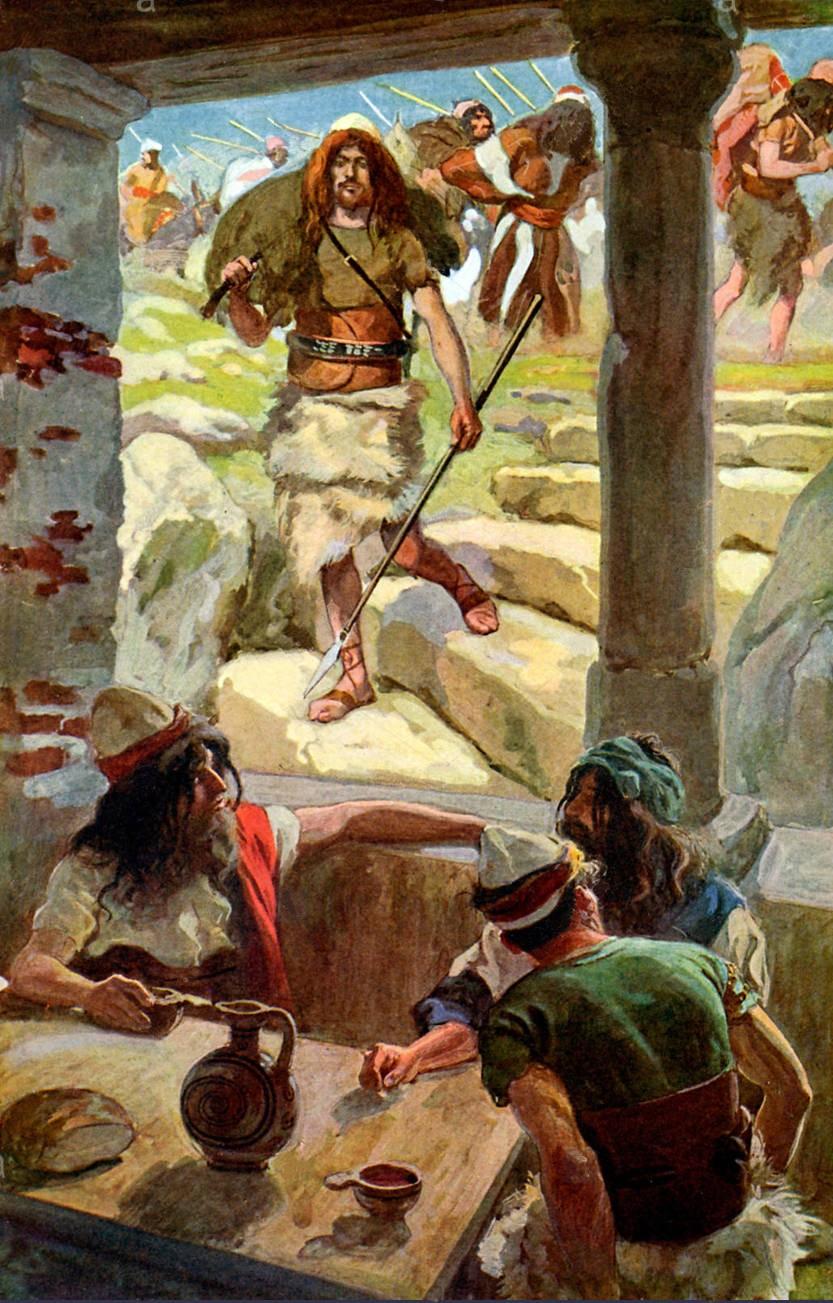
James Tissot, David Returns to Achish, nineteenth century. Public domain.
Joshua 11:22 · Place · Featured Study
Gath of the Philistines
Gath was a royal city of the Philistines and the home of Goliath.
David scratched on the doors of the gate and let his saliva run down his beard, so that the king of Gath took him for a madman.
No Anakim were left in the land of the Israelites; only in Gaza, Gath, and Ashdod did any survive.
No Anakim were left in the land of the Israelites; only in Gaza, Gath, and Ashdod did any survive.
- Today
- Tell es-Safi
- Region
- Where Judah borders Philistia
- Site
- 31.700, 34.847
- First named
- Joshua 11:22 “…the Israelites; only in Gaza, Gath, and Ashdod…”
- Last named
- Micah 1:10 “Do not tell it in Gath; do not…”
Summary
Scripture names Gath from Joshua to Micah, in war, in exile and in lament.
- Men of Gath killed Ezer and Elead, who came to steal their livestock (1 Chronicles 7:21).
- Two men of Aijalon drove out the people of Gath (1 Chronicles 8:13).
- Four descendants of Rapha in Gath fell to David and his men (2 Samuel 21:22).
Gath in Joshua
The book of Joshua sets Gath among the cities still held by the Philistines.
This study asks where Gath stood and what Scripture tells of it. It follows the city from Joshua to Micah, reports the dig at Tell es-Safi and weighs two judgments of David's stay there.
All the territory of the Philistines and the Geshurites, from the Shihor east of Egypt to the territory of Ekron on the north (considered to be Canaanite territory)—that of the five Philistine rulers of Gaza, Ashdod, Ashkelon, Gath, and Ekron, as well as that of the Avvites;The list of the land that remained begins with the Philistine coast.
Strong's dictionary glosses the name as Gath, a Philistine city, and its entry counts it 32 times and Gittite 10 times. M. G. Easton, in his Bible Dictionary of 1897, glosses the name as a wine-vat.
The study of the Philistines teaches the people and their five cities.
Gath on Smith's Plate
Smith's plate of the land before Israel came sets the coastal cities beside the hill country of Hebron.
Gath lies inland from Ashdod and Ekron, and Hebron stands in the hills to the east.
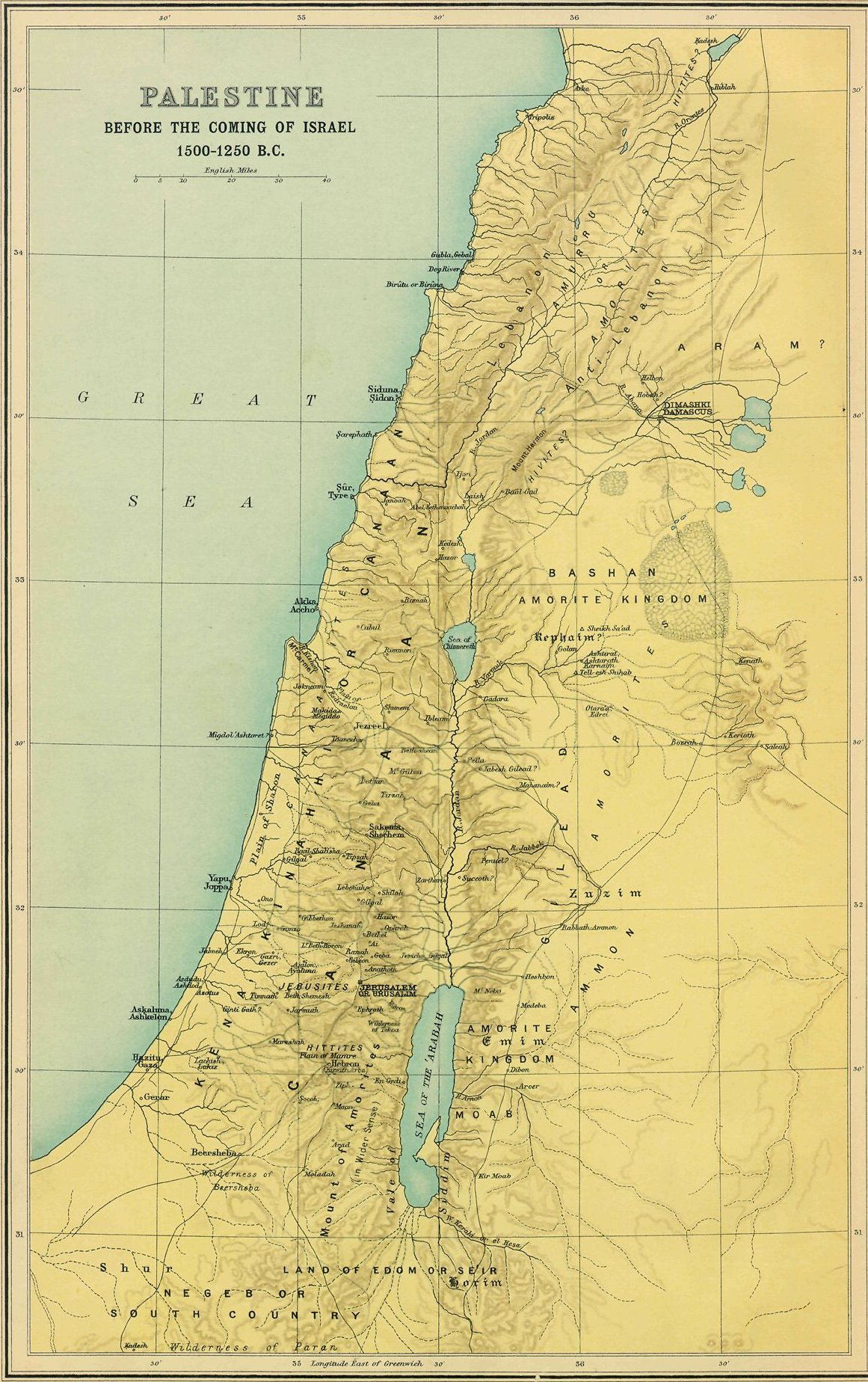
- EkronThe Philistines sent the ark on from Gath to Ekron, and the Ekronites cried out against it. The plate prints Ekron with no query, the northernmost point, and its place is known.1 Samuel 5:10
- AshdodWhen the ark brought trouble on Ashdod, the rulers of the Philistines had it moved to Gath. The plate prints Ashdod with no query, near the coast, and its place is known.1 Samuel 5:7 to 8
- GathGath was one of three towns where Anakim survived. The plate prints Ginti Gath with a query, so its place on the plate is proposed.Joshua 11:22
- GazaThe Philistines sent a gold tumor for Gaza with the ark when they returned it. The plate prints Hazitu and Gaza with no query, the south-westernmost point, and its place is known.1 Samuel 6:17
- HebronJoshua eliminated the Anakim from the hill country of Hebron, Debir and Anab. The plate prints Hebron with no query, the easternmost point, and its place is known.Joshua 11:21
George Adam Smith, Palestine before the Coming of Israel, 1500 to 1250 B.C., in his Atlas of the Historical Geography of the Holy Land, 1915. Public domain; File:Palestine before the coming of Israel (Smith, 1915).jpg.
Five numbered points, each where George Adam Smith's plate prints the place, with north at the top. The plate shows the land between 1500 and 1250 B.C. and prints an older form beside several names, such as Hazitu beside Gaza.
Gath in Scripture, in Order
Samuel, Kings and Chronicles name the city through the reigns of Saul, David, Solomon and the kings of Judah.
Gath took in the ark, sent out Goliath and sheltered David.
- The ark among the PhilistinesThe LORD's hand falls on Gath and its men while the ark is there1 Samuel 5:9
- The Valley of ElahGoliath, the champion from Gath, comes out against Israel1 Samuel 17:4
- David's flight from SaulDavid flees to Achish king of Gath and feigns madness before him1 Samuel 21:10 to 13
- David with AchishDavid and his six hundred men settle in Gath with their families1 Samuel 27:2 to 3
- The ark on the road to ZionDavid leaves the ark for three months in the house of Obed-edom the Gittite2 Samuel 6:10 to 11
- Absalom's revoltSix hundred Gittites who had followed David from Gath march out with him2 Samuel 15:18
- Solomon's reignShimei rides to Achish at Gath to bring back two runaway slaves1 Kings 2:39 to 41
- The reign of Joash of JudahHazael king of Aram fights against Gath and captures it2 Kings 12:17
- The reign of UzziahUzziah goes to war against the Philistines and tears down the walls of Gath, Jabneh and Ashdod2 Chronicles 26:6
Nine moments from 1 Samuel to 2 Chronicles in the order of the canon, each with its verse.
Solomon's reign, The reign of Joash of Judah, The reign of Uzziah
Two studies tell two of these moments whole: the ark among the Philistines, and Ittai the Gittite.
Gath at Tell es-Safi
The dig at Tell es-Safi has found a siege trench and a sherd with two Philistine names.
Aren Maeir of Bar-Ilan University writes that most scholars place Gath at Tell es-Safi. His team began a long-term project at the site in 1996 and began digging in 1997.
The team traced a trench about 2.5 kilometres long around the city. Maeir takes it for a siege system and likely evidence of the Aramean siege, and he dates Hazael's destruction of the city to about 830 BC.
At that time Hazael king of Aram marched up and fought against Gath and captured it. Then he decided to attack Jerusalem.The verse gives the siege no date, so its dating rests on the dig.
A sherd from about 950 BC, found in the 2005 season, carries two names read as alwt and wlt. In the project's overview Maeir calls them somewhat reminiscent of the original form of the name Goliath.
M. G. Easton had already set Gath at Tell es-Safieh in 1897. OpenBible's geocoding data scores Tell es-Safi at 850 for the city and its next candidate, Tel Nagila, at 35.
What the Prophets Leave Unsaid
Three oracles against the Philistine cities each name four of them and leave out Gath.
Amos 1:6 to 8, Zephaniah 2:4 and Zechariah 9:5 to 6 each name Gaza, Ashdod, Ashkelon and Ekron. Amos names Gath only in another oracle, at Amos 6:2, among the kingdoms Israel is told to look at. None of the three lists gives a reason for the gap.
Tell It Not in Gath
David's lament and Micah's oracle each keep Israel's grief from the ears of Gath.
Tell it not in Gath; proclaim it not in the streets of Ashkelon, lest the daughters of the Philistines rejoice, and the daughters of the uncircumcised exult.David wants no enemy city to rejoice over Saul.
Do not tell it in Gath; do not weep at all. Roll in the dust in Beth-leaphrah.Micah takes up David's line for the coming grief of Judah.
Voices on Gath
Jamieson, Fausset and Brown and Albert Barnes wrote on David's two stays at Gath.
Albert Barnes (1798 to 1870)
Albert Barnes, the American commentator, reads David's reason for leaving Gath for Ziklag.
“David, with characteristic Oriental subtlety (compare 1Sa 21:2), suggests as a reason for leaving Gath that his presence was burdensome and expensive to the king. His real motive was to be more out of the way of observation and control, so as to act the part of an enemy of Saul, without really lifting up his hand against him and his own countrymen of Israel.”
Albert Barnes · Notes, Explanatory and Practical, on the Old and New Testaments (1832-1869) · on 1 Samuel 27:5Evangelical
Jamieson, Fausset & Brown (1802 to 1910)
Jamieson, Fausset and Brown, the Scottish commentators, weigh the risk of David's first flight to Gath.
“In this place his person must have been known, and to venture into that country, he their greatest enemy, and with the sword of Goliath in his hand, would seem to have been a perilous experiment; but, doubtless, the protection he received implies that he had been directed by the divine oracle. Achish was generous (1Sa 27:6).”
Jamieson, Fausset & Brown · Commentary Critical and Explanatory on the Whole Bible · on 1 Samuel 21:10Reformed
David's Year with Achish
Readers differ on how to judge David's raids and his answers to the king of Gath.
who would ask him, “What have you raided today?” And David would reply, “The Negev of Judah,” or “The Negev of Jerahmeel,” or “The Negev of the Kenites.” David did not leave a man or woman alive to be brought to Gath, for he said, “Otherwise they will report us, saying, ‘This is what David did.’” And this was David’s custom the whole time he lived in Philistine territory. So Achish trusted David, thinking, “Since he has made himself an utter stench to his people Israel, he will be my servant forever.”These verses hold the deceit the readers judge.
Blame in every partAdam Clarke and John Wesley
Adam Clarke, the Methodist commentator, holds that not one circumstance of the stay is free of blame. David joined the enemies of his God and country, raided the Geshurites and Amalekites without a word from God and lied to his protector. John Wesley, the Methodist preacher, calls David's answers to Achish ambiguous and contrary to the simplicity that became him.
The objection: 1 Samuel 27 records the raids and the deceit and passes no verdict on either.
The raids were justMatthew Henry, Commentary on the Whole Bible
Matthew Henry acquits David of injustice and cruelty in the raids, since those peoples had long been doomed and David had been chosen to rule.
The objection: 1 Samuel 27:11 gives David's own reason for leaving no one alive, that no one would report what he had done.
In God I Trust
Cassiodorus, the sixth-century Roman writer, reads Psalm 56 as David's prayer when the Philistines held him in Gath. Psalm 56 asks the reader to meet fear with trust in God and in His word.
When I am afraid, I put my trust in You. In God, whose word I praise— in God I trust. I will not be afraid. What can man do to me?David's fear and his trust stand in one breath.
The study When I Am Afraid teaches Psalm 56 whole.
Sources
Scripture is the Berean Standard Bible.
- James Strong, Exhaustive Concordance of the Bible (1890), Hebrew dictionary, entries 1661 and 1663.
- M. G. Easton, Illustrated Bible Dictionary (1897), entry Gath.
- Aren M. Maeir, Tell es-Safi/Gath Archaeological Project, project overview (posted 2013, updated 2025)
- OpenBible.info, Bible Geocoding Data, ancient.jsonl, entry Gath 1 (CC BY 4.0)
- Adam Clarke, Commentary on the Bible (1832), on 1 Samuel 21:10 and 27:2.
- John Wesley, Explanatory Notes upon the Old Testament (1765), on 1 Samuel 21:10 and 27:10.
- Matthew Henry, Commentary on the Whole Bible (1710), on 1 Samuel 27:9.
- Cassiodorus, Exposition of the Psalms, on Psalm 56 (55 in his numbering)
- Jamieson, Fausset and Brown, Commentary Critical and Explanatory on the Whole Bible (1871), on 1 Samuel 21:10.
- Albert Barnes, Notes, Explanatory and Practical, on the Old and New Testaments (1832 to 1869), on 1 Samuel 27:5.
Keep Studying
Read it4
Studies5
People and groups5