
Place
En-gedi
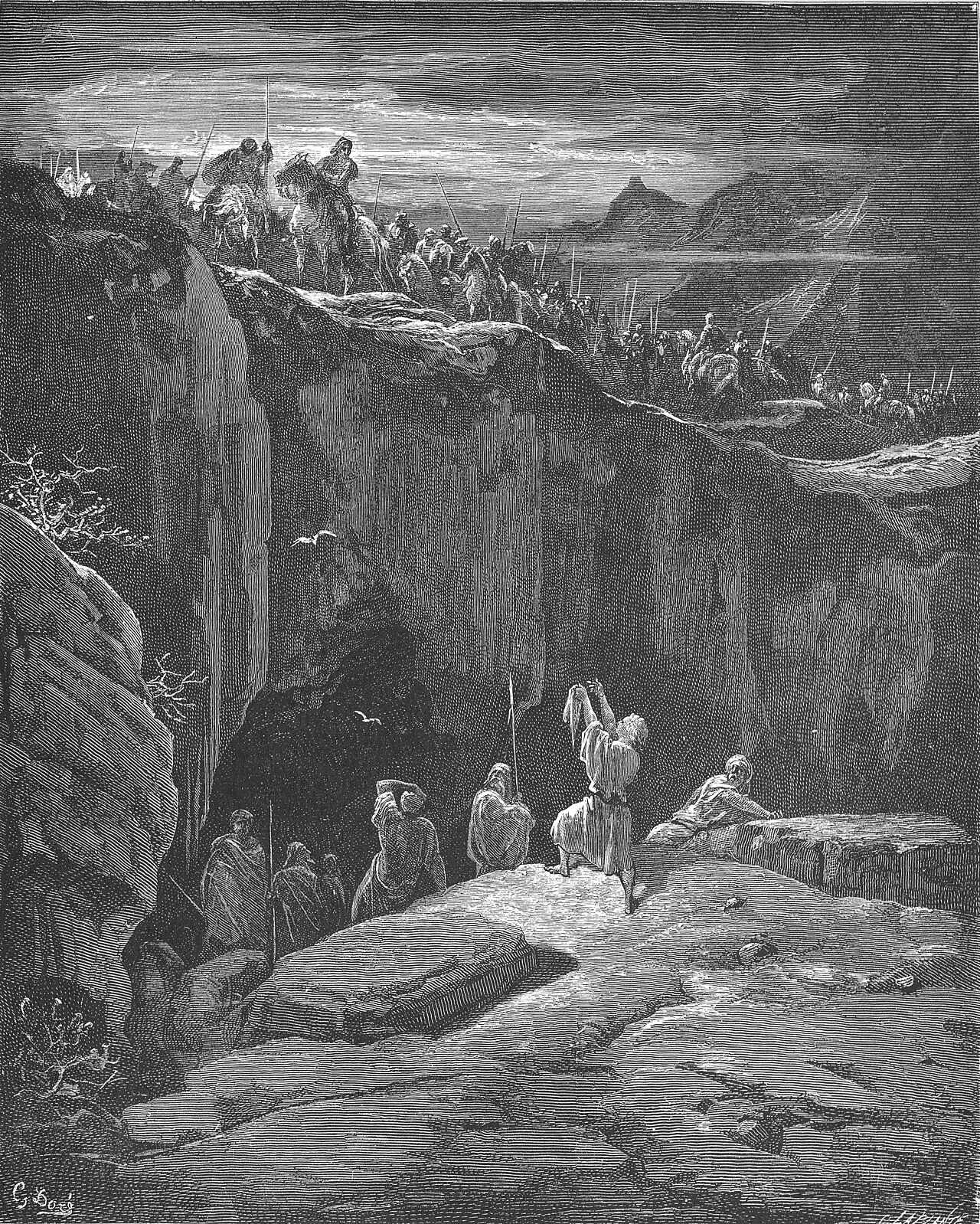
Gustave Doré, La Sainte Bible (Tours: Alfred Mame et fils, 1866). Public domain.
Summary
The oasis stronghold by the Dead Sea where David cut Saul's robe in the cave and let the king walk out alive.
- En-gedi is a freshwater spring and oasis on the western shore of the Dead Sea, cut through with caves and steep ravines.
- In its wilderness, David found Saul alone in a cave, cut off a corner of his robe, and let him walk out alive.
- Saul wept and admitted David was more righteous than he, and asked David to spare his descendants when the kingdom came to him.
- Later writers name En-gedi as the same place as the Hazazon-tamar of Genesis 14 and 2 Chronicles 20, though Genesis itself does not make that equation.
- The Song of Solomon and Ezekiel both use En-gedi's vineyards and shoreline as pictures of blessing that reaches beyond itself.
On this page
In Scripture
- Verses
- 6
- Books
- 5
Near En-gedi
- Tekoa26 km · 16 mi NW
- Machpelah28 km · 17 mi W
- Hebron29 km · 18 mi W
- Sodom29 km · 18 mi S
- Mamre30 km · 19 mi W
- Bethlehem33 km · 20 mi NW
Straight-line distances, computed from the gazetteer coordinates.
Where it is
the country around it
- Coordinates
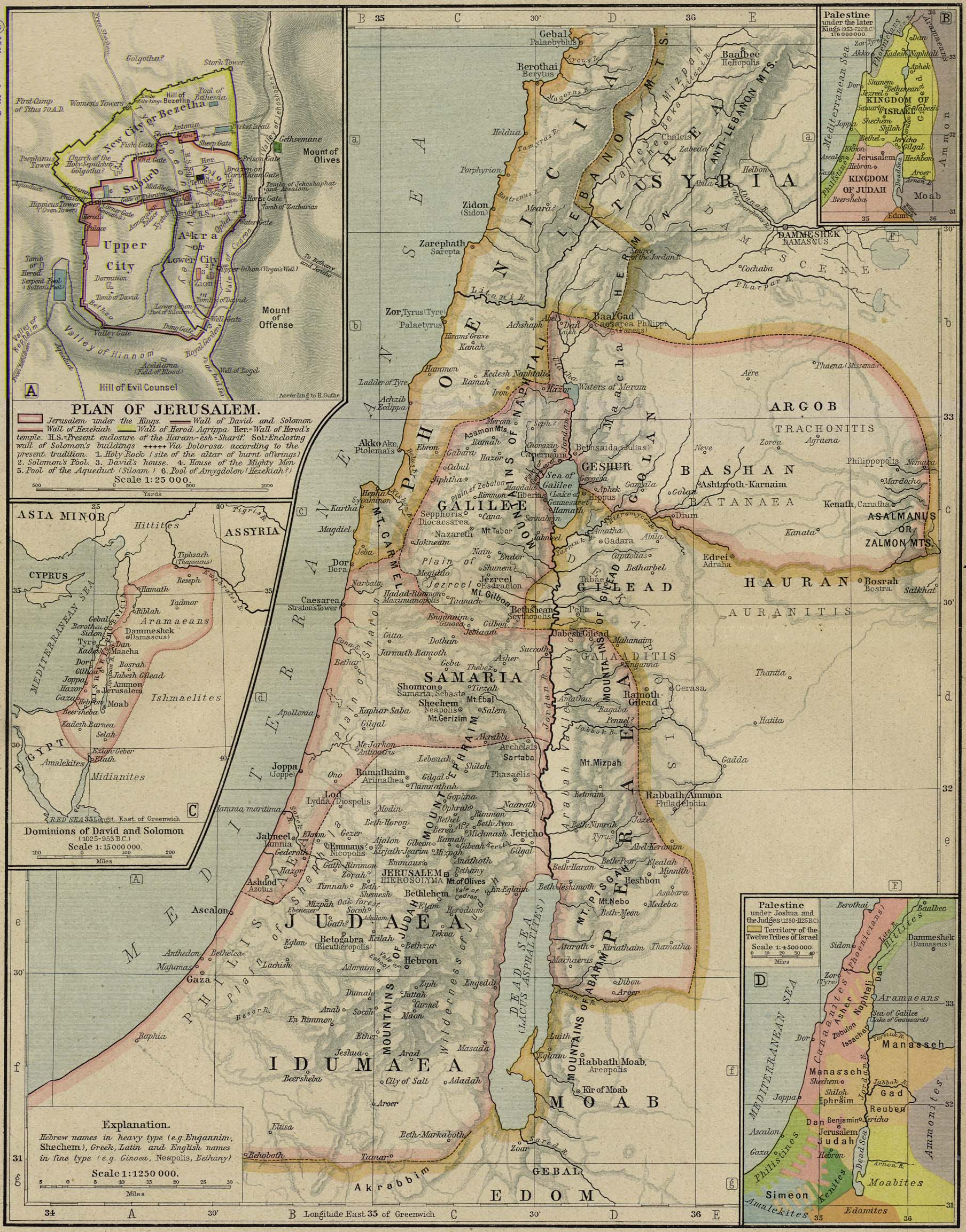
- 31.4615° N, 35.3924° Efind it on the Atlas →
- Region
- Dead Sea shore
- Kind of place
- Geographic feature
- Located: the gazetteer fixes one site
- Placed: the point stands for an area, or is rounded
- ? Proposed: one candidate among several
Not located: Edom. The gazetteer records no location for it, so it is not marked.
Why En-gedi matters
David spares Saul in the cave
1 Samuel 24, in the order it happens
Read 1 Samuel 24, in the order it happens
- Saul goes looking for David at En-gedi1 Samuel 24:2So Saul took three thousand chosen men from all Israel and went to look for David and his men in the region of the Rocks of the Wild Goats.
- Saul enters the cave where David is hiding1 Samuel 24:3Soon Saul came to the sheepfolds along the road, where there was a cave, and he went in to relieve himself. And David and his men were hiding in the recesses of the cave.
- David's men urge him to strike1 Samuel 24:4So David’s men said to him, “This is the day about which the LORD said to you, ‘Behold, I will deliver your enemy into your hand, that you may do with him as you wish.’” Then David crept up secretly and cut off a corner of Saul’s robe.
- David's conscience strikes him1 Samuel 24:5Afterward, David’s conscience was stricken because he had cut off the corner of Saul’s robe.
- David will not touch the Lord's anointed1 Samuel 24:6So he said to his men, “The LORD forbid that I should do such a thing to my master, the LORD’s anointed. May I never lift my hand against him, since he is the LORD’s anointed.”
- David restrains his men, and Saul leaves unharmed1 Samuel 24:7With these words David restrained his men, and he did not let them rise up against Saul. Then Saul left the cave and went on his way.
- David shows Saul the corner of his robe1 Samuel 24:11See, my father, look at the corner of your robe in my hand. For I cut it off, but I did not kill you. See and know that there is no evil or rebellion in my hands. I have not sinned against you, even though you are hunting me down to take my life.
- Saul weeps and confesses David is more righteous1 Samuel 24:17and said to David, “You are more righteous than I, for you have rewarded me with good, though I have rewarded you with evil.
- Saul asks David to spare his family1 Samuel 24:21So now, swear to me by the LORD that you will not cut off my descendants or wipe out my name from my father’s house.”
- David swears, and both go their way1 Samuel 24:22So David gave his oath to Saul. Then Saul returned home, but David and his men went up to the stronghold.
What happened here, in order
in the order the canon tells it
- Chedorlaomer's coalition strikes Hazazon-tamarGenesis 14:7Then they turned back to invade En-mishpat (that is, Kadesh), and they conquered the whole territory of the Amalekites, as well as the Amorites who lived in Hazazon-tamar.
- En-gedi listed among Judah's wilderness citiesJoshua 15:62Beth-arabah, Middin, Secacah, Nibshan, the City of Salt, and En-gedi—six cities, along with their villages.
- David goes up to the strongholds of En-gedi1 Samuel 23:29And David went up from there and lived in the strongholds of En-gedi.
- Saul is told David is in the wilderness of En-gedi1 Samuel 24:1After Saul had returned from pursuing the Philistines, he was told, “David is in the wilderness of En-gedi.”
- David refuses to harm the Lord's anointed1 Samuel 24:6So he said to his men, “The LORD forbid that I should do such a thing to my master, the LORD’s anointed. May I never lift my hand against him, since he is the LORD’s anointed.”
- Saul confesses David is more righteous1 Samuel 24:17and said to David, “You are more righteous than I, for you have rewarded me with good, though I have rewarded you with evil.
- The invading army is already at Hazazon-tamar, that is, En-gedi2 Chronicles 20:2Then some men came and told Jehoshaphat, “A vast army is coming against you from Edom, from beyond the Sea; they are already in Hazazon-tamar” (that is, En-gedi).
- The beloved compared to the vineyards of En-gediSong of Solomon 1:14My beloved is to me a cluster of henna blossoms in the vineyards of En-gedi.
- Fishermen stand from En-gedi to Eneglaim in the healed seaEzekiel 47:10Fishermen will stand by the shore; from En-gedi to En-eglaim they will spread their nets to catch fish of many kinds, like the fish of the Great Sea.
The voices
each quoted from the work named
It was not as leader of troops, you see, but as priest he commanded them, and that cave was a church on that occasion: like someone appointed as bishop, he delivered a homily to them, and after this homily he offered a kind of remarkable and unusual sacrifice, not sacrificing a calf, not slaying a lamb, but—what was of greater value than these—he offered to God gentleness and clemency, sacrificing irrational resentment, slaying anger and mortifying the limbs that are on the earth.
He should have said, Thou are righteous, but I am wicked; but the utmost he will own is this: Thou art more righteous than I. Bad men will commonly go no further than this in their confessions; they will own they are not so good as some others are; there are those that are better than they, and more righteous.
Strong holds at En-gedi - En-gedi was situated near to the western coast of the Dead Sea, not far from Jeshimon: it literally signifies the kid’s well, and was celebrated for its vineyards, Son 1:14. It was also celebrated for its balm. It is reported to be a mountainous territory, filled with caverns; and consequently proper for David in his present circumstances.
1 more teacher on these versesJamieson, Fausset & Brown
En-eglaim--En-gedi (meaning "fountain of the kid"), anciently, Hazazon-Tamar, now Ain-Jidy; west of the Dead Sea; David's place of refuge from Saul. En-eglaim means "fountain of two calves," on the confines of Moab, over against En-gedi, and near where Jordan enters the Dead Sea
En-gedi in Scripture
6 verses name it, in 5 books
Open a book to read its mentions here. Text: Berean Standard Bible.
Old TestamentNew Testamentsegment width = share of mentions
Old Testament5 books · 6 mentions
Joshua1 mention
1 Samuel2 mentions
2 Chronicles1 mention
Song of Solomon1 mention
Common questions
Where is En-gedi, and why did David hide there?
En-gedi is a freshwater spring on the western shore of the Dead Sea, about the middle of that shore, roughly two hundred yards from the water. Its name means the spring of the kid, after the wild goats that still climb the cliffs above it.
The ground around the spring is cut with steep ravines and full of caves, which made it a natural refuge. That is exactly why Saul went looking for David there with three thousand men, and why the story of the cave could happen at all: the country itself is built for hiding.
Did David spare Saul out of weakness, or on principle?
The text presents it as principle. David's men urged him to kill Saul, and he had the king alone and unarmed in the dark. He cut the robe instead of the man, and even that small act struck his own conscience.
David's stated reason was that Saul was still the Lord's anointed, and he would not lift his hand against him on that ground alone. John Chrysostom's homily on this chapter calls the cave a kind of church that day, because David offered God his own anger and resentment instead of Saul's blood.
Is En-gedi the same place as the Hazazon-tamar of Genesis 14?
Readers differ; the positions are named
Later commentators say yes without exception in this site's pool. Bede's commentary on Genesis states plainly that Hazazon-tamar is the town later called En-gedi. Albert Barnes and Jamieson, Fausset and Brown repeat the same identification, and 2 Chronicles 20:2 itself glosses Hazazon-tamar as En-gedi for its own readers.
Genesis itself never makes that equation. It simply names Hazazon-tamar as a place Chedorlaomer's coalition struck on their campaign. The identification is the unanimous reading of later writers rather than a statement the Genesis text makes about itself, and this page presents it on that footing.
Why does the Song of Solomon compare the beloved to the vineyards of En-gedi?
En-gedi was known in the ancient world for its vineyards and its balsam, prized and fragrant crops that could not be grown just anywhere. Calling the beloved a cluster of henna blossoms from En-gedi's vineyards is a picture of something rare and treasured, not available on every hillside.
Matthew Henry reads the image further, noting the word for henna blossom shares its root with the Hebrew word for atonement, and takes the cluster as a picture of Christ's own merit held out to believers.
What does En-gedi mean in Ezekiel's vision of the healed sea?
Ezekiel sees a river flowing from the temple into the Dead Sea, and the sea's salt water is healed so that fish can live in it. Fishermen are pictured standing along the very shore where David once hid from Saul, spreading their nets in water that had been too salt for anything to survive.
Matthew Henry reads this as gospel grace reaching a place that was once useless and making it productive. The passage does not fix a date for when this healing happens; this site reads it as part of the larger renewal Ezekiel's closing vision pictures for the land.
Sources cited
- OpenBible.info Bible Geocoding: Engediread 2026-09-02The coordinates on this page. Used under CC-BY with attribution to OpenBible.info.
- Berean Standard Bible (2023)Every verse quoted on this page, from the site's own verse store. Public domain.
- John Chrysostom, Homilies on David and Saul, Homily 2 (407)1 Samuel 24:6, the cave as a church. Public domain.
- Matthew Henry, Commentary on the Whole Bible (1710)1 Samuel 24:17 and Song of Solomon 1:14. Public domain.
- Adam Clarke, Commentary on the Bible (1832)1 Samuel 23:29, the location, vineyards and caves of En-gedi. Public domain.
- Jamieson, Fausset & Brown, Commentary Critical and Explanatory on the Whole Bible (1871)Ezekiel 47:10 and the Hazazon-tamar identification. Public domain.
- Albert Barnes, Notes, Explanatory and Practical, on the Old and New Testaments (1832-1869)1 Samuel 23:29, the geography and modern name of En-gedi. Public domain.
- Bede, Commentary on Genesis (Hexaemeron) (735)Genesis 14:7, the identification of Hazazon-tamar with En-gedi. Public domain.
- John Gill, Exposition of the Old Testament (1748-1763)Song of Solomon 1:14, the vineyards of En-gedi. Public domain.
- Gustave Doré, La Sainte Bible (Tours: Alfred Mame et fils, 1866)The cave engraving on this page. Public domain.
Keep studying
On this page
Keep this page