
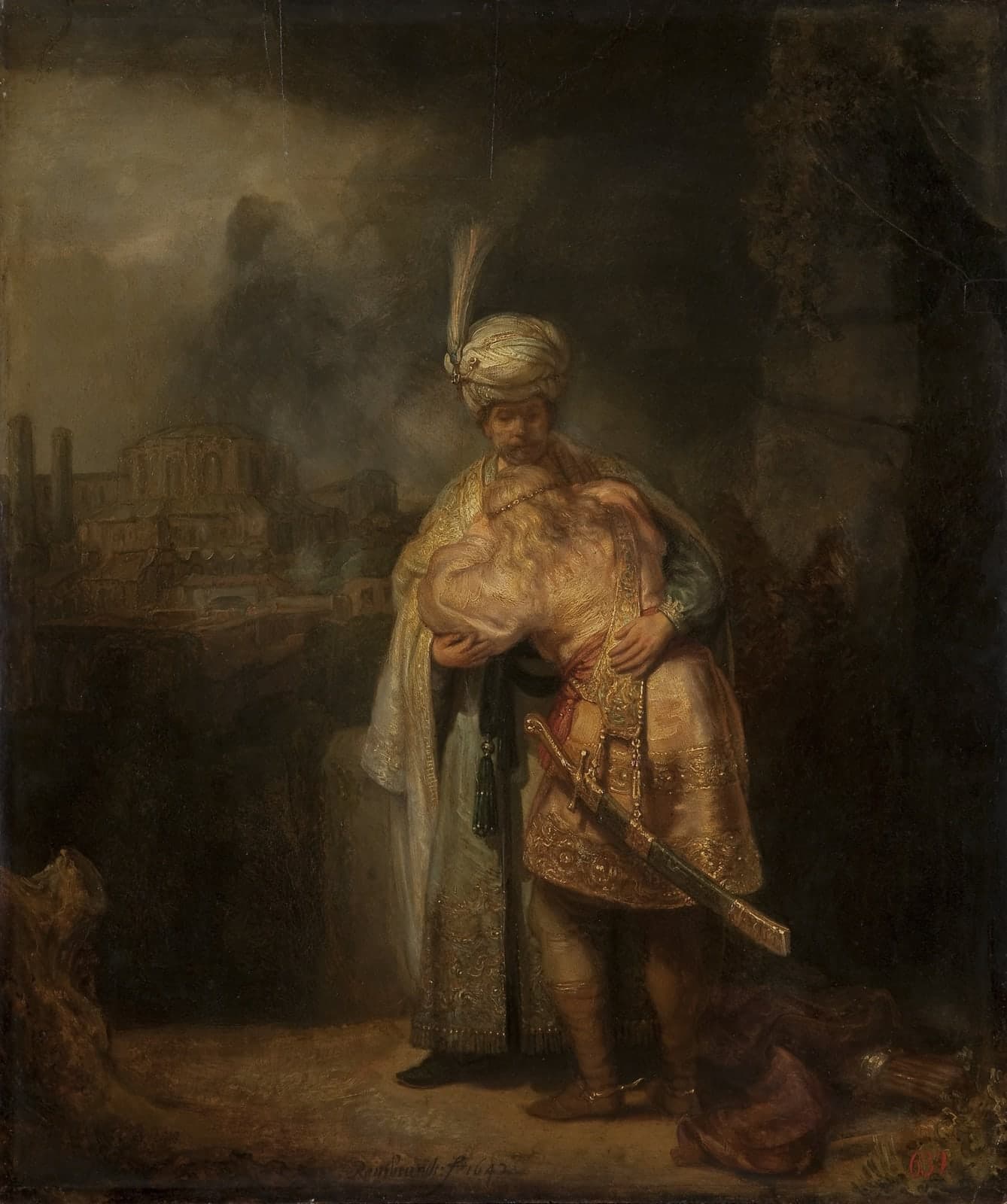
1 Samuel 18 to 20 · Story · Loyalty
Jonathan and David
Saul's son Jonathan made a covenant with David in 1 Samuel 18 and kept it through his father's attempts on David's life.
The heir to Saul's throne bound himself to the man who would take it.
Then Jonathan made a covenant with David because he loved him as himself.
- Who
- Jonathan, David, Saul
Summary
1 Samuel 18 to 20 follows a friendship that Saul's hatred of David put to the test at every turn. Jonathan sealed a covenant with gifts of his own robe and weapons, pleaded for David before Saul, and warned him with arrows in a field. The two men bound the covenant to the LORD as witness and to their children after them.
- Jonathan took David's side against his father's order to kill David, given to Jonathan and all Saul's servants (1 Samuel 19:1).
- The covenant was made three times, at Saul's court, in the field and at Horesh (1 Samuel 18:3, 1 Samuel 20:16 and 1 Samuel 23:18).
- Jonathan died beside his father in Saul's last battle against the Philistines (1 Samuel 31:2).
The King's Son and the Shepherd
Jonathan bound himself to David on the day Saul took David into his house.
Jonathan and David studies 1 Samuel 18 to 20, with the last meeting of the two men in 1 Samuel 23. In these chapters Saul's son made a covenant with David soon after David killed Goliath. It belongs to the value of loyalty, because the covenant Jonathan made in a single day held for the rest of his life.
The question the study answers is what Jonathan's covenant asked of him and how he kept it. It tells the account in its order and reads the terms the two men swore. It then weighs what the loyalty cost Jonathan and gives one question on which readers have differed.
The bond began at court. “After David had finished speaking with Saul, the souls of Jonathan and David were knit together” (1 Samuel 18:1).
The Hebrew verb behind knit together is qashar, which the Tyndale House brief lexicon glosses as to tie, physically or mentally, in love or in league. The tagged Hebrew text has the same verb in Genesis 44:30, where Jacob's life is “wrapped up in the boy’s life.”
And Jonathan removed the robe he was wearing and gave it to David, along with his tunic, his sword, his bow, and his belt.The gifts give the covenant a form anyone at court could see, since the king's son handed his own dress and arms to David.
Jamieson, Fausset and Brown explained what such a gift meant in the world of the text. In their words, “To receive any part of the dress which had been worn by a sovereign, or his eldest son and heir, is deemed, in the East, the highest honor”.
The Story in Twelve Events
The events run from 1 Samuel 18:2 to 1 Samuel 23:16.
The covenant was made at court, tested at the king's table and renewed in the wilderness.
- Saul keeps David at court“Saul kept David with him”1 Samuel 18:2
- Saul sets David over the men of war“Saul set him over the men of war.”1 Samuel 18:5
- The women's song turns Saul jealous“Saul kept a jealous eye on David.”1 Samuel 18:9
- Saul orders his son to kill David“Saul ordered his son Jonathan”1 Samuel 19:1
- Jonathan warns David to hide“Be on your guard in the morning”1 Samuel 19:2
- Saul swears an oath for David's life“As surely as the LORD lives”1 Samuel 19:6
- David flees to Jonathan from Naioth“What have I done?”1 Samuel 20:1
- The two go out to the field“let us go out to the field.”1 Samuel 20:11
- Jonathan makes a covenant with David's house“a covenant with the house of David”1 Samuel 20:16
- Jonathan leaves the king's table“got up from the table in fierce anger”1 Samuel 20:34
- Jonathan shoots the arrows and the two part“Isn’t the arrow beyond you?”1 Samuel 20:37
- Jonathan finds David at Horesh“strengthened his hand in God”1 Samuel 23:16
A timeline of twelve events, eleven in 1 Samuel 18 to 20 and the last in 1 Samuel 23, each with words of the Berean text and its verse.
David flees to Jonathan from Naioth, The two go out to the field, Jonathan makes a covenant with David's house, Jonathan leaves the king's table, Jonathan shoots the arrows and the two part, Jonathan finds David at Horesh
Jonathan Before His Father
Jonathan spoke for David to Saul twice, and the second time Saul's spear was thrown at him.
Then Jonathan spoke well of David to his father Saul and said to him, “The king should not sin against his servant David; he has not sinned against you. In fact, his actions have been highly beneficial to you. He took his life in his hands when he struck down the Philistine, and the LORD worked a great salvation for all Israel. You saw it and rejoiced, so why would you sin against innocent blood by killing David for no reason?”The plea stands here because Jonathan argues from David's record and from the LORD's salvation, the same ground on which he took David's side.
The second plea came at the meal of the New Moon, when Jonathan gave David's excuse for his empty seat (1 Samuel 20:28 to 29).
Then Saul’s anger burned against Jonathan, and he said to him, “You son of a perverse and rebellious woman! Do I not know that you have chosen the son of Jesse to your own shame and to the disgrace of the mother who bore you? For as long as the son of Jesse lives on this earth, neither you nor your kingship shall be established. Now send for him and bring him to me, for he must surely die!”Saul names the price of Jonathan's loyalty in his own words, the kingship his son would lose while David lived.
Jonathan asked his father why David must be put to death and what he had done (1 Samuel 20:32). Saul hurled his spear at his own son, and Jonathan knew that his father was determined to kill David (1 Samuel 20:33).
The Covenant and Its Loving Devotion
The two men's covenant carried a promise of loyal love on both sides.
The Hebrew word for covenant, berit, stands in 1 Samuel 18:3, 1 Samuel 20:8 and 1 Samuel 23:18. In 1 Samuel 20:8 David asks Jonathan for chesed on the ground of the covenant, and the Berean text renders the word there as “deal faithfully.”
And as long as I live, treat me with the LORD’s loving devotion, that I may not die, and do not ever cut off your loving devotion from my household—not even when the LORD cuts off every one of David’s enemies from the face of the earth.”The card stands here because Jonathan names what he asks in return, the same loving devotion for his life and for his house.
What Loyalty Cost Jonathan
Jonathan named his own place under David and went back to his father's city.
Jonathan knew what he was giving up. When he swore to warn David he prayed, “May the LORD be with you, just as He has been with my father” (1 Samuel 20:13).
Adam Clarke, in his Commentary on the Bible (1832), judged from this and other passages “that Jonathan knew that the Lord had appointed David to the kingdom.”
saying, “Do not be afraid, for my father Saul will never lay a hand on you. And you will be king over Israel, and I will be your second-in-command. Even my father Saul knows this is true.”The card stands here because Jonathan's own words name the place he chose for himself under David.
After the arrows Jonathan went back into the city (1 Samuel 20:42). Albert Barnes took this to show that “Jonathan’s filial duty and patriotism prevented a complete rupture with his father.”
What Jonathan Asked for His House
Two commentators read Jonathan's request for his household in two ways.
The question is what Jonathan sought when he asked David to show loving devotion to his house (1 Samuel 20:14 to 15).
Protection from the custom of a new lineJohn Wesley
John Wesley, in his Explanatory Notes upon the Old Testament (1765), read “that I may not die” as a plea that David would spare Jonathan and his family. Princes of a new line, he wrote, “use to kill the nearest relations of the former line”.
The objection: Jonathan had David renew his vow “out of love for him” (1 Samuel 20:17).
A request with nothing of self in itMatthew Henry
Matthew Henry, in his Commentary on the Whole Bible (1710), wrote that Jonathan's wish to pass the friendship on to his children “is purely generous, and has nothing of self in it”. In Henry's reading the reason was that Jonathan “loved him as he loved his own soul”.
The objection: Jonathan asks in plain words for his own life and for his household (1 Samuel 20:14 to 15).
Sources
Scripture is the Berean Standard Bible.
- STEP Bible, Translators Amalgamated Hebrew Old Testament, the tagged Hebrew text (Tyndale House, Cambridge), CC BY 4.0.
- STEP Bible, Translators Brief lexicon of Extended Strongs for Hebrew (Tyndale House, Cambridge), CC BY 4.0.
- Matthew Henry, Commentary on the Whole Bible (1710), on 1 Samuel 20:17.
- Albert Barnes, Notes, Explanatory and Practical, on the Old and New Testaments (1832 to 1869), on 1 Samuel 20:42.
- Robert Jamieson, A. R. Fausset and David Brown, Commentary Critical and Explanatory on the Whole Bible (1871), on 1 Samuel 18:4.
- John Wesley, Explanatory Notes upon the Old Testament (1765), on 1 Samuel 20:14.
- Adam Clarke, Commentary on the Bible (1832), on 1 Samuel 20:13.
Keep Studying
Studies6
People and groups9