
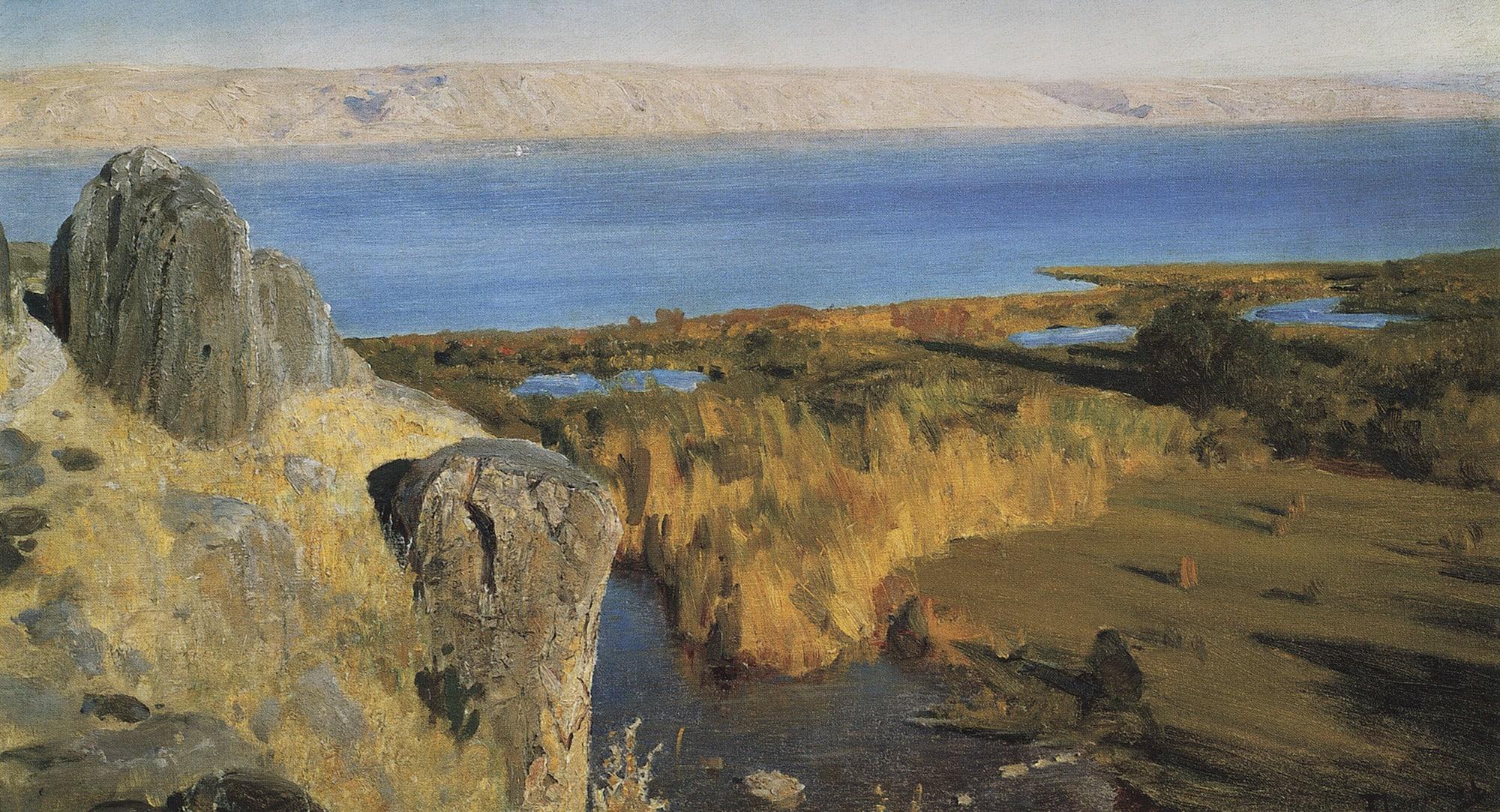
Vasily Polenov, Lake of Gennesaret, 1899. Public domain.
2 Samuel 13:37 · Place · Featured Study
Geshur
Geshur was a small kingdom east of the Jordan on the border of Bashan.
Now Absalom fled and went to Talmai son of Ammihud, the king of Geshur. But David mourned for his son every day.
- Region
- Geshur lay beside Maacah on the western edge of Bashan
- First named
- Deuteronomy 3:14 “…as the border of the Geshurites and Maacathites.…”
- Last named
- 1 Chronicles 3:2 “…daughter of King Talmai of Geshur; the fourth…”
Joab went to Geshur himself and brought Absalom back to Jerusalem.
Summary
Its king, Talmai, gave his daughter Maacah to David. Later he took in her son Absalom.
- Easton's Bible Dictionary puts Geshur near Gilead, between Hermon and the Lake of Tiberias.
- The Berean text names Geshur or the Geshurites in 14 verses.
- Absalom stayed three years in Geshur, from Amnon's death until Joab's plan.
Absalom's Refuge
Absalom left the land after Amnon's death because Israel's law offered him no shelter.
This study asks where Geshur lay, why Absalom went there and who its people were. It sets the kingdom on an atlas plate, follows the name through the record and weighs which Geshurites Joshua 13:2 means.
After Absalom had fled and gone to Geshur, he stayed there three years.Scripture gives the stay its length and nothing of what Absalom did there.
Jamieson, Fausset and Brown, the Scottish commentators, write that the law on a murderer gave Absalom no hope (Numbers 35:21). A city of refuge could not take him in, so he went to the court of his grandfather.
Strong's dictionary glosses the place as a district of Syria. In the Hebrew text the name Geshur stands 9 times and the people's name, Geshurite, 6 times.
The study of David tells the king whose son fled, and the study O Absalom, My Son follows the father's grief to its end.
Geshur on the Plate
George Adam Smith's plate of David's kingdom shows the small states north-east of Israel.
Maacah lies north of Geshur, and Bashan lies to its east.
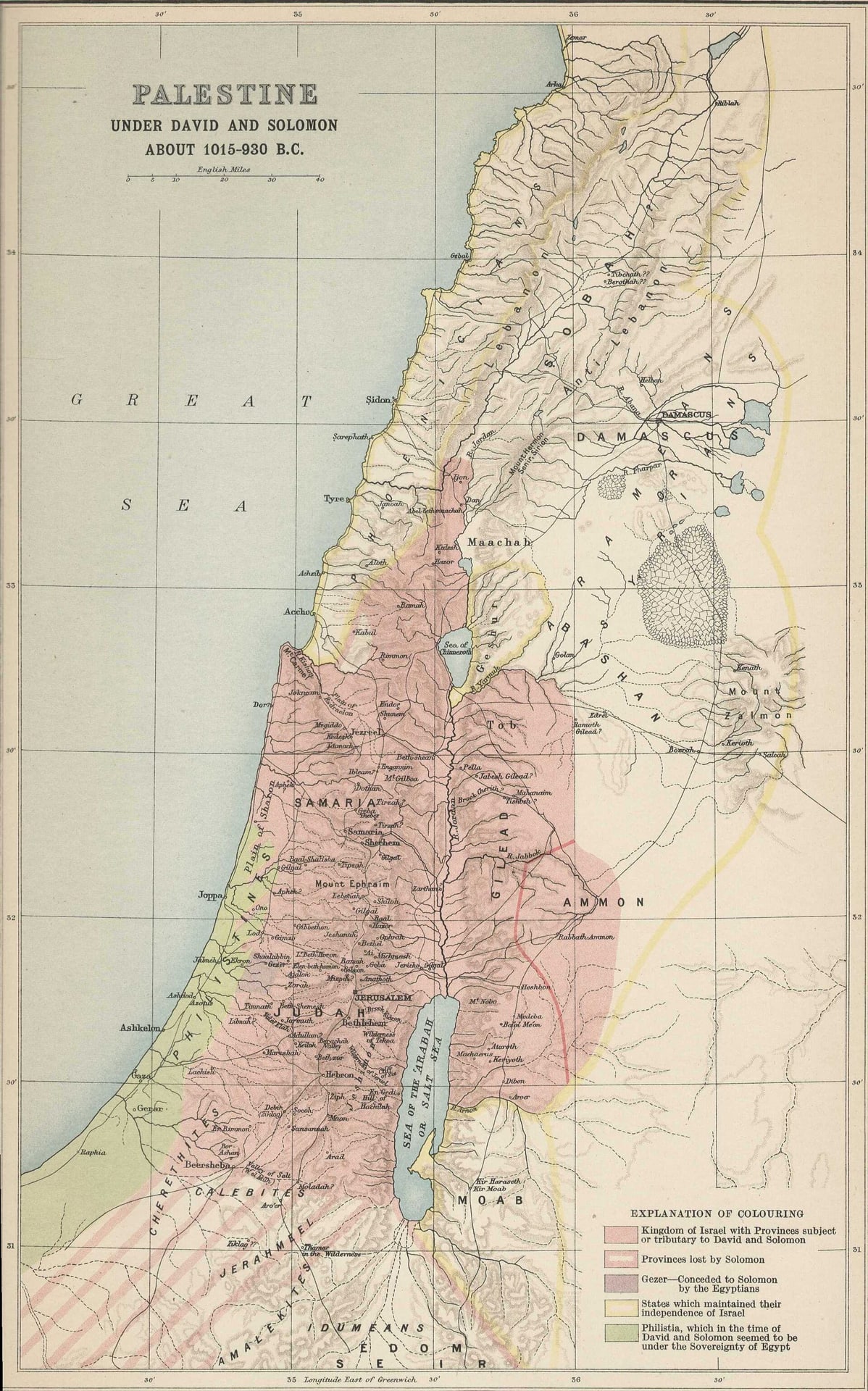
- Mount HermonJoshua lists the whole mountain with the land of the Geshurites and Maacathites. The plate letters it Mount Hermon, Senir, Sirion, the northernmost point.Joshua 13:11
- MaacahThe king of Maacah sent a thousand men to the Ammonites against David. The plate letters Maachah north of Geshur.2 Samuel 10:6
- GeshurAbsalom said he made his vow while he lived in Geshur. The plate letters Geshur along the east shore of the Sea of Chinneroth.2 Samuel 15:8
- BashanOg's Bashan reached as far as the Geshurite border. The plate prints Bashan east of Geshur, the easternmost point.Joshua 12:5
George Adam Smith, Palestine under David and Solomon, about 1015 to 930 B.C., in his Atlas of the Historical Geography of the Holy Land, 1915, engraved by John Bartholomew and Co. Public domain; File:John Bartholomew & Co., Palestine under David and Solomon about 1015 - 930 B.C (FL36567164 3907210).jpg.
Four numbered points, each where George Adam Smith's plate prints the place, with north at the top. The plate prints none of the four with a query.
One study teaches the mountain at the north end of Bashan.
Geshur in Scripture, in Order
Each of these verses names Geshur or its people.
Three of the four moments fall in the days of Moses and Joshua.
- The conquest east of the JordanJair of Manasseh takes the region of Argob as far as the border of the Geshurites and MaacathitesDeuteronomy 3:14
- The land that remainsJoshua is told that the territory of the Philistines and the Geshurites is still to be takenJoshua 13:3
- The land dividedIsrael does not drive out the Geshurites or the Maacathites, and they live among IsraelJoshua 13:13
- Absalom in JerusalemAbsalom asks why he was brought back from Geshur if he may not see the king2 Samuel 14:32
Four moments from Deuteronomy to 2 Samuel in the order of the canon, each with its verse.
The House of Talmai
Talmai's daughter married David, and the commentators weigh both the match and the name.
Jamieson, Fausset and Brown read David's marriage to Talmai's daughter as a political match. They hold that he sought a powerful ally in the north against Ish-bosheth's party.
John Gill, the Baptist commentator, notes on Joshua 13:13 that Geshur and Maacah later became kingdoms of their own. Scripture names a king of each in David's day.
Albert Barnes, the American commentator, notes on 2 Samuel 3:3 that one of the sons of Anak at Hebron was also named Talmai (Numbers 13:22). He suggests that the king of Geshur may have come of the same race.
What the Text Leaves Unsaid
Two things the record leaves blank are the kingdom's towns and Absalom's life there.
The 14 verses that name Geshur give no town of the kingdom. The narrative of 2 Samuel 13 and 14 moves from Absalom's flight to David's longing and to Joab's plan. They tell nothing of his days at Talmai's court.
The Banished One
Joab sent a wise woman from Tekoa to move the king to bring his son home.
The woman asked, “Why have you devised a thing like this against the people of God? When the king says this, does he not convict himself, since he has not brought back his own banished son?Her story of two sons was a parable aimed at the king.
For surely we will die and be like water poured out on the ground, which cannot be recovered. Yet God does not take away a life; but He devises ways that the banished one may not be cast out from Him.Her plea rests on what God does for those far from Him.
Voices on Geshur
Matthew Henry reads Absalom's vow as a show of religion, and Joshua 13:13 as a lesson about faith.
Matthew Henry (1662 to 1714)
“But how easy is it for children to take advantage of their good parents' credulity, and to impose upon them with the show of religion, while still they are what they were! David was overjoyed to hear that Absalom inclined to serve the Lord, and therefore readily gave him leave to go to Hebron, and to go thither with solemnity.”
Matthew Henry · Commentary on the Whole Bible · on 2 Samuel 15:7 to 8Puritan
“They had not leisure to reduce all the remote and obscure corners of the country in Moses's time, and afterwards they had no mind to it, being easy with what they had. Thus those who are not straitened in God's promises are yet straitened in their own faith, and prayers, and endeavours.”
Matthew Henry · Commentary on the Whole Bible · on Joshua 13:13Puritan
Which Geshurites Does Joshua 13:2 Mean?
Readers differ on whether the Geshurites of the land that remained were Talmai's people or another people in the south.
Now David and his men went up and raided the Geshurites, the Girzites, and the Amalekites. (From ancient times these people had inhabited the land extending to Shur and Egypt.)The southern reading leans on this verse more than on any other.
A southern people beside the PhilistinesAlbert Barnes, Adam Clarke and M. G. Easton
Barnes, on Deuteronomy 3:14, holds that the Geshurites of Joshua 13:2 were another people. He calls them neighbours of the Philistines. Adam Clarke, the Methodist commentator, places that Geshuri south of Canaan, toward Arabia or Egypt. Easton's Bible Dictionary reads it as the tribe David raided.
The objection: Joshua 13 names the Geshurites again at verses 11 and 13 and gives no sign that a second people is meant.
The people of the north-eastJohn Wesley, Explanatory Notes upon the Old Testament
John Wesley, the Methodist preacher, reads the Geshuri of Joshua 13:2 as a people in the north-east of Canaan, set over against the Philistines in the south-west.
The objection: Joshua 13:3 joins the Geshurites to the territory of the Philistines from the Shihor to Ekron.
The study of Aram weighs a second question, which Geshur Absalom fled to and whether it lay near Edom.
Brought Near
Absalom's return did not bring father and son together. Paul writes to Gentile believers of a homecoming that does.
But now in Christ Jesus you who once were far away have been brought near through the blood of Christ.Paul names the price of their welcome.
Sources
Scripture is the Berean Standard Bible.
- James Strong, Exhaustive Concordance of the Bible (1890), Hebrew dictionary, entries 1650 and 1651, with the occurrence counts of the site's lexicon.
- Jamieson, Fausset and Brown, Commentary Critical and Explanatory on the Whole Bible (1871), on 2 Samuel 13:37.
- Jamieson, Fausset and Brown, Commentary Critical and Explanatory on the Whole Bible (1871), on 2 Samuel 3:3.
- John Gill, Exposition of the Old Testament (1748 to 1763), on Joshua 13:13.
- Albert Barnes, Notes, Explanatory and Practical, on the Old and New Testaments (1832 to 1869), on 2 Samuel 3:3.
- Albert Barnes, Notes, Explanatory and Practical, on the Old and New Testaments (1832 to 1869), on Deuteronomy 3:14.
- Matthew Henry, Commentary on the Whole Bible (1710), on 2 Samuel 15:7 to 8.
- Matthew Henry, Commentary on the Whole Bible (1710), on Joshua 13:13.
- Adam Clarke, Commentary on the Bible (1832), on Joshua 13:2.
- John Wesley, Explanatory Notes upon the Old Testament (1765), on Joshua 13:2.
- M. G. Easton, Illustrated Bible Dictionary (1897), entries Geshur and Geshurites.
Keep Studying
Studies1