
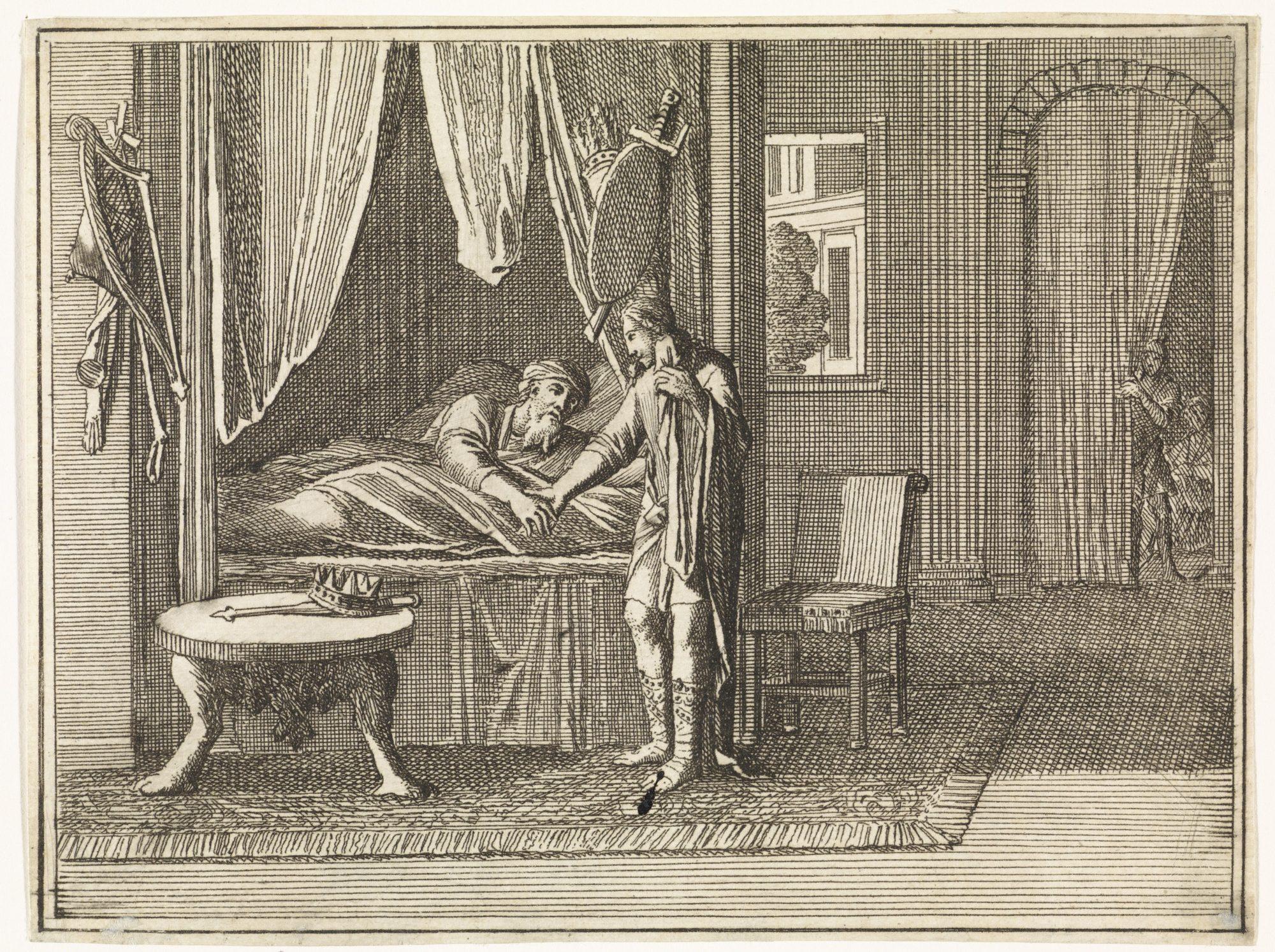
Caspar Luyken, David's Last Charge to Solomon, 1712. Public domain.
2 Samuel 23:1 to 7 · Passage · Featured Study
The Last Words of David
Second Samuel 23:1 to 7 is an oracle that its own title calls the last words of David.
The Spirit of the LORD spoke through me; His word was on my tongue.
- Books
- 2 Samuel, 1 Kings, 1 Chronicles
- When
- 1712
- Hold in memory
- 2 Samuel 23:2
The king who sang of his enemies closes on the ruler who rules in the fear of God.
Summary
The oracle speaks of the just ruler, of God's promise to David's house and of the end of the worthless. First Kings 2 and 1 Chronicles 28 to 29 each give a final charge of David's in another setting, and commentators read the title three ways.
- In 1 Kings 2 David charges Solomon to keep the Law of Moses and to deal with Joab and Shimei.
- In 1 Chronicles 28 he hands Solomon the plans of the temple before the leaders of Israel.
- Of the three accounts only the oracle is set in verse.
The Oracle of David
The title gives David four names before a word of the oracle is spoken.
The oracle follows the song David sang in 2 Samuel 22, and the roll of his mighty men follows it from 2 Samuel 23:8.
These are the last words of David: “The oracle of David son of Jesse, the oracle of the man raised on high, the one anointed by the God of Jacob, and the sweet psalmist of Israel:The title calls the words that follow an oracle.
The Hebrew word for oracle, ne'um, stands 376 times in the Hebrew text, by the count in Strong's dictionary. Albert Barnes notes that it is used between 200 and 300 times in the formula by which a prophet gives the word of the Lord.
The study of the Davidic covenant teaches the promise the oracle rests on, and the study of David teaches the life that ends here.
The Oracle in Five Parts
The oracle moves from the speaker to the word he heard, then to the ruler, the house and the worthless.
The just ruler stands at the centre, between the word from God and the house of David.
| Part | Verses | What the part says, in brief |
|---|---|---|
| 1 The speaker | 2 Samuel 23:1 | David son of Jesse, the man raised on high and anointed by the God of Jacob |
| 2 The word he heard | 2 Samuel 23:2 to 3a | The Spirit of the LORD speaks through David, and the Rock of Israel speaks to him |
| 3 The just ruler | 2 Samuel 23:3b to 4 | A just ruler is like the light of morning after rain |
| 4 The house | 2 Samuel 23:5 | David's family and its future under God |
| 5 The worthless | 2 Samuel 23:6 to 7 | The worthless are like thorns no hand can gather, and the fire burns them up |
Adam Clarke notes that 2 Samuel 23:6 has no word for sons. It names Belial, the good-for-nothing man, and the King James Version adds the word sons.
Three Scenes of David's Last Words
Samuel gives an oracle, Kings a private charge to Solomon, and Chronicles a charge before the whole assembly.
Each account gives David a different hearer and a different charge, and only Chronicles names the temple.
| Point | 2 Samuel 23:1 to 7 | 1 Kings 2:1 to 9 | 1 Chronicles 28 to 29 |
|---|---|---|---|
| Who hears | No hearer is named | Solomon his son | The leaders of Israel, the assembly and Solomon |
| The kind of words | An oracle in verse | A charge in prose | Two speeches, the plans of the temple and a prayer of blessing |
| The promise | Stated as a question | A man on the throne, if his sons walk faithfully | Solomon's kingdom established forever, if he keeps the commands |
| The enemies | None named, only a class of men | Joab and Shimei; kindness for the sons of Barzillai | No enemy is named |
| The temple | Not named | Not named | David gives the plans and his own gold and silver |
“I am about to go the way of all the earth. So be strong and prove yourself a man.Kings opens its charge with a command to Solomon about himself.
David also said to Solomon his son, “Be strong and courageous, and do it. Do not be afraid or discouraged, for the LORD God, my God, is with you. He will neither fail you nor forsake you before all the work for the service of the house of the LORD is finished.Chronicles gives the same command, tied to the work of the temple.
Is Not My House Right with God?
Two readings of the verse's first clause stand side by side.
Is not my house right with God? For He has established with me an everlasting covenant, ordered and secured in every part. Will He not bring about my full salvation and my every desire?The verse turns the oracle from the ruler to David's own house.
The King James Version reads the clause as a lament that David's house falls short with God. Albert Barnes, reading it so, takes David to set the troubles of his later years beside the righteous king of 2 Samuel 23:4.
Clarke proposed reading the Hebrew word for so as a word for established. He took the whole verse as a question that asks whether David's house is not established with God. The Berean text prints the clause as a question in the same way.
What the Text Leaves Unsaid
None of the accounts says which words came last in time.
The chapter gives no date for the oracle and no hearer. Kings and Chronicles do not mention the oracle, and neither says whether its charge came before or after the other.
Thus conclude the prayers of David son of Jesse.The Psalter marks its own end of David's prayers, and it does not name this oracle.
The Ruler in the Fear of God
Two commentaries of the nineteenth century read the just ruler of 2 Samuel 23:3 as the Messiah.
The God of Israel spoke; the Rock of Israel said to me, ‘He who rules the people with justice, who rules in the fear of God,The just ruler is the subject of the oracle's centre.
Keil and Delitzsch take the ruler, with the Chaldee rendering, as the Messiah himself, the righteous Shoot whom the LORD would raise up to David. Clarke writes that the Messiah seems to be the whole subject of these last words.
Behold, the days are coming, declares the LORD, when I will raise up for David a righteous Branch, and He will reign wisely as King and will administer justice and righteousness in the land.Keil and Delitzsch point to this verse.
Voices on the Last Words
John Wesley wrote on 2 Samuel 23:5 in his notes of 1765.
John Wesley (1703 to 1791)
Explanatory Notes upon the Old Testament
John Wesley, in his Explanatory Notes upon the Old Testament, read the words ordered and sure.
“It is ordered, well ordered in all things; admirably well, to advance the glory of God and the honour of the mediator, together with the holiness and happiness of believers. It is sure, and therefore sure, because well-ordered: the promised mercies are sure, on the performance of the conditions.”
on 2 Samuel 23:5Evangelical
How the Three Stand Together
Commentators read the title of 2 Samuel 23:1 as David's last song, his prophetic testament, or a compiler's heading, and each reading places Kings and Chronicles differently.
As the time drew near for David to die, he charged his son Solomon,The verse fixes the setting of the charge in Kings.
David son of Jesse was king over all Israel. The length of David’s reign over Israel was forty years—seven years in Hebron and thirty-three years in Jerusalem. He died at a ripe old age, full of years, riches, and honor, and his son Solomon reigned in his place.Chronicles closes the reign after the assembly and the anointing of Solomon.
His last words in verseAlbert Barnes and Adam Clarke
Albert Barnes reads the title as David's last psalm, his last words of song, and links it to the long song of 2 Samuel 22. Adam Clarke takes it as his last poetical composition. In his reading David may have spoken many words afterward in prose, and none in verse, so the charges of Kings and Chronicles can follow it.
The objection: 1 Chronicles 29:10 to 19 gives a prayer of blessing at the end of David's reign, and the reading must count that prayer as prose.
A prophetic testament at the close of his lifeKeil and Delitzsch, and Matthew Henry
Keil and Delitzsch call the passage the prophetic will and testament of the great king, a prophetic declaration uttered at the close of his life by divine inspiration. Matthew Henry sets it beside the recorded last words of Jacob and of Moses, as a legacy for those left behind. On this reading the oracle is David's testament as a prophet, and the charges are his orders as a king.
The objection: First Kings 2:1 places its charge at the time David was about to die, so the oracle cannot be the last thing he said in every sense.
A heading set by the compilerJamieson, Fausset and Brown
Jamieson, Fausset and Brown hold that the statement came from the compiler or collector of the canon. They report a view that, since the Hebrew Scriptures had no chapter divisions, the heading marks what follows as no part of the song before it. The reading leaves the order of the three scenes open.
The objection: the heading calls the words last, which a mark of division alone would not need to say.
Books to Read Next
Both works are in the public domain.
Biblical Commentary on the Books of Samuel
C. F. Keil and F. Delitzsch · 1880
Keil reads the oracle as David's prophetic testament and weighs each line of the Hebrew.
Read at the Internet ArchiveCommentary on the Bible
Adam Clarke · 1832
Clarke proposes the question of 2 Samuel 23:5 and reads the oracle as a prediction of the Messiah's kingdom.
Light After Rain
The songs of David in 2 Samuel end on this picture.
is like the light of the morning at sunrise of a cloudless dawn, the glistening after the rain on the sprouting grass of the earth.’The verse gives the morning picture in full.
Sources
Scripture is the Berean Standard Bible.
- King James Version, 2 Samuel 23:1 to 7.
- Strong's dictionary in the site's lexicon, entry h5002, with its count of the Hebrew text.
- Albert Barnes, Notes, Explanatory and Practical, on the Old and New Testaments (1832 to 1869), on 2 Samuel 23:1.
- Albert Barnes, Notes, Explanatory and Practical, on the Old and New Testaments (1832 to 1869), on 2 Samuel 23:5.
- Adam Clarke, Commentary on the Bible (1832), on 2 Samuel 23:1.
- Adam Clarke, Commentary on the Bible (1832), on 2 Samuel 23:4.
- Adam Clarke, Commentary on the Bible (1832), on 2 Samuel 23:5.
- Adam Clarke, Commentary on the Bible (1832), on 2 Samuel 23:6.
- Matthew Henry, Commentary on the Whole Bible (1710), on 2 Samuel 23:1.
- Jamieson, Fausset and Brown, Commentary Critical and Explanatory on the Whole Bible (1871), on 2 Samuel 23:1.
- C. F. Keil and F. Delitzsch, Biblical Commentary on the Books of Samuel (Edinburgh: T. and T. Clark, 1880), on 2 Samuel 23:1 to 7.
- John Wesley, Explanatory Notes upon the Old Testament (1765), on 2 Samuel 23:5.
Keep Studying
Read it4
People and groups4
Subjects1