
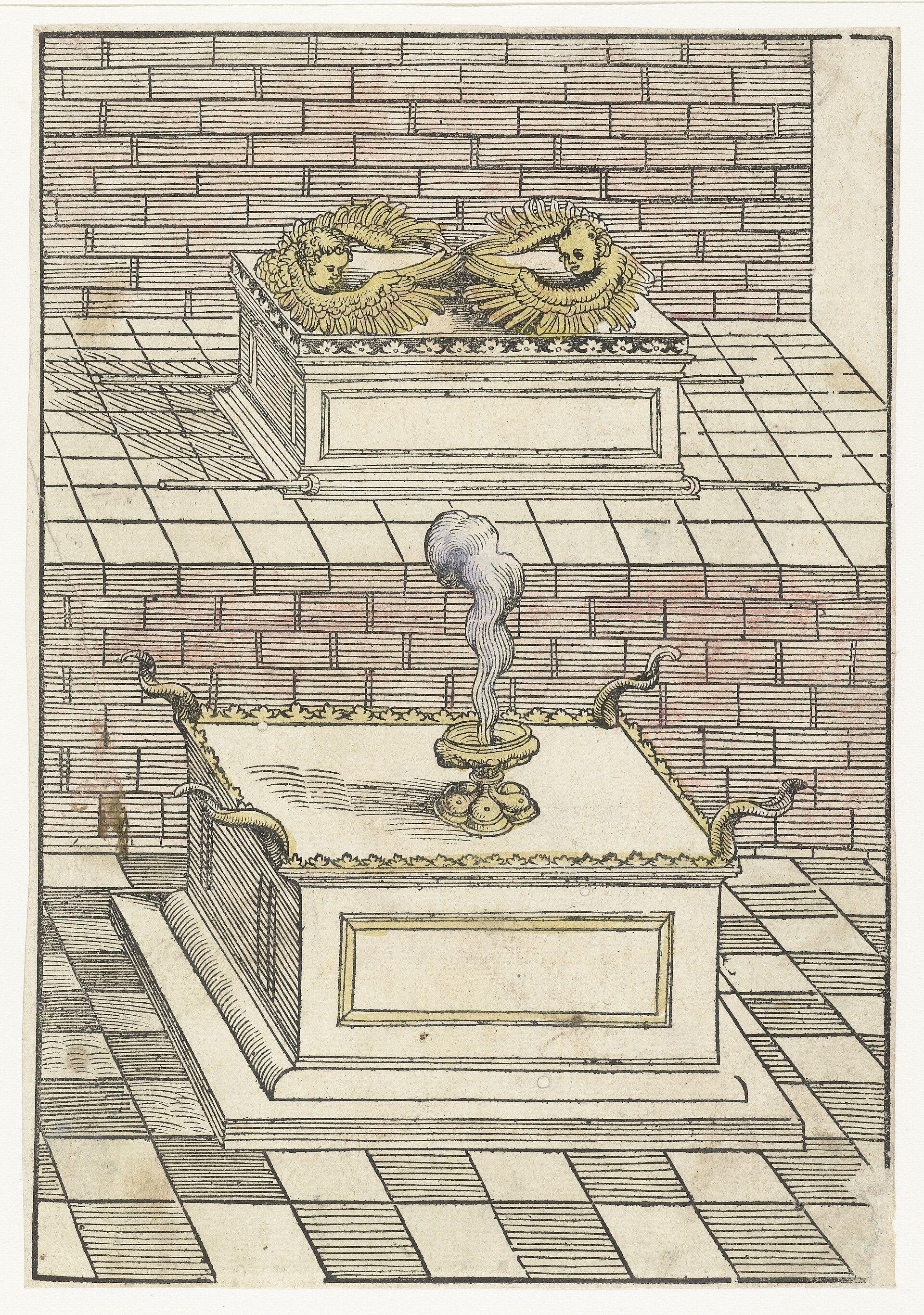
Lucas Cranach the Elder, The Ark of the Covenant and the Altar of Incense, 1523 to 1526. Public domain.
Malachi 1:11 · Passage · Featured Study
The Pure Offering Among the Nations
The LORD meets each question of the priests with a charge in Malachi 1:6 to 14.
The priests of the temple turned up their noses at the altar of the LORD.
For My name will be great among the nations, from where the sun rises to where it sets. In every place, incense and pure offerings will be presented in My name, because My name will be great among the nations,” says the LORD of Hosts.
For My name will be great among the nations, from where the sun rises to where it sets. In every place, incense and pure offerings will be presented in My name, because My name will be great among the nations,” says the LORD of Hosts.
- The passage
- Malachi 1:6 to 14
- Book
- Malachi
- Hold in memory
- Malachi 1:11
Summary
Malachi rebukes priests who gave the LORD their worst animals. The rebuke holds a promise that readers took in three ways.
- Leviticus 22:20 banned any gift with a defect.
- Aaron burned incense on the gold altar each morning and evening.
- The Didache and Justin Martyr applied the verse to the Lord's Supper.
The Verse in Its Charge
The verses before and after the promise speak to the temple's priests.
“A son honors his father, and a servant his master. But if I am a father, where is My honor? And if I am a master, where is your fear of Me?” says the LORD of Hosts to you priests who despise My name. “But you ask, ‘How have we despised Your name?’The charge opens with this verse, which names the priests as the ones who despise His name.
The LORD answers their question with a list of what they put on His altar. In Malachi 1:10 He wishes that someone would shut the temple doors, and He says He will accept no offering from their hands.
“But you profane it when you say, ‘The table of the Lord is defiled, and as for its fruit, its food is contemptible.’The priests' contempt for the altar follows the promise at once, so the two stand side by side.
From Sunrise to Sunset
Scripture follows the praise of the LORD from Israel's psalms to the incense before the throne.
Each step speaks of praise, prayer or an offering given to the LORD.
- Psalm 141:2David asks that his prayer rise like incense.Psalm 141:2
- Isaiah 66:20Survivors sent to the nations bring Israel's brothers to Jerusalem as a gift.Isaiah 66:20
- Malachi 1:11The worship of the nations is set against the priests' gifts.Malachi 1:11
- John 4:23True worshipers worship the Father in spirit and truth.John 4:23
- Romans 15:16Paul serves so that the Gentiles become an acceptable offering.Romans 15:16
- Hebrews 13:15Believers offer God a sacrifice of praise through Jesus.Hebrews 13:15
- Revelation 8:4The incense rises with the prayers of the saints before God.Revelation 8:4
Seven steps, in the order of the books.
What the Priests Brought
The charge names the animals the priests offered and sets each beside the LORD's answer.
The four charges run from defiled food to a broken vow.
| What the priests did | What the LORD says of it |
|---|---|
| They presented defiled food on His altar. | In this they despised His name. |
| They offered blind, lame and sick animals. | Their governor would not accept such gifts. |
| They brought stolen, lame and sick animals and called the service a nuisance. | He asks whether He should accept them from their hands. |
| A man vowed a sound male and sacrificed a defective one. | He calls the man a deceiver under a curse, because He is a great King. |
The word for governor in Malachi 1:8 is the title Nehemiah 5:14 gives Nehemiah under King Artaxerxes of Persia.
Three Words of Worship
Three Hebrew words of the temple carry the promise.
qatar
116 uses in the canon
Qatar means to turn into smoke by fire, the verb behind the incense of the verse.
minchah
211 uses in the canon
Minchah is a gift or offering, the grain offering of the law and the offering of this verse.
tahor
94 uses in the canon
Tahor means pure or clean, the word for the pure gold of the tabernacle.
Voices on the Pure Offering
Two teachers, of the fourth century and the eighteenth, explain what the promise meant for the priests who heard it.
John Chrysostom (died 407)
John Chrysostom set the verse against the sacrifices of the temple.
“Scripture did not pass over in silence the rejection of the Jews. Notice how the prophet Malachi foretold this too. ‘Behold, among you the doors will be shut, and fire will not be kindled on my altar for anything.’ He also foretold who would now pay God worship. ‘From the rising of the sun to its going down, my name has been glorified among the nations.’ And again he said, ‘And in every place incense is offered to me and a pure sacrifice.’ Do you see how he made clear the nobility of worship? How he showed that the new worship had a special honor and differed from the old? Worship will not be confined to a place or a way of sacrifice, nor will it consist in savor or smoke or omens; it will be a different ritual.”
John Chrysostom · Demonstration Against the Pagans 7:1 · on Malachi 1:10Patristic
Matthew Henry (1662 to 1714)
Matthew Henry answered a fear that the priests' failure might raise.
“It might be said, ‘If these are not the worshippers whom God will accept, then he has no worshippers.’ As if he must make the best of their service, or else he would have no service done him; and then what will he do for his great name? But let him alone for that; though Israel be not faithful, be not gathered, yet God will be glorious.”
Matthew Henry · Commentary on the Whole Bible · on Malachi 1:11Puritan
How the Offering Has Been Read
Readers from the first century to the nineteenth name what the offering is.
The worship of the nations under the gospelAlbert Barnes; Adam Clarke
Albert Barnes wrote that the form of the words leaves the time open, but that the things spoken of show it to be future. He added that the sacrifices of Jerusalem could never be the religion of the world, because they were fixed to one place.
Adam Clarke read the verse as a foretelling of spiritual worship over the whole earth, with the Lamb without spot as its offering.
The Lord's SupperThe Didache; Justin Martyr
The Didache, a church manual of about the year 100, applies the verse to the bread broken on the Lord's day.
“But every Lord's day do ye gather yourselves together, and break bread, and give thanksgiving after having confessed your transgressions, that your sacrifice may be pure. But let no one that is at variance with his fellow come together with you, until they be reconciled, that your sacrifice may not be profaned. For this is that which was spoken by the Lord: In every place and time offer to me a pure sacrifice; for I am a great King, saith the Lord, and my name is wonderful among the nations.”
Didache · The Didache, Chapter 14 · on Malachi 1:11 to 14Patristic
Justin Martyr, in his Dialogue with Trypho, read the Gentiles' offering in every place as the bread and the cup of the Eucharist.
Prayer and praiseJohn Wesley; Jamieson, Fausset and Brown
John Wesley called the incense a law term for a gospel duty, the prayers and praises of the church. Jamieson, Fausset and Brown took the incense as prayer, citing Psalm 141:2, and allowed the reference to the Lord's Supper held by many of the fathers as a spiritual offering.
A Holy Priesthood
The New Testament calls the whole church to worship as priests.
you also, like living stones, are being built into a spiritual house to be a holy priesthood, offering spiritual sacrifices acceptable to God through Jesus Christ.Peter names the sacrifices God accepts from His people now.
Therefore I urge you, brothers, on account of God’s mercy, to offer your bodies as living sacrifices, holy and pleasing to God, which is your spiritual service of worship.Paul asks for the whole life as the offering that pleases God.
Malachi's charge asks the reader to bring the LORD the best and to honor His name.
Sources
Scripture is the Berean Standard Bible.
- The Hebrew text of Malachi 1:11, word by word, with Strong's numbers.
- Strong's Hebrew lexicon, the counts of uses.
- The notes of the commentators and the fathers on Malachi 1 to 4.
- John Chrysostom, Demonstration against the Pagans 7:1 (407), on Malachi 1:10.
- Matthew Henry, Commentary on the Whole Bible (1710), on Malachi 1:11.
- Albert Barnes, Notes, Explanatory and Practical (1832 to 1869), on Malachi 1:11.
- Adam Clarke, Commentary on the Bible (1832), on Malachi 1:11.
- The Didache, chapter 14 (about 100)
- Justin Martyr, Dialogue with Trypho, chapter 41 (165)
- John Wesley, Explanatory Notes upon the Old Testament (1765), on Malachi 1:11.
- Jamieson, Fausset and Brown, Commentary Critical and Explanatory on the Whole Bible (1871), on Malachi 1:11.
Keep Studying
Studies1
Doctrines8
Go further7