
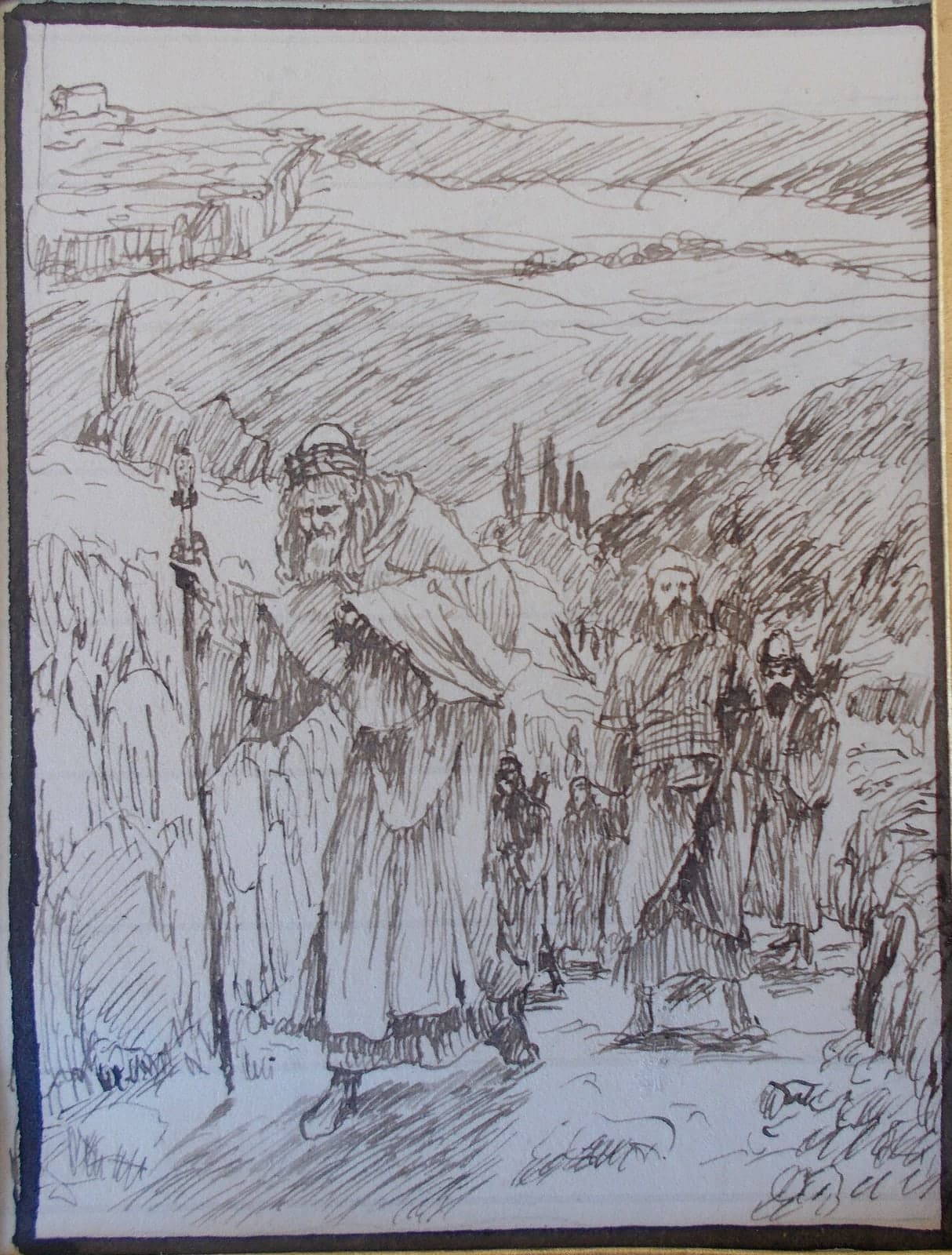
2 Samuel 15 · Story · Loyalty
Ittai the Gittite
Ittai, a Philistine from Gath, refused to leave King David when David fled Jerusalem from Absalom.
David's flight from Jerusalem divided his people into those who stayed, those who went over to his son and those who went with him.
But Ittai answered the king, “As surely as the LORD lives, and as my lord the king lives, wherever my lord the king may be, whether it means life or death, there will your servant be!”
- Where
- Jerusalem, Gath
- Who
- David
Summary
2 Samuel 15 sets loyalty and betrayal side by side on the day King David fled from his son Absalom. Among those who went out with David was Ittai the Gittite, a foreigner who had joined him only the day before. The same chapter records the choices of two of David's counsellors, Ahithophel and Hushai.
- Six hundred Gittites, men of Gath, marched past David as he left the city (2 Samuel 15:18).
- Ittai the Gittite is another man than Ittai son of Ribai, one of David's mighty men (2 Samuel 23:29).
- Ahithophel hanged himself when Absalom took Hushai's advice over his (2 Samuel 17:23).
The King Leaves Jerusalem
The revolt that drove David out was led by his own son.
Ittai the Gittite studies 2 Samuel 15, the chapter of David's flight from Jerusalem before his son Absalom. It belongs to the value of loyalty, because it shows the loyalty of a foreigner, which the vow of Ruth the Moabite also shows.
The question the study answers is what David asked of Ittai and what Ittai gave him. It tells the account in its order and reads David's blessing. It then sets Ittai beside two counsellors and gives one question on which readers have differed.
Absalom met every man with a grievance before the king could hear him, and so drew the people to himself (2 Samuel 15:2 to 6). He went to Hebron on the plea of a vow and sent for Ahithophel the Gilonite, David's counsellor (2 Samuel 15:7 to 12).
Then a messenger came to David and reported, “The hearts of the men of Israel are with Absalom.” And David said to all the servants with him in Jerusalem, “Arise and let us flee, or we will not escape from Absalom! We must leave quickly, or he will soon overtake us, heap disaster on us, and put the city to the sword.”The report and the order to flee open the account, since everything Ittai does takes place on the road out of the city.
The Story in Ten Events
Ten events from 2 Samuel 15 to 2 Samuel 18 frame Ittai's choice.
The flight runs from Absalom's proclamation at Hebron to David's orders for the battle.
- Absalom is proclaimed king at Hebron“Absalom reigns in Hebron!”2 Samuel 15:10
- David's servants pledge to go with him“we are your servants.”2 Samuel 15:15
- David leaves the city with his household“his entire household followed him”2 Samuel 15:16
- Six hundred men of Gath march past the king“six hundred Gittites who had followed him”2 Samuel 15:18
- Zadok and the Levites bring out the ark“carrying the ark of the covenant of God”2 Samuel 15:24
- The priests take the ark back to the city“returned the ark of God to Jerusalem”2 Samuel 15:29
- Hushai reaches Jerusalem as Absalom enters“David’s friend Hushai arrived in Jerusalem”2 Samuel 15:37
- Absalom and Ahithophel come into Jerusalem“and Ahithophel was with him.”2 Samuel 16:15
- David reviews his troops“Then David reviewed his troops”2 Samuel 18:1
- David charges his three commanders about Absalom“Treat the young man Absalom gently”2 Samuel 18:5
A timeline of ten events in 2 Samuel 15, 2 Samuel 16 and 2 Samuel 18, each with words of the Berean text and its verse.
Hushai reaches Jerusalem as Absalom enters, Absalom and Ahithophel come into Jerusalem, David reviews his troops, David charges his three commanders about Absalom
The Charge and the Oath
David gave Ittai leave to go back, and Ittai answered him with an oath.
Then the king said to Ittai the Gittite, “Why should you also go with us? Go back and stay with the new king, since you are both a foreigner and an exile from your homeland. In fact, you arrived only yesterday; should I make you wander around with us today while I do not know where I am going? Go back and take your brothers with you. May the LORD show you loving devotion and faithfulness.”David's charge stands here because it frees Ittai from any duty to stay, which is what makes his answer loyalty.
The blessing at the end of the charge, “loving devotion and faithfulness”, renders the Hebrew words chesed and emet. The tagged Hebrew text has the same pair in the LORD's own name in Exodus 34:6.
David accepted the oath, “March on then,” and Ittai marched past “with all his men and all the little ones who were with him” (2 Samuel 15:22). The whole countryside wept as the people passed and the king crossed the Kidron toward the wilderness (2 Samuel 15:23).
Men of Gath in David's Service
The six hundred Gittites of 2 Samuel 15:18 marched beside the Cherethites and Pelethites.
So David set out with his six hundred men and went to Achish son of Maoch, the king of Gath.The verse shows where David's tie to Gath began, in the years he lived under its king with six hundred men.
Albert Barnes held that David gathered such a band during his years among the Philistines. In his reading, “after the settlement of his kingdom, and the subjugation of the Philistines, the band received recruits from Gath”.
Ittai the Gittite is named in six verses of the Berean text, three in 2 Samuel 15 and three in 2 Samuel 18.
Two Counsellors in the Same Chapter
David's counsellor and David's friend took opposite sides on the same day.
On the Mount of Olives David was told, “Ahithophel is among the conspirators with Absalom,” and he prayed that the LORD would turn Ahithophel's counsel into foolishness (2 Samuel 15:31).
At the summit Hushai the Archite met him with his robe torn and dust on his head. David sent him back to pretend to serve Absalom and so thwart Ahithophel (2 Samuel 15:32 to 34).
“Is this the loyalty you show your friend?” Absalom replied. “Why did you not go with your friend?”Absalom's question uses the word loyalty of the very man who was keeping faith with David against him.
Ahithophel's counsel came to nothing, as David had prayed. When Absalom chose Hushai's advice over Ahithophel's, the text says, “the LORD had purposed to thwart the good counsel of Ahithophel in order to bring disaster on Absalom” (2 Samuel 17:14).
A Foreigner's Loyalty
Ittai's answer to David follows the same shape as Ruth's answer to Naomi.
Both were foreigners told to go back to their own. Naomi told Ruth, “follow her back home” (Ruth 1:15), and David told Ittai to return to the new king (2 Samuel 15:19).
Both answered by naming a place they would share. Ruth said, “wherever you go, I will go” (Ruth 1:16), and Ittai swore to be wherever the king might be (2 Samuel 15:21).
Both swore by the LORD and both spoke of death. For Ruth it was the one thing that could part her from Naomi, and for Ittai a fate he would share with the king.
Was David Right to Send Hushai Back to Deceive?
Two commentators judged the ruse David gave Hushai in two ways.
The question is whether David did right to send Hushai into Absalom's court with a false promise of service (2 Samuel 15:34).
A sin of David's that God turned to goodJohn Wesley
John Wesley, in his Explanatory Notes upon the Old Testament (1765), wrote that “David's suggesting this crafty counsel must be reckoned amongst his sins. Nevertheless God was pleased to direct this evil advice to a good end.”
The objection: the narrator records the ruse without a word of blame.
Hard to justify, though a rebel must guard himself against allMatthew Henry
Matthew Henry, in his Commentary on the Whole Bible (1710), wrote, “How this gross dissimulation, which David put Hushai upon, can be justified, as a stratagem in war, I do not see.”
The best he could offer was that Absalom, as a rebel, “must stand upon his guard against all mankind, and, if he will be deceived, let him be deceived.”
The objection: the defence Henry offers rests on no word of the text.
A Third Under Ittai
The account closes three chapters later, before the battle.
He sent out the troops, a third under Joab, a third under Joab’s brother Abishai son of Zeruiah, and a third under Ittai the Gittite. And the king said to the troops, “I will surely march out with you as well.”The verse stands last because it puts the foreigner David had tried to send home at the head of a third of his army.
Sources
Scripture is the Berean Standard Bible.
- STEP Bible, Translators Amalgamated Hebrew Old Testament, the tagged Hebrew text (Tyndale House, Cambridge), CC BY 4.0.
- Matthew Henry, Commentary on the Whole Bible (1710), on 2 Samuel 15:34.
- John Wesley, Explanatory Notes upon the Old Testament (1765), on 2 Samuel 15:34.
- Albert Barnes, Notes, Explanatory and Practical, on the Old and New Testaments (1832 to 1869), on 2 Samuel 15:18.
Keep Studying
Read it1
In this value2
People and groups5
Doctrines1