
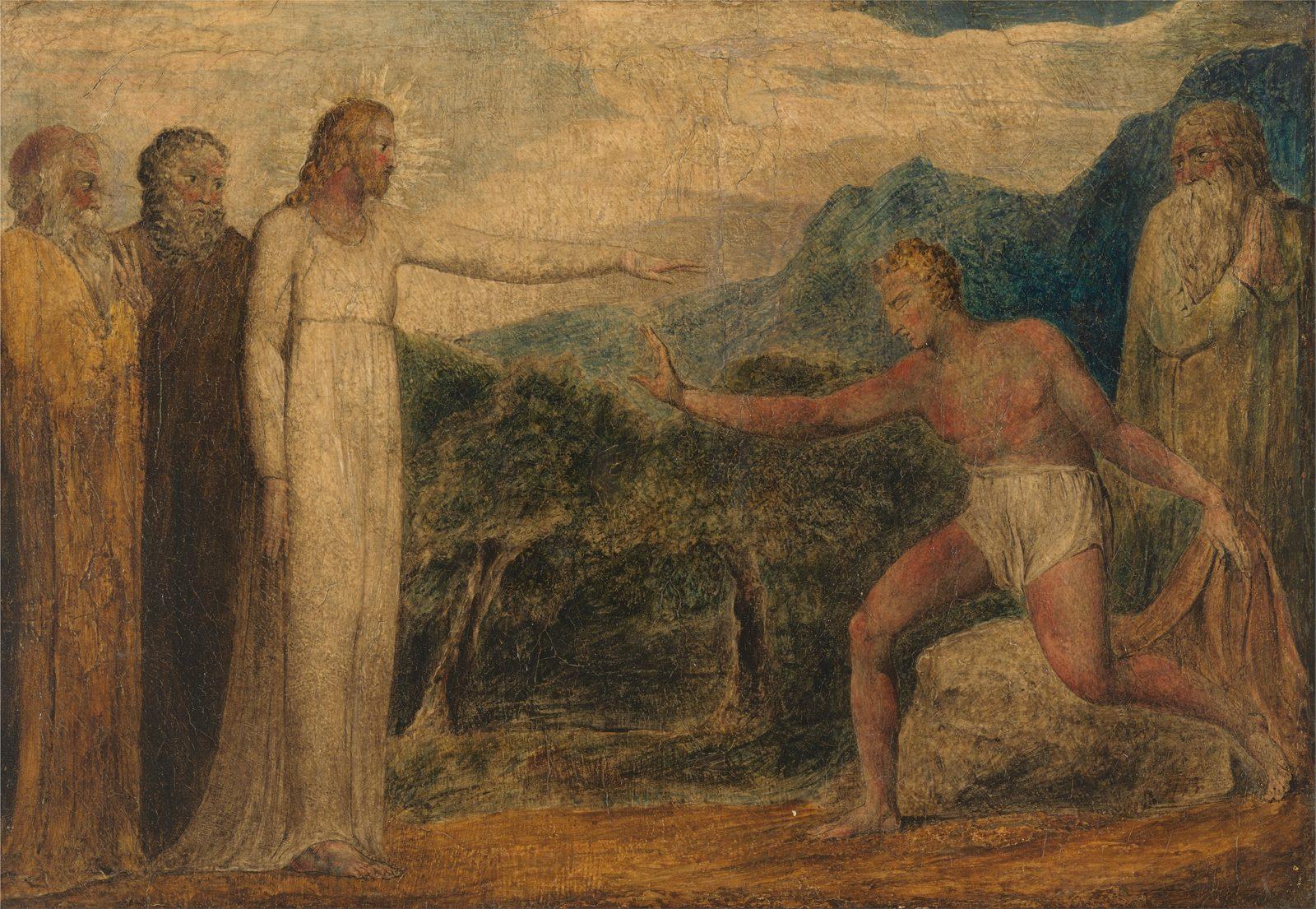
William Blake, Christ Giving Sight to Bartimaeus, 1799 to 1800. Public domain.
Numbers 22:1 · Place · Featured Study
Jericho
Moses saw the valley of Jericho from the top of Pisgah (Deuteronomy 34:1 to 3).
Then the Israelites traveled on and camped in the plains of Moab near the Jordan, across from Jericho.
- Region
- The Jordan valley, north-west of the Salt Sea
- First named
- Numbers 22:1 “…near the Jordan, across from Jericho.”
- Last named
- Hebrews 11:30 “By faith the walls of Jericho fell, after…”
Numbers names Jericho nine times, always as the landmark across the Jordan from Israel's camp or from the land of the eastern tribes.
Summary
59 verses of the Berean text name Jericho.
- The men of Jericho fought Israel (Joshua 24:11).
- 345 men of Jericho came home from exile (Ezra 2:34; Nehemiah 7:36).
- Babylon's army caught King Zedekiah in the plains of Jericho (2 Kings 25:5; Jeremiah 39:5).
The City of Palms
Four verses of the Berean text use the name City of Palms, in Deuteronomy, Judges and 2 Chronicles.
Is the City of Palms of Judges the same place as Jericho? 2 Chronicles 28:15 calls Jericho the City of Palms when the men of Samaria bring the captives of Judah there. Judges 1:16, and Judges 3:13 in the story of Ehud, name the City of Palms and never Jericho. Adam Clarke, on Judges 1:16, takes the City of Palms there to be some place near Jericho, and suggests that Jericho, though destroyed by Joshua, might have had suburbs remaining where the Kenites lived.
Jericho on Fuller's Plate
On the plate Benjamin palms ring the walled city.
Ten marks on Fuller's plate of Benjamin, from Bethel to Jerusalem.
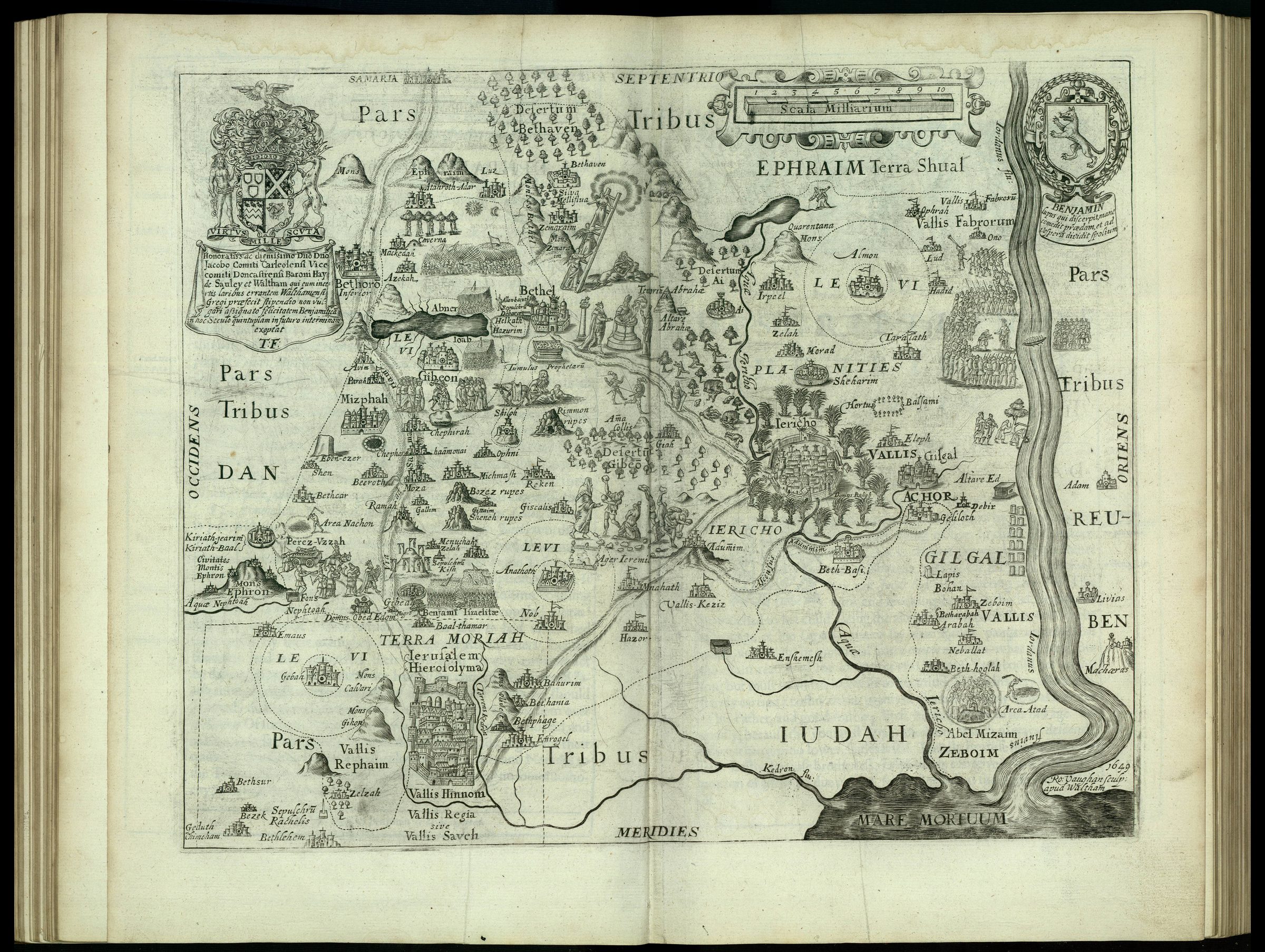
- JerichoThe plate prints Iericho in a ring of palms, with the brook it calls Aqua Iericho running south. OpenBible rates the identification known.Joshua 16:1
- Rahab's houseThe plate writes Domus Rahab inside the wall, the house of Joshua 2:15.Joshua 2:15
- GilgalThe plate prints Gilgal east of the city, between it and the river. OpenBible rates the identification probable.Joshua 4:19
- The JordanThe plate draws the Iordanus down its east edge. OpenBible rates the identification known.Joshua 3:16
- Salt SeaThe plate prints Mare Mortuum south of the plain. OpenBible rates the identification known.Joshua 3:16
- Ascent of AdummimThe plate prints Adumim on a hill south-west of the city. OpenBible rates the identification known.Joshua 18:17
- JerusalemThe plate draws Ierusalem as a walled city at its lower left, south-west of Jericho. OpenBible rates the identification known.Joshua 18:28
- BethelThe plate prints Bethel north-west of Jericho, beside a ladder with angels on it. OpenBible rates the identification probable.Joshua 16:1
- Elisha and the bearsThe plate draws the boys and the two bears of 2 Kings 2:24 by the road toward Bethel.2 Kings 2:24
- The plainThe plate writes Planities, the plain, north of the city; OpenBible has no entry for the plains of Jericho.Joshua 5:10
Thomas Fuller, Benjamin, A Pisgah-Sight of Palestine, 1650; the plate signed 1649, Ro: Vaughan sculp:. Public domain (PD-old-assumed); Eran Laor Cartographic Collection, National Library of Israel; Wikimedia Commons, File:Thomas_Fuller,_Benjamin_(FL199985416_2368565).jpg.
Ten marks are numbered where the plate prints them. The plate is a seventeenth-century maker's drawing of the land, with scenes from several books. Each label gives what the plate shows and its verse. A place with its own entry in the OpenBible gazetteer also carries that entry's rating of its modern identification. North is at the top, and the plate is not to a modern scale.
Jericho Through the Books
After Joshua 6 the city stands in the allotments, the kings and the rebuilding of Jerusalem's wall.
Joshua 6 tells how the walls fell and the city was devoted to the LORD, with Joshua's oath over the ruin. The OpenBible gazetteer takes the mound of Tell es-Sultan for the city, and the mound has been excavated more than once.
Six verses from Joshua 16 to Nehemiah 3 set Jericho in Israel's later history.
- JoshuaJoseph's allotment starts from the Jordan at JerichoJoshua 16:1
- JoshuaJericho heads the list of the cities of BenjaminJoshua 18:22
- 2 SamuelDavid tells his envoys to stay in Jericho until their beards have grown back2 Samuel 10:5
- 1 KingsHiel the Bethelite rebuilds Jericho at the cost of his firstborn and his youngest1 Kings 16:34
- 2 KingsThe sons of the prophets at Jericho speak with Elisha before Elijah is taken2 Kings 2:5
- NehemiahThe men of Jericho build next to EliashibNehemiah 3:2
Each row gives its verse in the Berean text.
Jericho in the Gospels
Matthew, Mark and Luke each give their own count; Luke alone sets it as Jesus drew near.
Matthew 20:29 to 30 tells of two blind men by the road as Jesus was leaving Jericho. Mark 10:46 names one blind beggar, Bartimaeus son of Timaeus, also as Jesus was leaving the city. Luke 18:35 sets a blind man beside the road as Jesus drew near to Jericho. Luke 19:1 to 10 then brings Jesus into the city to the house of Zacchaeus, a chief tax collector.
The Spring Elisha Healed
The men of the city told Elisha that its location was good and its water bad (2 Kings 2:19).
and Elisha went out to the spring, cast the salt into it, and said, “This is what the LORD says: ‘I have healed this water. No longer will it cause death or unfruitfulness.’”Elisha speaks in the first person for God, so the healing is God's act.
Albert Barnes, on 2 Kings 2:21, takes the spring to be probably the one now called Ain es-Sultan. He describes it as a large fountain of sweet water not much more than a mile from the site of the old town. On 2 Kings 2:20 he reads the new bowl and the salt as signs of purity.
Flavius Josephus, in the Wars of the Jews, Book 4, chapter 8, section 3 in William Whiston's translation, tells how Elisha healed the fountain by Jericho with an earthen vessel full of salt. He says its water ran over a plain seventy furlongs long and twenty broad, full of palm trees and balsam. Fuller plants a garden of balsam, Hortus Balsami, beside the city on his plate.
What Scripture Leaves Unsaid
Two questions of place stay open in the text.
Judges does not say where Eglon's City of Palms stood.
The Gospels do not say whether the town Jesus passed through stood on the old mound.
By Faith the Walls Fell
The letter to the Hebrews names the city once.
Matthew Henry on Jericho
Both quotations come from Matthew Henry's Commentary on the Whole Bible.
Matthew Henry (1662 to 1714)
On Luke 19:1, where Jesus enters Jericho, Matthew Henry writes:
“This city was build under a curse, yet Christ honoured it with his presence, for the gospel takes away the curse. Though it ought not to have been built, yet it was not therefore a sin to live in it when it was built.”
Matthew Henry · Commentary on the Whole Bible · on Luke 19:1Puritan
On Luke 10:30, the road from Jerusalem down to Jericho, he writes:
“The mentioning of those places intimates that it was matter of fact, and not a parable; probably it happened lately, just as it is here related. The occurrences of Providence would yield us many good instructions, if we would carefully observe and improve them, and would be equivalent to parables framed on purpose for instruction, and be more affecting.”
Matthew Henry · Commentary on the Whole Bible · on Luke 10:30Puritan
Your Faith Has Healed You
Mark 10:46 sets the healing of Bartimaeus, which Blake painted, at Jericho. There Bartimaeus called Jesus the Son of David and asked Him for mercy (Mark 10:47 to 48).
“Go,” said Jesus, “your faith has healed you.” And immediately he received his sight and followed Jesus along the road.Jesus gives the healing to the man's trust, and the man goes on with Him.
Sources
Scripture is the Berean Standard Bible.
- OpenBible.info, Bible Geocoding Data, ancient places (CC BY 4.0)
- Flavius Josephus, The Wars of the Jews, Book 4, chapter 8, section 3, translated by William Whiston, Project Gutenberg text 2850.
- Adam Clarke, Commentary on the Bible, on Judges 1:16.
- Albert Barnes, Notes, Explanatory and Practical, on the Old and New Testaments, on 2 Kings 2:21.
- Albert Barnes, Notes, Explanatory and Practical, on the Old and New Testaments, on 2 Kings 2:20.
- Matthew Henry, Commentary on the Whole Bible, on Luke 19:1.
- Matthew Henry, Commentary on the Whole Bible, on Luke 10:30.
Keep Studying
Read it4
Studies7
People and groups4
Go further3