
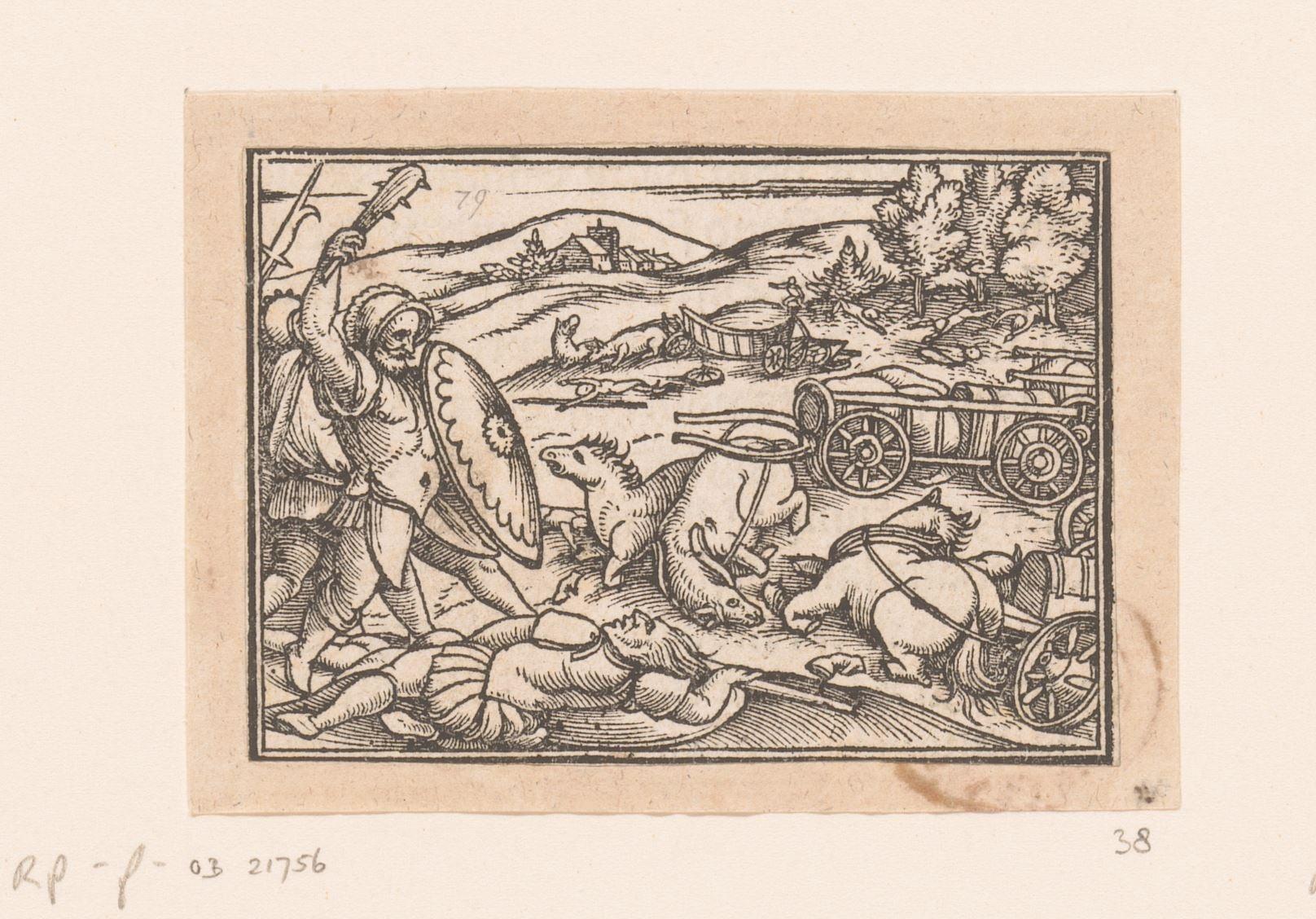
Anonymous woodcut after Hans Holbein, Troepen van David veroveren de strijdwagen van de koning van Zoba, 1552. CC0.
1 Samuel 14:47 · Place · Featured Study
Zobah
Zobah was an Aramean kingdom whose armies fought David north of Israel (2 Samuel 8:3 to 5).
After Saul had assumed the kingship over Israel, he fought against all his enemies on every side—the Moabites, the Ammonites, the Edomites, the kings of Zobah, and the Philistines. Wherever he turned, he routed them.
- Today
- The land from the eastern slopes of Lebanon toward the Euphrates, by Easton's description
- Region
- Aram, north of Damascus
- First named
- 1 Samuel 14:47 “…the Edomites, the kings of Zobah, and the…”
- Last named
- 1 Chronicles 19:6 “…horsemen from Aram-naharaim, Aram-maacah, and Zobah.”
David hamstrung the chariot horses he took from the king of Zobah and kept a hundred (2 Samuel 8:4).
Summary
Saul fought the kings of Zobah (1 Samuel 14:47).
- Other kings of Aram served Zobah's king (2 Samuel 10:19).
- Solomon took Hamath-zobah (2 Chronicles 8:3).
- Igal of Zobah was one of David's mighty men (2 Samuel 23:36).
The Kingdom of Hadadezer
Samuel, Kings and Chronicles name Zobah in 12 verses.
This study asks where Zobah lay and what its wars with Israel brought about.
David also defeated Hadadezer son of Rehob, king of Zobah, who had marched out to restore his dominion along the Euphrates River.Hadadezer is named with his father and his kingdom as he marches toward the Euphrates.
Strong's dictionary of 1890 calls Zobah a region of Syria. Easton's Bible Dictionary of 1897 places it south of Coele-Syria, running from the eastern slopes of Lebanon north and east toward the Euphrates.
Easton also cites the title of Psalm 60, which names Aram-zobah. He gives the meaning of the king's name as Hadad is help, and Albert Barnes, the American commentator, calls Hadad the chief idol of the Syrians.
Zobah on Fuller's Plate of Lebanon
Thomas Fuller's plate of 1650, engraved by W. Marshall, maps Lebanon and the Aramean kingdoms north and east of it.
Fuller sets Zobah at Aleppo, far to the north of Damascus.
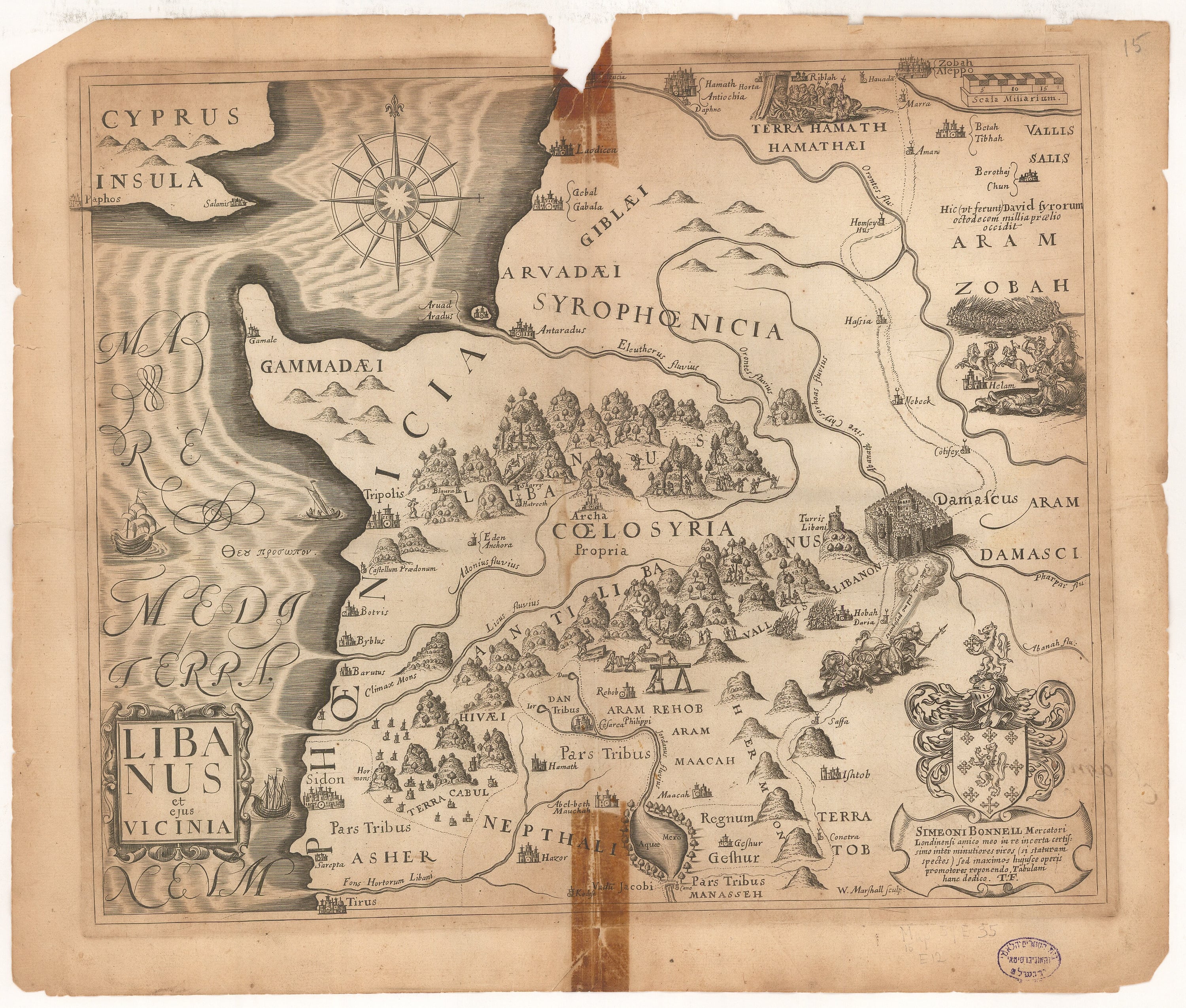
- HamathDavid defeated Hadadezer as far as Hamath. Fuller's placing, proposed: he prints Hamath beside Antioch, the westernmost point.1 Chronicles 18:3
- ZobahThe kingdom of Hadadezer. Fuller's placing, proposed: the northernmost point.2 Samuel 8:3
- BetahDavid took bronze from Betah, which Chronicles calls Tibhath. Fuller's placing, proposed: he prints Betah and Tibhah at one city.2 Samuel 8:8
- BerothaiBerothai, which Chronicles calls Cun, was another city of Hadadezer. Fuller's placing, proposed: he prints Berothai and Chun at one city.1 Chronicles 18:8
- HelamHadadezer's army met David at Helam. Fuller's placing, proposed: he draws a battle of horsemen beside the town.2 Samuel 10:17
- DamascusThe Arameans of Damascus came to help Hadadezer. Fuller's placing, known: a walled city, the southernmost point.2 Samuel 8:5
Thomas Fuller, Libanus et eius Vicinia, engraving, 1650. Public domain; National Library of Israel, Eran Laor Cartographic Collection; File:Thomas Fuller, Libanus et eius Vicinia (FL13729719 2519550).jpg.
Six numbered points, each where Fuller's plate Libanus et eius Vicinia prints the place, with north at the top. The plate prints a scale of miles.
Zobah Through Scripture, in Order
Passages from 2 Samuel to 1 Kings set Zobah's armies against David and its exiles against Solomon.
Zobah's soldiers met David three times: in Hadadezer's own war, as Ammon's hired army and at Helam.
- 2 Samuel 8:4
- David captures a thousand chariots, seven thousand charioteers and twenty thousand foot soldiers from Hadadezer
- 2 Samuel 8:5 to 6
- David strikes down twenty-two thousand Arameans of Damascus and sets garrisons there
- 2 Samuel 8:7
- David brings the gold shields of Hadadezer's officers to Jerusalem
- 2 Samuel 10:6
- The Ammonites hire twenty thousand Aramean foot soldiers from Beth-rehob and Zoba
- 2 Samuel 10:16 to 18
- Hadadezer brings Arameans from beyond the Euphrates under Shobach, and David defeats them at Helam
- 1 Kings 11:23 to 24
- Rezon, who fled from Hadadezer, gathers raiders and rules in Damascus
In the order of the canon, each with its verse.
What the Text Leaves Unsaid
Scripture names Hadadezer's cities and never names the city he ruled from.
Easton's dictionary places the kingdom by its region alone.
Bronze for the Temple
David gave the spoil of Zobah to the LORD.
and King David dedicated these to the LORD, along with the silver and gold he had dedicated from all the nations he had subdued— from Edom and Moab, from the Ammonites and Philistines and Amalekites, and from the spoil of Hadadezer son of Rehob, king of Zobah.Zobah is the last nation in the list.
And from Tibhath and Cun, cities of Hadadezer, David took a large amount of bronze, with which Solomon made the bronze Sea, the pillars, and various bronze articles.Chronicles alone carries the metal of Zobah on into Solomon's work.
The study of Solomon's temple describes its furnishings.
Voices on Zobah
Two commentators wrote on David's foreign soldiers and on Solomon's war with Hamath-zobah.
Albert Barnes (1798 to 1870)
Barnes traces one foreigner in the list of David's mighty men to David's war with Ammon.
“It is remarkable that we have several foreigners at this part of the list: Igal of Zobah, Zelek the Ammonite, Uriah the Hittite, and perhaps Nahari the Beerothite. The addition of Zelek to the mighty men was probably the fruit of David’s war with Ammon 2Sa 8:12; 10; 2Sa 12:26-31.”
Albert Barnes · Notes, Explanatory and Practical, on the Old and New Testaments (1832-1869) · on 2 Samuel 23:36Evangelical
Jamieson, Fausset & Brown (1802 to 1910)
Jamieson, Fausset and Brown, in their Commentary of 1871, note that Scripture gives no cause for Solomon's war on Hamath-zobah.
“Its king, Toi, had been the ally of David; but from the combination, Hamath and Zobah, it would appear that some revolution had taken place which led to the union of these two petty kingdoms of Syria into one. For what cause the resentment of Solomon was provoked against it, we are not informed, but he sent an armed force which reduced it.”
Jamieson, Fausset & Brown · Commentary Critical and Explanatory on the Whole Bible · on 2 Chronicles 8:3 to 6Reformed
The Two Counts of Helam
Commentators explain the gap between the two books in two ways.
Chronicles counts ten times as many charioteers at Helam as Samuel does.
The three counts as a table
| Count | Men | What the verse counts | Verse |
|---|---|---|---|
| 2 Samuel, charioteers | 700 | seven hundred charioteers | 2 Samuel 10:18 |
| 1 Chronicles, charioteers | 7,000 | seven thousand of their charioteers | 1 Chronicles 19:18 |
| Foot soldiers, in either | 40,000 | forty thousand foot soldiers | 1 Chronicles 19:18 |
The dead at Helam as Samuel and Chronicles count them in the Berean text.
A copyist's slip between two numeralsJamieson, Fausset and Brown, 1871
Jamieson, Fausset and Brown, on 1 Chronicles 19:18, name the scholars Keil and Davidson for the view that the text of one of the two books is corrupt. On 1 Chronicles 18:4 they meet the same kind of gap, seven hundred horsemen in 2 Samuel 8:4 as their text read it against seven thousand in Chronicles. They explain it as a transcriber's confusion of the two Hebrew letters that stand for the numbers.
The objection: the slip accounts for the gap and leaves the first number unknown.
The two accounts combinedKennicott, Houbigant and Calmet, as Jamieson, Fausset and Brown report them
Their note on 1 Chronicles 19:18 reports that the scholars Kennicott, Houbigant and Calmet combined the two accounts, so that David killed seven thousand horsemen, seven thousand chariots and forty thousand footmen.
The objection: each book then gives part of the count and names it as the whole.
The Throne of His Father David
Luke ties the Son of Mary to the throne David held against Zobah and its allies.
He will be great and will be called the Son of the Most High. The Lord God will give Him the throne of His father David, and He will reign over the house of Jacob forever. His kingdom will never end!”Gabriel's promise reaches past every kingdom David fought.
Sources
Scripture is the Berean Standard Bible.
- James Strong, Exhaustive Concordance of the Bible (1890), Hebrew dictionary, entry 6678.
- The Hebrew text tagged word by word with Strong's numbers.
- Easton's Bible Dictionary (1897), entries Zobah and Hadadezer.
- Albert Barnes, Notes, Explanatory and Practical, on the Old and New Testaments, on 2 Samuel 23:36.
- Jamieson, Fausset and Brown, Commentary Critical and Explanatory on the Whole Bible (1871), on 1 Chronicles 18:4, 19:18 and 2 Chronicles 8:3.
- Albert Barnes, Notes, Explanatory and Practical, on the Old and New Testaments, on 2 Samuel 8:3.
Keep Studying
Read it4
Studies1
People and groups6
Places8