
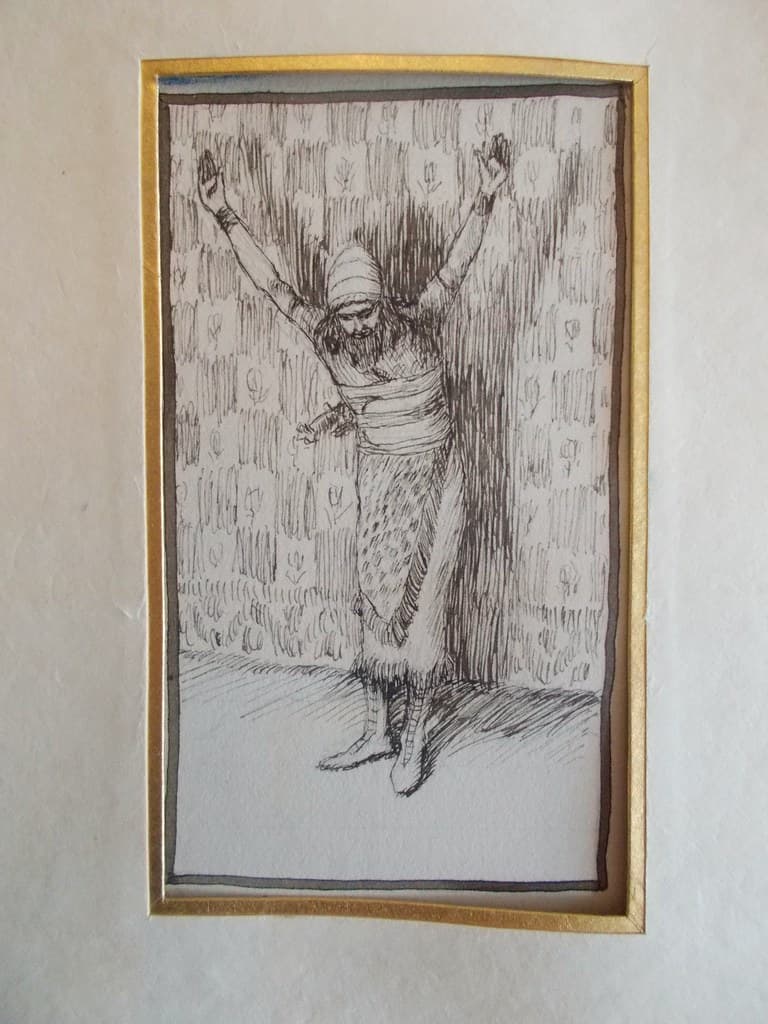
Joshua 1 · Passage · Courage
Be Strong and Courageous
The first chapter of Joshua gives the LORD's charge to Israel's new leader and the answer of the people.
Joshua had served as Moses' assistant, and now the whole people were his to lead.
No one shall stand against you all the days of your life. As I was with Moses, so will I be with you; I will never leave you nor forsake you.
- The passage
- Joshua 1:1 to 18, Deuteronomy 31:6 to 8, Deuteronomy 31:23
- Books
- Joshua, Deuteronomy
- Hold in memory
- Joshua 1:9
Summary
The LORD hands Israel to Joshua, promises him the land and His own presence, and charges him to be courageous. The middle charge ties courage to keeping the law of Moses, and the last gives its ground in the LORD who goes with him. Joshua then orders the camp to be ready to cross within three days.
- The LORD charges Joshua to be strong and courageous three times in the chapter (Joshua 1:6, Joshua 1:7 and Joshua 1:9).
- The eastern tribes give Joshua the same charge a fourth time (Joshua 1:18).
- Moses had given Joshua the same charge before he died (Deuteronomy 31:7).
- Hebrews 13:5 gives the promise of Joshua 1:5 to every believer.
The Handover at the Jordan
The LORD speaks to Joshua after the death of Moses, with the Jordan still to cross.
Joshua 1 is the chapter in which the LORD gives Israel's new leader his commission. It belongs to the value of courage, because it is the Bible's fullest charge to be courageous and it gives the reason for it.
The question the chapter answers is where a man finds courage when the leader he served is gone and a war lies ahead. This study reads the chapter in its order, with the seven charges of Deuteronomy 31 and Joshua 1 set side by side.
Now after the death of His servant Moses, the LORD spoke to Joshua son of Nun, Moses’ assistant, saying, “Moses My servant is dead. Now therefore arise, you and all these people, and cross over the Jordan into the land that I am giving to the children of Israel.The chapter begins with a death and a command to move, so the call to courage comes in a time of loss.
Joshua's years in the wilderness and his later wars are read on the page about his life.
Seven Charges in Two Chapters
The charge to be strong and courageous, once with “very” added, stands in seven verses of Deuteronomy 31 and Joshua 1, and six of them are spoken to Joshua.
The LORD gave the charge three times in Joshua 1, and each time He gave a reason with it.
| Speaker and hearer | The charge | What goes with it |
|---|---|---|
| Moses to all Israel | Be strong and courageous | the LORD your God goes with them |
| Moses to Joshua | Be strong and courageous | Moses names the land sworn to their fathers |
| The LORD to Joshua | Be strong and courageous | the LORD will be with him |
| The LORD to Joshua | Be strong and courageous | Joshua will give the people their inheritance |
| The LORD to Joshua | Above all, be strong and very courageous | so that he may keep all the law Moses commanded |
| The LORD to Joshua | The third charge, put as a question | the LORD goes with him wherever he goes |
| The eastern tribes to Joshua | Above all, be strong and courageous! | a warning that rebels against him will die |
The Promise of Land and Presence
Before the first charge the LORD names the land's borders and promises to be with Joshua as He was with Moses.
I have given you every place where the sole of your foot will tread, just as I promised to Moses. Your territory shall extend from the wilderness and Lebanon to the great River Euphrates—all the land of the Hittites—and west as far as the Great Sea.The gift of the land comes before the command, so Joshua hears what God will do before he hears what he must be.
The promise of presence that follows the borders repeats what Moses had told all Israel in Deuteronomy 31.
Courage and the Book of the Law
The middle charge is the longest, and it turns courage toward obedience to what Moses wrote.
This Book of the Law must not depart from your mouth; meditate on it day and night, so that you may be careful to do everything written in it. For then you will prosper and succeed in all you do.This verse gives the courage of Joshua 1 its direction, since the hardest thing asked of Joshua is to keep the law without turning aside.
The middle charge adds the words “Above all” and “very” to the first. Success in Joshua 1:8 follows from meditating on the Book of the Law and doing what it says.
The Ground of the Third Charge
The third charge is a question, two commands, two prohibitions and one reason.
Have I not commanded you to be strong and courageous? Do not be afraid; do not be discouraged, for the LORD your God is with you wherever you go.”The chapter's last charge is the one most often learned by heart, and its grammar shows where courage comes from.
In Hebrew the two commands of Joshua 1:9 are the verbs chazaq, to be strong, and amats, to be courageous. The two prohibitions use other verbs, 'arats, to be terrified, and chatat, to be dismayed.
The common Hebrew verb for fear, yare, does not stand in the verse. The reason given is the LORD's presence wherever Joshua goes, the promise of Joshua 1:5 in other words.
Joshua's Orders and the People's Answer
Joshua passes the command to the officers at once, and the people answer him.
Then Joshua commanded the officers of the people: “Go through the camp and tell the people, ‘Prepare your provisions, for within three days you will cross the Jordan to go in and take possession of the land that the LORD your God is giving you to possess.’”Joshua's first act as leader is an order to get ready, which shows that he took the charge as a call to move.
So they answered Joshua, “Everything you have commanded us we will do, and everywhere you send us we will go. Just as we obeyed Moses in all things, so we will obey you. And may the LORD your God be with you, as He was with Moses.The people ask for Joshua the same presence of God that Moses had, so the promise of Joshua 1:5 becomes their prayer.
Joshua reminds the Reubenites, the Gadites and the half-tribe of Manasseh that their fighting men must cross ahead of their brothers (Joshua 1:12 to 15).
Joshua 1 is a commission for a war of conquest, and the questions that war raises are read on their own page.
Voices on Joshua 1
A bishop of the fourth century and a commentator of the eighteenth read the chapter in three comments.
died 397 · Ambrose of Milan
Ambrose of Milan, in On the Duties of the Clergy (fourth century), looked behind Joshua 1 to the years in which Joshua was trained.
Read the page on Ambrose of Milan
“Joshua the son of Nun became so great, because his union with Moses was the means not only of instructing him in a knowledge of the law but also of sanctifying him to receive grace. When in his tabernacle the majesty of the Lord was seen to shine forth in its divine Presence, Joshua alone was in the tabernacle. When Moses spoke with God, Joshua too was covered by the sacred cloud. The priests and people stood below, and Joshua and Moses went up the mount to receive the law. All the people were within the camp; Joshua was without the camp in the tabernacle of witness. When the pillar of a cloud came down and God spoke with Moses, Joshua stood as a trusty servant beside him. He, a young man, did not go out of the tabernacle, though the old men who stood far off trembled at these divine wonders.”
Ambrose of Milan · On the Duties of the Clergy 2.20.98 · on Joshua 1:1 to 2Patristic
1662 to 1714 · Matthew Henry
Matthew Henry, in his Commentary on the Whole Bible, read the first charge (Joshua 1:6) as encouragement drawn from the end in view.
Read the page on Matthew Henry
“It was a great encouragement to him in beginning this work that he was sure to see it finished and his labour should not be in vain. Some make it a reason why he should arm himself with resolution, and be of good courage, because of the bad character of the people whom he must cause to inherit that land.”
Matthew Henry · Commentary on the Whole Bible · on Joshua 1:6Puritan
1662 to 1714 · Matthew Henry
On Joshua 1:7 to 8, Henry read the middle charge as a call to faithfulness in what had been given.
“Joshua was to maintain and carry on the work that Moses had begun, and therefore he must not only complete the salvation Moses had wrought for them, but must uphold the holy religion he had established among them. There was no occasion to make new laws; but that good thing which was committed to him he must carefully and faithfully keep, 2 Tim. i.”
Matthew Henry · Commentary on the Whole Bible · on Joshua 1:7 to 8Puritan
Where the Charge Goes Next
The same words pass from Moses to Joshua, from David to Solomon, and into the promise of Hebrews.
David also said to Solomon his son, “Be strong and courageous, and do it. Do not be afraid or discouraged, for the LORD God, my God, is with you. He will neither fail you nor forsake you before all the work for the service of the house of the LORD is finished.David hands the charge to his son with the ground Joshua was given, the presence of God until the work is done.
Keep your lives free from the love of money and be content with what you have, for God has said: “Never will I leave you, never will I forsake you.” So we say with confidence: “The Lord is my helper; I will not be afraid. What can man do to me?”Hebrews takes the promise first spoken to Israel and Joshua and gives it to believers as a reason to be content and unafraid.
Sources
Scripture is the Berean Standard Bible.
- STEP Bible, Translators Amalgamated Hebrew Old Testament, the tagged Hebrew text (Tyndale House, Cambridge), CC BY 4.0.
- Matthew Henry, An Exposition of the Old and New Testament (Commentary on the Whole Bible) (1710)
- Ambrose of Milan, On the Duties of the Clergy, Nicene and Post-Nicene Fathers, second series, vol. 10 (1896)
- STEP Bible lexicon of Extended Strongs for Hebrew (Tyndale House, Cambridge), CC BY 4.0.
Keep Studying
Studies4
In this value5
People and groups6
Places1