
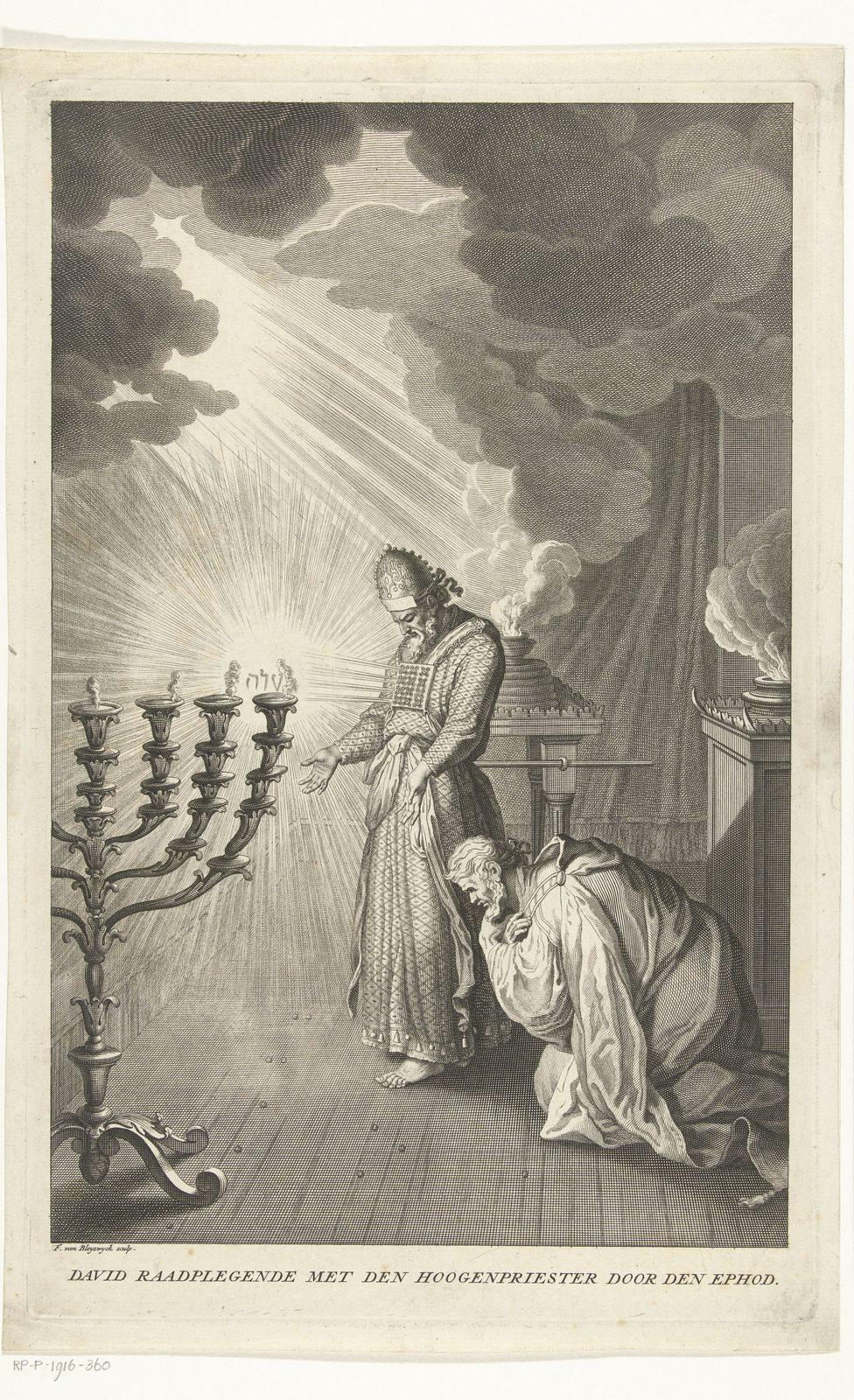
François van Bleyswijck, David and Abiathar Consult God, 1681 to 1746. Public domain.
1 Samuel 22 to 1 Kings 2 · Person · Featured Study
Abiathar
The one survivor of Nob carried the ephod for David and lost his office under Solomon.
Abiathar came to David with the ephod in his hands and the news that Saul had killed his whole family.
Stay with me; do not be afraid, for he who seeks your life is seeking mine as well. You will be safe with me.”
Stay with me; do not be afraid, for he who seeks your life is seeking mine as well. You will be safe with me.”
- Family
- father: Ahimelech son of Ahitub; grandfather: Ahitub; son: Jonathan
- Places
- Nob, Keilah, Ziklag, Jerusalem, Anathoth
- First named
- 1 Samuel 22:20 “…Ahitub escaped. His name was Abiathar, and he…”
- Last named
- Mark 2:26 “During the high priesthood of Abiathar, he entered…”
Summary
Abiathar son of Ahimelech was the one priest who escaped when Saul had the priests of Nob killed. He fled to David with the ephod, and through it David asked the LORD what to do. He served as David's priest beside Zadok to the end of David's reign. When he sided with Adonijah, Solomon sent him home to Anathoth.
- David told him that he was responsible for the deaths of his father's house.
- He and Zadok carried the ark out of Jerusalem with David and took it back again.
- His removal ended the line of Eli in the high priest's office.
- Jesus names him in Mark 2:26, and readers explain that verse in more than one way.
Where Abiathar Stands in Scripture
He is named from 1 Samuel 22 to 1 Kings 4, in Chronicles and once by Jesus in Mark.
Abiathar is named thirty times in the Hebrew Bible and once in the Gospels. He enters the story at Nob, the city of the priests, on the day Doeg struck it down.
From that day he served David as priest, through the years of flight, the reign in Jerusalem and the revolt of Absalom. His story closes in the first days of Solomon, after he took Adonijah's side.
But one of the sons of Ahimelech son of Ahitub escaped. His name was Abiathar, and he fled to David. And Abiathar told David that Saul had killed the priests of the LORD.The priests had died because Ahimelech gave David bread and Goliath's sword in 1 Samuel 21.
His Life, Turn by Turn
The turns follow the order of the text.
Abiathar stood with David at every crisis of his reign but the last.
- Survives Doeg's sword aloneNob1 Samuel 22:20
- Brings the ephod to DavidKeilah1 Samuel 23:6
- The LORD warns David to leave the townKeilah1 Samuel 23:9 to 12
- David asks again after the raidZiklag1 Samuel 30:7 to 8
- Summoned to bring up the arkJerusalem1 Chronicles 15:11
- Carries the ark out as David flees Absalomoutside Jerusalem2 Samuel 15:24
- Returns the ark to the cityJerusalem2 Samuel 15:29
- Receives Hushai's report for DavidJerusalem2 Samuel 17:15
- Named among David's priests with ZadokJerusalem2 Samuel 20:25
- Sides with AdonijahJerusalem1 Kings 1:7
- Sent home and removed from the priesthoodAnathoth1 Kings 2:26 to 27
- Zadok appointed in his placeJerusalem1 Kings 2:35
Six of the twelve turns take place in Jerusalem.
Returns the ark to the city, Receives Hushai's report for David, Named among David's priests with Zadok, Sides with Adonijah, Sent home and removed from the priesthood, Zadok appointed in his place
From Nob to Anathoth
His story runs from 1 Samuel 22 to 1 Kings 2.
The killing at Nob1 Samuel 21 to 22, with Albert Barnes
Doeg the Edomite saw Ahimelech help David and told Saul. Saul's guards would not strike the priests of the LORD, so Doeg killed eighty-five men who wore the linen ephod and put Nob to the sword.
Then David said to Abiathar, “I knew that Doeg the Edomite was there that day, and that he was sure to tell Saul. I myself am responsible for the lives of everyone in your father’s house.Doeg had been at Nob on the day of David's visit, as 1 Samuel 21:7 records.
Albert Barnes, in his Notes on the Old Testament, reads David's answer as the mark of his character.
“The characteristic generosity of David’s disposition breaks out in these words. He never forgot a friend. (Compare 2Sa 1:26; 2Sa 9:1, etc.) David acknowledges that Saul’s enmity against Abiathar is the consequence of his enmity against himself, and therefore David makes common cause with him.”
Albert Barnes · Notes, Explanatory and Practical, on the Old and New Testaments (1832-1869) · on 1 Samuel 22:23Evangelical
The ephod in exile1 Samuel 23 and 30, with Albert Barnes
(Now Abiathar son of Ahimelech had brought the ephod with him when he fled to David at Keilah.)The narrator stops the story to say what Abiathar carried.
At Keilah David asked through the ephod whether Saul would come and whether the town would hand him over, and he left when the LORD answered yes to both.
Albert Barnes reads the answers as given by the word of the LORD through the high priest.
“Abiathar had continued to abide with David, ever since he joined him at Keilah 1Sa 23:6. On inquiry of the Lord by the ephod, see Jdg 1:1 note. The answers were evidently given by the Word of the Lord in the mouth of the high priest (compare Joh 11:51).”
Albert Barnes · Notes, Explanatory and Practical, on the Old and New Testaments (1832-1869) · on 1 Samuel 30:7Evangelical
The ark carried out and back2 Samuel 15, with Matthew Henry
When Absalom took Jerusalem, Zadok and Abiathar brought the ark out with David. David sent it back and left the priests in the city with their sons to carry word to him.
Then the king said to Zadok, “Return the ark of God to the city. If I find favor in the eyes of the LORD, He will bring me back and let me see both it and His dwelling place again. But if He should say, ‘I do not delight in you,’ then here I am; let Him do to me whatever seems good to Him.”David leaves his return in the LORD's hands.
Matthew Henry, in his Commentary on the Whole Bible, sets David's care for the ark beside Eli's.
“He is very solicitous for the safety of the ark: ‘By all means carry the ark back into the city, let not that be unsettled and exposed with me, lodge that again in the tent pitched for it; surely Absalom, bad as he is, will do that no harm.’ David's heart, like Eli's trembles for the ark of God.”
Matthew Henry · Commentary on the Whole Bible · on 2 Samuel 15:24Puritan
Adonijah and the sentence1 Kings 1 to 2, with Albert Barnes
So Adonijah conferred with Joab son of Zeruiah and with Abiathar the priest, who supported him. But Zadok the priest, Benaiah son of Jehoiada, Nathan the prophet, Shimei, Rei, and David’s mighty men would not join Adonijah.The two priests stood on opposite sides of the succession.
Albert Barnes calls Abiathar's turn more surprising than Joab's, because he and David had been the firmest of friends.
Then the king said to Abiathar the priest, “Go back to your fields in Anathoth. Even though you deserve to die, I will not put you to death at this time, since you carried the ark of the Lord GOD before my father David, and you suffered through all that my father suffered.” So Solomon banished Abiathar from the priesthood of the LORD and thus fulfilled the word that the LORD had spoken at Shiloh against the house of Eli.Kings joins this act to the prophecy of 1 Samuel 2:27 to 36.
The Ephod and the Two Priests
The breastpiece held the Urim, and David's reign had two chief priests.
The ephod was the high priest's garment, and the breastpiece fastened to it held the Urim and Thummim.
And place the Urim and Thummim in the breastpiece of judgment, so that they will also be over Aaron’s heart whenever he comes before the LORD. Aaron will continually carry the judgment of the sons of Israel over his heart before the LORD.The breastpiece was the means by which the high priest sought the LORD's decision.
The Family of Abiathar
The line runs from Eli to Abiathar's sons.
His removal ended the high priesthood of Eli's house.
Generation 1
- EliThe priest of Shiloh whose house the word of 1 Kings 2:27 names
Generation 2
- PhinehasEli's son, who died when the ark was taken
Generation 3
- AhitubHis grandfather, father of Ahimelech
Generation 4
- AhimelechHis father, the priest at Nob killed by Saul's order
Generation 5
- AbiatharAbiathar himself
Generation 6
- JonathanHis son, who carried news to David and to Adonijah
- Ahimelech son of AbiatharNamed in 2 Samuel 8:17, a name the readings dispute
The line from Eli to Ahitub follows 1 Samuel 14:3, which Keil reads as the same Ahitub.
The Places of His Service
Five places mark his service, from Nob to Anathoth.
His life ran from one priests' town to another, both in Benjamin.
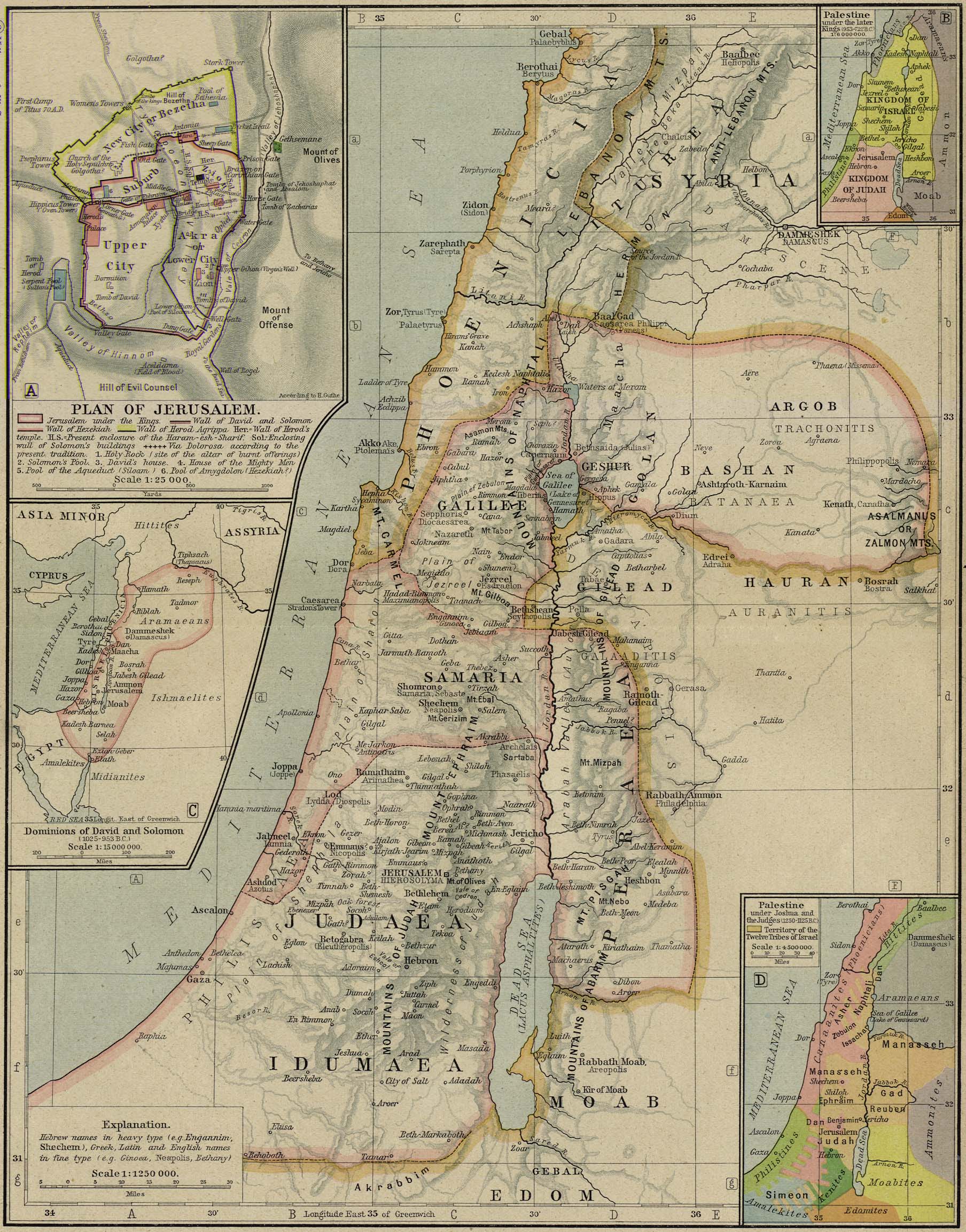
- 1Nob, The city of the priests, where his family was killed. 1 Samuel 22:19
- 2Keilah, The walled town where he reached David.
- 3Ziklag, David's town in the Philistine years.
- 4Jerusalem, The city of the ark and of David's court.
- 5Anathoth, A priests' town of Benjamin, and his home. Joshua 21:18
Not placed: Keilah (2), Anathoth (5).
Base map: Reference map of ancient Palestine, Rand McNally reference map (1926), public domain. Each place stands at its place page's coordinates, set on the plate by Jerusalem and Damascus, as the plate prints them.
Anathoth was also the home of Jeremiah, one of its priests.
Questions His Life Raises
Three questions answered from their verses
How did David ask the LORD through Abiathar?Numbers 27:21, with John Wesley
He shall stand before Eleazar the priest, who will seek counsel for him before the LORD by the judgment of the Urim. At his command, he and all the Israelites with him—the entire congregation—will go out and come in.”The law set the priest to seek counsel by the Urim for the leader of Israel.
John Wesley, in his Explanatory Notes, says the ephod Abiathar brought held the Urim and Thummim, and that Saul was justly deprived of it.
Why was Joab killed and Abiathar spared?1 Kings 2:26 to 35
Solomon named Joab's shedding of innocent blood, the deaths of Abner and Amasa, as the reason for his death.
Joab, who also sided with Adonijah, was put to death in the same chapter.
Is 2 Samuel 8:17 in the right order?Albert Barnes, and Keil and Delitzsch
Zadok son of Ahitub and Ahimelech son of Abiathar were priests; Seraiah was the scribe;Elsewhere Abiathar is the son of Ahimelech.
Albert Barnes, on 1 Chronicles 24:6, calls Ahimelech the son of Abiathar a wrong reading for Abiathar the son of Ahimelech.
Keil and Delitzsch answer that the same name stands in 1 Chronicles 24:3 and 1 Chronicles 24:6, so the names would have to be changed in several places. They hold that Abiathar had a son named Ahimelech after his grandfather, who served beside Zadok.
What the Text Leaves Unsaid
Three things the text does not tell about him
The text gives no reason for Abiathar's support of Adonijah. It does not record his death.
First Kings 4:4 still names Zadok and Abiathar as priests in Solomon's list of officials, and the text does not explain the name there.
The Word Spoken at Shiloh
His removal ends a prophecy given to Eli at Shiloh.
A man of God told Eli that the LORD would cut off the strength of his house and raise up a faithful priest. First Kings names Abiathar's removal as the fulfilment.
Then I will raise up for Myself a faithful priest. He will do whatever is in My heart and mind. And I will build for him an enduring house, and he will walk before My anointed one for all time.The promise of a faithful priest stands beside the sentence on Eli's house.
Hebrews names the priest who needs no successor.
But because Jesus lives forever, He has a permanent priesthood. Therefore He is able to save completely those who draw near to God through Him, since He always lives to intercede for them.The priests of Eli's line died or lost their office, and this Priest lives forever.
Voices on Abiathar
Matthew Henry and Albert Barnes wrote on his removal.
Matthew Henry (1662 to 1714)
Commentary on the Whole Bible
Matthew Henry, in his Commentary on the Whole Bible, counted the years between the word to Eli and Solomon's sentence.
“The depriving of Abiathar was the fulfilling of the threatening against the house of Eli ( 1 Sam. ii. 30 ), for he was the last high priest of that family. It was now above eighty years since the ruin was threatened; but God's judgments, though not executed speedily, will be executed surely.”
on 1 Kings 2:26 to 27Puritan
Albert Barnes (1798 to 1870)
Notes, Explanatory and Practical, on the Old and New Testaments (1832-1869)
Albert Barnes, in his Notes on the Old Testament, described the priesthood after Abiathar.
“The high priesthood had been for some time in a certain sense divided between Zadok and Abiathar. (See the 1Ki 1:8 note). Henceforth, Zadok became sole high priest.”
on 1 Kings 2:35Evangelical
In the Days of Abiathar: Mark 2:26
Mark names Abiathar where 1 Samuel 21:1 names his father Ahimelech.
During the high priesthood of Abiathar, he entered the house of God and ate the consecrated bread, which was lawful only for the priests. And he gave some to his companions as well.”Matthew and Luke tell the same event without the name.
Then David came to Nob, to Ahimelech the priest. And when Ahimelech met David, he trembled and asked him, “Why are you alone? Why is no one with you?”This is the visit Jesus recalls in Mark 2:25 to 26.
In the time of Abiathar, the better-known priestBede, Matthew Henry, and Jamieson, Fausset and Brown
Bede holds that father and son were both there when David came for bread, and that Abiathar's later standing earned him the title.
Jamieson, Fausset and Brown read the phrase as in his time, and Matthew Henry takes Abiathar as his father's deputy that day. The objection is that Mark calls him high priest at that time.
Father and son bore both namesreported by Adam Clarke, with Theophylact's reading
Adam Clarke, in his Commentary on Mark 2:26, reports, without naming its holders, the reading that Ahimelech was also called Abiathar and Abiathar also called Ahimelech. He also reports Theophylact's reading that Abiathar was the priest and Ahimelech the high priest.
The objection is that no verse gives either man both names.
Books to Read Next
Both works are in the public domain, and each has a free copy to read.
Biblical Commentary on the Books of Samuel
C. F. Keil and F. Delitzsch · 1880
Keil explains the Hebrew of 1 Samuel 22 and 23, where Abiathar comes to David.
Read at the Internet ArchiveAntiquities of the Jews, Books 6 to 8
Flavius Josephus, translated by William Whiston · about 93
Josephus retells Abiathar's escape from Nob and his removal by Solomon.
Read at Project GutenbergThe Priest Who Stayed
Abiathar served David through every flight, and the sentence fell under David's son. The priesthood of his house ended, and Christ holds a priesthood that has no end.
Sources
Scripture is the Berean Standard Bible.
- James Strong, Exhaustive Concordance of the Bible, 1890, entries H54 and H646.
- C. F. Keil and F. Delitzsch, Biblical Commentary on the Books of Samuel, T. and T. Clark, 1880, pp. 365 to 366.
- Flavius Josephus, Antiquities of the Jews 6.12.6, 6.12.8 and 8.1.3, translated by William Whiston (finished, by Whiston's note, in A.D. 93)
- Albert Barnes, Notes, Explanatory and Practical, on the Old Testament, on 1 Samuel 22:23.
- Albert Barnes, Notes, Explanatory and Practical, on the Old Testament, on 1 Samuel 30:7.
- Albert Barnes, Notes, Explanatory and Practical, on the Old Testament, on 1 Kings 1:7 and 2:35.
- Albert Barnes, Notes, Explanatory and Practical, on the Old Testament, on 1 Chronicles 24:6.
- Matthew Henry, Commentary on the Whole Bible, 1710, on 2 Samuel 15:24.
- Matthew Henry, Commentary on the Whole Bible, 1710, on 1 Kings 2:26 to 27.
- Matthew Henry, Commentary on the Whole Bible, 1710, on Mark 2:25 to 26.
- John Wesley, Explanatory Notes upon the Old Testament, 1765, on 1 Samuel 23:6.
- Jamieson, Fausset and Brown, Commentary Critical and Explanatory on the Whole Bible, 1871, on Matthew 12:4.
- Bede, in Thomas Aquinas, Catena Aurea, on Mark 2:26.
- Adam Clarke, Commentary on the Bible, 1832, on Mark 2:26.
Keep Studying
Read it4
Studies6
People and groups6
Places6