
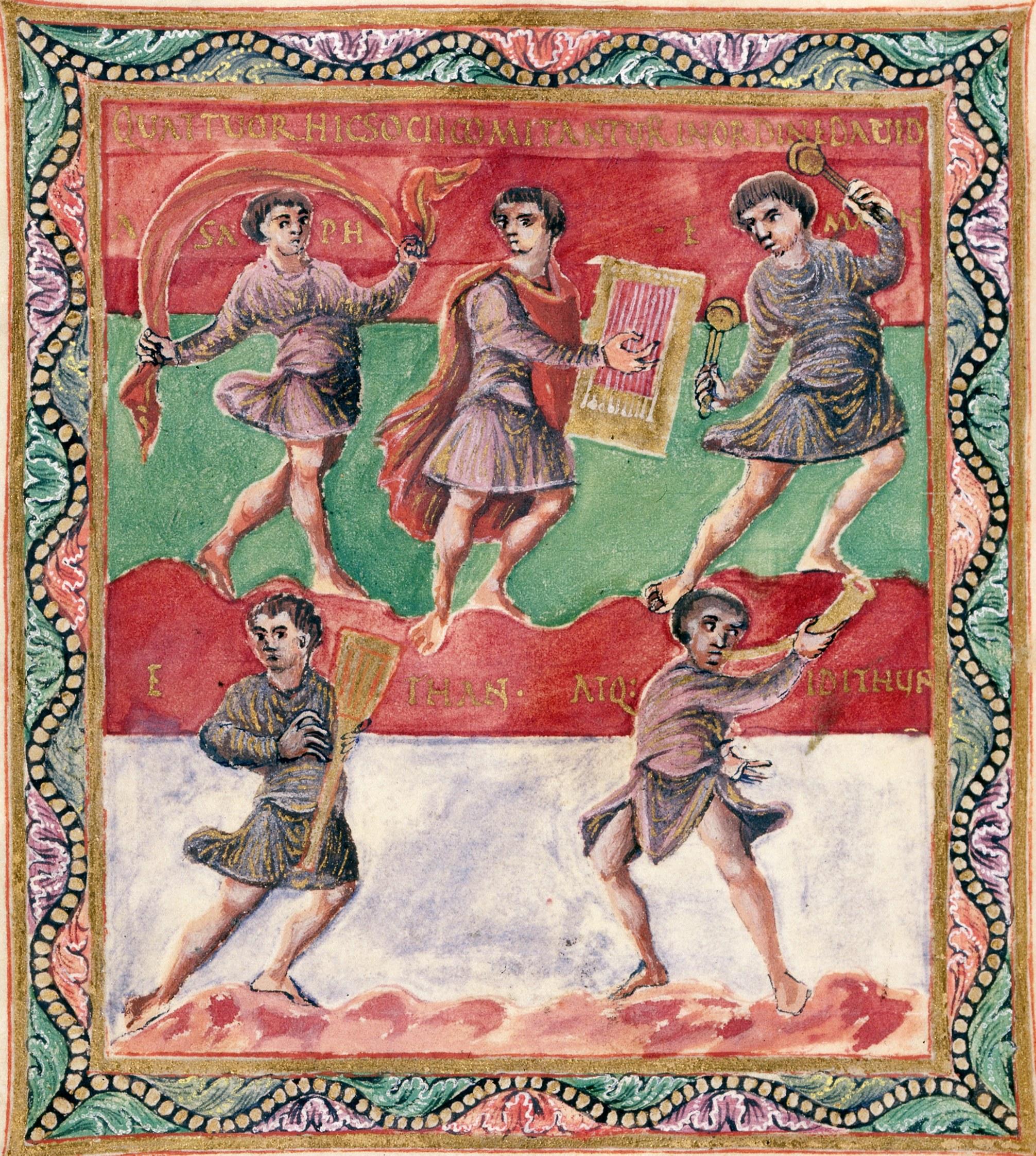
The Psalter of Charles the Bald, folio 1v, before 869. Public domain.
Psalms 50 and 73 to 83 · Subject · Featured Study
The Psalms of Asaph
Twelve psalms carry the name of Asaph, a Levite of the line of Gershom.
A singer's family carried his songs from the ark to the rebuilt temple.
Then King Hezekiah and his officials ordered the Levites to sing praises to the LORD in the words of David and of Asaph the seer. So they sang praises with gladness and bowed their heads and worshiped.
- Books
- 1 Chronicles, 2 Chronicles, Ezra, Nehemiah, Psalms, Matthew
- Hold in memory
- Psalm 80:1
Summary
David made Asaph chief of the singers before the ark. His sons sang under Hezekiah and Josiah, and came home from Babylon.
- Matthew quotes Psalm 78:2 as a prophet's word
- Kirkpatrick finds five marks in these psalms
- Two scholars date Psalms 74 and 79 long after David
Asaph in the Record
Chronicles gives Asaph's office, his kin and his line.
David appointed some of the Levites to minister before the ark of the LORD, to celebrate, to give thanks, and to praise the LORD, the God of Israel. Asaph was the chief, Zechariah was second, then Jeiel, Shemiramoth, Jehiel, Mattithiah, Eliab, Benaiah, Obed-edom, and Jeiel. They were to play the harps and lyres, while Asaph sounded the cymbalsAsaph's name heads the list.
He was Heman's kinsman and stood at his right hand, and his line runs back to Gershom son of Levi.
His sons prophesied with lyres, harps and cymbals under his direction, and he prophesied under the direction of the king.
The Guild Across the Centuries
The stops trace Asaph and his line through Chronicles, Ezra and Nehemiah.
The singers of Asaph's line served from David's reign to the dedication of Nehemiah's wall.
- Appointed a singerDavid's reignThe Levites appoint Asaph son of Berechiah to sound the bronze cymbals.1 Chronicles 15:17 to 19
- Chief before the arkDavid's reignDavid makes Asaph the chief of the Levites who minister before the ark.1 Chronicles 16:5
- The temple dedicatedSolomon's reignAsaph, Heman, Jeduthun and their sons stand east of the altar in fine linen.2 Chronicles 5:12
- A Levite prophesiesJehoshaphat's reignThe Spirit of the LORD comes on Jahaziel, a Levite of Asaph's descendants.2 Chronicles 20:14 to 15
- The songs restoredHezekiah's reignHezekiah's Levites restore the songs of David and Asaph.2 Chronicles 29:30
- The PassoverJosiah's reignThe singers, the descendants of Asaph, are at their stations.2 Chronicles 35:15 to 16
- The returnWith ZerubbabelThe singers among the returning exiles are the descendants of Asaph, 128 of them; Nehemiah 7:44 counts 148.Ezra 2:41
- The foundation laidThe returnThe sons of Asaph take their places with cymbals, as David had prescribed.Ezra 3:10
- In the processionThe dedication of the wallA descendant of Asaph is among the priests and Levites.Nehemiah 12:35
Each stop carries its verse; the reign or event stands where the same chapter names it. The text gives no year at any stop.
The return, The foundation laid, In the procession
The Twelve Psalms
One verse from each of the twelve shows its subject.
A. F. Kirkpatrick, in the Cambridge Bible, counts twelve psalms entitled of Asaph.
PSALM 50
God speaks and summons the whole earth.
PSALM 73
The singer's feet nearly slipped when he saw the wicked prosper.
PSALM 74
The enemy has burned the sanctuary to the ground.
PSALM 75
The people give thanks, for God's Name is near.
PSALM 76
God is known in Judah, and His dwelling place is in Zion.
PSALM 77
The psalm recalls the LORD leading His people through the sea like a flock.
PSALM 78
The fathers' story is told to the next generation, ending with David the shepherd.
PSALM 79
The nations have defiled the temple and left Jerusalem in rubble.
PSALM 80
A prayer that pictures Israel as God's flock.
PSALM 81
The ram's horn sounds for the feast, a statute for Israel.
PSALM 82
God presides in the divine assembly and judges among the gods.
PSALM 83
The nations conspire to erase Israel's name, and God is asked not to stay silent.
Psalm 74, Psalm 75, Psalm 76, Psalm 77, Psalm 78, Psalm 79, Psalm 80, Psalm 81 and 2 more
God Puts His People on Trial
Psalm 50 is set as a court summoned to judge Israel.
He summons the heavens above, and the earth, that He may judge His people: “Gather to Me My saints, who made a covenant with Me by sacrifice.” And the heavens proclaim His righteousness, for God Himself is Judge. Selah “Hear, O My people, and I will speak, O Israel, and I will testify against you: I am God, your God.God summons the court and states His charge.
Kirkpatrick reads the psalm as a trial in the presence of all nature, as in Isaiah 1 and Micah 6, with the LORD at once Plaintiff and Judge. Ellicott calls it a vision of judgment in which heaven and earth sit as God's assessors.
In his Explanatory Notes upon the Old Testament, John Wesley sees a tribunal set up, the judge coming to it, the witnesses summoned and the sentence given.
Kirkpatrick names the psalm's theme as the prophets' message from Samuel on: merely formal sacrifices are worthless in the sight of God.
Who Wrote the Psalms of Asaph
The name has been read as Asaph's own, his family's or a later guild's.
Asaph himself, David's singerThomas Aquinas
The guild of his descendants kept his nameA. F. Kirkpatrick
Kirkpatrick holds that the psalms bearing Asaph's name cannot all be the work of David's musician, if indeed any of them are, because some belong to the time of the exile.
He dates Psalms 74 and 79 some fifteen or twenty years after the destruction of Jerusalem, about the time of Lamentations.
The objection: the titles read of Asaph, and Chronicles sets Asaph's own words beside David's in Hezekiah's day.
A guild of musicians, late in dateCharles Ellicott
Ellicott holds that the title to Asaph may imply only the family of Asaph or a guild of musicians bearing his name. He refers Psalms 74 and 79 to the year before the rising of the Asmoneans.
The objection: Kirkpatrick places the same two psalms after the fall of Jerusalem to Babylon.
Asaph the Seer
Chronicles gives Asaph the title of seer.
I will open my mouth in parables; I will utter things hidden from the beginning,Psalm 78 opens its history.
So was fulfilled what was spoken through the prophet: “I will open My mouth in parables; I will utter things hidden since the foundation of the world.”Matthew calls the psalm's words a prophet's.
Sources
Scripture is the Berean Standard Bible.
- A. F. Kirkpatrick, The Book of Psalms, The Cambridge Bible for Schools and Colleges, on Psalms 50, 73 and 74.
- Charles Ellicott, Commentary for English Readers, on Psalms 50 and 74.
- John Wesley, Explanatory Notes upon the Old Testament (1765), on Psalm 50:1.
- Thomas Aquinas, Exposition on the Psalms of David, on Psalm 50:1.
Keep Studying
Read it6
Studies4
People and groups6