
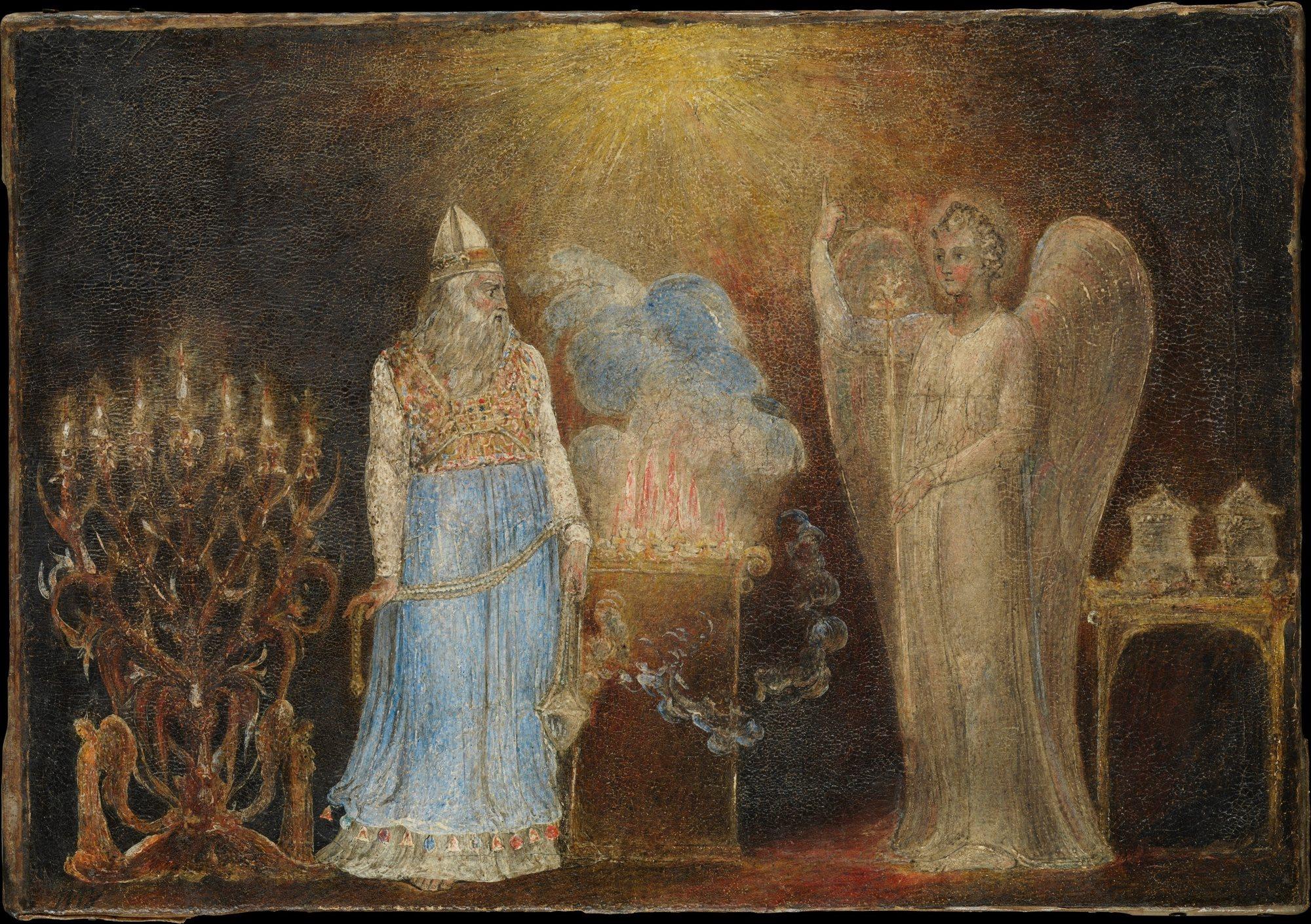
William Blake, The Angel Appearing to Zacharias, 1799 to 1800. Public domain.
1 Chronicles 23 to 26 · Subject · Featured Study
The Priestly and Levitical Courses
Twenty-four houses of priests took turns at the altar in the order the lot gave them.
This was their appointed order for service when they entered the house of the LORD, according to the regulations prescribed for them by their forefather Aaron, as the LORD, the God of Israel, had commanded him.
- Books
- 1 Chronicles, Luke
- Hold in memory
- 1 Chronicles 24:5
The eighth lot fell to Abijah, and Luke names a priest of that course chosen by lot to burn incense in the time of Herod.
Summary
When David was old, he counted the Levites. He divided them by the three sons of Levi. The priests came from Eleazar and Ithamar, and they were divided by lot into twenty-four courses. The singers and the gatekeepers got their duties beside them. The order still stood in the days of Herod.
- Sixteen heads of families came from Eleazar and eight from Ithamar.
- The singers came from the sons of Asaph, Heman and Jeduthun.
- Luke 1 shows the courses still serving in Herod's day.
Four Kinds of Levitical Work
David counted 38,000 Levites of thirty years or older and gave them four kinds of work.
The Levites by Their Work
Overseers of the work far outnumber the other three groups.
Twenty-four thousand Levites served the temple's work, six times the number of the gatekeepers.
The four counts as a table
| Work | Levites | Verse |
|---|---|---|
| Overseeing the work of the house | 24,000 | 1 Chronicles 23:4 |
| Officers and judges | 6,000 | 1 Chronicles 23:4 |
| Gatekeepers | 4,000 | 1 Chronicles 23:5 |
| Musicians | 4,000 | 1 Chronicles 23:5 |
A bar chart of the four kinds of work David gave the Levites, by the numbers of 1 Chronicles 23:4 to 5.
How the Lot Was Cast
The houses of Eleazar and Ithamar drew in turn before the king.
The scribe, Shemaiah son of Nethanel, a Levite, recorded their names in the presence of the king and of the officers: Zadok the priest, Ahimelech son of Abiathar, and the heads of families of the priests and the Levites—one family being taken from Eleazar, and then one from Ithamar.The written record made the order public and fixed.
Jamieson, Fausset and Brown hold that the lot was used to remove all cause of jealousy over precedence. Adam Clarke reasons that every family was equally noble and so had an equal right to every distinction.
The singers' lots ran from Joseph of the sons of Asaph to Romamti-ezer of the sons of Heman, each with his sons and his brothers, twelve in all (1 Chronicles 25:9 to 31). The gatekeepers cast lots for each gate, young and old alike (1 Chronicles 26:13).
Work After the Carrying
The Levites no longer carried the tabernacle, and their age of service changed.
For David had said, “The LORD, the God of Israel, has given rest to His people and has come to dwell in Jerusalem forever. So now the Levites no longer need to carry the tabernacle or any of the articles for its service.”The change follows from the move to a fixed house.
The count of 1 Chronicles 23:3 starts at thirty years old. By David's final instructions, 1 Chronicles 23:24 and 1 Chronicles 23:27 start it at twenty. Adam Clarke reads the two as different ordinances, the second David's last orders. Albert Barnes reports two readings of David's last words in 1 Chronicles 23:27. Some take them as a history of his later reign by Gad or Nathan, and others as a work of directions for the sanctuary.
The chapter ends by setting the Levites under the descendants of Aaron, over the courts, the chambers, the showbread and the praise of morning and evening.
The study of the Levites tells their clans, their charges in the wilderness and their ages of service under Moses.
The Twenty-Four Courses, in the Order of the Lot
The names are given in 1 Chronicles 24:7 to 18.
Jehoiarib drew the first lot and Maaziah the last.
6 columns, scroll sideways
| Lot | Course | Lot | Course | Lot | Course |
|---|---|---|---|---|---|
| 1 | Jehoiarib | 9 | Jeshua | 17 | Hezir |
| 2 | Jedaiah | 10 | Shecaniah | 18 | Happizzez |
| 3 | Harim | 11 | Eliashib | 19 | Pethahiah |
| 4 | Seorim | 12 | Jakim | 20 | Jehezkel |
| 5 | Malchijah | 13 | Huppah | 21 | Jachin |
| 6 | Mijamin | 14 | Jeshebeab | 22 | Gamul |
| 7 | Hakkoz | 15 | Bilgah | 23 | Delaiah |
| 8 | Abijah | 16 | Immer | 24 | Maaziah |
7, 8
What the Text Leaves Unsaid
Three matters the list leaves open.
The list of 1 Chronicles 24 gives the order of the courses and no length for each turn. Second Chronicles 23:8 shows divisions coming on duty and going off duty on the Sabbath, in the days of Jehoiada the priest. Josephus, in his Antiquities, writes that David ordained each course to minister to God eight days, from Sabbath to Sabbath.
The text names all twenty-four courses and does not mark which eight came from Ithamar. Albert Barnes notes that 1 Chronicles 24:20 to 31 lists the Levitical families again without the Gershonites. He judges that the writer found no account of their heads in his sources.
The Courses After David
Solomon, Hezekiah and Josiah each kept the divisions David set.
In keeping with the ordinances of his father David, Solomon appointed the divisions of the priests over their service, and the Levites for their duties to offer praise and to minister before the priests according to the daily requirement. He also appointed gatekeepers by their divisions at each gate, for this had been the command of David, the man of God.The order outlived its maker.
Hezekiah reestablished the divisions of the priests and Levites (2 Chronicles 31:2). Josiah told the Levites to prepare by families in their divisions (2 Chronicles 35:4). He cited the instructions of David and Solomon.
Four houses of priests are counted among the returned exiles in Ezra 2:36 to 39: Jedaiah, Immer, Pashhur and Harim. Alfred Edersheim, in The Temple: Its Ministry and Services, writes that only these four of the courses returned. Each drew five lots, so that twenty-four courses stood again under the ancient names.
In the time of Herod king of Judea there was a priest named Zechariah, who belonged to the priestly division of Abijah, and whose wife Elizabeth was a daughter of Aaron.Luke dates the scene by the king and by the course.
One day while Zechariah’s division was on duty and he was serving as priest before God, he was chosen by lot, according to the custom of the priesthood, to enter the temple of the Lord and burn incense.Edersheim's account of the daily lots stands below.
Edersheim writes that the lot was cast four times in the daily service and that the third lot determined who offered the incense. On his reading of Luke 1, that service fell to Zechariah for the first time in his life and the last. Zechariah's course only bore Abijah's ancient name.
Matthew Henry holds that the courses continued until the Romans destroyed the second temple. In his reading they were perhaps interrupted in the bad reigns and broken off by the captivity. The study of John the Baptist tells the son born to that priest of Abijah's course.
Voices on the Courses
One commentator weighs the lot as a practice of faith.
Matthew Henry (1662 to 1714)
Commentary on the Whole Bible
The note asks whether the lot may still be used.
“The lot is an appeal to God, and ought to be managed with corresponding reverence and sincerity. Matthias was chosen to the apostleship by lot, with prayer ( Acts i. 24, 26 ), and I know not but it might be still used in faith in parallel cases, as an instituted ordinance.”
on 1 Chronicles 24:5Puritan
When Was the List Drawn Up?
Keil, Edersheim and Josephus hold that David set the order, and Herzfeld and Schürer, as others report them, hold a later date.
David set the orderC. F. Keil, Alfred Edersheim, Josephus and Matthew Henry
Keil calls Herzfeld's later dating a baseless hypothesis. He takes the twenty-five men of Ezekiel 8:16 to 18, in the priests' court, as a witness that the twenty-four orders stood before the exile. Edersheim holds that the courses undoubtedly date from the times of David, and Josephus writes that David's partition remained to his own day.
Matthew Henry adds that the account was of great use when Ezra published it, to set the affairs of the returned exiles in their old channel.
The objection: the list puts Jehoiarib first, the course from which the Hasmoneans sprang, as Curtis and Madsen note.
The Chronicler's own day set in David'sHerzfeld and Schürer as Keil and Curtis report them, with the Jewish Encyclopedia
Keil reports that Herzfeld took the courses to be formed only after the exile, from the families that returned with Zerubbabel. Curtis and Madsen report that Emil Schürer suspected the list was not framed until the Hasmonean period. The Jewish Encyclopedia, in its article on the priest, names 1 Chronicles 23 to 26 as an example of postexilic conditions set in pre-exilic times.
The objection: Curtis and Madsen themselves judge Schürer's evidence not conclusive, able only to question the place of Jehoiarib's course.
Books to Read Next
All three works are in the public domain, and each has a free copy to read.
The Temple: Its Ministry and Services as They Were at the Time of Jesus Christ
Alfred Edersheim · 1874
Edersheim describes the temple service as it stood in the time of Jesus.
Read at the Internet ArchiveThe Books of the Chronicles
C. F. Keil · 1872
Keil's commentary covers 1 Chronicles 24, the chapter of the courses.
Read at the Internet ArchiveA Critical and Exegetical Commentary on the Books of Chronicles
Edward Lewis Curtis and Albert Alonzo Madsen · 1910
Curtis and Madsen's commentary covers both books of Chronicles.
Read at the Internet ArchiveAn Order for the House
The courses kept the house of the LORD served by turns.
As their brothers the descendants of Aaron did, they also cast lots in the presence of King David and of Zadok, Ahimelech, and the heads of the families of the priests and Levites—the family heads and their younger brothers alike.One method served the whole tribe.
Sources
Scripture is the Berean Standard Bible.
- Adam Clarke, Commentary on the Bible (1832), on 1 Chronicles 23:24.
- Adam Clarke, Commentary on the Bible (1832), on 1 Chronicles 24:5.
- Albert Barnes, Notes, Explanatory and Practical, on the Old and New Testaments (1832 to 1869), on 1 Chronicles 23:1.
- Albert Barnes, Notes, Explanatory and Practical, on the Old and New Testaments (1832 to 1869), on 1 Chronicles 23:27.
- Albert Barnes, Notes, Explanatory and Practical, on the Old and New Testaments (1832 to 1869), on 1 Chronicles 24:5.
- Albert Barnes, Notes, Explanatory and Practical, on the Old and New Testaments (1832 to 1869), on 1 Chronicles 24:20.
- Albert Barnes, Notes, Explanatory and Practical, on the Old and New Testaments (1832 to 1869), on 1 Chronicles 25:8.
- Jamieson, Fausset and Brown, Commentary Critical and Explanatory on the Whole Bible (1871), on 1 Chronicles 24:5.
- Matthew Henry, Commentary on the Whole Bible (1710), on 1 Chronicles 24:5.
- Matthew Henry, Commentary on the Whole Bible (1710), on 1 Chronicles 24:6.
- Matthew Henry, Commentary on the Whole Bible (1710), on 1 Chronicles 24:10.
- Matthew Henry, Commentary on the Whole Bible (1710), on 1 Chronicles 24:20 to 31.
- Flavius Josephus, Antiquities of the Jews 7.14.7, translated by William Whiston.
- Alfred Edersheim, The Temple: Its Ministry and Services as They Were at the Time of Jesus Christ (London: Religious Tract Society, 1874), chapters on the priesthood and the daily service.
- C. F. Keil, The Books of the Chronicles (Edinburgh: T. and T. Clark, 1872), on 1 Chronicles 24.
- Edward Lewis Curtis and Albert Alonzo Madsen, A Critical and Exegetical Commentary on the Books of Chronicles (New York: Scribner, 1910), on 1 Chronicles 24.
- The Jewish Encyclopedia, article Priest, section The Priestly Orders.
Keep Studying
Read it4
Studies3
People and groups10
Subjects1
Doctrines2
Church history2