
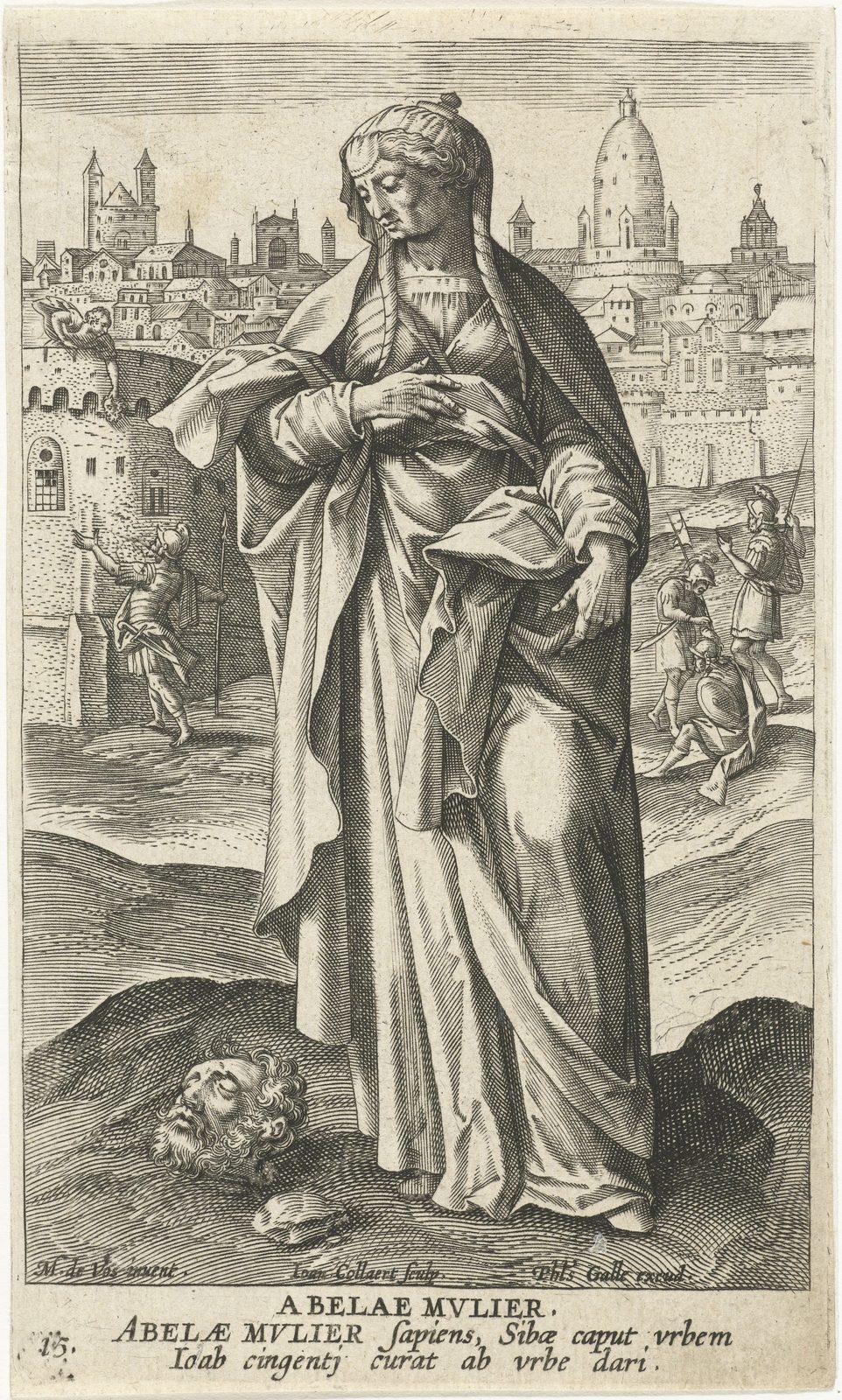
Jan Collaert II, The Wise Woman of Abel, 1588 to 1595. Public domain.
2 Samuel 20 · Person · Featured Study
The Wise Woman of Abel
She spoke for a city in the far north of Israel when Joab besieged it.
When the wall was about to fall, one woman asked to speak with the commander.
Then the woman went to all the people with her wise counsel, and they cut off the head of Sheba son of Bichri and threw it to Joab. So he blew the ram’s horn and his men dispersed from the city, each to his own home. And Joab returned to the king in Jerusalem.
Then the woman went to all the people with her wise counsel, and they cut off the head of Sheba son of Bichri and threw it to Joab. So he blew the ram’s horn and his men dispersed from the city, each to his own home. And Joab returned to the king in Jerusalem.
- Places
- Abel Beth Maacah, Dan, Jerusalem
- First named
- 2 Samuel 20:16 “a wise woman called…”
- Last named
- 2 Samuel 20:22 “…all the people with her wise counsel, and…”
Summary
The wise woman of Abel lived in Abel-beth-maacah. When Sheba son of Bichri rebelled against David and took refuge there, Joab laid siege to the city. She spoke with Joab from the wall, learned that he wanted Sheba alone, and persuaded her people to give him Sheba's head. Joab withdrew and the city was spared.
- Joab had killed Amasa on the road north.
- The siege ended with one death in the city.
- Joab returned to the king in Jerusalem.
Where She Stands in Scripture
Her words stand in 2 Samuel 20:16 to 20:21.
She appears at the end of the revolt of Sheba son of Bichri, and the text gives her no name.
Her city, Abel-beth-maacah, is named again when Ben-hadad of Aram took it in the days of Asa and when Tiglath-pileser of Assyria took it in the days of Pekah.
Sheba passed through all the tribes of Israel to Abel-beth-maacah and through the entire region of the Berites, who gathered together and followed him.Sheba's flight ran the length of the land to its northern edge.
The Siege, Step by Step
The steps run from the revolt to the end of the siege.
A revolt that began with a horn ended with a horn at Abel.
- Sheba blows the horn against Davidafter the return from the Jordan2 Samuel 20:1 to 2
- Joab kills Amasa and takes the pursuitthe great stone in Gibeon2 Samuel 20:8 to 10
- Sheba shuts himself in the cityAbel-beth-maacah2 Samuel 20:14
- Joab builds a ramp and batters the wallAbel-beth-maacah2 Samuel 20:15
- She calls Joab to the wallthe city wall2 Samuel 20:16 to 17
- She pleads for the citythe city wall2 Samuel 20:18 to 19
- She promises Sheba's headthe city wall2 Samuel 20:21
- She counsels her people, and Joab withdrawsAbel-beth-maacah2 Samuel 20:22
Four of the eight steps are her words or her deed.
She promises Sheba's head, She counsels her people, and Joab withdraws
A Word from the Wall
Three scenes at the wall of Abel.
After Absalom's death a Benjamite called the men of Israel away from David, and they followed him. David sent Abishai after him, and Joab took the lead on the road.
The siege2 Samuel 20:14 to 15; Matthew Henry
And Joab’s troops came and besieged Sheba in Abel-beth-maacah and built a siege ramp against the outer rampart of the city. As all the troops with Joab were battering the wall to topple it,A city that sheltered a rebel against the king was put under siege.
Matthew Henry turns the siege into a lesson about the heart.
“Justly is that place attacked with all this fury which dares harbour a traitor; nor will that heart fare better which indulges those rebellious lusts that will not have Christ to reign over them.”
Matthew Henry · Commentary on the Whole Bible · on 2 Samuel 20:15Puritan
Her plea2 Samuel 20:16 to 17; John Wesley
a wise woman called out from the city, “Listen! Listen! Please tell Joab to come here so that I may speak with him.” When he had come near to her, the woman asked, “Are you Joab?” “I am,” he replied. “Listen to the words of your servant,” she said. “I am listening,” he answered.John Wesley, on 2 Samuel 20:19, explains that great cities were called mothers and the towns that depended on them their daughters.
Joab's terms2 Samuel 20:21; Jamieson, Fausset and Brown
That is not the case. But a man named Sheba son of Bichri, from the hill country of Ephraim, has lifted up his hand against the king, against David. Deliver him alone, and I will depart from the city.” “Look,” the woman replied, “his head will be thrown to you over the wall.”Joab's terms spared every life in the city but one.
Jamieson, Fausset and Brown weigh Joab's character in his answer.
“The answer of Joab brings out the character of that ruthless veteran as a patriot at heart, who, on securing the author of this insurrection, was ready to put a stop to further bloodshed and release the peaceable inhabitants from all molestation.”
Jamieson, Fausset & Brown · Commentary Critical and Explanatory on the Whole Bible · on 2 Samuel 20:18 to 20Reformed
A City of Counsel in the North
Abel stood near Dan, at the northern edge of Israel.
Keil and Delitzsch place Abel-beth-maacah at Abil el-Kamh, a village named for its wheat.
And Ben-hadad listened to King Asa and sent the commanders of his armies against the cities of Israel, conquering Ijon, Dan, Abel-beth-maacah, and the whole land of Naphtali, including the region of Chinnereth.The People Around Her
Five people and one city stand around her in the text.
The text names no family for her; her tie was to her city.
Generation 1
- DavidThe king Sheba rebelled against
- JoabThe commander she spoke with
- AbishaiJoab's brother, sent first after Sheba
- AmasaThe commander Joab killed on the road
- Sheba son of BichriThe rebel her people gave up
- The people of AbelThose she went to with her counsel
Her circle was the people of her city and the men at its wall.
The Places of Her Story
Four places mark her story, from Jerusalem to the north.
Joab pursued Sheba from Jerusalem to the far north.
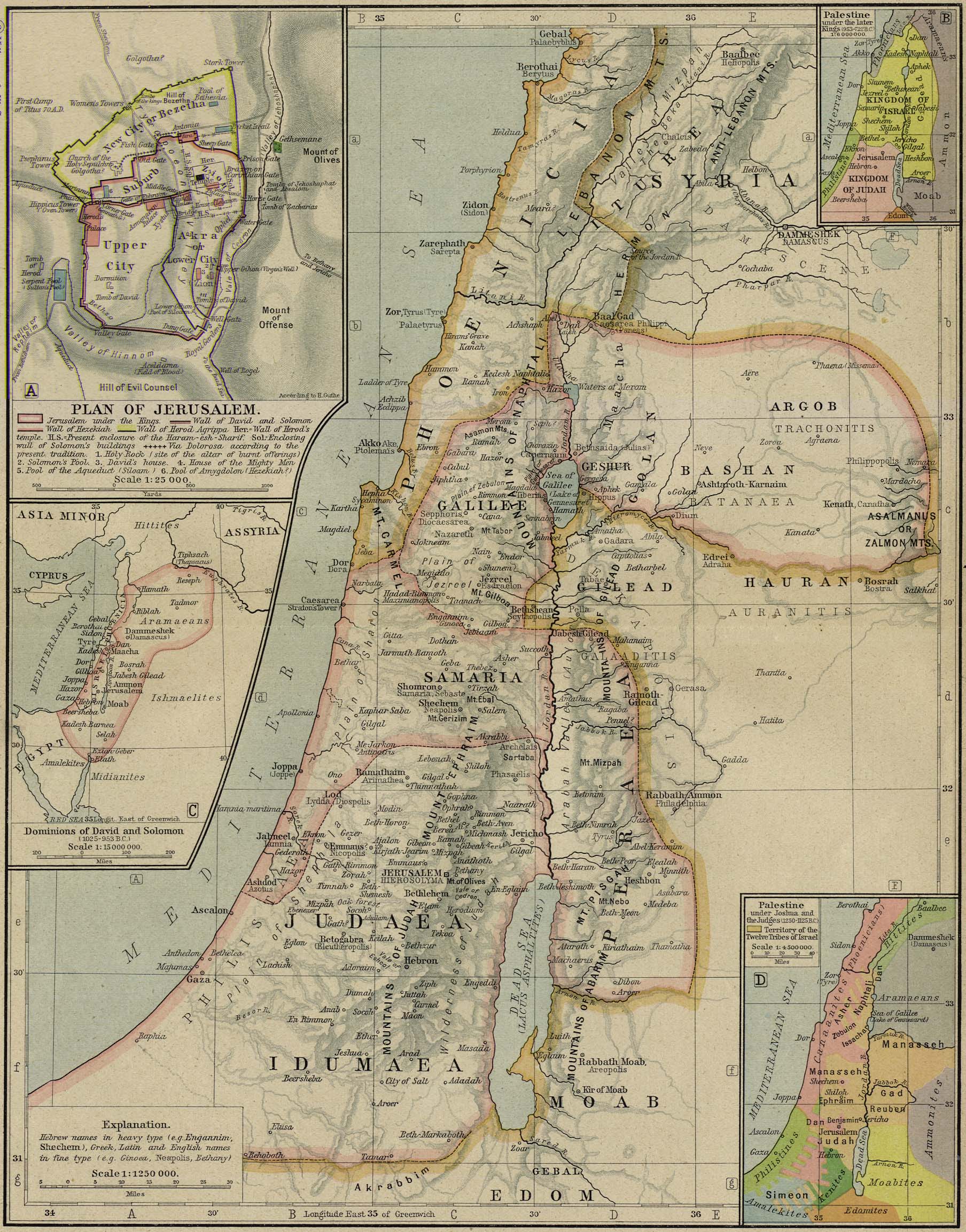
- 1Jerusalem, Joab's men marched out from it, and Joab returned to the king there. 2 Samuel 20:22
- 2Gibeon, A city of Benjamin on the road north. Joshua 18:25
- 3Dan, Named with Abel in 1 Kings 15:20 and in the Greek reading of her words. 1 Kings 15:20
- 4Abel-beth-maacah, The city she saved by her counsel. 2 Samuel 20:15
Not placed: Gibeon (2), Abel-beth-maacah (4).
Base map: Reference map of ancient Palestine, Rand McNally reference map (1926), public domain. Each place stands at its place page's coordinates, set on the plate by Jerusalem and Damascus, as the plate prints them.
The pursuit ran the length of the land, from Jerusalem to Abel.
Questions Her Story Raises
Three questions answered from the text and its commentators
Where was Abel-beth-maacah?H. P. Smith; the Tel Abel Beth Maacah excavations
H. P. Smith records that Edward Robinson identified the city with Abil el Kamh. Digging there began in 2013, and the excavation is directed by Naama Yahalom-Mack and Nava Panitz-Cohen.
Was she the same woman as the wise woman of Tekoa?2 Samuel 14:2 and 2 Samuel 20:16
The woman of Tekoa came from Judah at Joab's bidding. The woman of Abel spoke for her own city in her own words.
So Joab sent to Tekoa to bring a wise woman from there. He told her, “Please pretend to be a mourner; put on clothes for mourning and do not anoint yourself with oil. Act like a woman who has mourned for the dead a long time. Then go to the king and speak these words to him.” And Joab put the words in her mouth.What does her promise show about her?2 Samuel 20:21 to 22; Adam Clarke
Adam Clarke, in his Commentary on the Bible, reads her promise as a sign that she had great weight in the city's counsels.
What the Text Leaves Unsaid
Four things the text does not tell about her
The text gives her no husband and no office in the city. It does not record the words she spoke to her people.
It does not say what became of her after the siege.
How Scripture Reads Her
Her wisdom is the narrator's own word for her.
The text calls her a wise woman when she first speaks and says she went to the people with her wise counsel.
There was a small city with few men. A mighty king came against it, surrounded it, and built large siege ramps against it. Now a poor wise man was found in the city, and he saved the city by his wisdom. Yet no one remembered that poor man.The Preacher draws from such a case that wisdom is better than strength (Ecclesiastes 9:16).
What Did She Say in 2 Samuel 20:18?
The Hebrew has seek counsel at Abel, and the Greek adds Dan.
Then the woman said, “Long ago they used to say, ‘Seek counsel at Abel,’ and that is how disputes were settled. I am among the peaceable and faithful in Israel, but you are trying to destroy a city that is a mother in Israel. Why would you swallow up the LORD’s inheritance?”Keep the HebrewKeil and Delitzsch
Keil and Delitzsch hold that the Hebrew is sound and read it as a saying that people used to ask counsel at Abel and so settled matters. They call the longer Greek a gloss.
The objection is that the Greek gives two renderings of the verse, and H. P. Smith finds a better sense in one of them.
Read with the GreekH. P. Smith
H. P. Smith reads from the Greek that people used to ask in Abel and in Dan whether what the faithful in Israel had set up had come to an end.
The objection is that the Hebrew makes sense as it stands, as Keil and Delitzsch argue.
Books to Read Next
Both works are in the public domain, and each has a free copy to read.
Biblical Commentary on the Books of Samuel
C. F. Keil and F. Delitzsch · 1880
Keil places the city and defends the Hebrew of her words in his notes.
Read at the Internet ArchiveA Critical and Exegetical Commentary on the Books of Samuel
Henry Preserved Smith · 1899
Smith sets the Greek beside the Hebrew of her words.
Read at the Internet ArchiveThe City That Was Spared
At Abel a word from the wall did what the battering of Joab's men could not.
A wise man scales the city of the mighty and pulls down the stronghold in which they trust.Solomon's proverb sets wisdom above the strength of a city's walls.
Sources
Scripture is the Berean Standard Bible.
- C. F. Keil and F. Delitzsch, Biblical Commentary on the Books of Samuel, T. and T. Clark, 1880, pp. 455 to 456.
- Henry Preserved Smith, A Critical and Exegetical Commentary on the Books of Samuel, T. and T. Clark, 1899, pp. 371 to 372.
- The Tel Abel Beth Maacah Excavations, directed by Naama Yahalom-Mack and Nava Panitz-Cohen.
- Noah Wiener, Abel Beth Maacah Excavations Uncover Silver Hoard at an Ancient Crossroads, Bible History Daily, Biblical Archaeology Society, 26 February 2014.
- Matthew Henry, Commentary on the Whole Bible, 1710, on 2 Samuel 20:15.
- Jamieson, Fausset and Brown, Commentary Critical and Explanatory on the Whole Bible, 1871, on 2 Samuel 20:18 to 20.
- John Wesley, Explanatory Notes upon the Old Testament, 1765, on 2 Samuel 20:19.
- Adam Clarke, Commentary on the Bible, 1832, on 2 Samuel 20:21.
Keep Studying
People and groups7