

Prophet
Samuel
Prophet, Judge, Priest · United Monarchy · c. 1100-1010 BC
Gustave Doré, La Sainte Bible (Tours: Alfred Mame et fils, 1866). Public domain.
Summary
Samuel is the transitional figure between the period of the judges and the monarchy. Born of the previously barren Hannah and dedicated from birth to the sanctuary at Shiloh, he served as Israel's last judge, first major prophet, and the anointer of Israel's first two kings, Saul and David.
- Hannah promised God that if He gave her a son she would give him back, and Samuel spent his childhood in the sanctuary at Shiloh serving the priest whose house he would later be sent to condemn.
- God called his name in the dark in a generation when the word of the LORD was rare, and the first message Samuel ever carried was a sentence against the family that raised him.
- He was the last of Israel's judges and the first of the long line of its prophets, and one chapter shows him judging a nation, offering a whole burnt offering and being answered by God in the same afternoon.
- He warned Israel what a king would cost, anointed Saul anyway, told him that obedience is better than sacrifice when he would not obey, and then went to Bethlehem for a shepherd boy.
- His own sons took bribes and perverted justice, and that is the reason the elders gave for wanting a king. The text states it and does not soften it.
On this page
Start here
Then the LORD came and stood there, calling as before, “Samuel! Samuel!” And Samuel answered, “Speak, for Your servant is listening.”
1 Samuel 3:10→- 6 key events in order
- 124 verses name Samuel, across 7 books
In Scripture
- Verses
- 124
- Books
- 7
Samuel
- Role
- Prophet, Judge, Priest
- Era
- United Monarchy
- Dates
- c. 1100-1010 BC
- Tribe
- Ephraim
- Father
- Elkanah
- Mother
- Hannah
The life in order
in the order the canon tells it
- Hannah vows at Shiloh that a son would be given back to God for life1 Samuel 1:11And she made a vow, pleading, “O LORD of Hosts, if only You will look upon the affliction of Your maidservant and remember me, not forgetting Your maidservant but giving her a son, then I will dedicate him to the LORD all the days of his life, and no razor shall ever come over his head.”
- He is born and named for the asking1 Samuel 1:20So in the course of time, Hannah conceived and gave birth to a son. She named him Samuel, saying, “Because I have asked for him from the LORD.”
- Once weaned, he is handed over at the sanctuary1 Samuel 1:28I now dedicate the boy to the LORD. For as long as he lives, he is dedicated to the LORD.” So they worshiped the LORD there.
- The boy ministers at Shiloh in a linen ephod1 Samuel 2:18Now Samuel was ministering before the LORD—a boy wearing a linen ephod.
- He grows in favor with God and with people, inside a corrupt house1 Samuel 2:26And the boy Samuel continued to grow in stature and in favor with the LORD and with man.
- God calls his name in the night and he answers1 Samuel 3:10Then the LORD came and stood there, calling as before, “Samuel! Samuel!” And Samuel answered, “Speak, for Your servant is listening.”
- The whole country from Dan to Beersheba knows he is a prophet1 Samuel 3:20So all Israel from Dan to Beersheba knew that Samuel was confirmed as a prophet of the LORD.
- Twenty years pass with the ark at Kiriath-jearim and Samuel out of the account1 Samuel 7:2And from that day a long time passed, twenty years in all, as the ark remained at Kiriath-jearim. And all the house of Israel mourned and sought after the LORD.
- He gathers the nation at Mizpah and judges Israel there1 Samuel 7:6When they had gathered at Mizpah, they drew water and poured it out before the LORD. On that day they fasted, and there they confessed, “We have sinned against the LORD.” And Samuel judged the Israelites at Mizpah.
- He offers a whole burnt offering with his own hands and God answers him1 Samuel 7:9Then Samuel took a suckling lamb and offered it as a whole burnt offering to the LORD. He cried out to the LORD on behalf of Israel, and the LORD answered him.
- He sets up a stone and names it Ebenezer, thus far the LORD has helped us1 Samuel 7:12Afterward, Samuel took a stone and set it up between Mizpah and Shen. He named it Ebenezer, saying, “Thus far the LORD has helped us.”
- He judges on a yearly circuit of Bethel, Gilgal and Mizpah1 Samuel 7:16Every year he would go on a circuit from Bethel to Gilgal to Mizpah, judging Israel in all these places.
- The sons he appointed as judges take bribes and pervert justice1 Samuel 8:3But his sons did not walk in his ways; they turned aside toward dishonest gain, accepting bribes and perverting justice.
- God tells him the demand for a king is not a rejection of him1 Samuel 8:7And the LORD said to Samuel, “Listen to the voice of the people in all that they say to you. For it is not you they have rejected, but they have rejected Me as their king.
- He pours a flask of oil on Saul's head1 Samuel 10:1Then Samuel took a flask of oil, poured it on Saul’s head, kissed him, and said, “Has not the LORD anointed you ruler over His inheritance?
- Replaced by a king, he says that giving up praying for them would be sin1 Samuel 12:23As for me, far be it from me that I should sin against the LORD by ceasing to pray for you. And I will continue to teach you the good and right way.
- He tells Saul that obedience is better than sacrifice1 Samuel 15:22But Samuel declared: “Does the LORD delight in burnt offerings and sacrifices as much as in obedience to His voice? Behold, obedience is better than sacrifice, and attentiveness is better than the fat of rams.
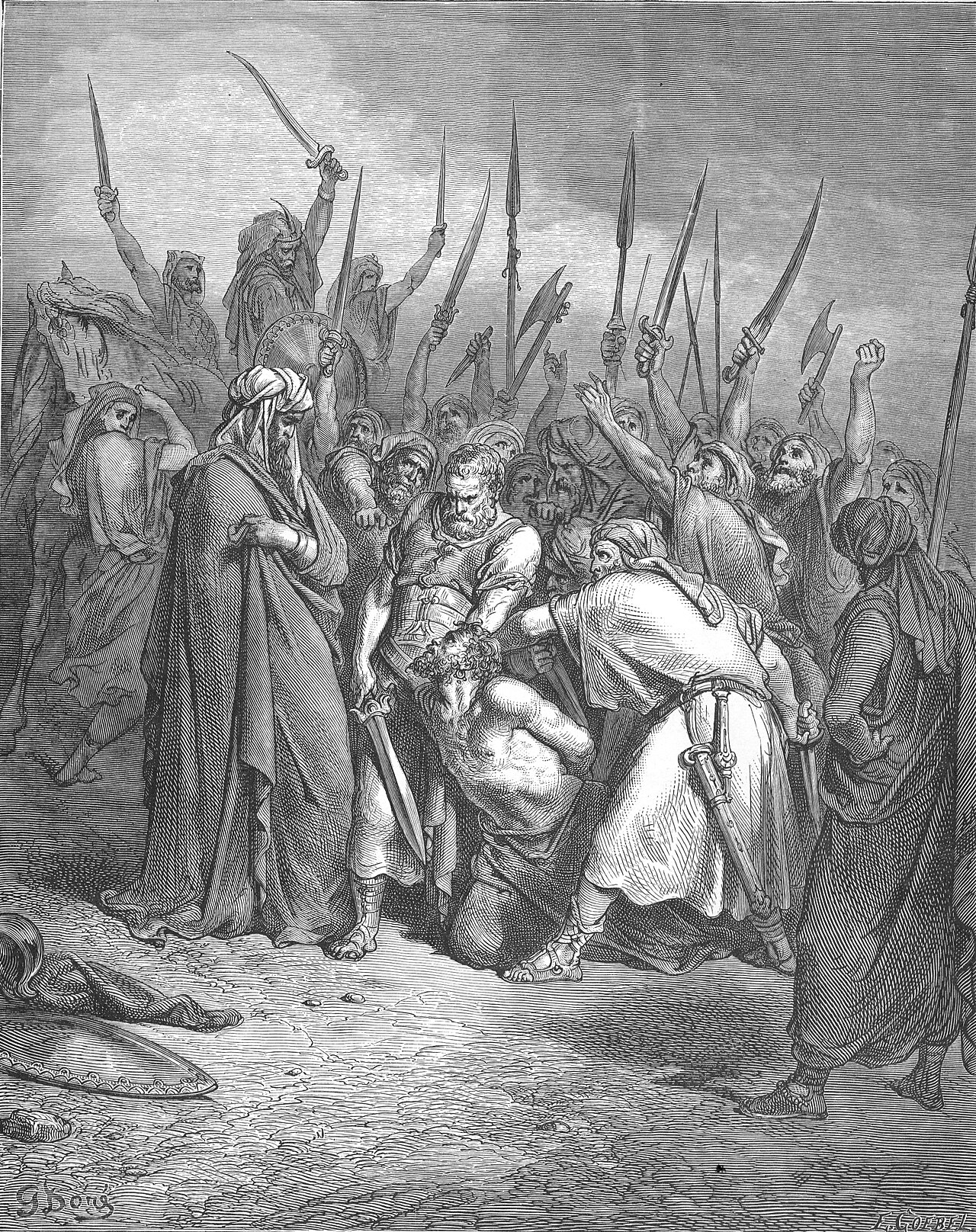
- He kills Agag at Gilgal, the king Saul had spared1 Samuel 15:33But Samuel declared: “As your sword has made women childless, so your mother will be childless among women.” And Samuel hacked Agag to pieces before the LORD at Gilgal.
- His last recorded act is anointing David at Bethlehem1 Samuel 16:13So Samuel took the horn of oil and anointed him in the presence of his brothers, and the Spirit of the LORD rushed upon David from that day forward. Then Samuel set out and went to Ramah.
- He dies, and the whole country gathers at Ramah to mourn1 Samuel 25:1When Samuel died, all Israel gathered to mourn for him; and they buried him at his home in Ramah. Then David set out and went down to the Wilderness of Paran.
Why Samuel matters
Samuel stood between two eras of Israel's life and handed one to the other. Behind him are the judges. In front of him is the monarchy. He is the man who closes the one and opens the other, and he never holds a throne himself. His life starts with somebody else's grief. Hannah could not have children, and she prayed at the sanctuary at Shiloh until the old priest there thought she was drunk. She promised God that a son would be given back to Him for life, with the razor clause of the Nazirite vow attached. That promise was the first thing anybody ever decided about Samuel, and he had no say in it. He grew up inside a scandal. The priest he served was old, and his two sons were the disgrace of the country. Samuel ministered in a linen ephod, and his mother brought him a bigger robe every year when the family came up to sacrifice. He did not join the scandal, and the narrator keeps saying so. Then God called his name in the night. The word of the LORD was rare in those days and visions were scarce, and the boy did not recognise the voice. What he was given to carry was a sentence on the house that had raised him. He lay awake until morning and was afraid to open the doors. Hearing God, in the Bible's own founding account of it, begins with a message the hearer does not want. After that the country listens to him for the rest of his life. He gathers Israel at Mizpah, prays for them, and sets up a stone on the ground of an old defeat with the name Ebenezer on it. He judges from a circuit of four towns and goes home to Ramah, where he builds an altar. When the people ask for a king he warns them in detail what a king will take, and then pours the oil on the man God names. He is also the man who told a king he was finished. Saul spared what God had told him to destroy and called the spared animals sacrifice, and Samuel answered that obedience is better than sacrifice. He killed Agag himself at Gilgal. Then he went to Bethlehem, telling God plainly that Saul would kill him for it, and anointed the youngest son of a farmer who had been left outside with the sheep. The text does not tidy him up. His own sons took bribes and perverted justice. He took the demand for a king personally, and God had to tell him the rejection was not of him. He picked the tall brother at Bethlehem and God told him to stop looking at height. He died at Ramah, and the whole country came to mourn him.
Biography
Samuel's birth narrative in 1 Samuel 1-2 is paradigmatic: Hannah's anguished prayer, her vow to dedicate her son, her song of reversal (one of the great OT hymns), and Samuel's early service under the priest Eli at Shiloh. As a boy, he received YHWH's direct call — "Speak, for your servant hears" — and was given the prophecy of judgment on Eli's house. As judge, Samuel led Israel in victory over the Philistines at Mizpah (1 Sam 7) and presided over a period of covenantal renewal. When the people demanded a king "like the nations," Samuel warned them of the costs but anointed Saul as commanded. When Saul repeatedly disobeyed (the premature sacrifice at Gilgal, the sparing of Agag), Samuel rejected him on YHWH's behalf and anointed the young David in his place. Samuel's ministry fused the offices of prophet, judge, and priest — a unique OT concentration. He is the first in the chain of "former prophets" (Samuel, Kings, Chronicles); his name titles two books. Even after his death, his voice came up through the medium of Endor to reject the desperate Saul once more (1 Sam 28).
Then the LORD came and stood there, calling as before, “Samuel! Samuel!” And Samuel answered, “Speak, for Your servant is listening.”
The night a boy heard his name
1 Samuel 3, in the order the chapter tells it
- A country where God had almost stopped speaking1 Samuel 3:1And the boy Samuel ministered to the LORD before Eli. Now in those days the word of the LORD was rare and visions were scarce.
- A boy asleep in the room where the ark was kept1 Samuel 3:3Before the lamp of God had gone out, Samuel was lying down in the temple of the LORD, where the ark of God was located.
- The first call, and an answer given to the wrong person1 Samuel 3:4Then the LORD called to Samuel, and he answered, “Here I am.”
- He did not yet know the LORD1 Samuel 3:7Now Samuel did not yet know the LORD, because the word of the LORD had not yet been revealed to him.
- On the third call, Eli works out who is speaking1 Samuel 3:8Once again, for the third time, the LORD called to Samuel. He got up, went to Eli, and said, “Here I am, for you have called me.” Then Eli realized that it was the LORD who was calling the boy.
- Eli teaches him the sentence to say1 Samuel 3:9“Go and lie down,” he said to Samuel, “and if He calls you, say, ‘Speak, LORD, for Your servant is listening.’” So Samuel went and lay down in his place.
- The LORD comes and stands there1 Samuel 3:10Then the LORD came and stood there, calling as before, “Samuel! Samuel!” And Samuel answered, “Speak, for Your servant is listening.”
- The message is a sentence on the house that raised him1 Samuel 3:13I told him that I would judge his house forever for the iniquity of which he knows, because his sons blasphemed God and he did not restrain them.
- He lay awake, then opened the doors he was afraid to open1 Samuel 3:15Samuel lay down until the morning; then he opened the doors of the house of the LORD. He was afraid to tell Eli the vision,
- He told Eli everything and hid nothing1 Samuel 3:18So Samuel told him everything and did not hide a thing from him. “He is the LORD,” replied Eli. “Let Him do what is good in His eyes.”
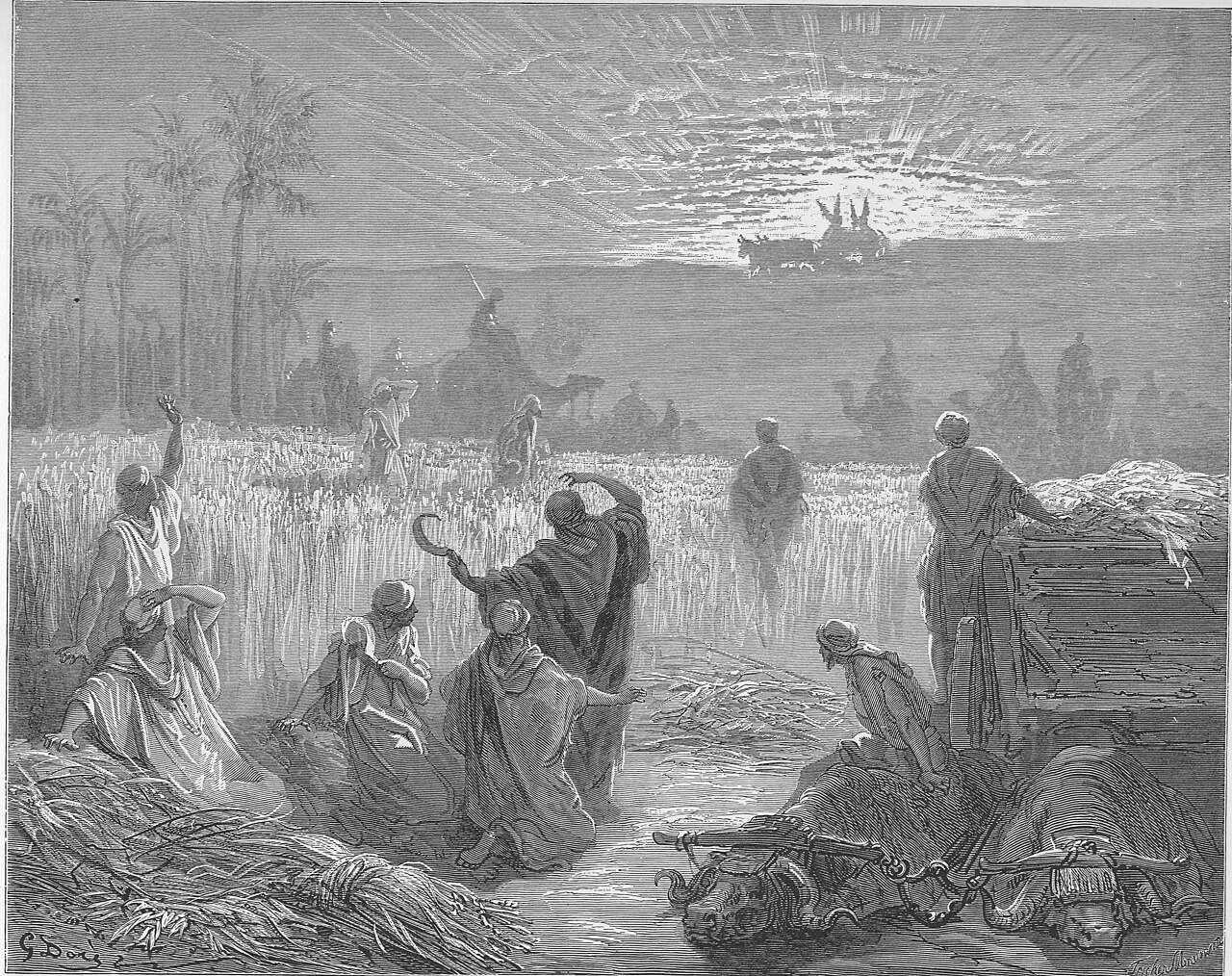
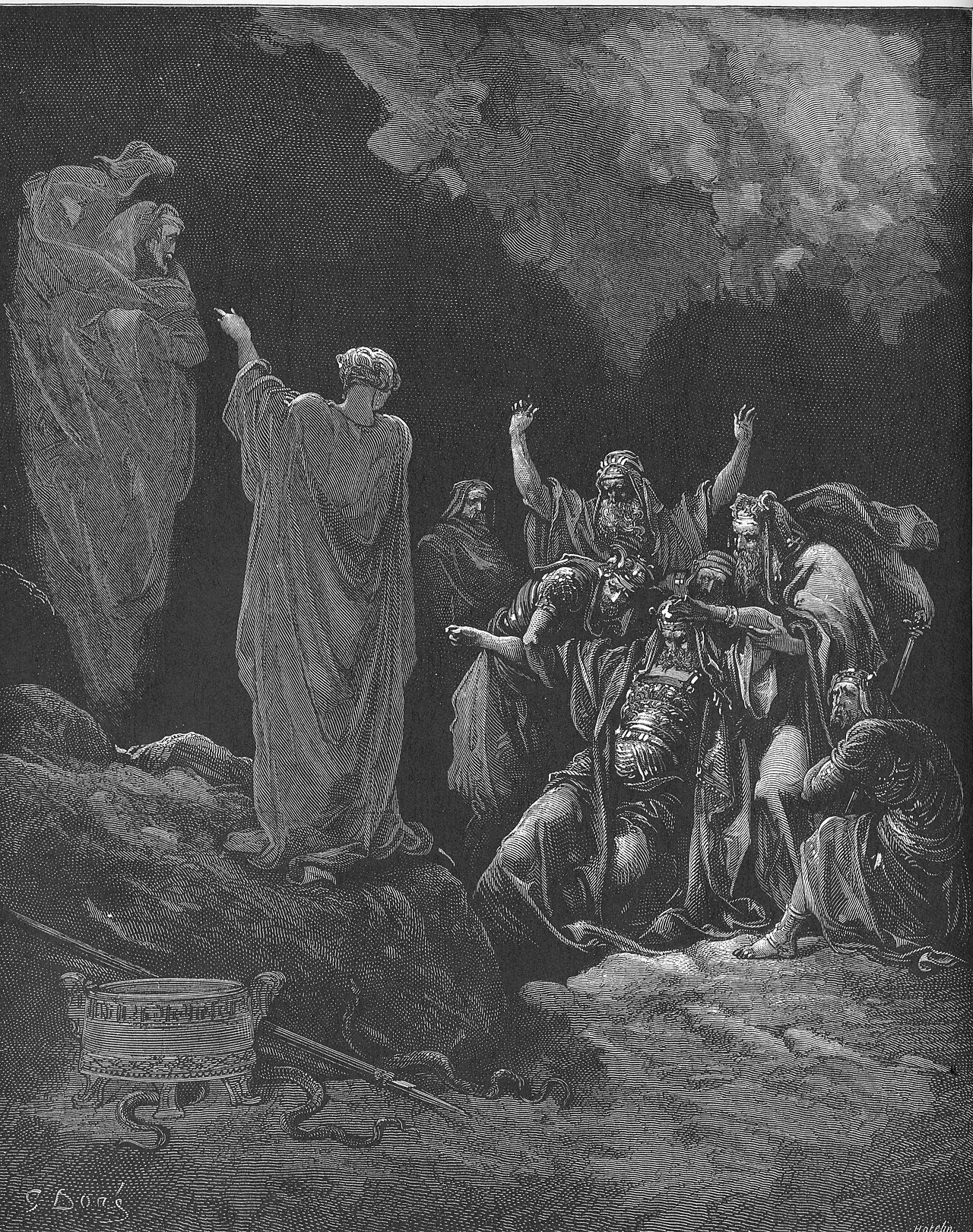
The chapter never gives Samuel's age. It gives a boy who ministers in the sanctuary, sleeps in the room where the ark was kept, and is trusted to open the heavy doors of the house of the LORD in the morning. The figure of twelve years old comes from Josephus, and Albert Barnes reports it as Josephus rather than as Scripture. Sir Joshua Reynolds painted an infant around 1776, and that painting has done most of the work of fixing the picture readers carry. Two details the retelling usually drops. The sentence Samuel was given to carry had already been delivered once, by an unnamed man of God in the previous chapter, so the new thing that night was the messenger rather than the message. And the answer Samuel gives at verse 10 is a line Eli taught him to say, minus one word: Eli said to say "Speak, LORD", and the boy said "Speak". The sanctuary has its own page, which carries Shiloh's whole story and the excavated town underneath it. One thing about the art on this page is worth saying out loud. No image of this night exists in this site's holdings, and neither does one of Hannah's vow, of Mizpah, of the Ebenezer stone, or of Samuel anointing David. The plates below show him acting on somebody else, and the bands with no art carry Scripture instead.
Samuel hears his name: the full studyKey events
- 1Birth to Hannah; dedication to Shiloh
c. 1100 BCE
- 2Divine call 'Speak, for your servant hears'
childhood
- 3Victory at Mizpah over the Philistines
c. 1070
- 4Anointing of Saul as first king
c. 1050
- 5Anointing of David
c. 1030
- 6Death
c. 1010
More key verses
Text: Berean Standard Bible.
“But Samuel declared: “Does the LORD delight in burnt offerings and sacrifices as much as in obedience to His voice? Behold, obedience is better than sacrifice, and attentiveness is better than the fat of rams.”
But the LORD said to Samuel, “Do not consider his appearance or height, for I have rejected him; the LORD does not see as man does. For man sees the outward appearance, but the LORD sees the heart.”
“And what more shall I say? Time will not allow me to tell of Gideon, Barak, Samson, Jephthah, David, Samuel, and the prophets,”
What they got right, and what they got wrong
Strengths
Unwavering fidelity to YHWH; courage in confronting Saul; pastoral care of the nation; integrity in office (1 Sam 12:3-5 — "whose ox have I taken?").
Weaknesses
Sons (Joel and Abijah) did not walk in his ways — a generational discipling failure that precipitated the people's request for a king.
Lessons
Faithfulness to God's call outweighs pleasing people. The prophetic word corrects kings; the king is not above the covenant. Early formation under godly mentorship matters across a lifetime.
Spiritual significance
Samuel bridges the judgeship and the monarchy; his fidelity during a period of priestly corruption preserves Israel through a generational transition. The prophetic office he establishes becomes the structural guarantor of monarchic accountability throughout the subsequent history.
How Samuel points to Jesus
The New Testament names Samuel three times and does three different things with him. Peter, preaching in Solomon's Colonnade two verses after quoting Deuteronomy 18 on the prophet like Moses, puts him at the head of the line: "Indeed, all the prophets from Samuel on, as many as have spoken, have proclaimed these days" (Acts 3:24). Paul, preaching at Antioch of Pisidia, puts him at the end of the era that closed with him, "God gave them judges until the time of Samuel the prophet" (Acts 13:20), and his next two sentences are Saul and then David. Hebrews 11:32 sets him in the roll of faith with Gideon, Barak, Samson, Jephthah and David, the last name before "and the prophets." That is the whole New Testament use of him. Samuel is nowhere presented there as a type of Christ, and this page does not invent one. One man in this book prophesies, judges and sacrifices. Albert Barnes states the concentration at 7:3, that Samuel appears in the threefold character of prophet, judge and the acknowledged leader of the whole people. The text carries it. He is confirmed as a prophet from Dan to Beersheba (3:20). He judges Israel all the days of his life (7:15). He offers a whole burnt offering with his own hands and builds an altar at Ramah (7:9, 7:17). Two limits belong beside that. The Chronicler traces his line through Kohath to Levi (1 Chronicles 6:33 to 6:38), so he is a Levite rather than a priest of Aaron's line, and John Wesley reads the altar at Ramah as raised by prophetic direction, with God's acceptance of what was offered on it as the evidence. What a reader can then see is a pattern rather than a claim the text makes. The three offices Israel afterwards kept apart, and that Uzziah was struck for confusing (2 Chronicles 26:16 to 26:21), sit together in one man at the hinge of the nation's history, and they sit together again and finally in Christ, who is prophet, priest and king. Samuel poured oil on two kings, and the covenant runs through the second. The Chronicler traces the whole Davidic monarchy back through him: the elders anointed David at Hebron "according to the word of the LORD through Samuel" (1 Chronicles 11:3). Lactantius, writing in the early fourth century, drew the line from that oil to the title itself. The sacred oil conferred the power of a king, and the Greek verb for anointing is where the word Christ comes from, which in Hebrew is Messiah. So the son of David is the Anointed One, and Samuel is the man who first poured the oil on that house. Scripture's own anointing word for Jesus falls at Acts 10:38, where God anointed Jesus of Nazareth with the Holy Spirit and with power, and at the Jordan John baptised Him. 1 Samuel 2:26 says the boy Samuel continued to grow in stature and in favor with the LORD and with man. Luke 2:52 says Jesus grew in wisdom and stature, and in favor with God and man, and Luke sets the sentence in a sanctuary. Barnes puts the two side by side and calls the accounts very similar. The claim worth making is about Luke's language. A first-century reader who knew 1 Samuel would hear the older sentence under the newer one. Reading it as an echo Luke is making keeps both sentences doing their own work. Luke makes the same move earlier in his Gospel, and it runs through Samuel's mother. Hannah's song at 1 Samuel 2 turns the world over on its way to its last line: the LORD brings down and raises up, He lifts the needy from the ash heap and seats them among princes, and He will "exalt the horn of His anointed." There is no king in Israel yet when she sings it, and her son is the man who will pour the oil. Mary's song at Luke 1:46 to 1:55 runs the same lines. The proud are scattered, rulers are brought down from their thrones, the humble are lifted up, the hungry are filled, and both songs end on God's mercy to Israel. Two women given a son they had no natural claim to sing almost the same song about a thousand years apart. Hannah's own page carries her prayer in full. Samuel's densest sentence is at 12:23. The nation had told him he was old and his sons were crooked, had asked for a king instead of him, and then asked him to pray for them. He answered that giving up praying for them would itself be a sin against the LORD. Jeremiah 15:1 pairs him with Moses as the two whose prayers carried the most weight in Israel's memory. Gregory the Great, preaching in the late sixth century, noticed what those two have in common: both prayed for the people who had turned on them. John Chrysostom, in the early fifth century, presses the other way and asks what Samuel's prayers actually secured for Saul or for Israel, and answers that prayer helps where the one praying and the one prayed for both act. This site does not settle their difference. It names the intercession that never stops, which is Christ's, and Matthew Henry reaches for that at 7:3: our great intercessor above never ceases and always appears in the presence of God for us. Two early writers take the stone at 7:12 to Christ, and both are readings rather than the meaning of the verse. Jerome, in a homily on the Psalms written about 420, says that the stone the builders rejected is the stone called Ebenezer in the book of Samuel, and that the stone is Christ. Augustine, in City of God 17.7, reads the stone of the helper as the mediation of the Saviour. The book itself puts the weight somewhere else. Samuel's last recorded act while alive is filling a horn with oil, walking to Bethlehem, pouring it on the one son nobody had bothered to call in from the sheep, and then going home to Ramah. A thousand years later the line from that horn runs back to the same town.
The prophet who anoints the king — a pattern culminating in John the Baptist anointing Jesus at the Jordan and the Father's voice confirming his messianic sonship.
The voices
each quoted from the work named
Such prayer rises higher than any petition for ourselves, for only he who is in favor with the Lord can venture upon pleading for others. Intercessory prayer is an act of communion with Christ, for Jesus pleads for the sons of men. It is a part of His priestly office to make intercession for His people. He has ascended up on High to this end and exercises this office continually within the veil. When we pray for our fellow sinners we are in sympathy with our Divine Savior who made intercession for the transgressors.
Compare the marginal references. Twenty years of Samuel’s life had passed away since the last mention of him 1Sa 4:1. Now he appears in the threefold character of prophet, Judge, and the acknowledged leader of the whole people. His words were an answer to a profession of repentance on the part of Israel, the practical proof of which would be the putting away all their false gods. (Compare Jdg 6:10 note.)
The place where this memorial was set up was the same where, twenty years before, the Israelites were smitten before the Philistines, for that was beside Eben-ezer, ch. iv. The sin which procured that defeat formerly being pardoned upon their repentance, the pardon was sealed by this glorious victory in the very same place where they then suffered loss; see Hos. i.
4 more teachers on these versesAdam Clarke · John Wesley · Gregory the Great · Lactantius
Witness against me - Did ever a minister of state, in any part of the world, resign his office with so much self-consciousness of integrity, backed with the universal approbation of the public? No man was oppressed under his government, no man defrauded! He had accumulated no riches for himself; he had procured none for his friends; nor had one needy dependant been provided for out of the public purse.
Sacrifice - Because obedience to God is a moral duty, constantly and indispensably necessary; but sacrifice is but a ceremonial institution, sometimes unnecessary, as it was in the wilderness: and sometimes sinful, when it is offered by a polluted hand, or in an irregular manner. Therefore thy gross disobedience to God's express command, is not to be compensated with sacrifice.
What then is it that Moses and Samuel are preferred to the other fathers in petition, except that these two alone in the entire sequence of the Old Testament are read to have prayed even for their enemies? One is assailed with stones by the people, and yet he entreats the Lord for the one who stoned him; the other is cast down from leadership, and yet when asked to pray, he confesses saying: "Far be this sin from me against the Lord, that I should cease to pray for you."
The Jews had before been directed to compose a sacred oil, with which those who were called to the priesthood or to the kingdom might be anointed. And as now the robe of purple is a sign of the assumption of royal dignity among the Romans, so with them the anointing with the holy oil conferred the title and power of king. But since the ancient Greeks used the word chriesthai to express the art of anointing, which they now express by anleiphesthai, as the verse of Homer shows, "But the attendants washed, and anointed them with oil"; on this account we call him Christ, that is, the Anointed, who in Hebrew is called the Messiah.
Samuel in Scripture
Open a book to read its mentions here. Text: Berean Standard Bible. Names repeat in Scripture, so some of these verses may speak of another person called Samuel. The two marks are drawn from the chapters this page's own references stand in.
Old TestamentNew Testamentsegment width = share of mentions
Old Testament5 books · 121 mentions
1 Samuel112 mentions
- 1 Samuel 1:20So in the course of time, Hannah conceived and gave birth to a son. She named him Samuel, saying, “Because I have asked for him from the LORD.”
- 1 Samuel 2:18Now Samuel was ministering before the LORD—a boy wearing a linen ephod.
- 1 Samuel 2:21So the LORD attended to Hannah, and she conceived and gave birth to three sons and two daughters. Meanwhile, the boy Samuel grew up in the presence of the LORD.
- 1 Samuel 2:26And the boy Samuel continued to grow in stature and in favor with the LORD and with man.
- 1 Samuel 3:1And the boy Samuel ministered to the LORD before Eli. Now in those days the word of the LORD was rare and visions were scarce.
107 further mentions in 1 Samuel, read them in the book.
1 Chronicles6 mentions
- 1 Chronicles 6:28The sons of Samuel: Joel his firstborn and Abijah his second son.
- 1 Chronicles 6:34Heman the singer, the son of Joel, the son of Samuel, the son of Elkanah, the son of Jeroham, the son of Eliel, the son of Toah,
- 1 Chronicles 9:22The number of those chosen to be gatekeepers at the thresholds was 212. They were registered by genealogy in their villages. David and Samuel the seer had appointed them to their positions of trust.
- 1 Chronicles 11:3So all the elders of Israel came to the king at Hebron, where David made a covenant with them before the LORD. And they anointed him king over Israel, according to the word of the LORD through Samuel.
- 1 Chronicles 26:28Everything that had been dedicated by Samuel the seer, Saul son of Kish, Abner son of Ner, and Joab son of Zeruiah, along with everything else that was dedicated, was under the care of Shelomith and his brothers.
1 further mention in 1 Chronicles, read them in the book.
2 Chronicles1 mention
Psalms1 mention
New Testament2 books · 3 mentions
Acts2 mentions
Common questions
How old was Samuel when God called him in the night?
The chapter never says. It gives a boy who ministers in the sanctuary, sleeps in the room where the ark was kept, and is trusted to open the heavy doors of the house of the LORD in the morning.
The figure of twelve years old comes from Josephus, and Albert Barnes reports it as Josephus rather than as Scripture. Josephus himself writes it at Antiquities of the Jews 5.10.4, in Whiston's translation: "Now when Samuel was twelve years old, he began to prophesy." Sir Joshua Reynolds painted an infant around 1776, and that painting is the reason most readers picture a toddler.
Was Samuel a priest, a prophet or a judge?
The text shows him doing all three. He judged Israel all the days of his life on a circuit of four towns (7:15 to 7:17), all Israel from Dan to Beersheba knew he was a prophet (3:20), and he offered a whole burnt offering with his own hands and built an altar at Ramah (7:9, 7:17).
On the priestly side there is a limit worth stating. 1 Chronicles 6:33 to 6:38 traces his line through Kohath to Levi, so he was a Levite, and he was not of Aaron's priestly line. John Wesley reads the altar at Ramah as raised by prophetic direction rather than by right of office.
Why was asking for a king wrong, when the Law had already provided for one?
Deuteronomy 17:14 to 17:20 does anticipate a king and set terms for him, so the office itself was not the offence.
What God names in 1 Samuel 8:7 is the motive. The elders asked for a king to judge them like all the other nations, and God calls that a rejection of His own kingship rather than of Samuel. Adam Clarke reads the request as a theocracy exchanged for a monarchy. Samuel then warns them in detail what a king will take, and they answer that they want one anyway.
Did God change His mind about Saul?
Readers differ; the positions are named
1 Samuel 15 says two things eighteen verses apart. At 15:11 and again at 15:35 the LORD regretted that He had made Saul king. At 15:29 Samuel says that the Glory of Israel does not lie or change His mind, for He is not a man that He should change His mind.
Readers have taken this in two directions. One holds that the language of regret is accommodation, Scripture describing God in human terms so that people can take it in. Gregory of Nyssa argued that in the fourth century, and John Wesley and Matthew Henry took the same line in the eighteenth. The other holds that both sentences are literal and describe different things, God's unchanging character at 15:29 and His real grief over a real human choice at 15:11.
This page names both readings and settles nothing. Worth noticing either way: Samuel spent the whole night before the confrontation crying out to God on Saul's behalf.
What appeared to Saul at Endor?
Readers differ; the positions are named
Three readings, and this site gives all three in the same shape the Mount Gilboa page uses, so the two surfaces agree.
The first holds that Samuel really appeared, permitted by God and outside the medium's power. Justin Martyr in the second century, Origen in the third, Methodius in the early fourth and Augustine in the fifth all read it that way, and Augustine appeals to Sirach 46:20, a Second Temple study resource rather than Scripture, which says Samuel prophesied after his death. Adam Clarke and Albert Barnes land here as well, and Clarke notes that the complaint at 28:15 is aimed at Saul and not at the woman.
The second holds that a spirit took Samuel's form. Tertullian is the earliest holder, around the year 220, and he argues that the power granted was the power to deceive. Hippolytus of Rome argues it at length in the third century, and Matthew Henry takes the same view in 1710.
The third holds that the woman staged it. Barnes and Clarke both report that reading and both set it aside in this case, because she was frightened by what she saw. No verdict is given here.
Is it ever right to consult a medium?
No. Scripture forbids it by name and calls the practice detestable, in Leviticus 19:31, Leviticus 20:6 and Deuteronomy 18:10 to 18:12.
Saul had enforced that law himself. 1 Samuel 28:3 says he had removed the mediums and spiritists from the land, and then he went looking for one at night in disguise. The account reports what the king did without approving it, and 1 Chronicles 10:13 names the consultation as one of the reasons he died.
The question of what appeared that night is disputed on this site. The question of whether Saul should have gone is not.
Why did God tell Saul to destroy the Amalekites, and why did Samuel kill Agag?
The command at 15:2 is stated as judgment for what Amalek did to Israel on the way up from Egypt. Exodus 17:8 to 17:16 records the attack and Deuteronomy 25:17 to 25:19 recalls it, naming the ones who were cut off at the back of the column when Israel was worn out.
Saul kept the king and the best of the livestock and called the animals material for sacrifice. 15:22 is Samuel's answer to that excuse, and 15:23 finishes it: because Saul rejected the word of the LORD, the LORD rejected him as king.
Samuel then killed Agag himself, at Gilgal. The page quotes 15:33 rather than paraphrasing it away, and it does not offer a defence the text does not make.
Did Samuel fail as a father, the way Eli did?
The text says his sons took bribes and perverted justice (8:3), and that the elders cited exactly that when they asked for a king (8:5). He had appointed them himself. The parallel with the house he grew up in is close enough that a reader cannot miss it.
What the text does not do is apply to Samuel the sentence it applies to Eli. 3:13 says Eli knew what his sons were doing and did not restrain them. No verse says that of Samuel, and no sentence is pronounced on his house. This page reports the facts, marks the parallel, and leaves the silence as silence.
One reading from another tradition sits beside the verse rather than in place of it. Rashi, Rabbi Shlomo Yitzchaki of Troyes, who died in 1105 and whose notes are the standard Jewish commentary on the Hebrew Bible, cites the Babylonian Talmud at Shabbat 56a for the view that the sons did not sin at all, but only failed to travel their father's circuit, settling at Beersheba and making people come to them. That is reception history, and the verse's own words stand.
Where is Samuel in the New Testament?
Three places. Peter puts him at the head of the prophets who spoke of these days (Acts 3:24). Paul puts him at the end of the judges, one sentence before Saul and David (Acts 13:20). Hebrews 11:32 puts him in the roll of faith with Gideon, Barak, Samson, Jephthah and David.
He is not presented anywhere in the New Testament as a type of Christ. What the New Testament does with him is give him a position: the last of one office and the first of the next.
How old was Samuel when he died?
1 Samuel 25:1 says only that he died and all Israel gathered to mourn him at Ramah. It gives no age. Adam Clarke supposes about ninety-eight years in his commentary, and says himself that the number is supposition rather than a stated fact. The Babylonian Talmud, at Taanit 5b, gives fifty-two, in an aggadic passage that reasons from Psalm 99:6 rather than reporting a record. Neither number is in the text, and this page names both as what they are and settles nothing between them.
Notable art
3 verified pieces depicting Samuel
Sources cited
- Berean Standard BibleEvery verse quoted on this page, taken byte for byte from the site's verses table. Public domain since 2023.
- Gustave Doré, La Sainte Bible (1866)The four engravings on this page. Public domain.
- Charles H. Spurgeon, The Metropolitan Tabernacle PulpitSermon No. 1537, “Samuel, an Example of Intercession” (1880), quoted here. Public domain, CCEL edition.
- Albert Barnes, Notes, Explanatory and Practical, on the Old and New Testaments (1832-1869)Quoted on 1 Samuel 7:3 and reported on 1 Samuel 2:26 beside Luke 2:52, on 1 Samuel 25:1, and on the age at the call, which he gives as Josephus's figure rather than as Scripture. Public domain.
- Matthew Henry, Commentary on the Whole Bible (1710)Quoted on 1 Samuel 7:12 and reported on 1 Samuel 7:3, 15:29, 15:35 and 28:17. Public domain.
- John Wesley, Explanatory Notes upon the Old Testament (1765)Quoted on 1 Samuel 15:22 and reported on 1 Samuel 7:17, 15:29 and 28:15. Public domain.
- Adam Clarke, Commentary on the BibleQuoted on 1 Samuel 12:3 and reported on 1 Samuel 8:5, 25:1 and 28:15. Public domain.
- Jamieson, Fausset & Brown, Commentary Critical and Explanatory on the Whole Bible (1871)Consulted on 1 Samuel 7:12 and 16:1. Public domain.
- The early Christian writers cited on this pageJustin Martyr, Tertullian, Hippolytus of Rome, Origen of Alexandria, Methodius of Olympus, Lactantius, Gregory of Nyssa, John Chrysostom, Jerome, Augustine of Hippo and Gregory the Great, each named here by century and by the named work rather than by a stored death year. Public domain translations.
- The Apocrypha, King James Version with Apocrypha (1769 standardized text)Sirach 46:20, which says Samuel prophesied after his death, quoted from the site's apocrypha_verses table and labelled a Second Temple study resource rather than Scripture. Ben Sira wrote in Jerusalem in the early second century BC.
- Sefaria, Rashi on I SamuelRashi on 1 Samuel 8:3, citing Babylonian Talmud Shabbat 56a. Metsudah Tanach series translation, CC-BY, quoted within the site's excerpt ceiling and presented as reception history.
- Sir Joshua Reynolds, The Infant Samuel (c. 1776), National Gallery, LondonNamed on this page as the reason readers picture a toddler at the call. The painting is not shown here; the chapter gives no age.
- Shiloh on this siteThe sanctuary town of chapters 1 to 4, with the excavation history from Aage Schmidt in 1922 through Hans Kjaer, Israel Finkelstein and Scott Stripling, and the eleventh-century burn layer. This page tells the man and doors to the town.
- Josephus, Antiquities of the Jews 5.10.4, Whiston's translation"Now when Samuel was twelve years old, he began to prophesy." Confirmed by search in the 2026-09-02 session 7 re-verification and added to the age question with its own citation, rather than only through Barnes's report of it.
- Sefaria, Babylonian Talmud, Taanit 5bWilliam Davidson Edition, CC-BY-NC. The aggadic reading giving Samuel's age at death as fifty-two, presented as reasoning from Psalm 99:6 rather than as a record, alongside Clarke's own estimate.
Keep studying
On this page
Studies14
On this person
On this passage
Every page that names them1
Doorway1
Keep this page