
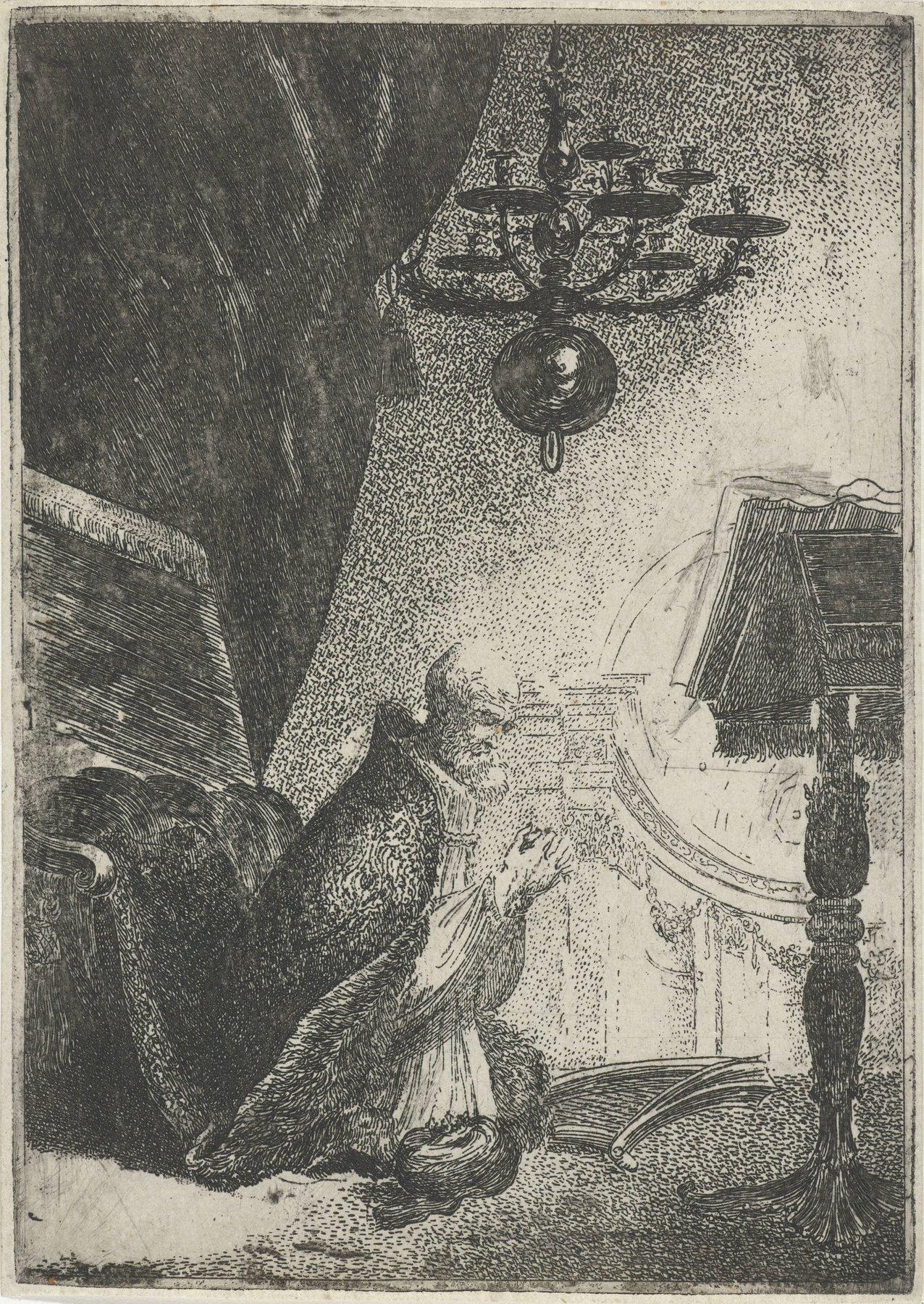
Pieter Rottermondt, David in Prayer, 1639 to 1706. Public domain.
1 Chronicles 29:10 to 19 · Passage · Featured Study
David's Prayer at the Great Offering
David blessed the LORD before the assembly after the leaders of Israel gave for the house his son would build.
David prayed ten verses at the height of the giving and asked nothing for himself.
But who am I, and who are my people, that we should be able to give as generously as this? For everything comes from You, and from Your own hand we have given to You.
But who am I, and who are my people, that we should be able to give as generously as this? For everything comes from You, and from Your own hand we have given to You.
- Book
- 1 Chronicles
- Hold in memory
- 1 Chronicles 29:14
Summary
First Chronicles 29 tells of gifts for the house of God. The leaders give, the people rejoice, and David prays. Commentators weigh its sums of gold three ways.
- At the opening of the chapter David calls Solomon young and inexperienced.
- Barnes and Keil take the word palace in verses 1 and 19 for a later word used of the Persian king's residence.
- After the prayer the whole assembly bowed to the LORD and to the king together.
Who Will Fill His Hand?
David closed his account of the gifts with a question to the whole assembly.
for the gold work and the silver work, and for all the work to be done by the craftsmen. Now who will volunteer to consecrate himself to the LORD today?”The giving of the leaders answers this question.
Albert Barnes notes that the Hebrew behind consecrate means to fill the hand, to come with full hands to the LORD. He reads the words as a call for gifts made of the giver's own will.
Then the leaders of the households, the officers of the tribes of Israel, the commanders of thousands and of hundreds, and the officials in charge of the king’s work gave willingly.The verse shows who answered the call first.
The Prayer in Four Movements
The prayer turns from praise of God to requests for others.
The prayer turns at its second movement, where praise becomes confession.
| Movement | Verses | Its theme | Who is named |
|---|---|---|---|
| 1 Blessing | 1 Chronicles 29:10 to 13 | The LORD rules over all things | God of Israel |
| 2 Confession | 1 Chronicles 29:14 to 16 | The givers return to God what He gave | David and his people |
| 3 The heart | 1 Chronicles 29:17 | God tests the giver's heart | David and the people |
| 4 Request | 1 Chronicles 29:18 to 19 | David asks for the hearts of the people and of the heir | The patriarchs and Solomon |
From the Gifts to the Prayer
The steps lead from David's provision to the blessing he spoke before the assembly.
The giving comes before the prayer, and the joy of the people comes between them.
- David's provisionDavid tells the assembly what he has gathered for the house of God1 Chronicles 29:2
- The callDavid asks who will give1 Chronicles 29:5
- The leaders giveThe heads of households and the officers give for the service of the house1 Chronicles 29:6 to 7
- The stonesPrecious stones go to the treasury under Jehiel the Gershonite1 Chronicles 29:8
- The joyThe people and the king rejoice, and the prayer begins1 Chronicles 29:9 to 10
The steps of 1 Chronicles 29:2 to 10 in the order the text gives them.
Barnes sets the gift of precious stones beside the leaders' gift for the tabernacle in Exodus 35:27. He writes that the same spirit moved the givers at both times.
Ten Thousand Darics
Barnes and Keil read the coin named in 1 Chronicles 29:7 as a sign of the writer's own day.
Toward the service of God’s house they gave 5,000 talents and 10,000 darics of gold, 10,000 talents of silver, 18,000 talents of bronze, and 100,000 talents of iron.The verse names the coin the commentators weigh.
The word is 'adarkon, which Strong's dictionary glosses as a daric, a Persian coin. The King James Version renders it drams.
Barnes writes that the Jews had no darics in David's time. In his reading the writer put the sums of his documents into the coin his own readers used. Keil quotes the same judgment from Ernst Bertheau and gives the coin's worth as about 22 shillings and sixpence.
What the Prayer Leaves Unsaid
The prayer names no sin and asks for no forgiveness.
Its confession in 1 Chronicles 29:14 to 16 concerns the source of the gifts and the shortness of life.
And give my son Solomon a whole heart to keep and carry out all Your commandments, decrees, and statutes, and to build Your palace for which I have made provision.”The prayer's last request is for another man, the son who will build.
Keep This Desire
David asks God to keep in the people the willingness He gave them.
O LORD, God of our fathers Abraham, Isaac, and Israel, keep this desire forever in the intentions of the hearts of Your people, and direct their hearts toward You.David prays for the people who had just given.
Adam Clarke reads the request as a prayer that God would keep, by the same grace, the good dispositions He had first given. John Wesley reads it the same way: the willing minds came from God's grace, and David asks that grace to continue them.
Voices on the Prayer
Matthew Henry wrote on the prayer in his Commentary on the Whole Bible of 1710.
Matthew Henry (1662 to 1714)
Commentary on the Whole Bible
On 1 Chronicles 29:11 Henry turns the words of the blessing into a measure of the reader's own praise.
“His is the power, and it is almighty and irresistible; power belongs to him, and all the power of all the creatures is derived from him and depends upon him. His is the glory; for his glory is his own end and the end of the whole creation. All the glory we can give him with our hearts, lips, and lives, comes infinitely short of what is his due.”
on 1 Chronicles 29:11Puritan
Matthew Henry
Commentary on the Whole Bible
On 1 Chronicles 29:17 he turns the names of the fathers into a prayer for grace.
“In this prayer he addresses God as the God of Abraham, Isaac, and Jacob, a God in covenant with them and with us for their sakes. Lord, give us grace to make good our part of the covenant, that we may not forfeit the benefit of it. Or thus: they were kept in their integrity by the grace of God establishing their way; let the same grace that was sufficient for them be so for us.”
on 1 Chronicles 29:17Puritan
Are the Sums as Written?
Commentators have weighed the talents of the chapter three ways.
three thousand talents of gold (the gold of Ophir) and seven thousand talents of refined silver, to overlay the walls of the buildings,This is the sum Barnes suspects.
Now behold, I have taken great pains to provide for the house of the LORD—100,000 talents of gold, 1,000,000 talents of silver, and bronze and iron too great to be weighed. I have also provided timber and stone, and you may add to them.Keil weighs this earlier count, the largest of all.
Exact as they standAdam Clarke
Adam Clarke turns each sum of 1 Chronicles 29:7 into pounds sterling as it stands. He puts the five thousand talents of gold at more than twenty-five million pounds.
The objection: Keil, on 1 Chronicles 22:14, calls sums of hundreds of millions of pounds incredible.
Round valuations of the metalC. F. Keil
On 1 Chronicles 22:14 Keil holds that the round numbers rest on a general valuation of masses of gold and silver. Much of it was in vessels, booty and tribute, and the sums rest on no exact count or weighing.
The objection: Barnes holds that the numbers were changed in copying.
A copyist has changed a numberAlbert Barnes
Barnes holds that the numbers have suffered from the carelessness of copyists, and he points to his note on 1 Chronicles 22:14. He reckons the gold of 1 Chronicles 29:4 at more than thirty million pounds and suspects an error in the three thousand talents.
The objection: Keil reads such round numbers as valuations, which need no error of copying.
Books to Read Next
Both works are in the public domain.
Commentary on the Whole Bible
Matthew Henry · 1710
Henry reads the prayer verse by verse and draws lessons for the reader from it.
Notes, Explanatory and Practical, on the Old and New Testaments
Albert Barnes · 1832 to 1869
Barnes explains the daric and weighs the gold of David's own gift.
Yours, O LORD
The page ends where the blessing makes its widest claim.
Yours, O LORD, is the greatness and the power and the glory and the splendor and the majesty, for everything in heaven and on earth belongs to You. Yours, O LORD, is the kingdom, and You are exalted as head over all.This claim is the ground of the confession that follows it.
Sources
Scripture is the Berean Standard Bible.
- King James Version, 1 Chronicles 29:7.
- Strong's dictionary in the site's lexicon, entry h150, and the word-by-word Hebrew of 1 Chronicles 29:7.
- Albert Barnes, Notes, on 1 Chronicles 29:4.
- Albert Barnes, Notes, on 1 Chronicles 29:5.
- Albert Barnes, Notes, on 1 Chronicles 29:7.
- Albert Barnes, Notes, on 1 Chronicles 29:8.
- Adam Clarke, Commentary on the Bible (1832), on 1 Chronicles 29:7.
- Matthew Henry, Commentary on the Whole Bible (1710), on 1 Chronicles 29:11.
- Matthew Henry, Commentary on the Whole Bible (1710), on 1 Chronicles 29:17.
- C. F. Keil and F. Delitzsch, Biblical Commentary on the Old Testament, on 1 Chronicles 29.
- Albert Barnes, Notes, on 1 Chronicles 29:1.
- Adam Clarke, Commentary on the Bible (1832), on 1 Chronicles 29:18.
- John Wesley, Explanatory Notes upon the Old Testament (1765), on 1 Chronicles 29:18.
- C. F. Keil and F. Delitzsch, on 1 Chronicles 22:14.
- Pieter Rottermondt (possibly), David in gebed, etching, 1639 to 1706, Rijksmuseum RP-P-OB-73.781; the museum marks it with the Public Domain Mark 1.0.
Keep Studying
Studies5
Doctrines1
Go further3